

Ethyl Acetate Production: Process, Raw Materials and Applications
At a Glance
- Four industrial routes: Fischer esterification of ethanol and acetic acid, the Tishchenko reaction of acetaldehyde, ethanol dehydrogenation, and acetic acid added to ethylene.
- Water is the esterification problem: The water formed inhibits the reaction, so plants remove it, often with reactive distillation.
- Raw materials follow the route: The common route uses ethanol and acetic acid, so their costs flow into the quoted price.
- Separation sets quality: Ethyl acetate boils at about 77 °C, but azeotropes with water and ethanol make clean separation the hard step.
- Main uses: Coatings, adhesives, printing inks, pharmaceutical work and decaffeination.
- Buyer takeaway: Compare assay, water, acidity and residue on the certificate of analysis, not the route name.
What You’ll Learn
This guide explains how ethyl acetate is made, what each route needs, where the solvent is used, and which specification checks matter when buying.
Introduction
Ethyl acetate production is a topic that buyers and students both search for, but they want different answers. Students need the chemistry. Buyers need to know whether the process behind a drum of solvent changes what they receive.
Ethyl acetate is the ester of ethanol and acetic acid, made at industrial scale as a solvent. Four routes appear in commercial or patent literature, and each has its own raw materials and separation problems. This guide walks through them in plain terms, then links the process to purity, price and handling. Along the way, it flags where sources disagree and where figures come from older patent literature.
It is written for procurement teams, formulators and plant staff. They work with ethyl acetate suppliers and need to read a specification sheet with confidence.
Ethyl Acetate Production Routes: Four Industrial Methods
Four routes make ethyl acetate at industrial scale. They differ in raw materials, catalysts and the separation work that follows the reaction.
The Fischer, Tishchenko and ethylene rows draw on one patent background. The dehydrogenation row draws on a second patent.
| Route | Raw materials | Catalyst and conditions (as reported) | Main limit |
| Fischer esterification | Ethanol, acetic acid | Acid catalyst. Sulfuric acid in the patent background. | Water formed inhibits the reaction. |
| Tishchenko reaction | Acetaldehyde | Aluminium alkoxide. One variant reports about 98% one-pass conversion near 0 °C. | Needs acetaldehyde. Distillation yields light ends and an acetal by-product. |
| Ethanol dehydrogenation | Ethanol | Copper-based catalysts. Prior art ranges from about 180 to 300 °C. Hydrogen is the co-product. | By-products boil close to ethyl acetate. |
| Acetic acid plus ethylene | Acetic acid, ethylene | Solid acid catalyst. One system reports 30 to 60% conversion at 126 to 150 °C. | Slow, so it needs a very large reactor. |
Sources disagree on which route dominates. One patent background calls the Tishchenko reaction the main industrial process. General references describe Fischer esterification as the main one. No single route can be assumed for a given drum.
Fischer Esterification: The Process Step by Step
Fischer esterification reacts ethanol with acetic acid over an acid catalyst to give ethyl acetate and water. The water formed inhibits the reaction, so a plant has to remove it continuously. That requirement shapes the whole flow sheet.
A plant typically follows these steps:
- Feed ethanol and acetic acid into the reaction section.
- React them over the acid catalyst.
- Remove water as an azeotrope, often in a reactive distillation column.
- Separate ethyl acetate from water and unreacted ethanol.
- Recycle unreacted feed to the reactor.
- Finish the product and release it against the agreed specification.
Why Reactive Distillation Is Used
Reactive distillation runs the reaction and the separation in one column. It can overcome equilibrium limits and make azeotropic or close-boiling mixtures easier to separate.
The patent background describes a conventional esterification layout with two decanters and three columns, plus a wastewater stream. Combining steps in one column reduces that equipment count, though design details vary by producer.
Tishchenko, Dehydrogenation and Ethylene Routes
The other three routes avoid the water problem in different ways. Each swaps it for a different raw material or separation challenge.
The Tishchenko Reaction
Two acetaldehyde molecules combine to form one ethyl acetate molecule over an aluminium alkoxide catalyst. In the Hoechst variant, one pass converts about 98% of the feed. The reactor is cooled to about 0 °C, with a residence time near one hour.
The product then goes through several distillations. They yield ethyl acetate, recycled acetaldehyde, light ends and an acetal by-product.
Ethanol Dehydrogenation
Ethanol can be converted directly to ethyl acetate over a catalyst, with hydrogen as the co-product. Prior art cited in the second patent uses copper-based catalysts at roughly 180 to 300 °C.
The difficulty is purity. By-products such as butyraldehyde and butan-2-one boil close to ethyl acetate, so they are hard to distil out.
Acetic Acid and Ethylene
Acetic acid can also add across ethylene over a solid acid catalyst. One patent background reports 30 to 60% acetic acid conversion at 126 to 150 °C in a vapor-phase system. It notes that the slow rate needs a very large reactor.
These are patent-era figures. Treat them as illustrations, not as current plant performance.
Raw Materials and What Moves Their Cost
The raw materials depend on the route. Fischer esterification uses ethanol and acetic acid. Tishchenko uses acetaldehyde, dehydrogenation uses ethanol alone, and the addition route uses acetic acid and ethylene.
For the common ethanol and acetic acid route, feedstock cost flows into the quote. Elchemy’s product page notes that ethyl acetate is quoted per metric ton and moves with ethanol and acetic acid prices. For the full cost picture, see our ethyl acetate price guide. Acetic acid moves on its own drivers, covered in acetic acid pricing.
Purification and Quality: Why Separation Sets the Specification
Within the ethyl acetate manufacturing process, separation decides how clean the finished solvent is. Ethyl acetate forms azeotropes with water and ethanol, so simple distillation cannot finish the job. The second patent lists an ethanol and ethyl acetate azeotrope. It boils at about 71.7 °C at 1 atm, below the ester’s own boiling point.
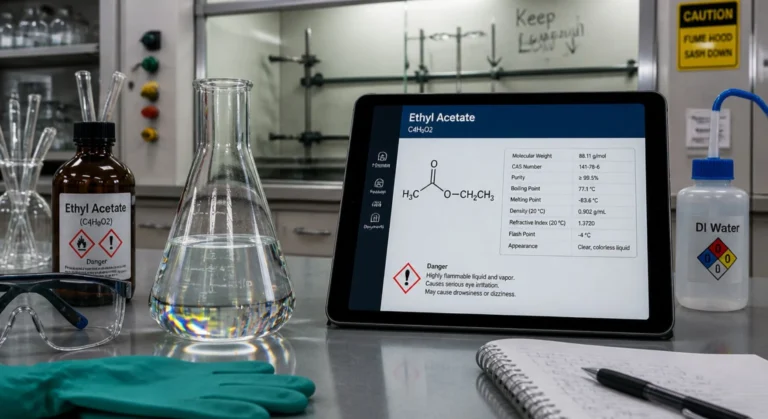
The properties below shape both the separation and the handling. Boiling point, flash point, flammable range and specific gravity come from the NIOSH Pocket Guide. Water solubility comes from our properties and safety guide, which has the full list.
| Property | Value | Why it matters |
| Boiling point | About 77 °C (171 °F) | Sets the distillation cut |
| Flash point | About -4 °C (24 °F) | Drives storage and transfer rules |
| Flammable range | 2.0 to 11.5% in air | Sets ventilation and ignition control |
| Specific gravity | 0.90 | The ester layer sits above water in a decanter |
| Water solubility | About 8.3 g per 100 mL at 20 °C | Water is only partly soluble, so phases separate |
What the Route Means for Your Specification
The route matters less to a buyer than the results on the certificate of analysis. Each row below links a specification line to its source in the process. The last row is qualified, because it rests on patent literature rather than producer data.
| Parameter | Where it comes from | What to check |
| Assay | Overall purity after distillation | The grade minimum. Elchemy’s ELRASA EAC listing shows 99.80% w/w minimum. |
| Water | Reaction water and separation | The water maximum. The same listing shows 0.0500% w/w maximum. |
| Acidity | Residual acetic acid | Acidity as acetic acid. The listing shows 0.0100% w/w maximum. |
| Non-volatile residue | Heavy ends left after evaporation | Residue on evaporation. The listing shows 0.0100% w/w maximum. |
| Close-boiling impurities | Route-dependent. Aldehydes and ketones are reported for dehydrogenation. | Ask whether your application is sensitive to them. |
Elchemy tests each shipment for assay, water, acidity and non-volatile residue before dispatch. A certificate of analysis travels with each order. To compare your own limits against a listed grade, Request a Quote with your grade and volume.
Applications of Ethyl Acetate
The main ethyl acetate uses are as a solvent and diluent in industrial formulations. Buyers choose it where a fast-drying solvent is needed. Our solvent evaporation comparison shows where it sits against toluene, acetone and butyl acetate.
| Application | Role of ethyl acetate | Grade to ask about |
| Coatings and adhesives | Solvent and diluent | Technical or urethane grade |
| Printing inks | Primary solvent in gravure and flexographic inks | Technical grade |
| Pharmaceutical work | Extraction and purification solvent | Pharmaceutical grade |
| Decaffeination and flavour | Extraction solvent and flavouring | Food or flavour grade |
The decaffeination use is covered in our guide to decaf coffee use. Food and flavour work calls for the FCC grade. Confirm the grade against your own specification before ordering.
Safety and Handling Basics
Ethyl acetate is a flammable liquid with a low flash point, so storage and transfer rules matter. NIOSH lists an exposure limit of 400 ppm as a time-weighted average, with an immediately dangerous level of 2,000 ppm. Overexposure irritates the eyes, skin, nose and throat, and can cause narcosis.
Shipments travel under UN1173 as a Class 3 flammable liquid. Confirm the details in section 14 of the supplier’s SDS, and read our note on SDS in procurement. Qualified EHS review is required before you set storage and ventilation.
Sourcing Ethyl Acetate: Producers, Distributors and Suppliers
Few companies run ethyl acetate plants, so most buyers purchase through distributors and suppliers. In Elchemy’s US shortlist, only two of ten companies were producers. The role of each company is set out in the list of ethyl acetate manufacturers.
Elchemy is a supplier and distributor that sources from partner plants. It does not run a US ethyl acetate plant. Choosing between a producer and a distributor depends on volume, documents and delivery needs. Our guide to manufacturers versus distributors sets out the trade-offs.
Elchemy offers EXW, FOB, CIF and DDP terms and ships to 40+ countries. TDS, SDS and a certificate of analysis are standard. Samples are available before a bulk order, so you can qualify the material first. Request a Sample to start.
FAQs
Does the production route change what I receive?
It can change trace impurities, but the specification matters more. Patent literature reports close-boiling aldehydes and ketones from dehydrogenation. Ask for assay, water, acidity and residue limits for your grade. Check them against the certificate of analysis for every batch you receive.
Is food-grade ethyl acetate a different grade?
Yes. Elchemy lists food and flavour material separately from technical and pharmaceutical grades. The FCC grade page covers flavour extraction and related food uses. Confirm the specification and certificate of analysis against your own requirements before ordering, because needs differ by application.
How fast do samples ship?
Elchemy’s product page says domestic samples are dispatched within 24 to 48 hours. Timing can change with grade, quantity and destination. Share your grade, pack and delivery location when you ask. The team will confirm the dispatch window for your request.
What is the typical minimum order?
The product page says commercial orders typically start from 1 MT. The exact minimum depends on the grade, pack and destination. Contact the team with your requirement, and they will confirm the minimum order quantity in the quote before you commit.
Which documents come with an order?
A certificate of analysis, TDS and SDS are standard with each order. A packing list, bill of lading and certificate of origin are available on request. Halal, kosher and non-GMO certificates are offered for qualifying grades and origins, so ask early if your process needs them.
Can I buy from US stock?
Elchemy lists US warehouses in New Jersey, Texas and California, and says domestic stock supports faster fulfilment. Availability depends on the grade and quantity you need. Stock and lead time are confirmed in the quote, so ask for both when you request pricing.
Conclusion
Ethyl acetate comes from four industrial routes, and each trades raw materials against separation effort. For most buyers, the route matters less than the specification: assay, water, acidity and residue on a certificate of analysis.
Use the process to ask better questions, then judge a supplier on documents, grade fit and delivery terms. Elchemy sources ethyl acetate for industrial buyers against your specification. If your application is sensitive to trace impurities, say so when you ask for a grade. That lets the supplier match the specification to the job. Request a Quote.