

At a Glance
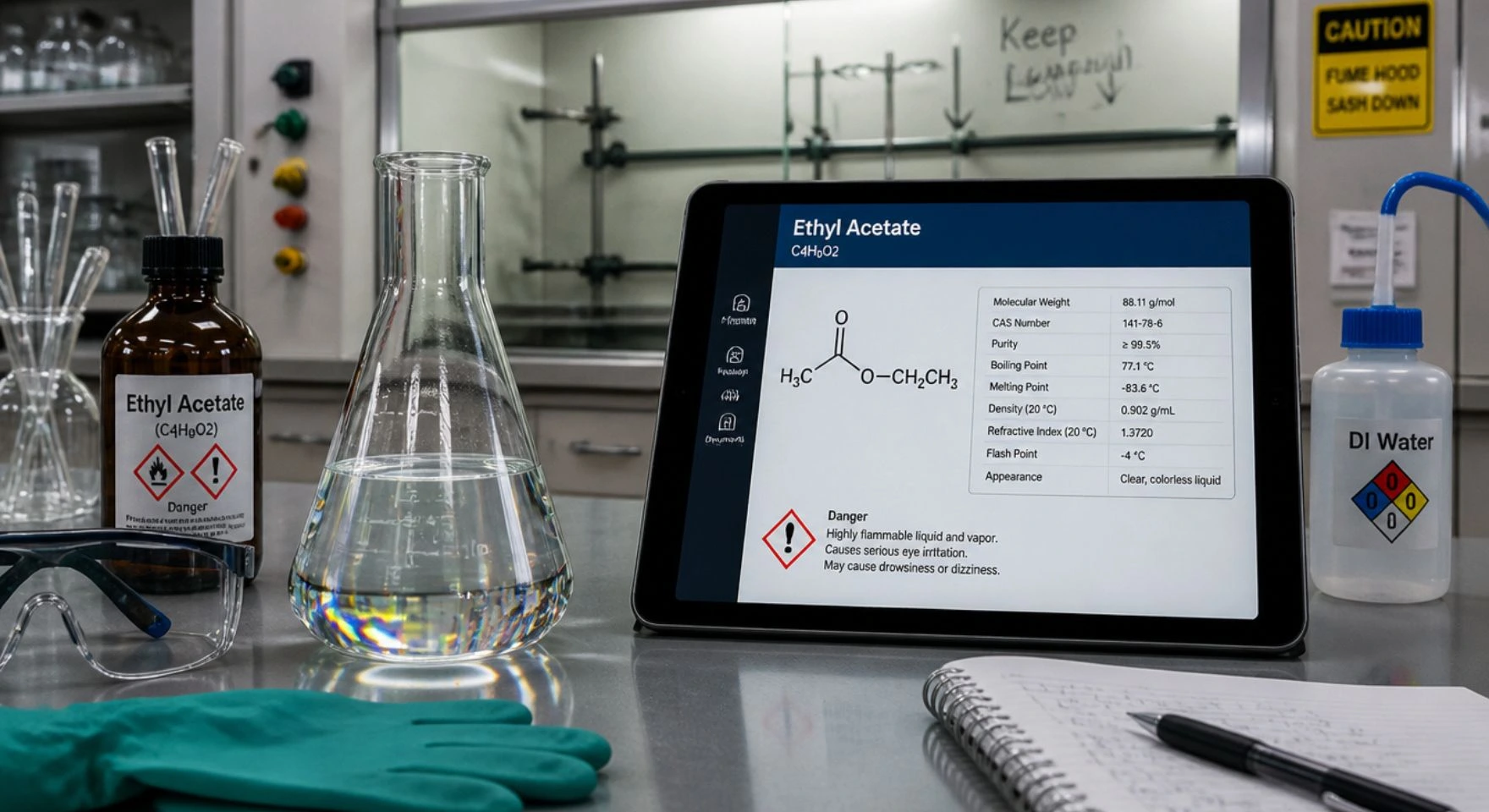
- Ethyl acetate evaporates roughly twice as fast as toluene on the industry-standard n-butyl acetate = 1 scale (ethyl acetate 4.1, toluene 1.9, per Eastman’s published solvent data).
- Butyl acetate is the reference point, not a competitor. It’s fixed at 1.0, which is why every other solvent’s number is a ratio rather than a measured rate in mL/hr or g/hr.
- Acetone is the fastest of the four, but supplier charts disagree sharply on how fast, ranging from roughly 6 to 14 on the same n-BuAc scale.
- The disagreement is structural, not sloppy testing. The Shell Thin-Film Evaporometer method behind these numbers, ASTM D3539, was withdrawn in 2015 with no replacement standard.
- Under controlled nitrogen blowdown the ranking holds but the gaps narrow, which is the more reliable way to compare solvents if you need your own number.
- The real answer is conditional: evaporation rate shifts with airflow, temperature, film thickness, and blend composition, which is why formulators build fast/medium/slow blends instead of picking one solvent.
What you’ll learn: the true evaporation-rate ranking of ethyl acetate, toluene, acetone and butyl acetate, why published numbers disagree, and how to pick between them for coatings, adhesives, or chromatography.
Introduction
Pick the wrong solvent speed and you get blush, orange peel, or a coating that never fully levels before it skins over. Formulators and lab buyers hit this problem constantly because supplier evaporation-rate charts rarely agree, sometimes off by a factor of two for the same solvent. That gap isn’t a data-entry error. It traces back to a test method that the industry quietly stopped standardizing on nearly a decade ago, which is covered in our broader industrial solvents guide. This page settles the real ranking between ethyl acetate, toluene, acetone and n-butyl acetate, explains why the numbers diverge, and gives coating formulators, adhesive manufacturers, procurement leads, and analytical chemists a working framework for choosing between them, whether the job is a solvent-borne coating or a chromatography mobile phase.
Quick Answer: Evaporation Rate of Toluene vs Ethyl Acetate
Ethyl acetate is the faster of the two, evaporating at roughly twice the rate of toluene. On the n-butyl acetate = 1 scale, ethyl acetate sits around 4.1 and toluene around 1.9, meaning ethyl acetate leaves a wet film in roughly half the time under identical conditions. That number is relative to n-butyl acetate, not an absolute physical constant, so treat it as a ranking tool rather than a lab-verified rate for your own process.
| Solvent | Evaporation rate (n-BuAc = 1) | Boiling point | Flash point | Class |
| Ethyl acetate | ~4.1 | 77°C | -4°C | Ester |
| Toluene | ~1.9 | 111°C | 4°C | Aromatic hydrocarbon |
| Acetone | 6.3–14.4 (source-dependent) | 56°C | -20°C | Ketone |
| n-Butyl acetate | 1.0 (reference) | 126°C | 22°C | Ester |
How Solvent Evaporation Rate Is Measured (and Why Charts Disagree)
Evaporation rate in coatings is a relative ratio measured against n-butyl acetate, not a physical constant like boiling point. That single design choice is the root of most of the confusion buyers run into.
The n-BuAc = 1 convention exists because paint and coatings chemists needed a practical way to rank hundreds of solvents by flash-off speed without running absolute mass-loss experiments on every batch. The method behind it, ASTM D3539, used a Shell thin-film evaporometer to time weight loss against the butyl acetate baseline. That standard was withdrawn in 2015, and no replacement standard has taken its place since. Suppliers who still publish evaporation-rate tables are largely relying on legacy data or in-house variants of the old method, which is exactly why the same solvent shows different numbers on different data sheets.
| Solvent | Eastman | DisperseTech | Producers Chemical |
| Acetone | 6.3 | 11.6 | 14.4 |
| Ethyl acetate | 4.1 | 5.5 | 4.1 |
| Toluene | 1.9 | 2.0 | 1.8 |
| n-Butyl acetate | 1.0 | 1.0 | 1.0 |
The variables that actually move the real-world rate are airflow velocity, ambient or bath temperature, film thickness, vapor pressure, and humidity. Treat any published value as a rank order rather than a guarantee, and validate the absolute flash-off time on your own line before locking a formulation.
Ethyl Acetate vs Acetone: Speed, Solvency and Substrate Risk
Acetone is faster and more aggressive; ethyl acetate is slower and gentler on sensitive substrates. The underlying chemistry explains why: acetone is a small, highly polar ketone, while ethyl acetate is a milder ester with lower solvency strength for many resin systems.
Acetone’s speed is exactly what causes defects in thicker or less-controlled films. Blush, orange peel, pinholing, and solvent trap all show up more often when a fast, aggressive solvent flashes off before the film can level. Ethyl acetate’s slower, gentler profile makes it the safer default for sensitive plastics, cellulose-based systems, and food-contact or cosmetic applications where residual solvent limits matter. Ethyl acetate also carries a notably higher flash point than acetone, which shifts its storage and transport classification in most jurisdictions.
Choose ethyl acetate when: substrate sensitivity, food-contact approval, or a controlled flash-off window is required.
Choose acetone when: maximum flash-off speed matters more than film quality, or when it’s being used only as one component in a larger blend.
Evaporation Rate Toluene vs Ethyl Acetate: Solvency Power Compared
Toluene evaporates slower, but it dissolves aromatic and high-molecular-weight resins that ethyl acetate simply can’t touch. Kauri-butanol value, a standard measure of aromatic solvency, favors toluene outright against most ester and ketone solvents. Toluene’s aromatic hydrocarbon structure gives it real advantages with certain alkyd, epoxy, and rubber-based resin systems where an ester like ethyl acetate is too weak a solvent.
That solvency strength comes with regulatory weight. Toluene sits under Hazardous Air Pollutant (HAP) scrutiny in several jurisdictions, and many formulators are actively reformulating away from aromatics to cut VOC and HAP exposure. Bulk pricing and availability tend to favor toluene in most regions, but the compliance overhead can offset that cost advantage depending on your target market.
Choose toluene when: resin solubility genuinely requires aromatic character and regulatory exposure is manageable for your target market.
Choose ethyl acetate when: faster flash-off, a lower toxicity profile, or an aromatic-free formulation is required.
Butyl Acetate: The Slow Solvent That Anchors the Scale
n-Butyl acetate is the 1.0 reference point on the evaporation scale and the standard slow-tail solvent in most coating blends. The industry settled on it as the benchmark because its evaporation speed sits in a practical middle ground: slow enough to matter for flow and leveling, fast enough not to trap solvent indefinitely in a curing film.
Its main job in a blend is as the tail solvent: it controls flow, leveling, gloss development, and prevents the solvent trap that happens when a fast solvent flashes off and leaves resin stranded near the surface. Isobutyl and t-butyl acetate are adjacent grades with slightly different rates, useful when a formulation needs a rate close to but not exactly at 1.0.
| Solvent | Evaporation rate | Role in blend | Typical loading |
| Acetone | Fast | Fast flash | Low, as accelerant |
| Ethyl acetate | Fast to medium | Fast to medium flash | Moderate |
| Toluene | Medium | Solvency carrier | Moderate to high |
| n-Butyl acetate | Slow (reference) | Slow tail, flow and leveling | Moderate |
Every supplier of this butyl acetate supplier grade should be able to confirm which isomer and purity you’re getting, since that detail changes the actual evaporation behavior more than the headline number suggests.
Polarity & Solvent Selection
Ethyl acetate is substantially more polar than hexane, which is exactly why the two form the standard gradient pair in column chromatography. On dielectric constant, a common proxy for polarity, ethyl acetate sits around 6.0 while hexane sits close to 2.0, a roughly three-fold difference that governs how strongly each solvent interacts with polar analytes and stationary phases, per McMaster University’s solvent reference data.
That answers both directions of the question buyers actually search: ethyl acetate is the more polar of the pair, and hexane is the less polar of the pair. Polarity, not evaporation rate, is what governs separation behavior in chromatography, so don’t let a fast flash-off time substitute for checking ethyl acetate polarity against your target analytes.
Hexane and Ethyl Acetate in Chromatography Gradients
Standard mobile-phase gradients run from pure hexane up through hexane/ethyl acetate mixtures, often in ratios like 9:1, 4:1, or 1:1, with increasing ethyl acetate content pulling more polar analytes off the column faster and lowering Rf values. Acetone and toluene rarely appear as primary mobile-phase components; acetone’s strong UV absorbance interferes with detection, and toluene’s aromatic character and higher boiling point make it a poor fit for standard TLC and flash chromatography workflows.
For lab-scale rotary evaporation or nitrogen blowdown, relative speed still tracks the coatings ranking: ethyl acetate around 5.75 mL/hr, acetone around 8.2 mL/hr, and toluene around 2.1 mL/hr at room temperature in typical bench trials. Note that HPLC and analytical grades differ meaningfully from industrial grade in trace metals, water content, and UV cutoff, so specify accordingly when ordering for lab use.
Building a Coating Solvent Blend
Production coatings almost never rely on a single solvent. A practical blend uses a fast component for initial flash-off, a medium component for open time during application, and a slow tail solvent, typically n-butyl acetate, for flow and leveling as the film cures.
Get the balance wrong and the failure modes are predictable: too much fast solvent causes blush and pinholing as moisture condenses into a rapidly cooling film; too much slow solvent causes sag and solvent trap as the film skins over before the bulk has released. Ambient plant conditions, especially humidity and airflow, shift the ideal ratio, and VOC-constrained formulations add another layer of tradeoffs between speed, solvency, and regulatory compliance.
Side-by-Side Quick Reference
| Property | Ethyl acetate | Toluene | Acetone | n-Butyl acetate |
| Evaporation rate (n-BuAc=1) | ~4.1 | ~1.9 | 6.3–14.4 | 1.0 |
| Boiling point | 77°C | 111°C | 56°C | 126°C |
| Flash point | -4°C | 4°C | -20°C | 22°C |
| Polarity (dielectric) | Moderate (~6.0) | Low | High (~20.7) | Low-moderate |
| Solvency strength | Moderate, ester | High, aromatic | High, ketone | Moderate, ester |
| Water miscibility | Slight | Immiscible | Fully miscible | Slight |
| Primary applications | Coatings, adhesives, chromatography | Aromatic resin coatings, rubber | Fast-flash coatings, cleaning | Tail solvent, flow control |
| Regulatory notes | Lower toxicity profile | HAP-listed in several regions | High VOC, flammable | Standard VOC solvent |
Formulator’s Selection Checklist
- Confirm resin compatibility before comparing evaporation rates at all.
- Define the target flash-off window for your line speed and cure conditions.
- Check the VOC and HAP position required for your target market.
- Decide whether a single solvent or a fast/medium/slow blend fits the application.
- Set purity and water-content specifications, and confirm food-contact or analytical grade where needed.
- Request the supplier’s own evaporation data with stated test conditions, not a generic chart.
- Validate on a trial batch under your actual production airflow and temperature.
Verdict
Ethyl acetate is the strongest general-purpose choice of the four for most coating and adhesive work: fast enough for efficient flash-off, gentle enough for sensitive substrates, and free of toluene’s regulatory overhead. Toluene still wins outright where aromatic resin solvency is non-negotiable, acetone wins where raw speed matters more than film quality, and butyl acetate remains essential as the slow tail that keeps a blend from failing at the finish line. If your formulation can tolerate a moderate-polarity ester, start your trial with an ethyl acetate supplier and benchmark from there.
Where to Buy Ethyl Acetate, Toluene, Acetone and Butyl Acetate
A bulk buyer should evaluate purity spec, COA availability, minimum order quantity, lead time, and documentation before comparing headline pricing. Grade matters as much as the base chemical: industrial, technical, food-contact, and analytical grades carry different specs and different costs, so match the grade to the actual application rather than defaulting to whatever’s cheapest.
Demand a Certificate of Analysis (COA) and Safety Data Sheet (SDS) with every shipment, and confirm REACH or regional compliance documentation upfront if you’re importing across borders. Packaging typically scales from drums to IBCs to ISO tanks depending on volume, and export buyers should factor lead time and landed cost, not just unit price, into any comparison. Current ethyl acetate price benchmarks shift with feedstock costs and regional demand, so request a live quote rather than relying on last quarter’s number.
Manufacturers and Direct Supply
Elchemy supplies ethyl acetate, toluene, acetone, and butyl acetate directly to formulators and distributors, with COA and SDS documentation available on request. If you’re validating a new blend, request a sample before committing to a bulk order, and confirm grade and packaging against your specific application before quoting volume.
Beyond Solvent Comparison
For the broader context on how these solvents fit into a formulation strategy, see our solvents pillar page, along with related reading on VOC compliance in coatings, solvent recovery and recycling, and green solvent alternatives gaining ground in regulated markets.
FAQs
What is the evaporation rate of toluene vs ethyl acetate?
Ethyl acetate evaporates roughly twice as fast as toluene on the n-butyl acetate = 1 scale, with ethyl acetate around 4.1 and toluene around 1.9. The exact gap varies by source because the underlying test standard, ASTM D3539, was withdrawn in 2015, so treat published numbers as a ranking rather than an absolute rate for your process.
Which evaporates faster, acetone or ethyl acetate?
Acetone evaporates faster than ethyl acetate under nearly every published dataset, though the margin varies widely by source, from roughly 6 to over 14 on the n-BuAc scale versus ethyl acetate’s consistent ~4.1. Acetone’s speed also makes it more prone to causing film defects like blush and pinholing in thicker coatings.
Why do different suppliers list different evaporation rates for the same solvent?
The industry standard test method behind these numbers, ASTM D3539, using the Shell thin-film evaporometer, was withdrawn in 2015 with no direct replacement. Suppliers now rely on legacy data or in-house variants of the old method, which produces genuinely different numbers for the same solvent depending on test conditions and equipment.
Is ethyl acetate more polar than hexane?
Yes, ethyl acetate is substantially more polar than hexane. On dielectric constant, a common polarity proxy, ethyl acetate sits around 6.0 compared to hexane’s roughly 2.0, which is exactly why the two are combined in standard chromatography gradients to control analyte separation and Rf values.
Can ethyl acetate replace toluene in a coating formulation?
Sometimes, but not universally. Ethyl acetate works well as a substitute where resin solvency requirements are moderate and faster, lower-toxicity flash-off is preferred, but it can’t match toluene’s aromatic solvency for resin systems like certain alkyds and rubbers that genuinely require an aromatic hydrocarbon.
What does n-butyl acetate = 1 actually mean?
It means n-butyl acetate was chosen as the fixed reference point for relative evaporation rate, assigned a value of exactly 1.0. Every other solvent’s number is a ratio against that baseline rather than a standalone physical measurement, which is why the scale is only meaningful for comparing solvents against each other, not as an absolute speed.
Which of these solvents is safest to store and handle?
Toluene and n-butyl acetate have higher flash points, 4°C and 22°C respectively, making them somewhat easier to store under standard conditions than acetone at -20°C or ethyl acetate at -4°C. All four require standard flammable-liquid handling, proper ventilation, and compliance with local storage classification regardless of relative flash point.
What purity grade should I order for chromatography versus coatings?
Chromatography work typically requires HPLC or analytical grade, with tight specs on water content, UV cutoff, and trace metals that industrial grade doesn’t guarantee. Coatings and adhesive applications generally run on industrial or technical grade, which is more cost-effective at bulk volumes and sufficient for most formulation work.
Conclusion
Ethyl acetate evaporates roughly twice as fast as toluene, acetone is faster still but with wide disagreement across supplier charts, and n-butyl acetate anchors the whole scale as the fixed 1.0 reference. The right solvent ultimately depends on your resin system, your line’s flash-off window, and how much regulatory exposure your target market can absorb, not on chasing the single fastest number on a data sheet. Published evaporation charts narrow the field, but the number that matters is the one you measure under your own airflow, temperature, and film thickness.
When you’re ready to validate a formulation, request a sample from our ethyl acetate supplier page and benchmark the real-world flash-off rate before committing to a bulk order.