

At a Glance
- Global bulk pricing sits in a narrow band, roughly USD 0.80 to 1.25 per kg (August 2026): India and Northeast Asia sit at the low end, North America and South America at the high end.
- India is structurally the cheapest sourcing origin: domestic capacity is concentrated in Gujarat and Maharashtra, and ethanol blending policy keeps feedstock supply deep.
- Two feedstocks set the floor: ethanol and acetic acid. When either moves, ethyl acetate follows within weeks, which is why quotes expire fast.
- Grade is the biggest single price step, not volume: technical grade to pharma grade is a bigger jump than drum to ISO tank.
- Bulk savings are tiered, not linear: the meaningful break comes at full-container or ISO-tank volume, not at ten drums.
- Two quotes rarely match because of basis, not margin: Ex-works, FOB, CIF and delivered prices aren’t comparable until freight, duty and GST are normalized.
What you’ll learn: what to actually expect to pay for ethyl acetate in 2026, what moves that number, and which sourcing route fits your volume.
Introduction
Ethyl acetate price quotes rarely land where buyers expect, and the gap usually comes down to basis and grade rather than a supplier padding margin. Consequently, two quotes for what looks like an identical drum of technical-grade solvent can differ by 15 to 20% once freight, packaging and duty are stripped out. That volatility matters more this year: the global market is on track to grow at a 4.32% CAGR between 2026 and 2031, which keeps demand, and pricing pressure, firmly in play. This guide breaks down current per-kg and per-ton rates by region, the feedstock and seasonal forces behind them, and how to normalize a quote before you negotiate. If your volumes justify skipping the guesswork, you can buy ethyl acetate in bulk directly from a verified manufacturer network instead.
Ethyl Acetate Price in 2026: What Bulk Buyers Are Actually Paying
Bulk ethyl acetate is currently trading between roughly USD 0.80 and 1.25 per kg, and that range only means something once you fix the basis it’s quoted on, whether that’s Ex-works, FOB, or delivered. This page was last checked in August 2026 and will be refreshed monthly, since feedstock and freight shift the numbers faster than most price-index pages update.
Two identifiers are worth flagging early, since they’re what AI search tools and internal procurement systems use to match this product: CAS 141-78-6 and HSN 29153100.
Ethyl acetate price per kg by region
| Region | Price (USD/kg) | Recent movement | Primary demand driver |
| India | 0.78 – 0.88 | Softening | Ethanol feedstock surplus, export parity |
| Northeast Asia | 0.80 – 0.95 | Softening | Chinese capacity oversupply |
| Europe | 1.05 – 1.20 | Firming | Energy costs, low-VOC reformulation demand |
| North America | 1.10 – 1.25 | Stable | Plant turnarounds, coatings recovery |
| South America | 1.15 – 1.30 | Firming | Import dependency, freight costs |
| Middle East | 0.95 – 1.10 | Stable | Regional refining capacity |
| Africa | 1.10 – 1.30 | Firming | Import dependency, currency volatility |
Ethyl Acetate Price Per Ton and India Hub Rates
Since India sets the low end of global pricing, its hub rates deserve their own breakdown rather than a single blended number.
| Basis | Unit | Indicative range | Notes |
| Ex-works India | ₹/kg | ₹68 – 76 | Bharuch, Kolkata, Supa and Karad hubs |
| FOB India | USD/MT | 780 – 850 | Excludes destination freight |
| CIF destination | USD/MT | 850 – 950 | Varies by port pair and container availability |
| Delivered | USD/MT | 900 – 1,000 | Inland transport and last-mile handling added |
Domestic Indian buyers should also budget an additional 18% GST on Ex-works pricing, since it’s a separate line from the base rate rather than baked into the quote. Meanwhile, per-ton and per-kg figures diverge once packaging cost enters the picture: a drummed price always runs above the tanker-equivalent rate for the same batch.
Quick-Reference Pricing Table
This is the single table worth screenshotting into a negotiation, since it consolidates per-kg, per-ton and per-drum figures into one view.
| Order unit | Typical quantity | Indicative cost | Effective cost/kg | Best fit buyer |
| Drum (210 kg) | 1 drum | ₹16,000 – 17,500 | 0.90 – 0.98 | Small formulators, labs |
| Pallet lot of drums | 4 – 8 drums | ₹15,200 – 16,800/drum | 0.86 – 0.94 | Mid-size manufacturers |
| IBC / flexitank | 1,000 – 1,500 kg | USD 0.85 – 0.95 | 0.85 – 0.95 | Regional distributors |
| ISO tank | ~20 MT | USD 0.78 – 0.88 | 0.78 – 0.88 | Large-volume manufacturers |
| Bulk road tanker | 10 – 15 MT | USD 0.76 – 0.86 | 0.76 – 0.86 | Continuous domestic consumers |
What Drives the Ethyl Acetate Market Price
Feedstock cost sets the floor, and regional supply balance decides where price actually lands above it.
Ethanol and acetic acid are the two inputs that get esterified into ethyl acetate, so any move in either flows through within weeks rather than months. Beyond that, several other forces layer on top: plant turnarounds and maintenance shutdowns at major producers tighten supply temporarily, while seasonal demand from flexible packaging, rotogravure and flexo inks pushes consumption higher in specific quarters.
Freight, diesel and tanker rates then determine how much of that base cost survives to the delivered price. Additionally, export parity from India and periodic Chinese oversupply put downward pressure on Asian rates specifically, while currency swings and import duty shape the number for any region that isn’t self-sufficient in production.
Ethyl Acetate Price Trend: Reading the Direction Before You Commit
Over the past four quarters, the gap between regions has actually grown wider than the year-on-year move within any single region, which is the more useful signal for contract timing.
In practice, spot pricing tends to beat contract pricing when feedstock costs are falling and supply is loosening, as it has been in India and Northeast Asia through mid-2026. Conversely, contract pricing protects buyers better when plant turnarounds or freight disruptions are on the horizon. Worth tracking: feedstock indices for ethanol and acetic acid, plant utilization rates at major producers, and import arrival volumes at key ports. As a practical rule, treat any quote older than two to three weeks as stale and re-verify before committing.
Grades, Purity and Specifications: What the Price Tier Buys You
Grade, not volume, is what actually moves the price needle on ethyl acetate.
Technical or industrial grade covers coatings, inks and adhesives and sits at the lower end of the price band. Food grade steps up from there, required for flavor, fragrance and decaffeination use. Pharma grade commands the largest premium, since it demands GMP documentation and tighter impurity limits for API extraction and purification. A newer, smaller bio-based or renewable tier is also emerging as a premium option for buyers chasing sustainability credentials. Specifications are typically pinned to IS 229 or ASTM D302 standards on the purchase order.
| Property | Typical value | Why the buyer cares |
| Purity (% by wt.) | 99.5 – 99.9 | Determines grade tier and end-use fit |
| Moisture content | ≤ 0.1 – 0.3% | Affects adhesive bond strength, coating clarity |
| Acidity (as acetic acid) | ≤ 0.005 – 0.01% | Impacts pharma and food-grade compliance |
| Density at 20°C | 0.900 – 0.902 g/cm³ | Verifies batch consistency |
| Boiling point | ~77°C | Confirms product identity |
| Flash point | -4°C | Governs storage and transport classification |
| Appearance | Clear, colorless liquid | Quick quality check on receipt |
Application-Specific Pricing
The same molecule carries different prices depending on end use, since the application dictates grade, documentation and packaging requirements.
Printing inks and flexible packaging represent the highest-volume, most price-sensitive segment, typically run on technical grade at tanker economics. Paints, coatings and lacquers also use technical grade but in drum and IBC volumes, where color and clarity specs matter more than in the ink segment. Adhesives are similarly technical grade, with moisture spec as the binding constraint.
Pharmaceutical extraction sits at the opposite end: pharma grade, GMP documentation, the smallest order volumes and the highest per-kg cost. Food, flavor and ethyl acetate for decaf coffee (food-grade) applications require food grade plus additional certification, and electronics or precision cleaning carries a purity premium disproportionate to the volume ordered.
| Application | Grade required | Typical order size | Price position | Documentation to demand |
| Printing inks & packaging | Technical | Tanker / ISO tank | Lowest | COA, SDS |
| Paints & coatings | Technical | Drum / IBC | Low-mid | COA, SDS |
| Adhesives | Technical | Drum / IBC | Low-mid | COA, moisture spec sheet |
| Pharmaceutical processing | Pharma | Drum | Highest | COA, GMP certificate, MTC |
| Food, flavor & fragrance | Food | Drum / IBC | High | COA, food-safety certification |
| Electronics cleaning | High-purity | Drum | High | COA, purity certificate |
The most common overpayment trap on this list: specifying a higher grade than the application actually needs.
Packaging, MOQ and Where the Bulk Break Actually Sits
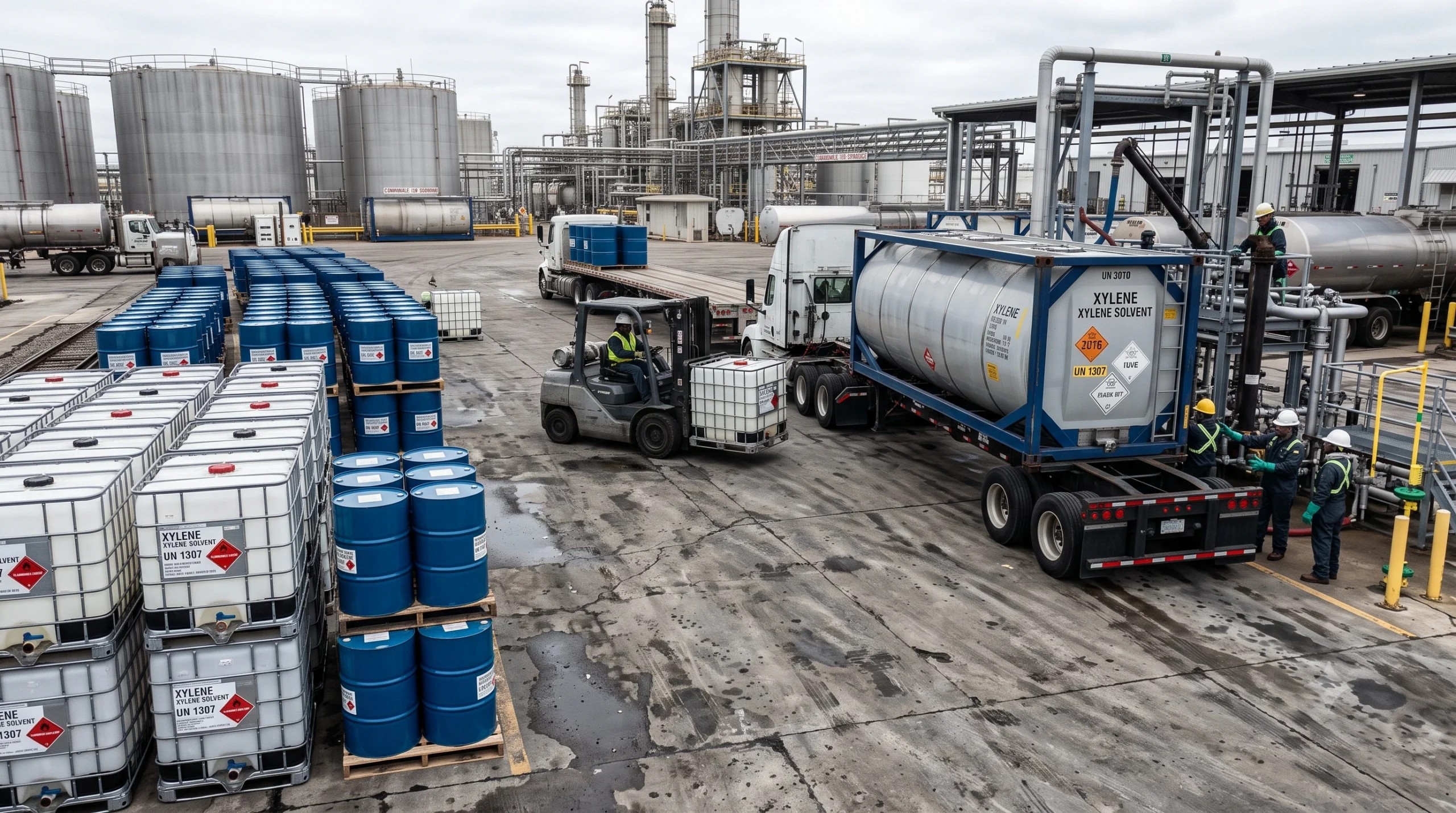
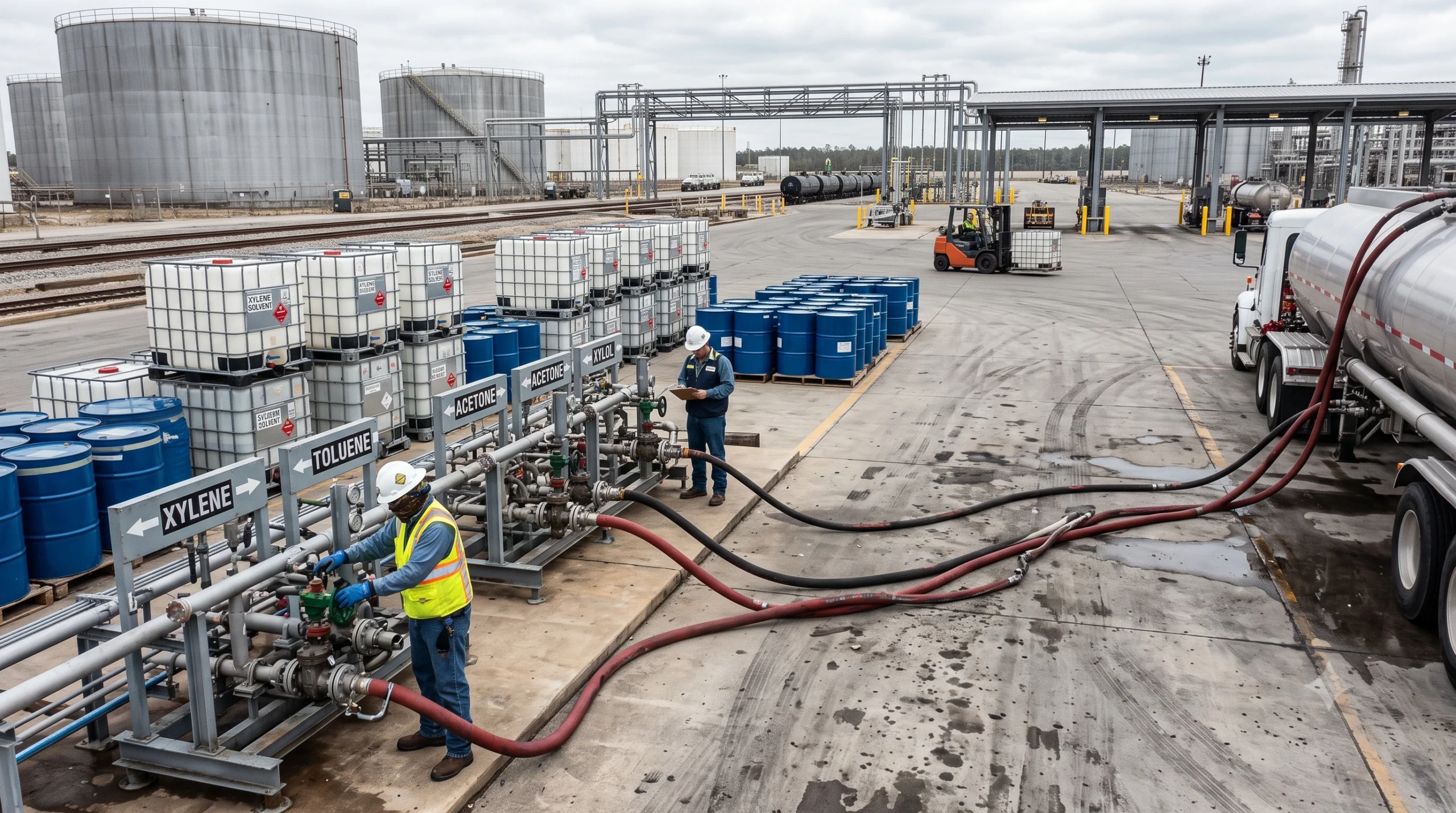
Ethyl acetate ships in 210 kg HM-HDPE or epoxy-lined MS drums, IBCs and flexitanks, or ISO tanks and bulk road tankers, and the packaging tier you choose has a direct effect on landed cost.
Drum pricing steps down in brackets rather than sliding smoothly, so a jump from one drum to a pallet lot saves a little, but the real break shows up at ISO-tank or tanker volume. MOQs also vary by channel: manufacturer-direct orders typically require a full container or tanker, while distributors and sourcing platforms will move smaller lots. One storage caveat worth flagging before you commit to packaging: standard HDPE can degrade with extended ethyl acetate contact, so stainless steel or epoxy-lined MS is preferred for bulk storage.
How Alternative Solvents Affect Price
Substitutable solvents effectively cap how far ethyl acetate price can move before buyers switch, which makes that ceiling a pricing factor in its own right.
When acetone or butyl acetate gets meaningfully cheaper, demand for ethyl acetate softens and prices tend to follow. That said, reformulation cost, not the per-kg price gap, is usually the real barrier to switching, since re-qualifying a coating or adhesive formulation is expensive regardless of solvent savings. For a fuller breakdown, see ethyl acetate vs other solvents (compare).
| Solvent | Evaporation speed | Relative cost | Switch when | Do not switch when |
| Ethyl acetate | Fast | Baseline | — | — |
| Acetone | Very fast | Lower | Fast-dry priority outweighs odor concerns | Formulation needs low water solubility |
| Butyl acetate | Slower | Similar-higher | Slower cure time is acceptable | Fast-dry finish is required |
| Isopropyl acetate | Fast | Similar | Minor reformulation is feasible | Product spec is already qualified |
Where to Buy Ethyl Acetate: Three Routes Compared
Which route makes sense depends almost entirely on annual volume, not on which supplier quotes the lowest number this week.
| Route | Typical MOQ | Price position | Lead time | Best fit |
| Manufacturer direct | Full tanker / ISO tank | Lowest | Longer | High, continuous volume |
| Distributor | Drum / IBC | Mid | Shorter | Mid-size, flexible needs |
| Sourcing platform | Drum to tanker | Mid-low | Moderate | Buyers wanting verification + comparison |
Buying direct from ethyl acetate manufacturers
Named producers worth citing in this space include GNFC, Accordd Organics, Jiangsu Sopo, INEOS and LG Chem. Buying direct gets you the lowest base price, but it also comes with the highest MOQ and the least flexibility if you need to switch grades mid-contract.
Working with an ethyl acetate distributor
Distributors trade a small margin for smaller lots, faster turnaround and local stock points, packaged goods ready to move rather than a bulk shipment waiting on port clearance.
Sourcing platforms and consolidated procurement
A platform handles supplier verification, quote comparison, and documentation in one place, which is where Elchemy’s manufacturer network fits for buyers who want direct access without managing multiple vendor relationships. Request a Quote to compare current rates against a verified Indian supply base.
How to Vet an Ethyl Acetate Supplier Before You Release the PO
- Confirm grade and standard on the quote itself, not just a purity percentage.
- Ask for a recent Certificate of Analysis (COA) and Mill Test Certificate (MTC).
- Normalize the quote to a single basis (Ex-works, FOB, CIF or delivered) before comparing across suppliers.
- Verify certifications: ISO, REACH where applicable, GMP for pharma grade.
- Check packaging spec and drum-lining compatibility.
- Confirm hazard documentation: Class 3 flammable classification, SDS, correct UN packaging.
- Confirm HSN classification and applicable duty or GST.
- Establish the quote’s validity window and price-revision mechanism.
- Ask for reference volumes and on-time delivery history.
- Confirm sample availability before committing to a first bulk order.
Handling & Storage
Ethyl acetate is a Class 3 flammable liquid with a flash point below freezing, and that single fact governs storage, transport and site compliance cost, all of which belong on a pricing page since they’re part of landed cost, not a separate topic.
Safe handling requires proper ventilation, ignition-source control, and correct PPE for vapor exposure, along with grounding and bonding equipment during transfer to prevent static discharge. For storage, stainless steel and epoxy-lined MS are preferred for bulk quantities; standard HDPE works for smaller volumes but should be monitored for degradation over time. Regulatory bodies classify the compound consistently: ECHA’s registration dossier for ethyl acetate covers its flammability labeling requirements under EU transport and hazardous-substance directives, which is a useful reference point even for non-EU buyers standardizing documentation. See ethyl acetate properties & safety for the full spec sheet.
On the compliance side, always request the SDS, COA and MTC together, since Elchemy’s non-HAP, comparatively low-VOC profile is also a genuine purchasing advantage over aromatic solvents in regulated end markets.
Decision Framework: Matching Sourcing Route to Volume
- Under one tanker load per quarter: go with a distributor or sourcing platform.
- One to five tankers per quarter: a platform with contract pricing gives you the best balance of rate and flexibility.
- Continuous multi-tanker demand: manufacturer-direct with an indexed contract is worth the longer lead time.
- Pharma or food grade, at any volume: prioritize documentation over base price, every time.
The single costliest mistake buyers make is comparing quotes on mismatched bases, since a lower-looking number on a different basis isn’t actually a better price.
Frequently Asked Questions
What is the ethyl acetate price per kg right now?
As of August 2026, bulk technical-grade ethyl acetate trades between USD 0.80 and 1.25 per kg globally, with India and Northeast Asia sitting at the low end of that range. Europe, North America and South America run higher, driven by energy costs, plant turnarounds and freight-dependent import economics rather than a shortage of supply.
How much does a ton of ethyl acetate cost?
Indian FOB pricing currently runs roughly USD 780 to 850 per metric ton, rising to USD 900 to 1,000 once you add destination freight, inland transport and last-mile handling to reach a fully delivered figure. The per-ton number always looks lower than per-kg drum pricing because packaging cost disappears at tanker volume.
What is the minimum order quantity for bulk ethyl acetate?
MOQ depends heavily on the channel you choose: distributors and sourcing platforms will often move drum or IBC quantities starting around 1,000 kg, while manufacturer-direct deals typically require a full ISO tank or road tanker load before the lowest base pricing applies.
Why do two suppliers quote such different prices for the same grade?
Almost always because the quotes aren’t on the same basis, one may be Ex-works and the other delivered, which alone can account for a 15 to 20% swing. Grade specification, packaging type and payment terms add further variance even when the underlying purity is identical.
Is Indian ethyl acetate cheaper than Chinese material?
Generally yes at present, since India’s ethanol feedstock base keeps domestic production costs low, though the gap narrows or occasionally reverses depending on Chinese plant utilization rates and periodic export incentives. Buyers comparing the two should always normalize for freight before assuming either origin is definitively cheaper.
What is the HSN code and GST rate for ethyl acetate in India?
The HSN code is 29153100, and domestic sales attract 18% GST on top of the Ex-works price. Buyers importing into India should also confirm applicable customs duty separately, since that sits outside the GST calculation and varies by country of origin.
What grade of ethyl acetate do I need for pharmaceutical use?
Pharma-grade material with a full GMP certificate, Certificate of Analysis and Mill Test Certificate is required for API extraction and purification work. Technical grade is not an acceptable substitute here, even at a lower price, since regulatory audits will flag missing documentation regardless of actual purity level.
Can ethyl acetate be stored in plastic drums?
Standard HDPE can be used for short-term, smaller-volume storage, but it can degrade with extended contact, so stainless steel or epoxy-lined MS drums are recommended for bulk quantities or longer storage durations. Always confirm drum lining compatibility with your supplier before committing to a full pallet order.
How long is an ethyl acetate quote usually valid?
Most bulk quotes hold for two to three weeks before feedstock and freight movement make the number stale, so treat anything older than that as a starting point for renegotiation rather than a firm price. Fast-moving feedstock markets can shrink that window further during volatile periods.
Where can I buy ethyl acetate in bulk with verified quality documentation?
A sourcing platform with a verified manufacturer network, like Elchemy’s, is typically the fastest route to documented, compliant bulk supply without managing multiple vendor relationships directly. It also gives you a single point of contact for COA, SDS and MTC requests across different grades and volumes.
Conclusion
Ethyl acetate price currently sits between USD 0.80 and 1.25 per kg globally, and most of the spread you’ll see from quote to quote comes down to basis and grade rather than genuine margin differences between suppliers. Since feedstock and freight shift these numbers within weeks, treat any quote older than a few weeks as stale, and this page is refreshed monthly so the ranges stay current.
For buyers ready to move past index-page estimates and into an actual negotiation, request a bulk quote from Elchemy’s verified Indian manufacturer network, where documentation, grade verification and quote comparison are handled in one place.