

At a Glance
- Yes, ethyl acetate is polar, but only moderately. Dipole moment around 1.78 D, dielectric constant 6.02, against water’s 80. It sits closer to diethyl ether than to an alcohol.
- It is a polar aprotic solvent. Polar carbonyl, no donatable hydrogen. That classification drives extraction behavior, chromatography and reaction solvent choice.
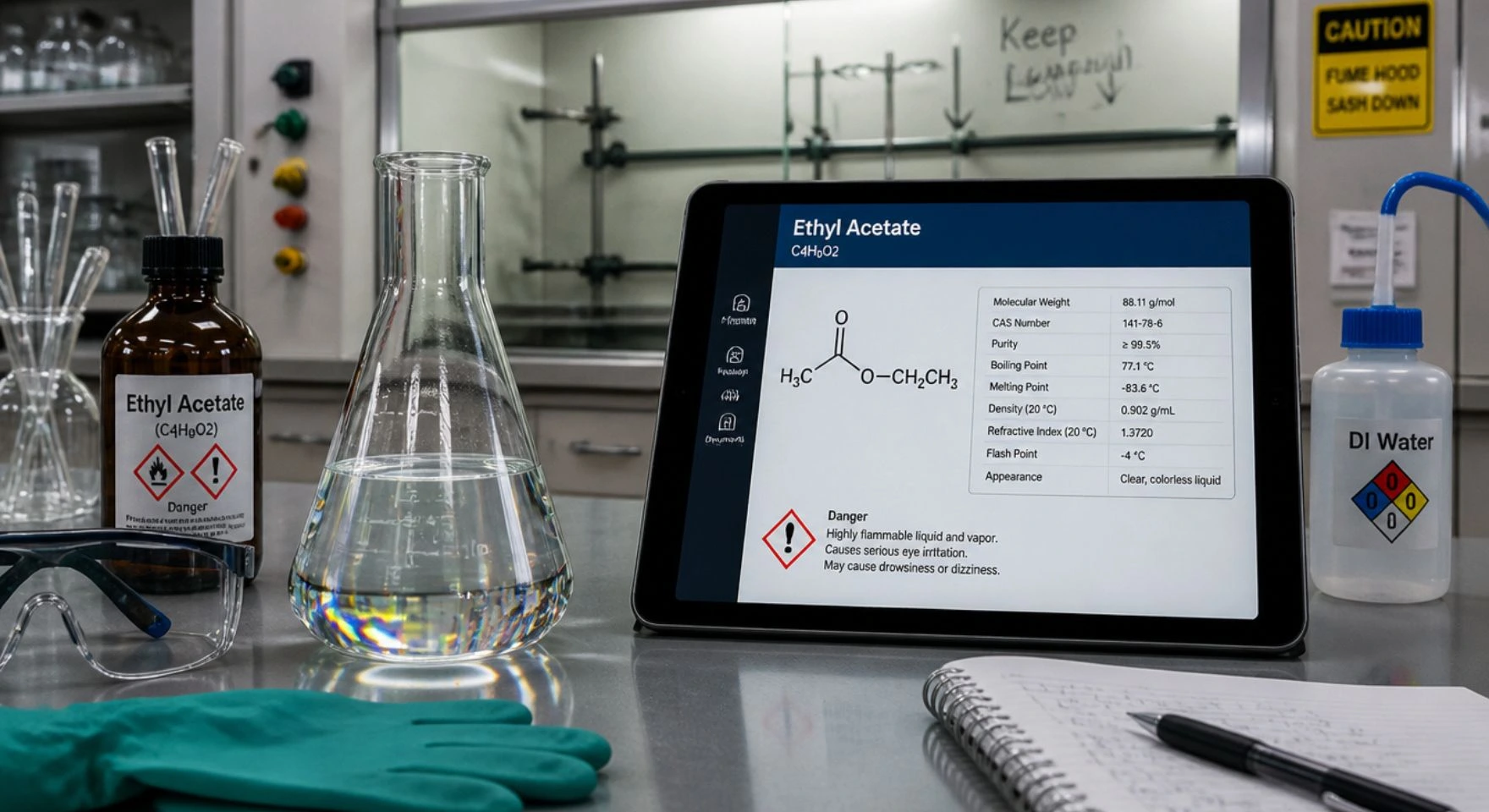
- It is an ester, C4H8O2, CAS 141-78-6, MW 88.11 g/mol, made from acetic acid and ethanol.
- Boiling point 77.1 °C, density 0.902 g/mL, so it floats on water. That density gap is why it works as an extraction solvent.
- Flammable, flash point about -4 °C, UN 1173, Class 3. Storage and transport rules follow from flammability, not toxicity.
- The “miscible” question has a trap in it. Ethyl acetate is only partially water soluble, roughly 8 g per 100 mL. It is miscible with ethanol, acetone, chloroform and ether, but not with water.
What You’ll Learn
Every recurring property, safety and solubility question about ethyl acetate in one place, with the numbers attached and the practical consequence spelled out.
Introduction
Specify the wrong solvent polarity and you do not find out in the lab. You find out three batches later, when extraction yield drops, a resin will not dissolve cleanly, or a coating flashes off faster than it can level. Ethyl acetate sits in an awkward middle band, and the answers online split between one-line forum replies and spec sheets with no interpretation.
“Yes, it is polar” is technically correct and practically useless. It does not tell a formulator whether the solvent will pull their analyte, dissolve their nitrocellulose, or separate cleanly from an aqueous phase. This guide covers polarity, physical properties, water behavior, safety limits, applications from coatings through to personal care formulations, and how to specify grade when you buy.
Still validating fit? Request a Sample at elchemy.com.
Is Ethyl Acetate Polar or Nonpolar?
Yes, ethyl acetate is polar, but moderately so, and more usefully it is polar aprotic.
The molecule carries a polar C=O carbonyl and a polar ester oxygen, offset by the nonpolar ethyl group on the other side. The two halves do not cancel, so a net dipole survives, but a modest one. This is why both answers appear online. Polarity is a spectrum, not a switch. Next to hexane, ethyl acetate is clearly polar. Next to methanol, it barely registers.
Where It Sits on the Polarity Scale
| Solvent | Dielectric constant | Dipole moment (D) | Relative polarity index | Protic / Aprotic |
| Water | 80.1 | 1.85 | 1.000 | Protic |
| Methanol | 32.7 | 1.70 | 0.762 | Protic |
| Acetone | 20.7 | 2.88 | 0.355 | Aprotic |
| Ethyl acetate | 6.02 | 1.78 | 0.228 | Aprotic |
| Diethyl ether | 4.3 | 1.15 | 0.117 | Aprotic |
| Hexane | 1.88 | 0.00 | 0.009 | Aprotic |
Polar Aprotic: Why the Distinction Matters
With no O-H or N-H bond, ethyl acetate accepts hydrogen bonds through the carbonyl but never donates one. For SN2 chemistry that helps, because the solvent will not cage and deactivate your nucleophile the way an alcohol does. For extraction it means bare anions stay poorly solvated, so charged species remain in the aqueous layer while neutral organics partition into the solvent. That selectivity is the whole basis of its use as a general-purpose extraction solvent.
What Is Ethyl Acetate?
Ethyl acetate is a clear, colorless, fast-evaporating ester solvent with a sweet fruity odor, produced by esterification of acetic acid and ethanol. It also occurs naturally as a fermentation byproduct in wine and beer and in ripe fruit, which is why the smell reads as pear drop rather than chemical. Synonyms on documentation include ethyl ethanoate, acetic acid ethyl ester, acetoxyethane, EtOAc and vinegar naphtha.
Is Ethyl Acetate an Ester?
Yes. It is the ethyl ester of acetic acid, built on the R-COO-R’ ester group. Acetone, by contrast, is a ketone and ethanol is an alcohol, and both behave differently in solvency and reactivity, which the comparison section below breaks down.
Identifiers and Regulatory References
| Identifier | Value |
| CAS Number | 141-78-6 |
| EC / EINECS Number | 205-500-4 |
| UN Number | UN 1173, Class 3 |
| Molecular formula | C4H8O2 |
| Molecular weight | 88.11 g/mol |
| E number (food additive) | E1504 |
| REACH status | Registered, see the ECHA substance record |
Physical Properties of Ethyl Acetate
The two numbers most people arrive looking for: boiling point 77.1 °C and density 0.902 g/mL at 20 °C.
| Property | Value |
| Boiling point | 77.1 °C |
| Melting point | -83.6 °C |
| Density (20 °C) | 0.902 g/mL |
| Flash point | approx. -4 °C (closed cup) |
| Vapor pressure (20 °C) | 73 mmHg |
| Vapor density (vs air) | 3.04 |
| Viscosity (25 °C) | approx. 0.42 cP |
| Refractive index (20 °C) | 1.3720 |
| Dielectric constant | 6.02 |
| Surface tension (20 °C) | approx. 23.9 mN/m |
| Water solubility (20 °C) | approx. 8.3 g per 100 mL |
Full identity and property data sits in the NIH PubChem record for ethyl acetate.
Is Ethyl Acetate Less Dense Than Water?
Yes. At 0.902 g/mL against water’s 1.00, ethyl acetate forms the upper layer in a separatory funnel. Worth being deliberate about, because discarding the wrong layer is the most common and most expensive error with this solvent. Your product is on top.
What Does Ethyl Acetate Smell Like?
Sweet, fruity and pear-like at low concentration, turning sharp and solvent-heavy as concentration climbs. The odor threshold sits well below the occupational exposure limit, so smell is a useful early warning that vapor is accumulating. It is not an exposure control. Olfactory fatigue sets in fast, and you stop noticing the smell long before the concentration drops.
Is Ethyl Acetate Soluble or Miscible in Water?
Partially soluble, roughly 8 g per 100 mL at 20 °C. Not miscible. The two words are not interchangeable and the whole confusion sits here.
Soluble means one substance dissolves into another up to a saturation limit. Miscible means the two mix in all proportions with no limit. Ethyl acetate is the first, not the second. It is miscible with ethanol, acetone, chloroform, diethyl ether and most organic solvents. With water it forms a distinct two-phase system, which is exactly why it works for liquid-liquid extraction and fails as a co-solvent for aqueous systems.
One storage consequence: ethyl acetate hydrolyzes slowly back to acetic acid and ethanol in the presence of water. Wet material drifts upward in acidity, so if your spec carries an acidity limit, moisture control is not optional.
Ethyl Acetate Safety: Flammability, Toxicity and Handling
Ethyl acetate is highly flammable and low in acute toxicity. Flammability is the operationally serious risk and the one that dictates how you store and ship it.
Is Ethyl Acetate Flammable?
Yes. Flash point around -4 °C, Class IB flammable liquid, UN 1173, DOT/UN Class 3. It is flammable at any normal ambient temperature.
Vapor density is 3.04 against air, so vapor sinks, pools in low points, and can travel along the floor to a distant ignition source and flash back. The explosive range in air runs roughly 2.0 to 11.5 percent by volume. Storage practice follows: bonded and grounded containers, mechanical ventilation, no spark or static sources, and segregation from oxidizers, nitrates, strong acids and strong bases.
Is Ethyl Acetate Toxic or Harmful?
Low acute toxicity, but a genuine irritant, and this is where “toxic” and “harmful” stop meaning the same thing. Vapor above roughly 400 ppm irritates eyes, nose and throat. Sustained high concentrations cause drowsiness, weakness and CNS depression, and repeated skin contact defats the skin. Carcinogenicity has not been assessed by EPA IRIS, IARC or NTP, which records the absence of an evaluation rather than a clearance.
| Body | Limit type | Value (ppm) |
| OSHA | PEL, 8-hour TWA | 400 |
| NIOSH | REL, 10-hour TWA | 400 |
| NIOSH | IDLH | 2,000 |
| ACGIH | TLV, 8-hour TWA | 400 |
Values as published in the NIOSH Pocket Guide to Chemical Hazards.
PPE and Spill Response
Nitrile gloves, splash goggles, and local exhaust ventilation or an organic vapor respirator where concentrations approach the limit. For spills, kill every ignition source first, absorb with inert material such as vermiculite or dry sand, and collect into a closed container. Do not flush to drain. Work from the grade-specific SDS and TDS, since acidity and impurity profiles differ between technical and USP material.
Applications of Ethyl Acetate
Ethyl acetate turns up wherever a fast-evaporating, low-toxicity, moderately polar solvent is needed.
Industrial and coatings. Lacquers, printing inks and coatings use it for resin solvency plus a controlled evaporation rate. In adhesives it is a true solvent for cellulose acetate, nitrocellulose and vinyl resins, so no co-solvent is required.
Pharmaceutical and laboratory. Extraction and purification of natural products from biological matrices. In chromatography the ethyl acetate and hexane gradient remains the default in column work, and it is the standard choice when the reaction medium must not donate hydrogen bonds.
Food, flavor and personal care. Coffee and tea decaffeination, fruit notes in confectionery, the gentler non-acetone nail polish remover, and a volatility carrier in perfumery.
Purity and documentation shift with the application, which is why buyers work with an ethyl acetate supplier (technical grade) who can also serve pharma and food-contact specs from one relationship.
Ethyl Acetate vs Acetone, MEK and Butyl Acetate
Ethyl acetate trades raw solvency power for gentler handling. It flashes off slower than acetone and faster than butyl acetate, and that middle position is usually why it gets specified.
| Property | Ethyl Acetate | Acetone | MEK | Butyl Acetate |
| Chemical class | Ester | Ketone | Ketone | Ester |
| Boiling point | 77.1 °C | 56.1 °C | 79.6 °C | 126 °C |
| Flash point | approx. -4 °C | approx. -20 °C | approx. -6 °C | approx. 22 to 27 °C |
| Evaporation rate (BuAc = 1) | approx. 4.1 | approx. 5.6 | approx. 3.8 | 1.0 |
| Water miscibility | Partial, approx. 8 g/100 mL | Fully miscible | Partial, approx. 27 g/100 mL | Low, approx. 0.7 g/100 mL |
| Relative solvency strength | Moderate | High | High | Moderate |
| Odor profile | Sweet, fruity | Sharp, pungent | Sharp, pungent | Mild, fruity |
For a deeper breakdown of the ester versus ketone tradeoff and where aromatics fit, see ethyl acetate vs acetone / toluene.
Choose Each One When
- Choose ethyl acetate when you need moderate solvency, a mild odor profile, food-contact clearance, or a gentler option for substrates acetone attacks.
- Choose acetone when you need maximum solvency and the fastest flash-off, and aggressive drying is acceptable.
- Choose MEK when you need strong solvency at a slower evaporation rate, typically for high-solids systems.
- Choose butyl acetate when you need the slowest evaporation for flow, levelling and finish quality.
Request a Quote for your grade and volume at elchemy.com.
Where to Source Ethyl Acetate
At commodity scale, grade and documentation separate suppliers, not price per ton. Two quotes that look identical on price rarely deliver identical material.
Grades and Specifications to Specify
Grades run from technical and laboratory through ACS reagent, HPLC, FCC food grade, USP/NF and anhydrous. Name the grade in your enquiry rather than asking for “ethyl acetate.” Then pin the numbers. Purity above 99.5 percent, water content, acidity as acetic acid, and non-volatile residue decide whether the material performs. Demand a batch-specific COA plus SDS, TDS, and REACH and food-contact declarations upfront. A supplier who cannot produce a per-batch COA before shipment is selling a specification they have not verified.
Packaging, MOQ and Logistics
| Packaging | Typical volume | Suited to |
| Drum | 160 to 200 kg | Lab, pilot and small production runs |
| IBC | 800 to 1,000 kg | Mid-volume manufacturing |
| ISO tank | 18 to 22 MT | Bulk industrial and continuous processes |
Shipping as a Class 3 flammable liquid means dangerous-goods routing, restricted vessel space and extra documentation, so build additional lead time in for first shipments to a new destination.
Manufacturers and Suppliers
Elchemy connects buyers directly to vetted Indian manufacturers, with batch COAs, full compliance documentation and samples dispatched in 24 to 48 hours. If you are consolidating several solvent lines, a single bulk ethyl acetate supplier also removes the documentation mismatch that appears when grades arrive from three different sources.
Frequently Asked Questions
Is ethyl acetate polar or nonpolar?
Ethyl acetate is polar, but only moderately, with a dipole moment near 1.78 D and a dielectric constant of 6.02. More precisely it is polar aprotic, meaning it accepts hydrogen bonds through its carbonyl but cannot donate them.
What happens when NaOH is added to ethyl acetate?
Sodium hydroxide saponifies ethyl acetate into sodium acetate and ethanol. Unlike acid hydrolysis this reaction is irreversible, because the carboxylate salt resists further attack. The practical warning: never store ethyl acetate alongside strong bases.
Is ethyl acetate the same as acetone?
No. Ethyl acetate is an ester and acetone is a ketone. Acetone is the stronger solvent, fully water miscible and faster evaporating. Ethyl acetate is milder on plastics, gentler in odor, and holds food-contact clearance.
s ethyl acetate safe to use at home?
In consumer products such as nail polish remover, yes, at the concentrations used. Bulk solvent is different. It is highly flammable, needs real ventilation, and should never be used near open flames, heaters or pilot lights.
Does ethyl acetate evaporate quickly?
Yes. With a boiling point of 77.1 °C and a relative evaporation rate near 4.1 on the butyl acetate scale, it flashes off fast. Slower than acetone, and considerably faster than butyl acetate or toluene.
Can ethyl acetate be used on skin or nails?
It is approved in cosmetic formulations such as nail products at controlled concentrations. Repeated or prolonged contact defats the skin and can cause dermatitis, so undiluted solvent should never be used to clean skin.
How should ethyl acetate be stored long term?
Cool, ventilated, flammables-rated storage in tightly sealed, grounded and bonded containers, away from oxidizers, acids and bases. Moisture ingress drives slow hydrolysis and rising acidity, so seal integrity matters more than buyers expect.
Is ethyl acetate biodegradable?
Yes. Ethyl acetate is readily biodegradable and hydrolyzes to acetic acid and ethanol, both of which break down quickly in the environment. That profile is one reason it substitutes for chlorinated solvents in greener formulations.
Conclusion
Three answers cover most of what brings people to this page. Ethyl acetate is moderately polar and, more usefully, polar aprotic. It is highly flammable with a flash point near -4 °C, and that is the risk shaping your storage and shipping. It is only partially water soluble at roughly 8 g per 100 mL, which is why it separates cleanly in extraction and fails as an aqueous co-solvent.
Grade selection follows from these properties, since purity, water content and acidity decide whether the material behaves the way the datasheet promises.
Ready to specify? Work with an ethyl acetate supplier (technical grade) who ships with a batch COA. Request a Quote.