

Natural vs Synthetic Caffeine: Which Should Your Supplement Brand Buy?
At a Glance
- The caffeine molecule: Natural-source and synthetic caffeine provide the same caffeine compound; their source and accompanying ingredient matrix may differ.
- The buying decision: Choose based on product positioning, formulation needs, verified specifications, and supply requirements, not an assumption that one source always works better.
- What to compare: Review source evidence, caffeine assay and basis, extract composition, testing, traceability, and batch documentation.
- The evidence caution: “Natural” alone does not prove slower absorption, a smoother effect, or better performance.
- The next step: Request the specification and current lot documentation for the exact ingredient you plan to qualify.
What you’ll learn
You’ll learn how natural and synthetic caffeine differ as ingredients, what evidence to request from suppliers, and how to choose a source that fits your supplement’s formulation and positioning.
Introduction
Choosing caffeine for a supplement can affect more than the ingredient line on a label. Procurement and formulation teams also need to consider product positioning, dose consistency, supporting extract components, supplier documentation, and whether the ingredient can be sourced reliably.
Natural-source caffeine and synthetic caffeine differ in origin, but that distinction alone does not tell a buyer which ingredient will work better in a finished product. The relevant evidence depends on the specific ingredient and formulation. It also helps to separate source from form: “natural” describes origin, while “anhydrous” describes a form of caffeine. For that distinction, see this anhydrous caffeine form guide. This guide compares the options using the same technical, quality, and sourcing criteria.
Which caffeine source should a supplement brand buy?
Neither source is the automatic winner. Choose the ingredient that fits your product brief and that the supplier can substantiate with relevant specifications and documentation.
A botanical-source ingredient may suit a product whose positioning depends on plant origin, provided the supplier can document the source and composition. A synthetic ingredient may suit a brief that calls for an isolated, defined caffeine input. In either case, request the exact product specification and review the evidence before approving a source claim or placing an order.
What do “natural” and “synthetic” caffeine mean to buyers?
“Natural” generally refers to caffeine extracted from a botanical source, while “synthetic” refers to caffeine produced through chemical synthesis. The labels describe origin, not a complete quality grade or a guarantee of how the ingredient will perform in a finished supplement.
Natural-source caffeine may be an extract or a more isolated ingredient
A natural-source ingredient may be supplied as a botanical extract containing other compounds, or as a more isolated caffeine ingredient. Those are different material profiles, so check the supplier’s specification to understand what is actually being sold.
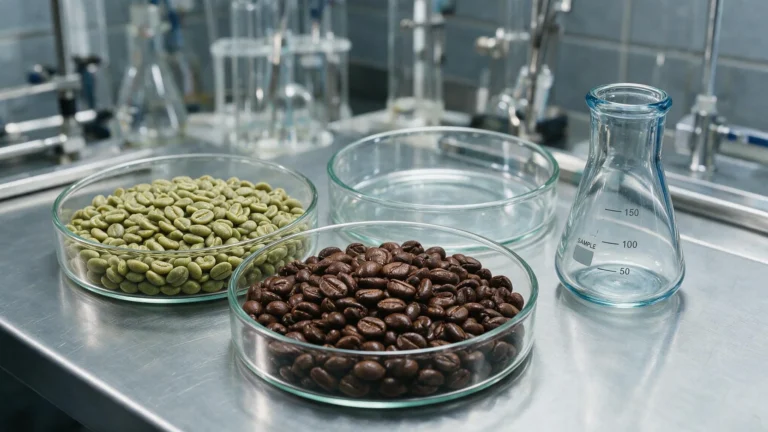
Green coffee and tea are examples of botanical sources used for caffeine ingredients. If your formulation also uses a tea-derived ingredient, see this green tea extract powder guide.
Synthetic caffeine describes origin, not quality
Synthetic caffeine is produced through chemical synthesis, but that description alone does not establish its grade, purity, or suitability. Buyers still need to review identity, assay, relevant impurity information, and lot documentation.
“Anhydrous” is a separate description of form. It does not, by itself, tell you whether caffeine is natural or synthetic.
Do natural and synthetic caffeine work differently?
The source label alone does not establish that one ingredient will act more slowly or feel smoother. Differences in the botanical extract, dose, other formula ingredients, and finished-product format may matter, so broad claims need evidence for the specific ingredient and use.
A small randomized crossover study compared a 200 mg dose of caffeine from green coffee extract and guayusa extract with a synthetic control in 12 adult men. The researchers reported bioequivalent caffeine pharmacokinetic measures for the tested ingredients. This is useful evidence, but it does not establish that every botanical extract or finished formulation will behave the same way. Read the clinical study.
Avoid saying natural caffeine always prevents jitters, avoids a “crash,” or provides better performance. Those claims need direct support, and the effect of a finished supplement cannot be inferred from source alone.
How should buyers compare natural and synthetic caffeine?
Compare the actual ingredients against the same criteria instead of comparing category labels. A source claim, price, or marketing description cannot replace a product specification and lot-level evidence.
| Buying criterion | Natural-source caffeine | Synthetic caffeine | Evidence to request |
| Source and source-claim documentation | Confirm the botanical source and how its origin is documented. | Confirm the stated synthetic source and supporting supplier documentation. | Source statement, traceability records, and claim substantiation. |
| Ingredient form and extract composition | Confirm whether it is an extract, standardized ingredient, or more isolated caffeine, and what else it contains. | Confirm the offered form and whether it contains carriers or other ingredients. | Current product specification and ingredient composition. |
| Caffeine assay and basis | Verify the caffeine content and the basis used for the assay. | Verify the caffeine content and the basis used for the assay. | Lot-specific CoA, assay method, and stated basis. |
| Identity and purity testing | Review the supplier’s identity and purity evidence for the offered ingredient. | Review the supplier’s identity and purity evidence for the offered ingredient. | Test methods, acceptance criteria, and lot results. |
| Relevant residual solvent and contaminant controls | Ask which controls apply to the botanical source and extraction process. | Ask which controls apply to the synthetic manufacturing process. | Applicable testing information and supplier quality documentation. |
| Batch CoA and traceability | Confirm the CoA matches the lot and that source traceability is available. | Confirm the CoA matches the lot and that manufacturing traceability is available. | Current lot CoA, lot identification, and traceability records. |
| Formulation fit and sensory impact | Evaluate the full extract and finished formula; do not assume source guarantees an effect. | Evaluate the ingredient and finished formula; do not assume source guarantees an effect. | Sample evaluation and evidence relevant to the specific formulation. |
| MOQ, price, lead time, and supply continuity | Confirm current terms for the exact source and grade. | Confirm current terms for the exact source and grade. | Supplier quote, MOQ, lead time, packaging, and continuity details. |
A supplier’s specification and current lot Certificate of Analysis (CoA) help establish what is being offered. The CoA should match the lot under review, and the assay basis should be clear so formulators can compare ingredients consistently. Elchemy’s caffeine technical data sheet is a starting point for product information; buyers should still request current lot documentation for qualification.
Natural origin does not automatically substantiate claims such as “clean label,” “more sustainable,” or “more effective.” Confirm that any source or product-positioning claim applies to the exact ingredient and finished product. For broader context, see this clean label ingredient sourcing article.
Which source fits different supplement scenarios?
A natural-source ingredient can fit a botanical-origin position when its source, composition, and claim support are documented. A synthetic ingredient can fit a formulation that prioritizes a defined isolated caffeine input, provided it meets the product specification and label requirements.
- Botanical-positioned product: Confirm botanical identity, extract composition, caffeine contribution, and substantiation for the intended source claim.
- Precisely dosed capsule or powder: Compare assay and basis, then evaluate blending, homogeneity, handling, and finished-dose controls.
- Multi-ingredient pre-workout or energy product: Account for caffeine contributed by all ingredients and assess the complete formulation. Do not assume source alone determines consumer experience.
- Cost- or continuity-sensitive program: Compare current quotes, order quantities, lead times, and supply alternatives using confirmed supplier terms.
If you are comparing suppliers as well as ingredients, use this supplement supplier qualification guide. For category context, see Elchemy’s food and nutrition ingredient range.
What should buyers verify before choosing a caffeine supplier?
Qualify the exact ingredient and supplier before approving the material or making a source claim. The required evidence depends on the ingredient, its intended use, and your company’s quality and regulatory review.
- Confirm identity and source. Check the exact ingredient name, source, grade, and intended-use suitability.
- Review the specification and CoA. Confirm the assay method and basis, and make sure the CoA applies to the lot under review.
- Ask about relevant testing. Request available identity, purity, residual-solvent, and contaminant information that applies to the material and its process.
- Check traceability. For a botanical ingredient, ask how the source and any origin claim are documented. Analytical methods can also help distinguish natural from synthetic caffeine in some samples; a study of 38 drinks identified four that were mislabeled as to caffeine source. Read the analytical study.
- Review supplier controls. Confirm lot traceability, change-control practices, packaging, storage, and supply-continuity details.
- Involve quality and regulatory teams. Have them review the ingredient and finished-product use under applicable US requirements.
The FDA’s dietary supplement CGMP guidance discusses component specifications and supplier qualification in the context of supplement manufacturing. Use it as regulatory context, and ask your regulatory team to confirm how requirements apply to your operations and product. FDA dietary supplement CGMP guidance.
Elchemy’s caffeine product listing and TDS provide a product-specific starting point for evaluation. Confirm the offered source, grade, and current specifications with the supplier before making a purchase decision.
FAQs
1. Is natural caffeine better than synthetic caffeine for supplements?
No source is universally better. Natural-source caffeine may fit a product that requires a documented botanical origin, while synthetic caffeine may fit a formulation seeking an isolated input. Compare the exact ingredient’s specification, supporting documentation, formulation fit, and supply terms before choosing.
2. Are natural and synthetic caffeine chemically the same?
Caffeine from either source is the same caffeine compound. The sourcing difference is how it is obtained and, for botanical extracts, what other compounds may be present in the ingredient. Ask suppliers to document source and composition rather than relying on the word “natural” alone.
3. Does natural caffeine absorb more slowly than synthetic caffeine?
That cannot be assumed for every product. A small clinical study found bioequivalent caffeine pharmacokinetic measures for two tested botanical sources and a synthetic control, but it did not cover every ingredient or finished formulation. Ask for evidence that matches the specific source, dose, and product.
4. Is caffeine anhydrous the same as synthetic caffeine?
No. “Anhydrous” describes a form of caffeine, while “synthetic” describes its source. The terms answer different questions, so a buyer should confirm both the form and origin in the supplier’s specification when those details matter to the formula or label.
5. What documents should a supplement brand request from a caffeine supplier?
Start with the product specification and a current, lot-specific CoA. Depending on the material and your qualification process, request identity and assay methods, relevant purity or contaminant testing, botanical-source traceability, and change-control information. Your quality team should decide which documents are necessary for approval.
6. What should buyers compare when requesting caffeine quotes?
Compare the same defined ingredient and grade across suppliers. Include caffeine assay and basis, source documentation, packaging, minimum order quantity, quoted price, lead time, available lot documents, and sample terms. A lower price is difficult to assess without confirming that the specifications and commercial terms are comparable.
Conclusion
The choice between natural-source and synthetic caffeine depends on what your supplement needs and what your supplier can verify. Compare source, ingredient composition, assay, documentation, formulation fit, and current commercial terms. Treat claims about a smoother or slower effect as evidence questions, not assumptions based on origin.
Elchemy lists a caffeine ingredient with product information and a technical data sheet. Review the Elchemy caffeine product listing and request a quote for the source and specification your team needs.