

At a Glance
- Five grades: Food, USP, feed, technical and fine or milled grades exist. Your end use decides which fits.
- Specs to compare: Assay, particle size, moisture and impurity limits belong on every lot-specific COA.
- US rules by use: 21 CFR 184.1736 covers food use, and 21 CFR 582.1736 covers feed use.
- Pack format sets handling: Suppliers sell 50 lb bags, supersacks and bulk loads. Elchemy orders typically start from 1 MT.
- Price falls with volume: One catalog showed 29% lower cost per lb at 2,750 lb than at 50 lb.
- Decision rule: Buy the lowest grade that fits your use and claims, then compare quotes on landed cost.
What You’ll Learn
Learn how to choose a grade, read COA specs, meet US rules, compare landed cost and shortlist suppliers.
Introduction
A bulk sodium bicarbonate order looks simple until the quotes arrive. One supplier lists 50 lb bags at a catalog price. Another quotes a supersack with a lot-specific certificate of analysis. These are different products with different paperwork, and the wrong grade can fail an audit or spoil a batch.
This guide is for US procurement teams, feed mills and manufacturers who buy by the pallet or more. It covers grades, specifications, US rules, price drivers and supplier checks. If you are new to buying chemicals in bulk, the same discipline applies here.
Shoppers looking for bulk baking soda for home use are outside its scope. You will also find a supplier checklist, a decision framework and a six-point RFQ list.
What Is Bulk Sodium Bicarbonate?
Sodium bicarbonate is NaHCO3, CAS 144-55-8. It is the same chemical that consumers know as baking soda.
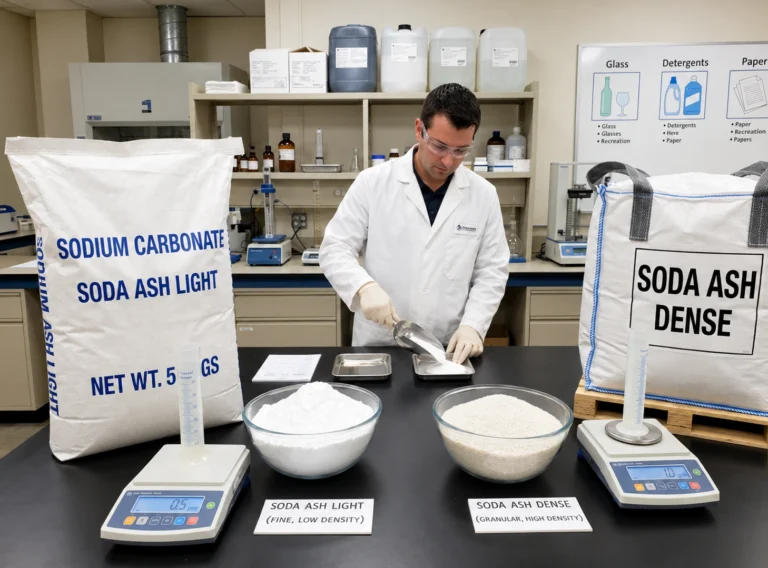
Producers make it by passing carbon dioxide through a soda ash solution. The solid is then filtered, rinsed and dried. Soda ash is much more alkaline, so the two are not interchangeable. This soda ash comparison explains the food-market differences.
In chemical supply, bulk means bags, supersacks or bulk loads. They come with a spec sheet and a lot-specific certificate of analysis (COA).
Grades of Sodium Bicarbonate
Grade is set by purity, impurity limits and end use. Elchemy’s sodium bicarbonate comes in food, pharmaceutical (USP), feed, technical and fine or milled grades.
Food Grade and USP
Food grade sodium bicarbonate follows the Food Chemicals Codex (FCC), and Elchemy lists it as E500ii. Sodium bicarbonate USP follows the pharmacopoeia and suits antacid and dialysis uses. Ask for Kosher and Halal papers if your customers need them.
Feed Grade
Feed grade is used mainly as a rumen buffer in dairy rations. US supplier sheets list sodium content, and one shows 27.1 percent minimum. Do not substitute feed grade for food grade. Check state feed requirements with your regulator.
Technical and Industrial Grade
Technical grade suits cleaning, pool pH and alkalinity, water treatment and fire-extinguishing powders. It is not intended for human consumption. Formulators comparing alkalis can read this borate or bicarbonate guide.
Fine, Milled and Granular
Particle size changes dissolution, dusting and flow. Suppliers report it as cumulative percent retained on US sieves. Elchemy lists a fine or milled grade but not its particle sizes, so ask for the size range.
Grade | Standard | Typical use | Documents to request |
Food | FCC, E500ii | Baking, beverages, food processing | COA, TDS, SDS |
USP | USP | Antacid, dialysis, pharmaceutical use | COA, TDS, SDS |
Feed | Supplier feed spec | Dairy rumen buffer | COA, TDS, SDS |
Technical | Supplier technical spec | Cleaning, pools, water treatment | TDS, SDS |
Fine or milled | Particle size spec | Powders, blends, effervescent products | COA with size data |
Choosing the Right Grade
Match the grade to what your product claims and who consumes it. Then match particle size to your process.
- Choose food or USP grade if people eat, drink or take the finished product.
- Choose feed grade if the material goes into animal rations.
- Choose technical grade if there is no ingestion or skin-contact claim.
- Choose a finer grade for fast dissolving, and a coarser grade if dust or flow is the problem.
Specifications and COA Checks
The COA is where a grade is proven. Ask for a lot-specific COA before your first order, and compare it with your own limits.
The reference values below come from several US supplier spec sheets for USP-grade material. Elchemy’s listing shows assay at 99.20 percent minimum as total alkalinity. Confirm all values against the current USP-NF monograph and your COA.
Parameter | What it tells you | Reference value | Ask the supplier for |
Assay (dry basis) | Purity | 99.0 to 100.5 percent for USP; 99 percent minimum for FCC | Result for each lot |
Loss on drying | Moisture and caking risk | 0.25 percent maximum | Result for each lot |
Chloride | Impurity | 0.015 percent maximum | Result for each lot |
Arsenic | Safety | 2 ppm maximum | Result for each lot |
Heavy metals or elemental impurities | Safety | 5 ppm maximum in older listings; newer USP sheets use elemental impurity limits | Which method the COA uses |
pH of a 1% solution | Alkalinity | About 8.3 | Result or typical value |
Particle size | Flow and dissolving | Cumulative percent retained by sieve | Sieve table |
Run simple incoming checks on every lot:
- Match the COA lot number to the bags or totes.
- Check that the powder is white and odorless.
- Compare particle size with your process needs.
- Confirm the packaging is sealed and dry.
Storage and Handling
Sodium bicarbonate is stable in dry air but decomposes slowly in moist air. Store it in sealed packaging away from moisture and heat. Decomposition begins near 50 °C (122 °F). Check the SDS for dust and protective equipment guidance, and take shelf life from the supplier’s COA or TDS.
Common Applications by Grade
Grade follows the application and the claims you make. These are the uses US buyers ask about most.
Food and Pharmaceutical Use
Food use falls under 21 CFR 184.1736. That section affirms sodium bicarbonate as GRAS and requires conformity with the Food Chemicals Codex. It sets no limit beyond good manufacturing practice. Elchemy lists leavening at 0.5 to 2.0 percent of flour weight. This overview of food industry uses covers baking and beverages in more depth.
Feed Use
21 CFR 582.1736 lists sodium bicarbonate as generally recognized as safe when used under good manufacturing or feeding practice. Dairy producers use it to buffer rumen acids. Rations and inclusion rates belong with your nutritionist, not with a purchasing guide.
Industrial, Cleaning and Pool Use
Technical grade raises pH and alkalinity in pool water and neutralizes acids. It also works as a mild abrasive and deodorizer in cleaning products. Dry-chemical fire-extinguishing powders use it too. Formulators can read about formulating with baking soda in industrial and personal care products.
Application | Suggested grade | Why | Documents |
Baking and food processing | Food | FCC, 21 CFR 184.1736 | COA, SDS |
Antacid and dialysis | USP | Pharmacopoeia standard | COA, TDS |
Dairy rumen buffer | Feed | Feed use, 21 CFR 582.1736 | COA, TDS |
Pool pH and alkalinity | Technical | No ingestion | TDS, SDS |
Cleaning and deodorizing | Technical | Mild abrasive | TDS, SDS |
Fire-extinguishing powder | Technical or fine | Particle size matters | TDS |
To test fit against your spec, Request a Sample.
Pack Sizes, MOQ and Ordering
Pack format drives handling, freight and unit cost. Bags suit trials and small runs, while supersacks and bulk loads suit regular production.
Format | Typical size | Best for | Handling notes |
50 lb bag | 50 lb (22.7 kg) | Trials and small runs | Manual handling, palletized |
Supersack | About 1 ton | Regular production | Needs lifting equipment |
Bulk truck or hopper car | Full loads | Very large users | Needs unloading equipment |
Container load | Confirm with supplier | Import and export volume | Protect from humidity in transit |
Sizes reflect formats listed by US suppliers, so confirm exact sizes with yours.
For sodium bicarbonate bulk orders, Elchemy’s product page says commercial orders typically start from 1 MT. Full container loads are available. The page lists shipping to the USA, UK, UAE and more than 40 countries. It also names US warehouse locations in New Jersey, Texas and California. Confirm pack sizes, stock and lead time in your RFQ.
What Affects Sodium Bicarbonate Price
No single price exists for sodium bicarbonate. Price follows grade, particle size, pack format, volume and freight. Elchemy says its pricing depends on soda ash and carbon dioxide feedstock costs, and it quotes against your specification. For feedstock context, see these soda ash price trends.
Cost driver | Effect on price | What to state in your RFQ |
Grade and particle size | Tighter specs can raise the quote | Standard and size range |
Pack format and volume | Unit price usually falls as volume rises | Format and annual volume |
Freight and warehouse location | Shifts the landed cost | Destination and delivery terms |
Certifications and documents | Decides which lots qualify | Papers you need |
Catalog Price Illustration
Public catalogs show how pack size changes unit price. On 9 November 2026, one supplier listed $0.72 per lb for 50 lb. Its 2,750 lb price was $0.51 per lb, about 29 percent lower.
Source (viewed 9 Nov 2026) | Pack | Price | Per lb | Per kg |
Bulk Apothecary (grade not stated) | 50 lb | $36.00 | $0.72 | $1.59 |
Bulk Apothecary | 500 lb | $310.00 | $0.62 | $1.37 |
Bulk Apothecary | 2,750 lb | $1,402.50 | $0.51 | $1.12 |
Ingredi USP Grade 5, single bag, includes sales tax | 50 lb | $51.30 | $1.03 | $2.26 |
Ingredi USP Grade 5, 55+ bags | 50 lb | $40.00 per bag | $0.80 | $1.76 |
Ideal Pool & Spa | 50 lb | $46.50 | $0.93 | $2.05 |
Augusta Cooperative, in-store farm supply (grade not stated) | 50 lb | $19.90 | $0.40 | $0.88 |
The rows are not like-for-like, because grade, supplier type, location and tax treatment differ. Treat every figure as an indicative catalog price, not a market quote.
Compare Quotes on Landed Cost
Landed cost includes material, packaging, freight, duty and handling, not just the unit price. Compare it for each quote. Keep four things identical:
- Same grade and standard.
- Same pack size.
- Same freight and duty terms.
- Same documents.
Origin changes both freight and duty, as this guide to importing bulk chemicals explains.
To compare a quote against these catalog figures, Request a Quote.
Documents and US Compliance
Ask for a technical data sheet, a safety data sheet and a lot-specific COA before you commit. Elchemy lists a GHS-aligned SDS and a COA with every order. A packing list, bill of lading and certificate of origin are available on request. For current formats, see this guide to SDS requirements.
US Food and Feed Rules
The rules that apply depend on the finished product. Food uses follow 21 CFR 184.1736, and feed uses follow 21 CFR 582.1736, both covered above. Qualified regulatory review is required for your product. This guide to FDA food requirements explains what US producers and importers need to know.
Customs Classification
Elchemy’s product page lists HS code 2836.30.00 for sodium bicarbonate. Duty rates and added tariffs change, so confirm the current rate with your customs broker. Our guide to importing chemicals to USA covers the wider process.
How to Choose a Sodium Bicarbonate Supplier
Supplier type decides support, documents and risk. Decide first whether you need a manufacturer, a distributor or a trader.
Manufacturer, Distributor or Trader
A manufacturer controls production. A distributor sources from several plants and adds documents, logistics and support. A trader buys and resells, so technical support varies. See this comparison of manufacturers vs distributors for the trade-offs.
Where to Find US Producers
US producers and distributors play different roles. Elchemy publishes a role-verified shortlist that is not a ranking. See this list of US sodium bicarbonate manufacturers as a starting point.
Supplier Checklist
Use this checklist before you shortlist a supplier. See these supplier selection checkpoints for more depth.
- Confirm the grade and standard in writing.
- Request a sample COA before the quote.
- Get the SDS before you commit.
- Require a lot-specific COA with each shipment.
- Confirm pack sizes and the minimum order.
- Confirm destination, terms, lead time and sample policy.
Buying Through Elchemy and Your RFQ
Elchemy supplies sodium bicarbonate as a supplier and distributor, working with audited manufacturers across multiple origins. Its product page lists food, USP, feed, technical and fine or milled grades.
The page says quote requests are answered within 24 to 48 hours. For the wider case for working with a distributor, see these specialty chemical distributor benefits.
Before any bulk sodium bicarbonate purchase, send a clear RFQ. Include these six items:
- Grade and standard.
- Per-order and annual volume.
- Pack format and particle size.
- Destination and delivery terms.
- Documents required.
- Sample request.
Decision Framework for Your Order
Your best format and supplier path depend on volume, handling equipment and how much import work you can manage. Use these rules to narrow the choice before you request quotes.
- Choose 50 lb bags if you are testing a formula or running small batches.
- Choose supersacks if you run regular production and have lifting equipment.
- Choose container loads if volume is high and you can manage import steps.
- Choose a distributor if you want several grades, documents and logistics in one place.
- Choose a direct producer if you buy very large volumes and manage imports yourself.
FAQs
Where can businesses buy sodium bicarbonate in bulk?
Businesses buy from chemical distributors, ingredient suppliers, feed and farm-supply dealers, and directly from producers. Retail sites suit 50 lb bags, while distributors suit pallets, supersacks and container loads with COAs. Compare each source on grade, pack size, documents and landed cost.
Can feed or technical grade be used in food?
No. Food use requires a grade that meets the Food Chemicals Codex under 21 CFR 184.1736. Feed and technical grades are made for other uses and may lack food-grade documentation. Order food grade, and ask for the lot-specific COA before you approve it.
What is the minimum order quantity?
Elchemy’s product page says commercial orders typically start from 1 MT, with full container loads available. Retail sellers and farm-supply stores sell single 50 lb bags. State your volume, grade and pack format in your RFQ so the supplier can confirm the minimum.
How much does sodium bicarbonate cost per pound in bulk?
There is no single price. In catalogs viewed on 9 November 2026, 50 lb bags ranged from about $0.40 to $1.03 per lb. One 2,750 lb price was $0.51. Grade, pack size and freight drive the gap, so compare landed cost.
Can sodium bicarbonate replace soda ash?
Usually not. Soda ash is much more alkaline, and heating sodium bicarbonate produces sodium carbonate, water and carbon dioxide. Swapping them changes pH, dosing and reaction behavior. Check your formula with your technical team, and test a sample, before you make any change.
Is sodium bicarbonate the same as baking soda?
Yes. Baking soda is the common name for sodium bicarbonate, CAS 144-55-8. Bulk supply differs from retail because it comes with a stated grade, a spec sheet and a lot-specific COA. Ask for those documents instead of relying on a brand name or a grocery label.
Conclusion
Buying bulk sodium bicarbonate comes down to three decisions. Pick the grade that fits your product and its claims. Verify it against a lot-specific COA. Then compare suppliers on the same pack size and delivery terms.
Treat price as the last step, not the first. A quote only means something when grade, particle size, documents and terms match. If you are still testing a formula, start with a sample before you commit to supersacks.
Share your grade, volume and destination, and Elchemy will quote against your specification. Request a Quote.