

At a Glance
- Bulk is a pack format, not a fixed tonnage. Suppliers list 50 lb bags, 2,000 lb supersacks and larger loads. Name the format in every request.
- Grade mostly means density. Dense and light soda ash share the same chemistry, but dense is free-flowing and light is a fine, dusty powder.
- Origin is a question to ask. USGS estimates 52 million of 71 million tons of 2025 world output was synthetic, and the rest was natural.
- Glass leads demand. USGS puts glass at 45% of US soda ash end use in 2025.
- The only public price here is a mine-gate average. USGS estimates $150 per metric ton for 2025, FOB mine or plant, which excludes delivery.
- Documents settle the comparison. Request a TDS, an SDS and a batch COA before you compare quotes.
What You’ll Learn
You will learn how to choose a soda ash grade, specify it, and compare bulk offers on equal terms.
Introduction
Buying bulk soda ash looks simple until three quotes arrive for products that are not the same. One supplier means dense granules, another offers a fine light powder, and pack sizes and documents differ. Prices only compare once the product is defined.
This guide is for procurement, plant and formulation teams that buy sodium carbonate for glass, detergents, chemicals or water treatment. It covers grade, origin, pack format, specifications, safety documents and quote comparison. For the basics of the chemical itself, read what sodium carbonate is.
A low quote can hide a different grade, a different origin or a missing document. Where sources disagree, this guide shows the disagreement instead of picking a winner. Every figure comes from a named source, and unsourced numbers are left out.
What bulk soda ash means for an industrial buyer
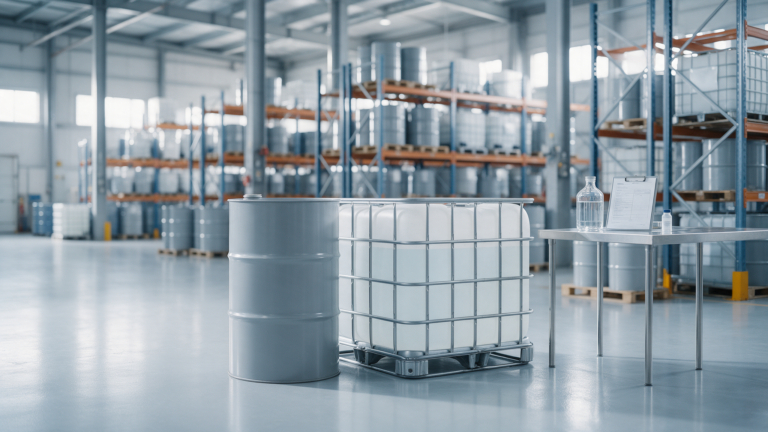
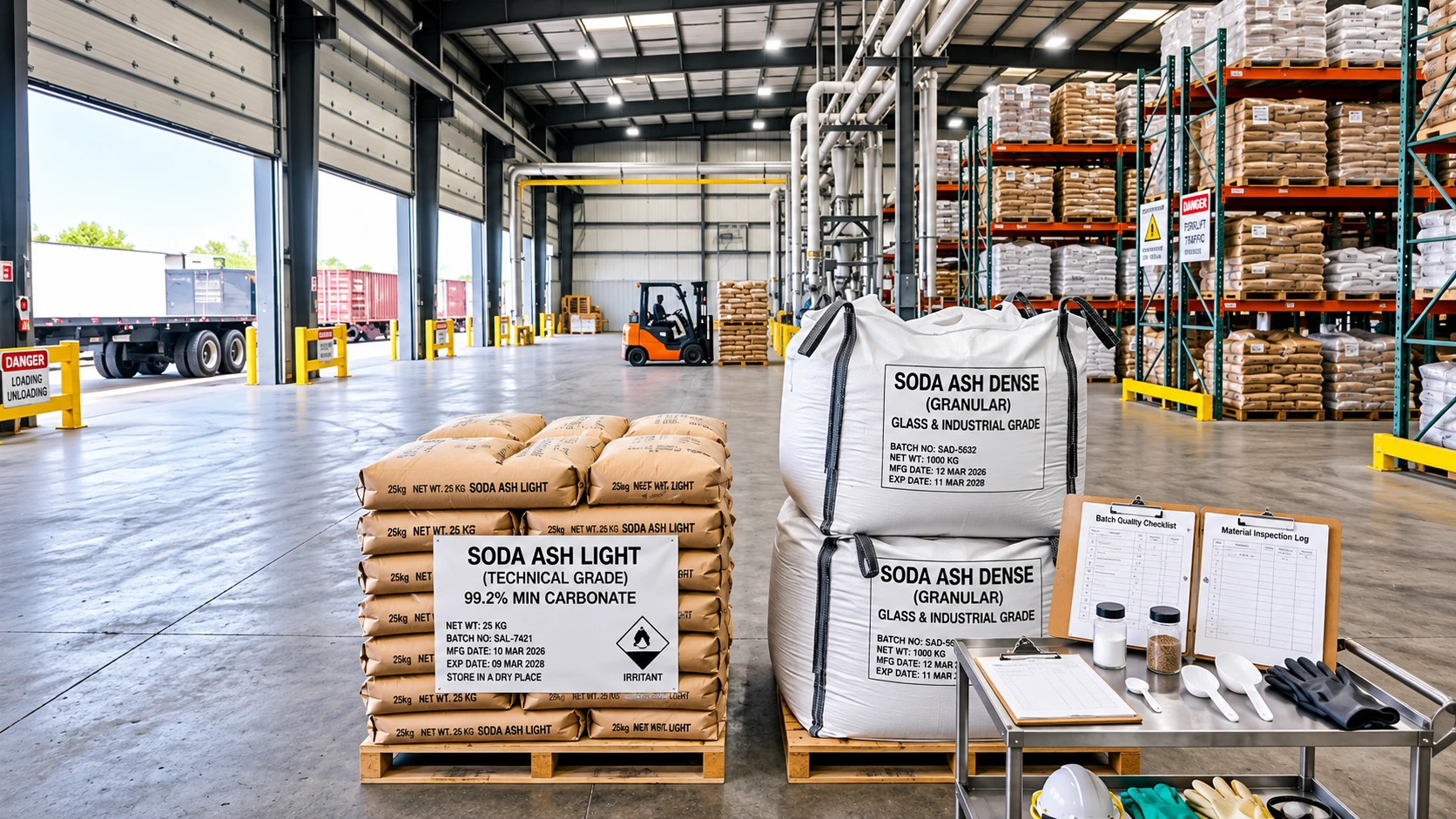
Bulk soda ash has no standard tonnage. Suppliers use the word for anything from one pallet to a full load. A listing of sodium carbonate bulk supply tells you little until it names the pack.
The table shows pack formats that suppliers publish today. Treat them as examples, because availability and minimum order depend on the supplier and the grade.
| Format | Where it is listed | Check before ordering |
| 25 kg and 50 kg bags | Elchemy sodium carbonate listing | Pallet size and bag material |
| 50 lb bags, 54 per pallet | US distributor listing | Pallet count and unit weight |
| 2,000 lb supersacks | US distributor listing | Lifting points and discharge spout |
| Pallets up to 2,700 lb | US distributor listing | Pallet footprint and stacking limits |
| Bulk shipments | Elchemy sodium carbonate listing | Loading method and receiving equipment |
Your receiving site decides the right format. A plant with a silo needs a different delivery from a workshop that doses by hand. Match the pack to your handling equipment before you compare price.
Natural and synthetic soda ash: why origin matters
Soda ash comes from two routes. Natural soda ash is refined from trona ore or sodium carbonate brines. Synthetic soda ash is made from salt and limestone.
USGS estimates 2025 world production at 71 million tons. Natural soda ash made 19 million tons and synthetic made 52 million. China, the United States and Turkey make about 80% of the total.
The US plants USGS lists are five in Wyoming and one in California. Wyoming holds the world’s largest trona deposit. USGS also calls synthetic production costlier, with environmental wastes.
For a buyer, origin is a question to ask, not a quality ranking. One distributor SDS lists different light-grade bulk densities for natural and synthetic product. Ask which process made the material, because origin can change the physical form you receive.
Dense soda ash vs light soda ash
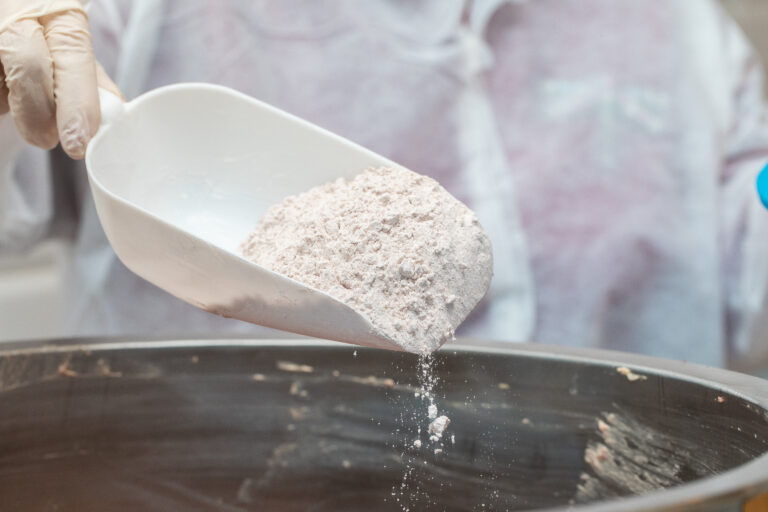
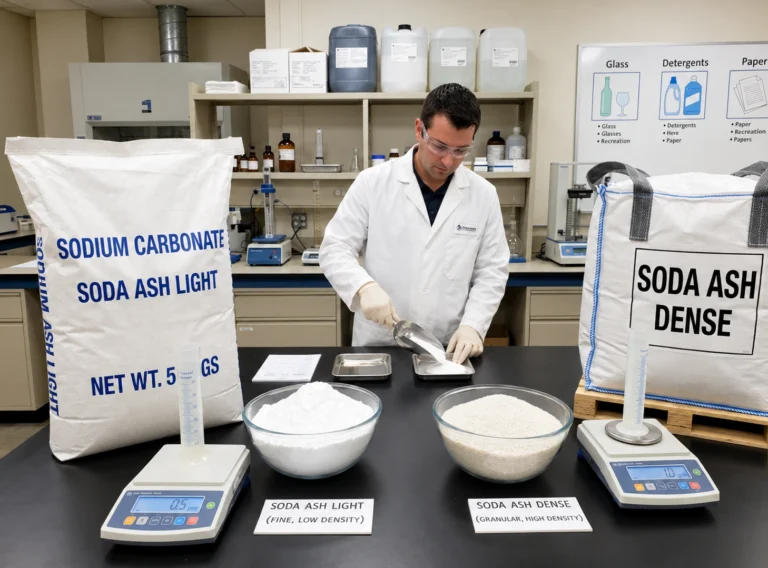
The two grades share the same chemistry. They differ in bulk density and granule structure. Dense is free-flowing, while light is porous, fine and often dusty, as the Solvay patent in the table describes.
Published density figures disagree, especially for light grades. The table shows what each source states, so you can see the spread before you write a specification.
| Source | Dense | Light |
| Solvay patent EP0742175 | about 60 to 65 lb/ft³ | about 35 lb/ft³ |
| Patent US 7507388 | 0.90 to 1.3 g/cm³ | 0.45 to 0.65 g/cm³ |
| Distributor SDS (unit not stated) | 0.9 to 1.1 | 0.7 to 0.9 natural, 0.5 to 0.7 synthetic |
| Elchemy light vs dense guide | 60 to 70 lb/ft³ | 44 to 54 lb/ft³ |
| Elchemy SAD and SAL product pages | 975 to 1,100 g/L | 600 to 700 g/L |
Most dense values sit near 0.9 to 1.1 g/cm³. Light values run from about 0.45 to 0.9 g/cm³, depending on source and process. Use the value on the supplier’s COA, not a generic range.
How to choose between the two
Neither grade is a quality ranking, because both can meet the same assay. The right choice depends on how your process handles powder.
- Choose dense if you batch glass or feed material through hoppers and conveyors that need free flow. Elchemy’s soda ash page states that glass plants need dense soda ash.
- Choose the light grade if your process favours a fine powder and you can control dust. Some detergent and textile users are believed to prefer it.
- Choose either if your process specification sets a density range and the supplier meets it on the COA.
Soda ash uses and the grade each one needs
Glass is the largest single use of soda ash. USGS puts glass at 45% of US end use in 2025, followed by chemicals at 28%. The table gives the full split, which shows how your application compares with the wider market.
| End use | Share of US use, 2025 |
| Glass | 45% |
| Chemicals | 28% |
| Miscellaneous | 9% |
| Distributors | 7% |
| Soap and detergents | 5% |
| Flue gas desulfurization | 4% |
| Pulp and paper | 1% |
| Water treatment | 1% |
Glass batching is the clearest case for a dense grade. For detergents and water treatment, run a lab trial. Dose and dissolution depend on your system.
Food and pharmaceutical use needs more than an industrial label. In the US, 21 CFR 184.1742 lists sodium carbonate as GRAS when it meets the Food Chemicals Codex. Ask for food-grade declarations and have qualified staff review them.
Specifications and documents to request
A quote is only comparable when the specification is. Ask every supplier for the same data on the same basis. This list covers what to request.
- Assay as Na₂CO₃, with a minimum value and the test method, such as ISO 740 for total soluble alkalinity.
- Bulk density, with units and test conditions.
- Particle size or sieve data, especially for dense grades.
- Moisture and loss on heating.
- Origin and process, natural or synthetic.
- Pack format, unit weight and pallet count.
- Documents: a current TDS, an SDS and a batch-specific COA.
Do not read purity from an SDS. One manufacturer’s SDS lists sodium carbonate at above 90% w/w, which says little about the assay you will buy. The COA carries the number that matters.
Safety, handling and storage basics
Soda ash is an eye irritant that needs dust control and dry storage. The Tata Chemicals SDS for its heavy grade lists Eye Irritation Category 2, H319, with the signal word Warning. The same SDS assigns no UN number or packing group.
That SDS advises controlling dust, keeping containers closed and avoiding moisture. Polyethylene is suitable packaging, but keep soda ash away from acids, which release carbon dioxide, and from finely divided aluminium. SDS content varies by supplier, so qualified safety staff should review the one you receive.
Before a first order, Request a Sample and test it against your own specification and the batch COA.
Soda ash price: what a quote should state
Public price data for soda ash is thinner than most buyers expect. USGS estimates 2025 at $150 per metric ton, an average unit value of natural-source sales, FOB mine or plant. That is a mine-gate average, so it does not include delivery to your site.
Use the USGS figure as context, not as a target. Any sodium carbonate price depends on grade, pack format, freight, volume and whether it is FOB or delivered. A soda ash price quoted without a basis cannot be compared, and our price guide covers wider drivers.
| Confirm in every quote | Why it matters |
| Grade and density | Light and dense are different products |
| Basis, FOB or delivered | Freight can reverse the ranking |
| Pack format and weight | Price per ton differs by unit |
| Volume and schedule | Both change the unit price |
| Validity period | Prices can move before you order |
| Documents included | Confirms the TDS, SDS and COA are covered |
To compare a dense grade on these terms, Request a Quote with your grade, pack and destination.
Choosing soda ash distributors and a sodium carbonate supplier
Where to buy bulk soda ash depends on volume, documents and handling. Buyers usually choose between a producer, a distributor and a sourcing partner. Each route suits a different buying pattern.
- Choose a producer if you buy full loads regularly and can manage your own logistics and supplier qualification.
- Choose soda ash distributors if you need smaller lots, mixed grades or local delivery.
- Choose a sourcing partner if you want one contact across several sources and grades.
Whichever route you pick, qualify the sodium carbonate supplier on documents, not on a website claim. Our supplier approval checklist lists the checks. The sodium carbonate buying guide includes an RFQ template.
Elchemy supplies sodium carbonate as a distributor. Confirm the producer and origin in any quote you receive, from Elchemy or anyone else.
Common buying mistakes
Most soda ash problems start with an unclear request, not a bad product. These mistakes are easy to avoid once you know them.
- Asking for “soda ash” without naming light or dense.
- Comparing a mine-gate figure with a delivered quote.
- Reading purity from an SDS instead of a COA.
- Mixing g/L and lb/ft³ figures without converting.
- Changing grade without a lab or plant trial.
FAQs
1. What counts as a bulk order of soda ash?
There is no fixed threshold. Suppliers use bulk for anything from a pallet of 50 lb bags to supersacks and full loads. State your monthly volume and pack format, then ask each supplier whether that qualifies for its bulk terms.
2. Can I swap the light grade for dense in an existing process?
Not without testing first. The chemistry is the same, but density, flow and dust differ, so feeders, hoppers and dosing rates may need adjustment. Run a lab or plant trial against your current specification before you change the approved grade.
3. What does industrial grade guarantee?
On its own, very little. Industrial grade is not a single standard, so it does not state assay, density or impurity limits. Ask for the supplier’s specification and a batch COA, and check both against your approved process requirements before you order.
4. How do I compare density figures in g/L and lb/ft³?
Divide g/L by 1,000 to get g/cm³, and multiply lb/ft³ by 0.016 to reach g/cm³. For example, 975 g/L is 0.975 g/cm³, and 60 lb/ft³ is about 0.96 g/cm³. Always confirm the units printed on the COA, because published figures use both.
5. How should soda ash be stored?
Keep it in tightly closed, dry containers away from heat. One manufacturer SDS lists polyethylene as suitable packaging and advises avoiding moisture. Store it apart from acids and finely divided aluminium, because details vary by supplier, and check the SDS you receive.
6. Is soda ash regulated for transport?
One manufacturer SDS lists it as not classified under UN transport rules, with no UN number or packing group assigned. Classification can differ by product form and region. Check the SDS and shipping documents for your lane, and ask qualified staff to confirm.
7. Is soda ash the same as baking soda or washing soda?
Soda ash is sodium carbonate, Na₂CO₃, which is a different chemical from baking soda, or sodium bicarbonate, NaHCO₃. Washing soda is a household name often used for sodium carbonate, though grade and form can differ. Confirm grade, form and documents before treating any household product as an industrial equivalent.
8. Can I request a sample before ordering a full load?
You can ask for one, but availability depends on the grade, quantity and destination. State all three in your request so the supplier can respond with a clear answer. Test the sample against your specification and compare it with the batch COA before approving a larger order.
Conclusion
Buying bulk soda ash well starts with defining the product. Fix the grade, origin, pack format and documents first, then compare quotes on one basis. That turns a price list into a real comparison.
Use the specification list above and ask for the COA before you commit. Treat published density ranges as a guide only, and use the same checklist for every supplier. Qualified staff should review the SDS for your site.
When your specification is ready, Request a Quote with your grade, pack format and destination.