

At a Glance
- Sodium carbonate is soda ash: Sodium carbonate, Na₂CO₃, is an alkaline inorganic compound used across glass, detergents, water treatment, and chemical processing.
- Form and grade answer different questions: Dense and light soda ash describe physical form, while industrial, food, and other regulated grades describe specification and intended-use requirements.
- The right material starts with the use case: Buyers should define the process, handling conditions, and required documentation before choosing a form or grade.
- It is not baking soda: Sodium carbonate and sodium bicarbonate are related but different compounds with different properties and typical uses.
- Product claims need verification: A supplier’s current TDS, SDS, COA, and applicable declarations should govern any application-specific approval.
What you’ll learn
This guide explains how sodium carbonate’s identity, alkaline behaviour, physical form, and grade requirements affect industrial use and sourcing decisions.
Introduction
Sodium carbonate is one of those industrial chemicals that appears simple until a buyer needs to specify it correctly. It is widely known as soda ash and sometimes called washing soda, but the name alone does not establish the right form, grade, documentation, or suitability for a given process.
For industrial teams, the useful question is not only “what is sodium carbonate?” It is also whether dense or light soda ash is appropriate, what the process requires from the material, and what evidence is needed before approval. The soda ash product details provide a product-level path for readers who are ready to assess a defined requirement.
This article explains the material from an industrial perspective, then gives buyers a practical framework for narrowing down the right questions before sourcing.
What is sodium carbonate?
Sodium carbonate is an inorganic alkaline compound with the formula Na₂CO₃, commonly known as soda ash. It is used as a process chemical and raw material in several industrial value chains, particularly where an alkaline contribution, mineral interaction, or fluxing function is required.
The term “soda ash” usually refers to sodium carbonate used in industrial settings. “Washing soda” is another common name, but a common name should never replace a product specification, current technical data sheet, or supplier documentation. PubChem’s sodium carbonate record is a useful starting point for confirming chemical identity and synonyms.
| Term | Meaning | What the buyer should confirm |
| Sodium carbonate | The chemical compound Na₂CO₃ | Formula, CAS number, form, and approved specification |
| Soda ash | Common industrial name for sodium carbonate | Whether the requirement is dense, light, or another defined form |
| Washing soda | Common name often associated with cleaning use | Exact composition and suitability for the intended process |
| Sodium bicarbonate | A related but different chemical, NaHCO₃ | That it is not being substituted for sodium carbonate |
The anhydrous form of sodium carbonate is commonly identified by CAS 497-19-8. Product documentation may also identify hydrated forms, including sodium carbonate monohydrate and decahydrate, so buyers should confirm the exact substance being offered rather than relying on a broad product label.
Which properties make sodium carbonate useful?
Sodium carbonate is valuable in industry because it is alkaline, water-soluble, and capable of supporting processes that need pH adjustment, water conditioning, chemical conversion, or fluxing action. Those broad properties explain why soda ash appears in diverse applications, but they do not by themselves prove suitability for a particular formulation or process.
A buyer should distinguish general chemical properties from product-specific requirements. The material’s particle profile, density, moisture, handling characteristics, and impurity limits may all influence process fit, so the current TDS and COA should guide technical approval.
Physical properties
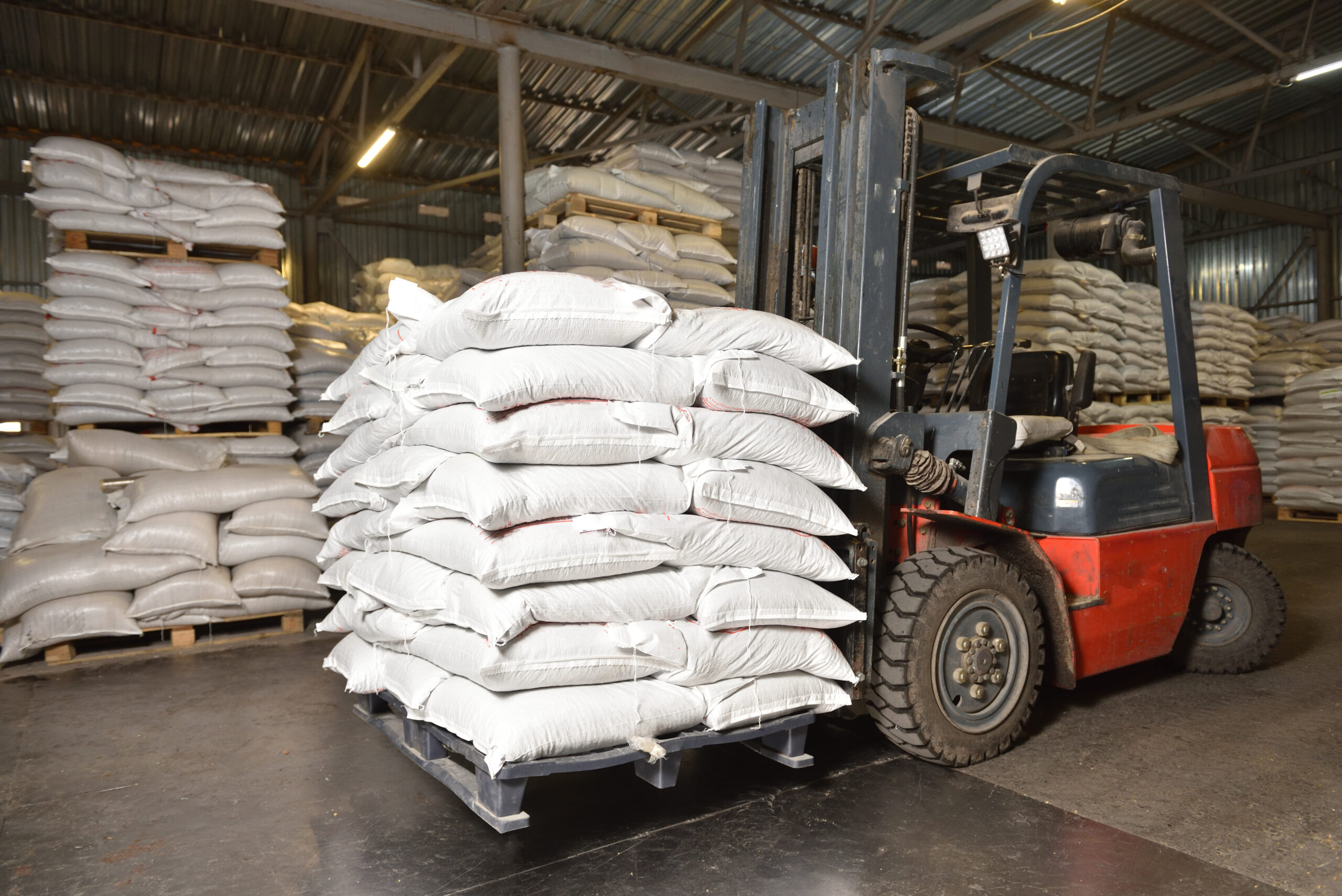
Sodium carbonate is generally supplied as a white solid, but its physical form can affect how it moves through storage, conveying, batching, and mixing systems. The practical issue is not simply whether a material is called soda ash. It is whether its product-specific physical profile fits the equipment and process already in place.
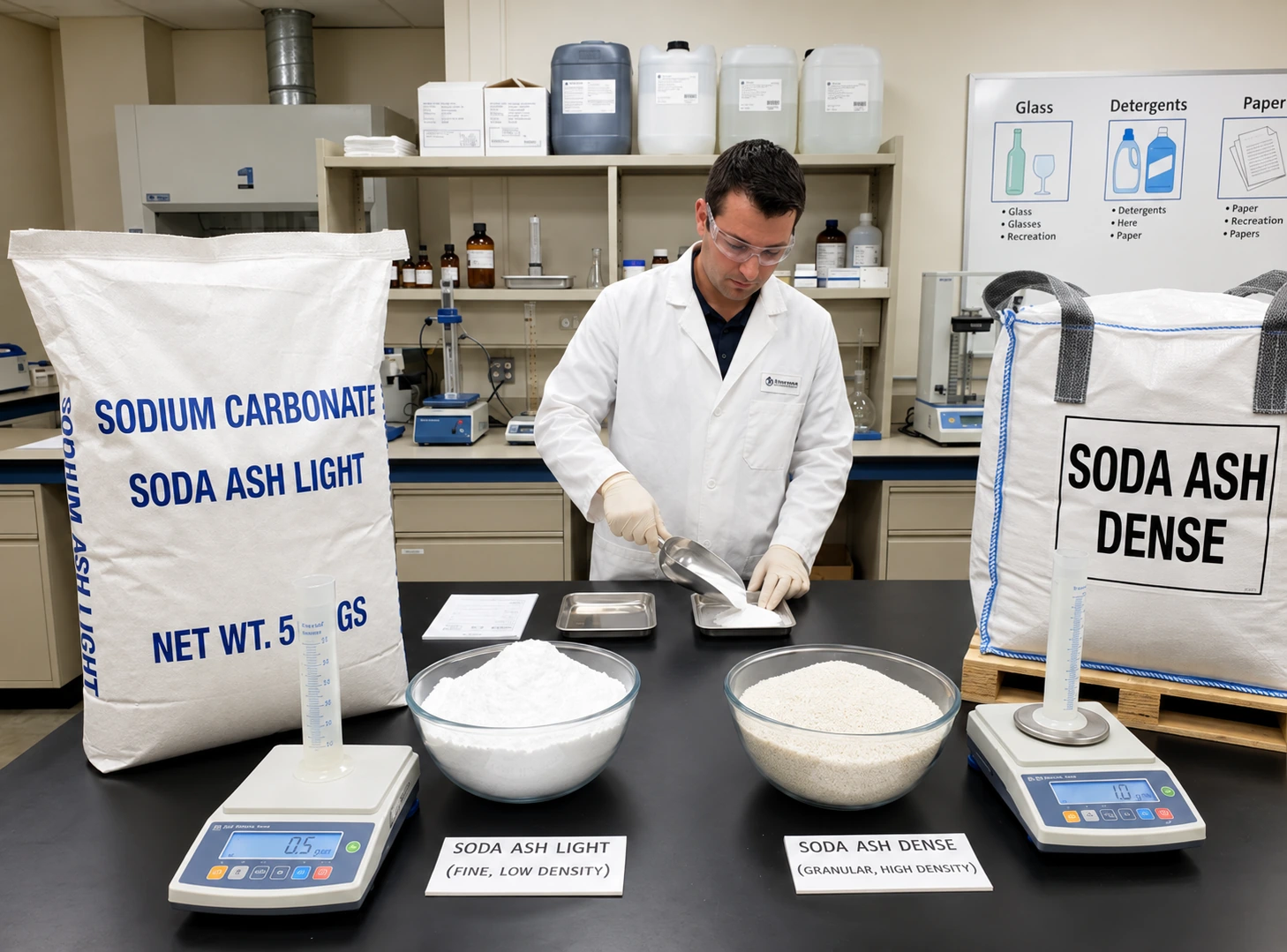
Dense and light soda ash can differ in bulk-density and handling profile. This matters in processes that depend on consistent flow, bulk-volume control, dust-management measures, or defined batching conditions. Buyers should review the proposed material’s TDS rather than infer physical performance from the name alone.
Chemical properties
When dissolved in water, sodium carbonate produces an alkaline solution. That alkaline behaviour supports its role in applications such as cleaning formulations, water treatment, and chemical processing.
The same property also means that compatibility, storage, and handling decisions should be made through the relevant site process and the SDS for the specific product. NOAA CAMEO Chemicals can support initial chemical-safety research, but it does not replace a supplier’s current SDS or a site-specific EHS assessment.
How is sodium carbonate used in industry?
Sodium carbonate is used where an industrial process needs an alkaline raw material, a fluxing contribution, water-conditioning support, or a chemical intermediate. The function matters more than the industry label because the same chemical may have different acceptance criteria across applications.
The following examples explain common industrial roles. They should be treated as application contexts, not as automatic approval for any grade, form, or product. The buyer must validate suitability against the relevant process specification and supplier documentation.
| Industry context | Functional role | Question for the buyer |
| Glass and ceramics | Can contribute a fluxing function in mineral-based batches | Does the process require a specific form, particle profile, or impurity limit? |
| Detergents and cleaning | Can provide alkaline and water-conditioning support | Does the formulation require a defined grade and particle behaviour? |
| Chemical processing | Can serve as an alkaline reactant or intermediate | What specification and documentation govern the process? |
| Water treatment | Can support water-conditioning or pH-management processes | What site-specific treatment objective and approval standard apply? |
| Pulp, paper, and textiles | Can support selected process chemistry needs | What limits, form, and handling requirements are required? |
Glass and ceramics
In glass and ceramics, sodium carbonate can contribute to a batch’s fluxing function. The exact material selection should reflect the production process, batch recipe, furnace operation, and approved quality criteria.
Dense soda ash is commonly associated with applications that benefit from stable bulk handling in a production environment. That does not make it an automatic choice for every glass or ceramics operation. The receiving plant should confirm the physical form and quality parameters it requires before sourcing.
Detergents and industrial cleaning
In detergents and industrial cleaning, sodium carbonate can provide an alkaline contribution and support water-conditioning functions. The appropriate material depends on the formulation, manufacturing route, dosing method, and finished-product requirements.
Readers exploring cleaning-related applications can review the home care industry context. A product must still be technically approved for the specific formula and operating conditions before it is introduced into production.
Water treatment and chemical processing
In water-treatment and chemical-processing settings, sodium carbonate can be considered where an alkaline material is relevant to the process. These applications are often controlled by site-specific process targets, water chemistry, regulatory requirements, and approved operating procedures.
The water treatment industry context offers a useful sector pathway, but it is not a substitute for process-engineering or technical approval. Buyers should document the intended role, required form, and acceptance criteria before asking suppliers to quote.
What is the difference between dense and light soda ash?
Dense and light soda ash are both forms of sodium carbonate, but their physical characteristics can make one more practical than the other for a particular handling or batching process. The distinction is about physical form and operational fit, not a universal difference in chemical identity.
A buyer should avoid treating dense versus light as a simple quality ranking. The right form depends on storage, conveying, dust control, feed system design, batch consistency, and the requirements of the end-use process.
| Selection factor | Dense soda ash | Light soda ash | Buyer review question |
| Physical handling profile | More compact bulk form | Lower-bulk-density form | Which form best fits existing handling equipment? |
| Storage and conveying | May suit systems designed for denser bulk material | May require different volume and dust-control considerations | Can the site store and convey the offered material reliably? |
| Batch-process compatibility | Can support processes requiring consistent compact bulk handling | Can suit processes where a lighter physical form is appropriate | What form is named in the approved process specification? |
| Evidence required | Product TDS, COA, SDS, and application approval | Product TDS, COA, SDS, and application approval | Has the exact proposed form been reviewed by technical stakeholders? |
The decision should be based on the site’s approved process requirements. Ask suppliers to identify the exact form, provide the corresponding technical documentation, and state the proposed packaging. This prevents a common error: approving “soda ash” in principle while receiving a form that does not fit the actual handling system.
What sodium carbonate grades are available?
Grade is a specification and compliance question, not simply a statement of chemical name or purity. A buyer should first determine whether the application is industrial, regulated, or governed by a customer-specific standard, then request the documents that prove the proposed material meets that requirement.
The same chemical name can appear across several market segments. That does not mean one material is interchangeable with another. Documentation, traceability, applicable standards, and acceptance criteria may differ significantly by use case.
Industrial grade sodium carbonate
Industrial-grade sodium carbonate should be evaluated against the buyer’s approved process specification and required documentation. It may be relevant to applications such as glass, cleaning, water treatment, and chemical processing, but suitability depends on the process rather than the term “industrial grade” alone.
Before approval, request the current TDS, SDS, COA, packaging details, and any process-specific declarations. The buyer should compare these documents with internal requirements for chemical identity, form, quality parameters, handling, and delivery.
Food, pharmaceutical, and other regulated grades
Food, pharmaceutical, and other regulated uses require the applicable standard and product-specific evidence from the supplier. A generic claim of high purity is not enough to establish that a material meets the requirements of a regulated application.
For these uses, buyers should confirm the exact applicable standard, required declarations, traceability expectations, and approval process before evaluating an offer. Do not assume that industrial-grade soda ash, or a product marketed for another regulated market, is suitable for the intended use.
How does sodium carbonate differ from sodium bicarbonate?
Sodium carbonate and sodium bicarbonate are related sodium salts, but they have different formulas, alkaline behaviour, and typical industrial roles. Sodium carbonate is Na₂CO₃, while sodium bicarbonate is NaHCO₃.
The two materials should not be substituted simply because both are sodium-based alkaline compounds. Their performance, reaction behaviour, product specifications, and common applications differ, so the intended process must determine which material is required.
| Question | Sodium carbonate | Sodium bicarbonate |
| Chemical identity | Na₂CO₃ | NaHCO₃ |
| Common name | Soda ash or washing soda | Baking soda or sodium hydrogen carbonate |
| General alkaline character | More strongly alkaline in solution | Milder alkaline material |
| Typical industrial role | Process chemical, fluxing, water-conditioning, and cleaning contexts | Buffering, leavening, pH control, and carbon-dioxide-source contexts |
| Buyer requirement | Confirm form, grade, and process fit | Confirm form, grade, and process fit |
For product-specific information about the related material, see sodium bicarbonate product information. The correct choice should always come from the approved formula or process requirement, not from a similarity of names.
How should buyers select a sodium carbonate form or grade?
Buyers should begin with the process requirement, then validate the grade, physical form, documentation, and delivery conditions against it. This sequence avoids the mistake of requesting a broad “soda ash” quote before deciding what technical evidence the supplier must provide.
A written requirement also makes commercial comparison more useful. Suppliers can only quote consistently when the buyer gives the same application, form, quantity, packaging, delivery location, and documentation requirements to each prospective source.
- Define the material. State sodium carbonate, Na₂CO₃, the required form, and the intended process.
- Identify the applicable specification. Include internal limits, customer requirements, or regulated-use standards where relevant.
- Confirm handling constraints. Describe storage, conveying, batching, dust-control, and package requirements.
- Request documentation. Ask for the current TDS, SDS, COA, and required declarations.
- Compare proposals consistently. Align the specification, form, package, quantity, destination, and commercial terms.
- Complete technical approval. Release the order only after the relevant technical, quality, and EHS reviewers approve the proposed product.
Teams moving from material understanding to sourcing can explore industrial chemical supply options. A future purchasing resource can also be linked here: <u>industrial soda ash buying guide</u> [Where to Buy Soda Ash: B2B Procurement Guide].
Common mistakes when specifying sodium carbonate
The most common sodium carbonate sourcing mistakes happen when a buyer treats the material name as a complete specification. A correct purchase decision requires the chemical identity, form, grade, document set, and intended use to align.
Avoid these mistakes:
- Confusing sodium carbonate with sodium bicarbonate, borax, or caustic soda.
- Selecting dense or light soda ash without considering process handling requirements.
- Assuming an industrial grade is suitable for food, pharmaceutical, or other regulated uses.
- Comparing price before aligning package format, quantity, destination, and documentation.
- Using a generic or old COA instead of reviewing current evidence for the proposed product.
- Assuming a product page confirms every grade, form, or application-specific approval.
For broader supplier research, the bulk soda ash supplier guide can help readers understand the market. It should be used alongside, not instead of, the buyer’s own technical qualification process.
FAQs
1. Is sodium carbonate the same as soda ash?
Yes. Soda ash is a common industrial name for sodium carbonate, Na₂CO₃. However, a purchasing requirement should go beyond the common name by defining the required form, grade, specification, package, and documents. Those details determine whether the proposed material is appropriate for a particular process.
2. Is sodium carbonate the same as baking soda?
No. Sodium carbonate is different from baking soda, which is sodium bicarbonate. They have different chemical formulas, alkaline behaviour, and common uses. A buyer should never substitute one for the other without a technically approved process specification, because similar names do not mean the materials perform the same function.
3. What are the main uses of sodium carbonate?
Sodium carbonate is used in industrial contexts including glass and ceramics, detergents and cleaning, chemical processing, water treatment, pulp, paper, and textiles. Its exact role varies by process. Buyers should confirm the required form, grade, and technical acceptance criteria before approving sodium carbonate for any specific use.
4. What is the difference between dense and light soda ash?
Dense and light soda ash are physical forms of sodium carbonate. They can differ in bulk-density and handling profile, which may affect storage, conveying, batching, and dust-control needs. The correct form depends on the site’s process and equipment, so buyers should review the TDS and internal requirements before selection.
5. What is industrial-grade sodium carbonate?
Industrial-grade sodium carbonate is material intended for industrial processes and evaluated against the relevant process specification. The term alone does not establish universal suitability, purity, or regulatory status. Buyers should request a current TDS, SDS, COA, and any required declarations to confirm the proposed material fits their intended application.
6. Can sodium carbonate be used in food or pharmaceutical applications?
It may be used in certain regulated applications only when the specific product meets the applicable standard and the supplier can provide the required evidence. Buyers should not infer suitability from an industrial-grade product or broad purity claim. Confirm the governing standard, documentation, traceability, and internal approval process first.
7. What information should I include in a sodium carbonate RFQ?
Include chemical identity, intended application, required form, approved specification, quantity, package preference, delivery destination, and required documentation. If the use is regulated or customer-controlled, state the relevant standard or declaration requirement. This gives suppliers a clear basis for responding with technically and commercially comparable offers.
8. What documents should a soda ash supplier provide?
The required documents depend on the use case, but buyers commonly request a current TDS, SDS, COA, packaging information, and relevant origin or compliance declarations. For regulated applications, additional documentation may be required. The buyer’s technical, quality, and EHS teams should review the documents before commercial approval.
Choosing sodium carbonate with confidence
Sodium carbonate is a versatile industrial material, but successful selection starts with more than its common name. The right choice depends on confirmed chemical identity, form, grade, documentation, handling conditions, and the actual process requirement.
Begin with a clear specification, then use current product documents to evaluate the proposed material. When a defined soda ash requirement is ready for product-level review, visit the soda ash product details.