

At a Glance
- Best buying route: Source commercial volumes from a qualified producer, distributor, stockist, or sourcing partner that can document the offered material, lot, origin, packaging, and delivery basis.
- Specify before comparing: “Sodium carbonate” or “soda ash” is not a complete RFQ. Define the form, grade, critical test limits, quantity, packaging, destination, documentation, and delivery window.
- Light versus dense: Select the physical form around application and handling requirements, then verify bulk density, particle characteristics, moisture, assay, and impurities against the supplier’s current specification.
- Compare delivered offers: Normalize freight, duties, packaging, payment terms, quote validity, lead time, and qualification costs instead of comparing headline prices alone.
- Verify every claim: Food, drinking-water, reagent, or other regulated-use suitability requires current evidence for the specific product and production facility.
- Next step: Qualify the offered source and commercial lot under your quality process before awarding repeat business.
What you’ll learn
You’ll learn how to choose a sodium carbonate supply route, distinguish common forms and grades, prepare an RFQ, compare delivered quotes, verify documents, and qualify a supplier for repeat B2B purchasing.
Introduction
Buying sodium carbonate for an industrial process is not the same as finding washing soda or a laboratory bottle online. A commercial buyer must establish that the material fits the process, quality system, destination market, and delivery plan before comparing prices.
Sodium carbonate and soda ash are often names for the same chemical, while listings differ in form, grade, specification, packaging, origin, and documentation. The same product name does not establish equivalence.
This guide is for procurement, technical, quality, and EHS teams sourcing commercial quantities in the United States or North America. It explains where to buy sodium carbonate, how to structure an RFQ, and how to compare qualified offers without treating a trade name or public price as a complete purchasing decision.
Quick answer: where should a business buy sodium carbonate?
Industrial buyers should purchase sodium carbonate from a producer, distributor, stockist, or sourcing partner that meets the specification, volume, documentation, and delivery conditions. Retail and laboratory channels suit trials, not repeat industrial supply.
The route depends on volume, release frequency, grade, location, inventory policy, and qualification burden. Buyers can review Elchemy’s sodium carbonate product details, while confirming the offered specification and terms for each requirement.
| Buying route | Best fit | What to verify | Main trade-off |
| Producer or direct contract | Stable, high-volume demand | Plant, capacity, specification, allocation, and contract terms | May require larger commitments |
| Distributor or stockist | Regional supply and flexible releases | Actual inventory, replenishment source, lot control, and delivery reach | Added distribution cost |
| Importer or sourcing partner | Alternate origins or cross-border supply | Producer, origin, importer scope, Incoterm, transit plan, and change control | Longer and more complex logistics |
| Laboratory or retail seller | Small trials or analytical quantities | Grade, lot documents, package integrity, and scale-up source | High unit cost and weak scale equivalence |
A distributor can be preferable when local inventory or smaller releases reduce operating risk. See bulk chemical distributors in America for regional context and the global chemical distributor landscape for cross-border models.
Confirm what “sodium carbonate” means in the offer
Sodium carbonate is the disodium salt of carbonic acid, with the formula Na₂CO₃ and CAS 497-19-8; soda ash is a common trade name for it. The PubChem sodium carbonate record also lists synonyms such as disodium carbonate, washing soda, and anhydrous sodium carbonate.
The trade name alone does not define the material. Confirm whether the offer is anhydrous or hydrated, light or dense, and technical, food, reagent, or another application-specific grade. The sodium carbonate properties and grades [What Is Sodium Carbonate? Properties, Uses and Grades] explainer can carry the deeper chemistry once published.
Do not confuse sodium carbonate with sodium bicarbonate, sodium percarbonate, sodium hydroxide, or borax. Reject any substitution without formal technical approval.
Light soda ash versus dense soda ash
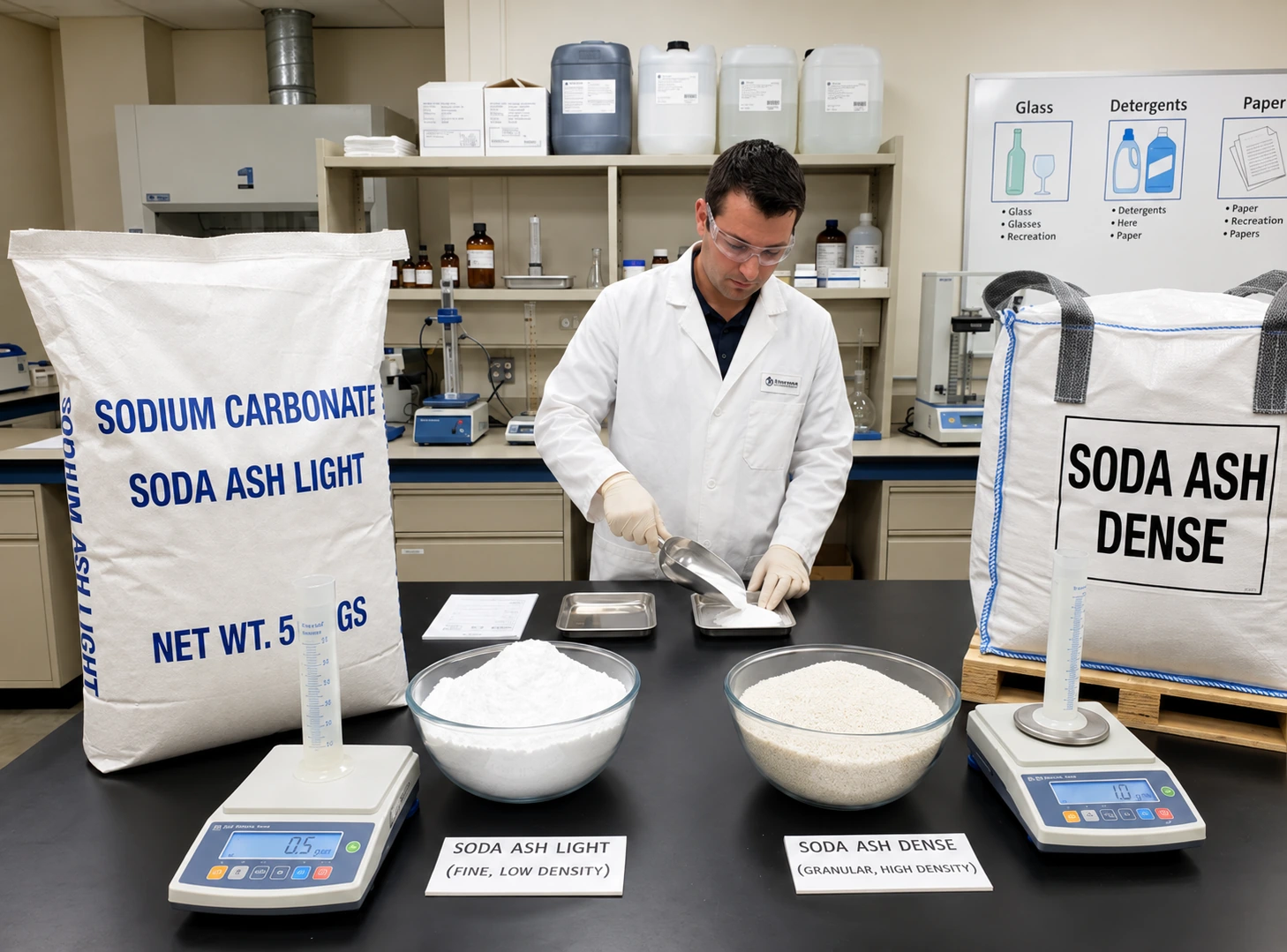
Light and dense soda ash have the same chemical identity but different physical characteristics, especially bulk density and particle behavior. Choice depends on the process, dissolution, conveying, storage, dust controls, and qualification history.
Bulk density is the mass of loose material per unit of occupied volume, not chemical purity. Dense material may reduce storage volume, while light material may suit different handling or dissolution needs. Neither is universally better.
| Decision criterion | Light soda ash | Dense soda ash | Buyer verification |
| Bulk density | Typically lower | Typically higher | Current TDS and agreed test method |
| Particle behavior | Supplier-specific | Supplier-specific | Particle-size data and plant trial |
| Dust and conveying | Process-dependent | Process-dependent | Receiving and handling assessment |
| Dissolution | Application-dependent | Application-dependent | Formulation or process validation |
| Storage volume | May require more volume | May require less volume | Site capacity and consumption rate |
| Freight and packaging | Quote-specific | Quote-specific | Delivered commercial comparison |
Do not treat “light” or “dense” as a full specification. Compare the technical data sheet, or TDS, and certificate of analysis, or CoA, for assay, moisture, bulk density, particles, critical impurities, and test methods.
Choose the grade around the intended use
The correct grade meets process, customer, and regulatory requirements without unnecessary cost or qualification. “Higher purity” is not a complete rule because grade designations can control different attributes, documents, and permitted uses.
Technical grades may suit general manufacturing when the agreed specification covers critical parameters. Food, reagent, and drinking-water contexts require separate product-specific evidence.
| Intended use | Status to investigate | Questions to resolve |
| Glass manufacture | Approved industrial specification | Which physical and impurity limits affect the batch? |
| Detergent or cleaning formulation | Technical or formulation-specific grade | Which alkalinity, moisture, particle, and impurity limits matter? |
| Water treatment | Product-specific treatment requirements | Is a current listing required for this facility and use? |
| Food processing | Applicable food-use requirements | Which regulation, standard, and intended technical effect apply? |
| Laboratory analysis | Reagent or method-specific grade | Which analytical standard and test method apply? |
The FDA sodium carbonate inventory identifies U.S. food-related technical effects and regulatory references. It does not make every commercial offer food grade; verify the source, documents, and applicable conditions.
For drinking-water applications, confirm whether a current listing such as NSF/ANSI/CAN 60 is required. It must match the trade designation, facility, function, and use conditions. Elchemy’s water treatment chemical applications page gives context, not certification evidence.
Build a specification-ready sodium carbonate RFQ
A useful RFQ converts the application into measurable material, quality, logistics, and commercial requirements. Send the same request to each supplier to establish technical equivalence.
Separate mandatory requirements from preferences. Mandatory parameters need approved limits, units, and test methods; preferences can remain negotiable.
| RFQ field | Buyer should define | Supplier should return |
| Identity and form | Name, CAS, hydration, light/dense | Designation and source |
| Grade | Standard or internal specification | Grade evidence |
| Critical tests | Limits, units, and methods | Guaranteed values |
| Demand | Annual volume and release size | Order constraints |
| Packaging | Package, pallet, labels, lot marking | Available configuration |
| Destination | Delivery point and unloading limits | Basis and accessorials |
| Timing | Required window and forecast | Lead time and validity |
| Documents | TDS, SDS, CoA, certificates | Current revisions |
| Traceability | Producer, site, origin, lot chain | Change process |
| Commercial basis | Incoterm and payment expectations | Price and terms |
Application-critical impurities differ by process. Do not treat a competitor’s specification as an industry standard; the buyer’s technical team should define the limits that affect performance, equipment, customers, or compliance.
Qualify suppliers before comparing price
A supplier should enter commercial comparison only after substantiating identity, specification control, documentation, traceability, logistics, and continuity for the offered source. Company credentials alone do not qualify a product, site, or lot.
Use the chemical supplier approval checklist for the vendor review. Add evidence for the specification, producer/site, representative lot, required status, source-change controls, and delivery model.
Verify technical and quality documents
Request a current TDS, safety data sheet, representative CoA, agreed specification, and required certificates before approval. Each document answers a different question and cannot substitute for the others.
The TDS describes product characteristics, the SDS communicates safety information, and the CoA reports lot results. A certificate or listing addresses a defined standard and scope. See SDS requirements in procurement for document-governance context.
Confirm that methods and units match the purchasing specification and that samples and commercial deliveries come from the approved source or follow agreed change control.
Verify regulatory and application status
Regulatory or certification suitability applies to a specific material, facility, market, and use. Claims such as “food grade,” “NSF,” or “reagent grade” require current evidence matched to the buyer’s requirement.
For imports, define origin, producer, importer responsibilities, customs documents, tariffs, and destination-market obligations. Customs clearance does not prove product suitability.
Verify supply continuity and change control
A repeat program should define source consistency, lot traceability, deviations, disruptions, and material changes. An unannounced source change can force costly requalification.
Require advance notice and approval for producer or facility changes. Qualify any backup source separately rather than assuming equivalence.
Compare quotes on a delivered basis
Compare quotations only after aligning grade, specification, package, quantity, origin, delivery basis, payment terms, and validity. A public bag price or undated “price per ton” does not represent repeat industrial cost.
Include material, freight, fuel, duties, brokerage, packaging, unloading, financing, qualification, and disruption risk. Use one unit of measure and destination across offers.
| Cost or term | Quote A | Quote B | Quote C |
| Grade and approved specification | |||
| Quantity and release basis | |||
| Package and pallet configuration | |||
| Material price | |||
| Freight, fuel, and accessorials | |||
| Duties, tariffs, and brokerage | |||
| Payment terms and quote validity | |||
| Lead time | |||
| Qualification and testing cost | |||
| Total delivered cost |
The USGS soda ash statistics resource distinguishes natural soda ash from synthetic production. This informs origin questions but does not establish a particular offer’s price or suitability.
Match packaging and logistics to the receiving site
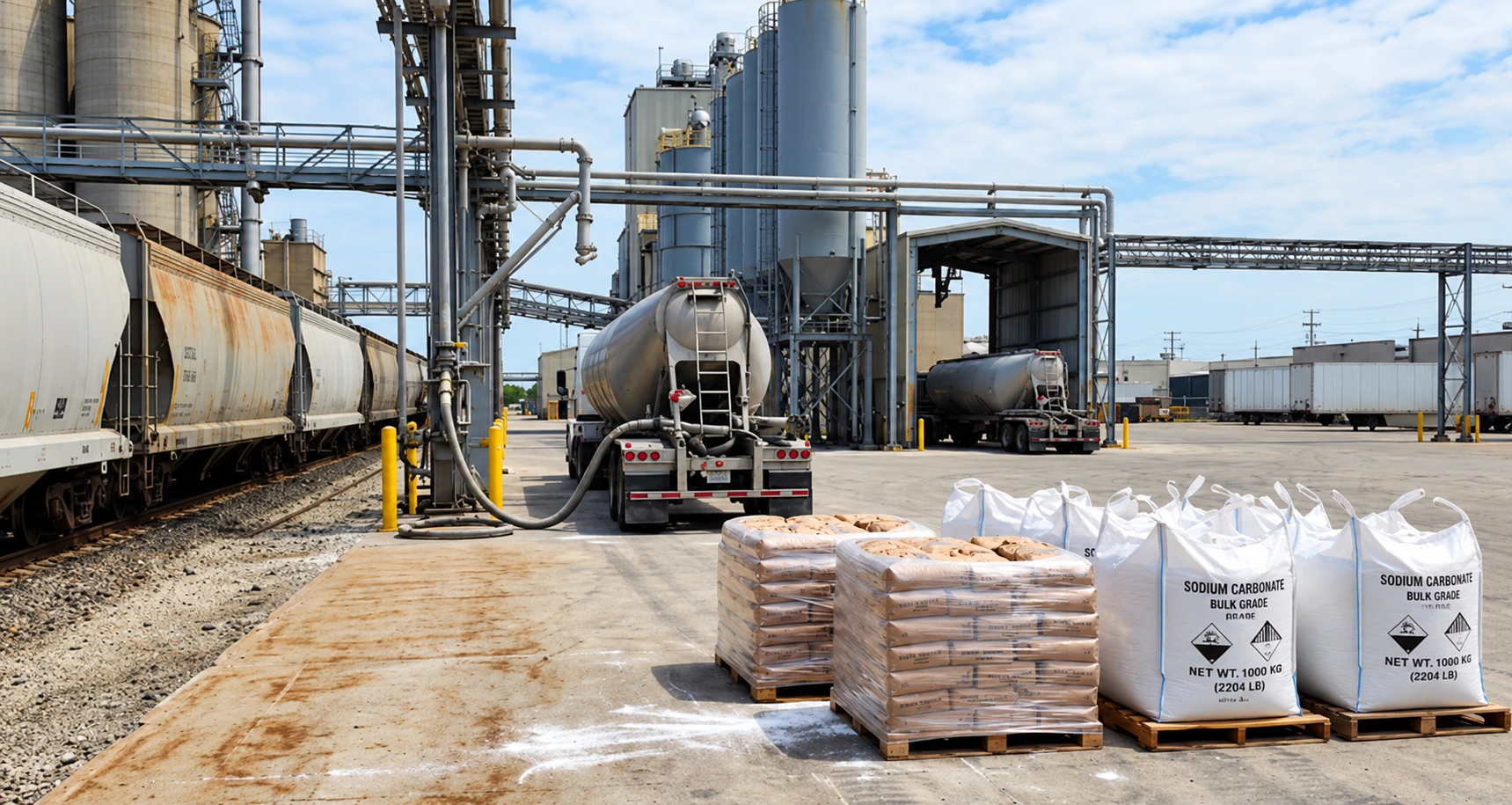
Packaging should match consumption, storage, unloading equipment, contamination controls, dust management, and inventory policy. Confirm available bags, pallets, bulk bags, or larger arrangements for the specific source.
State package material, net weight, pallet requirements, labels, lot identity, and moisture protection in the order. Follow the current SDS and site EHS procedures for storage and handling.
Use the same controlled receiving process for every delivery:
- Match the product, grade, producer or site, and purchase-order specification.
- Verify seals, labels, package condition, lot numbers, and received quantity.
- Match the lot CoA to required results and methods.
- Inspect for transit damage or moisture exposure.
- Quarantine and escalate nonconforming material before use.
Choose the best route for each buying scenario
The best sodium carbonate source changes with volume, application risk, local-stock needs, qualification burden, and contract horizon. Choose the route that controls operational risk while meeting the specification and delivered-cost target.
Apply the same evidence standard to every route. Verify source, specification, documents, package, logistics, change control, and commercial basis before award.
| Buying scenario | Route to evaluate first | Decision evidence |
| Repeat high-volume demand | Producer or contracted distributor | Capacity, forecast, allocation, source control, and contingency plan |
| Regional or variable releases | Qualified distributor or stockist | Physical inventory, replenishment source, lot control, and delivery reach |
| Cross-border diversification | Importer or sourcing partner | Producer, origin, Incoterm, customs scope, transit, and change control |
| Small trial or analytical need | Laboratory or specialty seller | Grade, lot documents, and sample-to-scale equivalence |
Use a nine-step buying checklist
A controlled purchase moves from requirements to qualification, normalized award, and receiving. The sequence aligns technical, quality, procurement, regulatory, EHS, and operations teams.
- Define use and customer or regulatory requirements.
- Set form, grade, limits, units, and test methods.
- Define volume, release size, packaging, destination, and timing.
- Choose buying routes and shortlist suppliers.
- Issue one RFQ and document request.
- Normalize equivalent delivered-cost offers.
- Review documents, origin, and traceability.
- Qualify the sample and commercial source.
- Award with specification, change control, and receiving checks.
Avoid common sourcing mistakes
The most common errors are comparing unlike grades, trusting product names, using public prices as delivered costs, and approving a company without product evidence. These can turn a low-looking quote into a qualification or production failure.
Watch for these rejection signals:
- The quote omits grade, form, specification, package, destination, or delivery basis.
- The seller cannot establish the required producer, facility, origin, or lot chain.
- A grade or certification claim lacks current evidence.
- Results lack methods, units, dates, or a link to the offered lot.
- The sample cannot be tied to the production source.
- The supplier can change sources without notice.
- The price omits freight, duties, accessorials, or qualification.
- Another chemical is proposed as an unapproved substitute.
Frequently asked questions
1. Where can I buy sodium carbonate in bulk?
Buy bulk sodium carbonate from a qualified producer, distributor, regional stockist, importer, or sourcing partner that can meet your grade, volume, packaging, documentation, and delivery requirements. Select the route according to release size, destination, qualification burden, inventory needs, and whether domestic or cross-border supply offers the better risk-adjusted fit.
2. Is sodium carbonate the same as soda ash?
Yes, soda ash is a common trade name for sodium carbonate, especially for anhydrous industrial material. The names do not establish the physical form, grade, purity, particle characteristics, impurities, certification status, or application suitability. Confirm those attributes in the supplier’s current specification and the agreed purchasing documents.
3. What is the difference between light and dense soda ash?
Light and dense soda ash share the same core chemical identity but differ in physical properties, particularly bulk density and particle behavior. Those differences can affect storage volume, conveying, dust, dissolution, packaging, and freight. Choose between them through process requirements, supplier data, and plant qualification, not a universal preference.
4. Is sodium carbonate the same as baking soda?
No. Sodium carbonate and sodium bicarbonate, commonly called baking soda, are different chemicals with different formulas, alkalinity, performance, and specifications. They should not be substituted without technical approval. A buyer should also distinguish sodium carbonate from sodium percarbonate, sodium hydroxide, and borax when reviewing supplier listings.
5. Which grade of sodium carbonate should I buy?
Buy the grade that satisfies your process, customer, and regulatory requirements with supporting product-specific evidence. Technical, food, reagent, and drinking-water contexts can require different specifications or documentation. Define the intended use first, then have technical, quality, and regulatory reviewers approve the offered specification and certificates.
6. What should a sodium carbonate RFQ include?
A sodium carbonate RFQ should state the chemical and physical form, grade, critical tests, limits, methods, volume, release size, packaging, destination, delivery window, and required documents. It should also request producer, facility, origin, traceability, Incoterm, payment terms, quote validity, lead time, and change-notification details.
7. What affects sodium carbonate price per ton?
The delivered price can change with grade, physical form, volume, package, origin, availability, freight, duties, brokerage, payment terms, lead time, and quote timing. Qualification, testing, storage, unloading, and disruption risk can also affect total cost. Compare equivalent offers at one destination and on the same commercial basis.
8. Which documents should a supplier provide?
Request a current TDS, SDS, representative CoA, lot-specific CoA, and agreed purchasing specification. Add product- and facility-specific certifications or regulatory evidence when the application requires them. Check revision dates, test methods, units, producer or site identity, traceability, sample-to-production equivalence, and the supplier’s change-notification process.
Conclusion
The right place to buy sodium carbonate is the source that can meet your validated specification, documentation, volume, delivered-cost, and continuity requirements. Define the form and grade first, issue the same RFQ to suitable routes, normalize the offers, verify the evidence, and qualify the commercial source.
A sodium carbonate or soda ash label and a public unit price are not enough for an industrial award. If you are evaluating supply for a commercial application, get sodium carbonate pricing with your required grade, specification, quantity, packaging, destination, documents, and delivery window.