

At a Glance
- One molecule, three feedstocks: palm, soy, and coconut-derived vegetable glycerin are chemically identical (glycerol). The sourcing choice is about label claims and cost, not performance.
- Palm dominates supply and cost, soy wins on non-GMO positioning, and coconut carries a premium for allergen-conscious and “tropical” claims.
- Grade determines application: USP/food-grade for food, pharma, and skin-contact use; technical grade for industrial applications.
- Certifications are the real differentiator: kosher, halal, vegan, organic, and RSPO (for palm) are what clean-label brands actually screen suppliers on.
- Bulk sourcing hinges on documentation, not just price: COA, SDS, and TDS consistency, plus MOQ flexibility, separate reliable suppliers from one-off sellers.
- The decision that matters most is which certification story your label needs to defend, not which source performs better.
What you’ll learn: the full range of vegetable glycerine uses across skincare, food, and industrial applications, how palm, soy, and coconut sourcing differ, and what to check before placing a bulk order.
Introduction
Vegetable glycerine uses span skincare, soap, food, and pharma, and getting the sourcing wrong is an expensive mistake: a “vegan” claim built on undocumented glycerin, or a “natural” claim assumed to also mean “kosher,” can fail an audit after the product is already on shelves.
Demand keeps climbing. The global vegetable glycerin market was valued at roughly USD 1.58 billion in 2026, with a projected compound annual growth rate of 5.3% through 2036, tracking the broader shift toward plant-based, traceable ingredients.
This guide covers what vegetable glycerin is used for, how palm, soy, and coconut sources compare, which grades and certifications matter, and what to check before you commit to a bulk supplier.
Request a Sample to test a specific grade before you commit to a bulk order.
Vegetable Glycerine Uses: Quick Overview
Before getting into sourcing, here’s the range of applications a single ingredient covers:
- Vegetable glycerin for skin: humectant and emollient in lotion, soap, shampoo, and toothpaste
- Plant based glycerin as a sweetener, solvent, and moisture-retention agent in bakery and confectionery
- Vegetable glycerin food grade material in low-alcohol beverages, syrups, and oral suspensions
- Vegan glycerin for clean-label and cruelty-free formulations
- Bulk vegetable glycerin as an e-liquid base, plasticizer, and industrial humectant
Each use case pulls buyers toward a different grade and certification, which is what the rest of this guide breaks down.
What Is Vegetable Glycerin?
Glycerin (glycerol, CAS 56-81-5, INCI name Glycerin) is a clear, odorless, viscous liquid classified as a humectant: it draws and holds moisture, which is why it shows up in everything from lotion to syrup. “Vegetable” glycerin specifically means the glycerol was derived from plant oils.
which is what separates it from animal-tallow-derived glycerin and matters directly for vegan glycerin claims. Note: “glycerin” (US) and “glycerine” (UK) are the same substance, used interchangeably throughout this guide.
Standard vs Vegetable Glycerin
The molecule is identical across sources. What differs is the feedstock and the label claims it supports, see our full glycerin vs vegetable glycerin comparison. Which is why plant based glycerin commands a different price and certification story than synthetic or animal-tallow glycerin even at identical purity.
| Factor | Standard/Synthetic or Animal Glycerin | Vegetable Glycerin |
| Feedstock | Petrochemical or animal tallow | Palm, soy, or coconut oil |
| Vegan/kosher/halal eligibility | Animal-derived versions excluded | Eligible, with certification |
| Typical buyer | Industrial/commodity formulators | Clean-label, cosmetic, food brands |
| Label claim supported | None, or “glycerin” generic | Vegan, plant-based, sustainable |
How Vegetable Glycerin Is Made
Vegetable glycerin is a byproduct of oleochemical processing: hydrolysis or transesterification of plant oils during soap-making and biodiesel production. The resulting crude glycerin is refined to progressively higher purity, then split into food, pharma, or industrial grade depending on final purity and processing conditions.
Because it’s a byproduct rather than a directly manufactured product, its price tracks the economics of the biodiesel and soap industries that generate it, which is a big part of why bulk pricing moves the way it does.
Global Sourcing: Where Vegetable Glycerin Comes From
Sourcing is distinct from processing. Palm-derived glycerin comes predominantly from Southeast Asia (Malaysia, Indonesia), soy-derived glycerin from the US and South America, and coconut glycerin largely from the Philippines and Indonesia.
Origin matters beyond cost: it determines what traceability documentation is even possible, particularly RSPO mass-balance or segregated-supply claims for palm-based material.
Palm vs Soy vs Coconut: Comparing the Three Sources
| Factor | Palm-Derived | Soy-Derived | Coconut-Derived |
| Global supply share | Largest | Second-largest | Smallest, premium niche |
| Relative cost | Lowest | Mid-range | Highest |
| Allergen profile | Low risk | Soy allergen labeling risk | Low risk, allergen-friendly positioning |
| Key certification buyers ask for | RSPO | Non-GMO | Vegan, “natural” claims |
| Best-fit use case | Cost-sensitive, high-volume formulations | Non-GMO/plant-forward brands | Premium skincare, allergen-conscious lines |
Choose palm when cost and scale matter most, but request RSPO certification as the baseline credential. Choose soy for a non-GMO, plant-forward positioning, while flagging the soy allergen labeling conflict on any product otherwise marketed as allergen-free. Choose coconut when the brand is built on a premium, allergen-conscious, or “tropical” story and the price premium is acceptable.
Coconut Glycerin: What Makes It Different
Coconut glycerin commands a price premium over palm and soy largely because of positioning, not performance: it fits allergen-friendly and “natural”/tropical marketing well, which makes it a common choice for premium skincare lines even though the finished glycerol is functionally the same molecule.
Applications: Vegetable Glycerin Uses by Industry
For a closer look at how formulators apply this ingredient day to day, see our guide on vegetable glycerin uses in food/skincare.
Vegetable Glycerin for Skin and Personal Care
As a humectant and emollient, vegetable glycerin for skin applications spans lotion, soap, shampoo, and toothpaste, either used standalone (diluted, since undiluted glycerin can pull moisture from skin in low-humidity conditions) or as a formulated ingredient at lower concentration. A basic patch test is standard practice before any new topical formulation goes to market.
Soap-Making
Glycerin is both a natural byproduct of soap-making and a prized additive: vegetable glycerin soap base carries extra humectancy compared to standard bar soap, which is why cold-process and melt-and-pour soapmakers add it back in deliberately. Commercial soap manufacturers sourcing at scale are exactly the buyer profile the bulk sourcing section below is written for.
Food Grade Vegetable Glycerin
Vegetable glycerin food grade material carries GRAS status under 21 CFR 182.1320 and functions as a humectant, sweetener, and solvent in bakery, confectionery, and low-alcohol beverage formulations.
Pharmaceutical Use
In pharma, glycerin acts as an excipient and solvent in syrups, oral suspensions, and capsules.
Industrial and Specialty Use
Beyond food and personal care, vegetable glycerin (VG) is the base liquid in e-liquid formulations, a plasticizer, a humectant in tobacco processing, an alcohol-free solvent for herbal tinctures, and an anti-crystallization agent in frozen desserts.
Request a Sample if you’re formulating against a specific grade for any of these applications.
Purity, Grade & Certifications
Grade and Purity Levels
100% pure vegetable glycerin typically means 99.5 to 99.7% purity, but “pure” alone doesn’t tell you which grade you’re buying, or which source fits your formulation. If you’re formulating soap specifically, see our guide on vegetable vs standard glycerin for soap before picking a grade.
| Grade | Typical Purity | Common Use | Certifications Available |
| USP/Pharma | 99.5%+ | Oral suspensions, capsules | USP, kosher, halal |
| Food/FCC | 99.5%+ | Bakery, beverages, confectionery | Kosher, halal, organic |
| Technical/Industrial | 95-99% | E-liquid base, plasticizers | RSPO (where palm-sourced) |
Kosher, Halal, Vegan & Organic Certification
Kosher glycerin and organic glycerine certifications verify different things: feedstock, processing equipment, and confirmation that no animal-derived inputs entered the process at any stage. A vegan claim does not automatically mean the material is also kosher, halal, or organic; buyers should request the specific certificate for the claim they need, not assume one implies the other.
Documentation to Request (COA / SDS / TDS / RSPO Traceability)
A Certificate of Analysis (COA) and Safety Data Sheet (SDS) should be the baseline for any order, with a Technical Data Sheet (TDS) available on request. For palm-sourced material specifically, ask which RSPO supply chain model applies: mass-balance, segregated, or identity-preserved, since each carries a different level of traceability guarantee.
Vegetable Glycerine Uses in Bulk Manufacturing
Buyers placing bulk orders are typically soap manufacturers, cosmetic formulators, food processors, or e-liquid producers, each pulling toward a different grade and packaging format even though the underlying vegetable glycerine uses case is the same molecule at scale.
Sourcing Vegetable Glycerin in Bulk
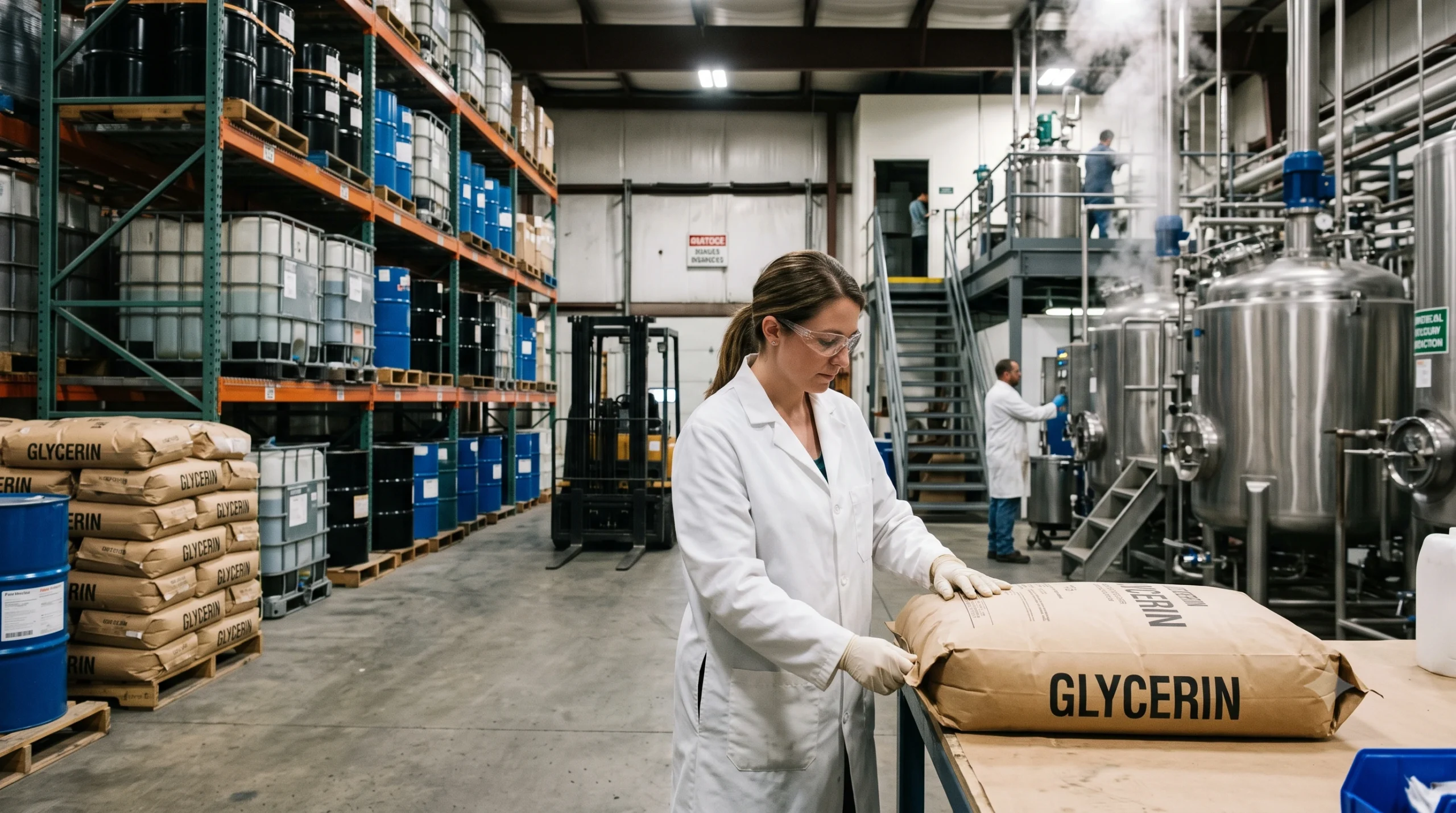
For bulk vegetable glycerin orders, packaging format and MOQ typically scale with order size. For a full breakdown of formats, MOQs, and lead times, see our bulk vegetable glycerin supplier guide. Because pricing is tied to feedstock commodity cycles (palm and soy oil in particular), it’s worth negotiating a price-review clause into any longer-term supply agreement rather than locking in a fixed rate.
| Package Format | Typical Volume | Best For |
| Drum | Smaller trial or repeat orders | Formulators testing a new source |
| Tote | Mid-volume production runs | Established manufacturers |
| Bulk tanker | Large-scale continuous production | High-volume industrial buyers |
Request a Quote to get current pricing across drum, tote, and bulk tanker volumes.
Buyer Checklist: Vetting a Bulk Vegetable Glycerin Supplier
- Confirm feedstock (palm, soy, or coconut) in writing on the COA.
- Match grade to application; don’t overspec or underspec.
- Request the relevant certifications: kosher, halal, vegan, organic, RSPO.
- Ask for the RSPO supply chain model if the material is palm-sourced.
- Review historical COA batch consistency, not just a single sample.
- Confirm packaging and logistics fit your order volume.
- Negotiate price-review terms given feedstock volatility.
Which Source and Grade Should You Buy? (Decision Framework)
Choose palm-sourced, technical or food grade if cost and scale are the priority and RSPO documentation is available. Choose soy-sourced, food or USP grade if a non-GMO claim matters more than lowest cost, and the product isn’t marketed as allergen-free.
Choose coconut-sourced, food or cosmetic grade if the brand story depends on a premium, allergen-conscious positioning and the higher unit cost is acceptable. There’s no universally “best” source: the right one is whichever matches the certification your label actually needs to defend.
Where to Source: Manufacturers & Bulk Suppliers
Elchemy is a vegetable glycerin supplier (bulk, RSPO/Kosher/Halal) across palm, soy, and coconut sources at food, USP, and technical grades, with kosher, halal, vegan, and RSPO documentation available on request for the relevant grade. Request a Quote to get current pricing and lead times for your volume.
FAQs
Is vegetable glycerin the same as glycerine?
Yes. “Glycerin” is the American spelling and “glycerine” the British spelling of the same substance; both are used interchangeably in the industry.
Is vegetable glycerin vegan?
It can be, but a vegan claim isn’t automatic. Vegetable glycerin is plant-derived by definition, but a vegan certification requires verifying that no animal-derived inputs or shared processing equipment were involved, so ask for the specific vegan certificate rather than assuming.
What’s the difference between USP and food-grade glycerin?
USP grade meets pharmacopeial standards for pharmaceutical use, while food-grade (FCC) meets food safety standards; both are typically 99.5%+ pure, but they’re certified against different regulatory frameworks.
Is 100% pure vegetable glycerin safe to apply directly to skin?
Undiluted glycerin can pull moisture from the skin’s surface in low-humidity conditions, so it’s usually diluted for direct topical use; a patch test is recommended before applying any new formulation.
What certifications should I ask for: kosher, halal, organic, RSPO?
Ask for whichever certification your label claim depends on specifically; kosher and halal verify feedstock and processing, organic verifies farming inputs, and RSPO verifies palm supply chain traceability. None of these implies the others.
Why does vegetable glycerin pricing fluctuate?
Because it’s a byproduct of biodiesel and soap production, its price tracks palm and soy oil commodity cycles rather than moving independently.
What’s the minimum order quantity for bulk vegetable glycerin?
MOQs vary by supplier and packaging format, from drums for smaller trial orders up to bulk tanker for continuous high-volume production; confirm current MOQ tiers directly with your supplier.
Conclusion
Choosing between palm, soy, and coconut vegetable glycerin comes down to which certification story your label needs to defend, not which source performs better, since the underlying molecule is the same either way. Talk to Elchemy, a vegetable glycerin supplier (bulk, RSPO/Kosher/Halal), and Request a Quote to get sourcing and certification documentation for your specific application.