 Top Product
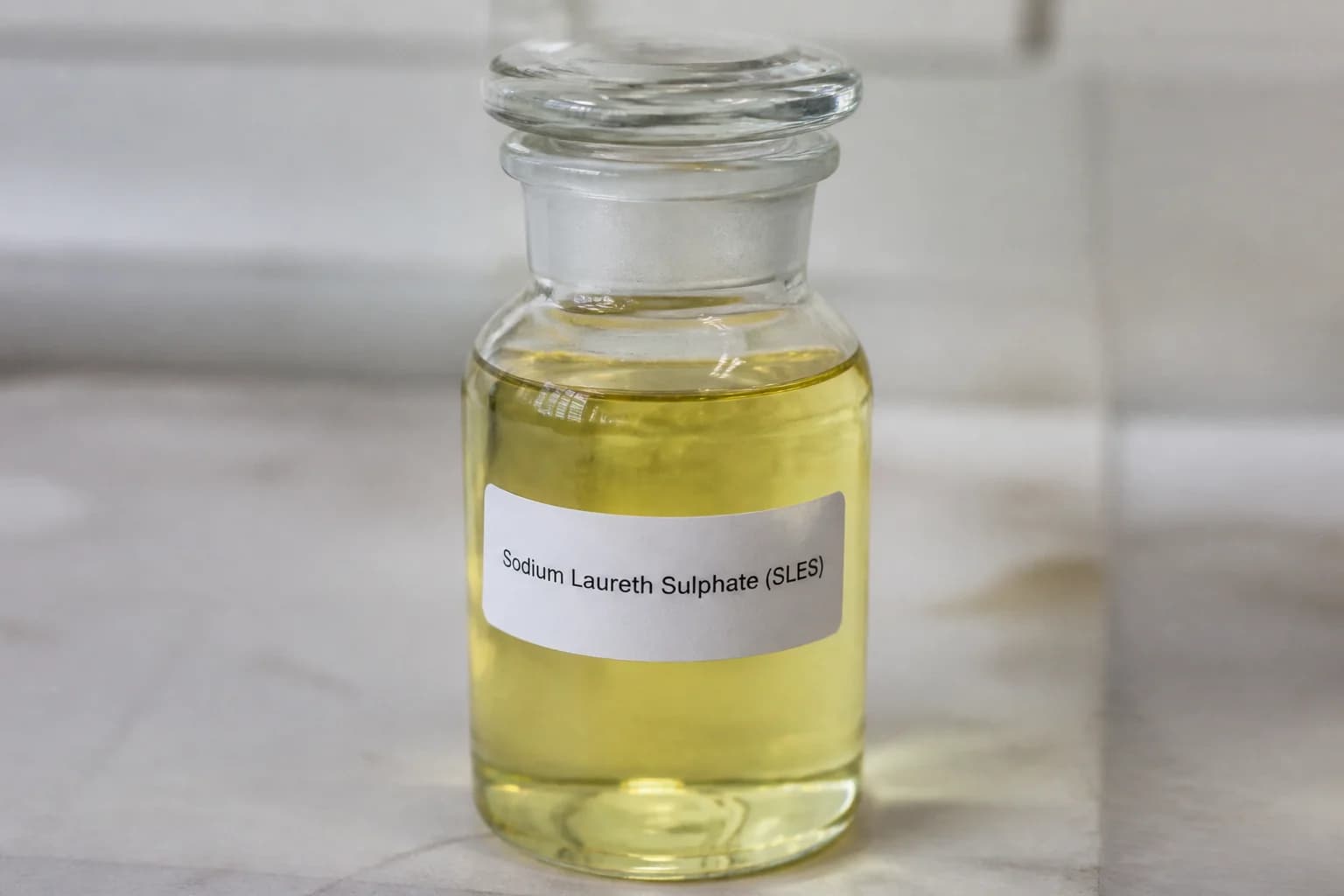
Sodium Laureth Sulphate (SLES)
ELSURFAC™TM – SES70
Get Pricing For This Product
Skip the quote. Sign up now and see pricing instantly
Speed Up Your Sample Testing Process
Express Delivery in 24–48 Hours
Elchemy supplies ELSURFAC™-SES70 Sodium Laureth Sulphate (SLES) in bulk to personal care, home care, and industrial cleaning manufacturers across 40+ countries. SLES is a high-performance anionic…
CAS Number
68891-38-3
HS Code
3402.11.90/3402.39.00
INCI Name
Sodium Laureth Sulfate (SLES)
Molecular Formula
C₁₂H₂₆Na₂O₅S
Top ProductSodium Laureth Sulphate (SLES)
ELSURFAC™TM – SES70
Elchemy supplies ELSURFAC™-SES70 Sodium Laureth Sulphate (SLES) in bulk to personal care, home care, and industrial cleaning manufacturers across 40+ countries. SLES is a high-performance anionic surfactant valued for its strong cleansing and foaming action with reduced…
CAS Number
68891-38-3
INCI Name
Sodium Laureth Sulfate (SLES)
HS Code
3402.11.90/3402.39.00
Molecular Formula
C₁₂H₂₆Na₂O₅S
Get Pricing For This Product
Skip the quote. Sign up now and see pricing instantly
Speed Up Your Sample Testing Process
We deliver domestic samples within 24 - 48 hours, helping you evaluate product without delays.
Product Specification
Physical Properties
| Property | Specification |
|---|---|
| Appearance | Colourless to Off-White liquid |
| Odor | Nearly odorless |
| Molecular Weight (G/Mol) | 420.5 |
| Density Or Specific Gravity | 1.04 g/cm3 at 20℃ |
| Viscosity | 25000mPa.s. (25°C) |
| Ph (If Aqueous Solution) | 7.0 – 8.5 (10% aqueous solution) |
| Hlb Value | 40 |
Chemical Properties
| Property | Specification |
|---|---|
| Incompatibilities | Strong oxidizers and acids |
| Hazardous Reactions | Releases toxic sulfur oxides when heated. |
Thermal Properties
| Property | Specification |
|---|---|
| Melting Point | 10-15 °C |
| Boiling Point | >100°C |
Processing Methods & Reference Formulations
A. Shampoo
Optimize SLES concentration for effective cleansing while minimizing irritation, and to include moisturizing agents to offset potential dryness and enhance scalp comfort. Add it slowly under gentle stirring to minimize foam generation. Maintain formulation pH between 5.5–6.5 for scalp compatibility and stability.
| Key Ingredients | Indicative Dosage (% w/w) |
|---|---|
| Sodium Lauryl Ether Sulfate (SLES, 70%) | 8.00% |
| Cocamidopropyl Betaine | 5.00% |
| Glycerin | 3.00% |
| Citric Acid (Anhydrous) | 0.50% |
| Phenoxyethanol (Preservative) | 0.50% |
| Fragrance | 0.50% |
| Demineralized Water | 82.50% |
B. Body Wash
Always combine SLES with a milder co-surfactant like Cocamidopropyl Betaine (CAPB) to reduce skin irritation and boost foam quality. Add slowly under gentle stirring to avoid excessive foaming. Adjust pH to 5.0–5.5 for skin compatibility and optimal product performance.
| Key Ingredients | Indicative Dosage (% w/w) |
|---|---|
| Sodium Lauryl Ether Sulfate (SLES, 70%) | 10.00% |
| Cocamidopropyl Betaine | 5.00% |
| Glycerin | 3.00% |
| Sodium Chloride | 1.00% |
| Preservative (e.g., Phenoxyethanol) | 0.50% |
| Fragrance | 0.50% |
| Citric Acid (to adjust pH) | 0.50% |
| Demineralized Water | 79.50% |
C. Laundry Detergent Liquid
In detergent production, pre-dilute Sodium Lauryl Ether Sulfate (SLES) with deionized water before adding to the batch to prevent gel formation. Add it slowly under gentle stirring to maintain smooth consistency and avoid air entrapment.
| Key Ingredients | Indicative Dosage (% w/w) |
|---|---|
| Sodium Lauryl Ether Sulfate (SLES) | 9-10% |
| LABSA (96%) | 3-6.2% |
| Caustic soda | 0.2-0.83% |
| CDEA (70%) | 1-2% |
| AEO-9 | 1-4% |
| EDTA-2Na | 0.2-0.5% |
| Deionized water, | 50-60% |
| Fragrance, Dye, Preservatives, Salt (NaCl) |
D. Liquid Soap
Pre-dilute SLES (70%) with deionized water to ease incorporation and reduce foaming during mixing. In liquid soap production, add Sodium Lauryl Ether Sulfate (SLES) slowly to the water phase under gentle stirring to avoid excessive foaming. Combine with mild co-surfactants (e.g., CAPB) to enhance foam and skin feel.
| Key Ingredients | Indicative Dosage (% w/w) |
|---|---|
| Sodium Laureth Sulfate (SLES 70%) | 5% |
| Sodium Lauryl Sulfate (SLS 92%) | 1.5% |
| Cocamidopropyl Betaine | 5% |
| Cocamide DEA (CDEA) | 1% |
| Glycerin | 1% |
| EDTA-2Na | 0.1% |
| Salt | 2% |
| Deionized Water | 70-80% |
| Pigment |
Dosing Guidelines
A. Dosing by Application
| Products | Authorized dosage |
|---|---|
| Shampoos | 10-25% |
| Liquid Soaps | 5-15% |
| Skin Cleansers | 1-5% |
About Sodium Laureth Sulphate (SLES)
Sodium Laureth Sulphate has been the default primary surfactant in rinse-off personal care for decades, and the reason is straightforward economics combined with performance. It delivers the high-foam, fast-cleansing experience consumers associate with effective products, costs less per unit of cleaning power than most alternatives, and ethoxylates well alongside the secondary surfactants formulators rely on for mildness tuning.
The product's positioning has evolved as the personal care industry has shifted toward "sulfate-free" marketing in some segments, but SLES remains the dominant primary surfactant by global volume because the trade-offs in performance, cost, and formulation flexibility favor it for the majority of mainstream products.
SLES (CAS 68585-34-2) is listed on the US TSCA Chemical Substance Inventory and is widely used across cosmetic-grade formulations aligned with FDA 21 CFR requirements. Formulators planning bulk procurement also track the SLES price as one of the higher-volume ingredient cost lines in finished product economics.
Manufacturing Process of Sodium Laureth Sulphate
SLES is produced through a three-step process. Lauryl alcohol (typically derived from coconut or palm kernel oil) is first reacted with ethylene oxide to introduce the ethoxylate group, producing lauryl ether alcohol at the target EO level (commonly 2 or 3 moles of ethylene oxide).
The ethoxylated alcohol is then sulfated using sulfur trioxide or chlorosulfonic acid, and the resulting sulfated intermediate is neutralized with sodium hydroxide to yield the final SLES paste at 70% active matter.
A by-product of the ethoxylation step is 1,4-dioxane, which modern facilities minimize through vacuum stripping or similar purification steps. Low-dioxane grades meeting California Prop 65 and
New York state limits are available where the end-market requires it. Every shipment Elchemy supplies is tested for active matter, unsulphated matter, sodium chloride, and 1,4-dioxane content (for low-dioxane grades) before dispatch, with a Certificate of Analysis travelling alongside each order.
SLES Price: Bulk Pricing for Personal Care and Cleaning Manufacturers
If you're looking for current SLES pricing for bulk procurement, Elchemy provides quotes based on your specific formulation requirements. Fill out the quote request form with the required details, such as volume, EO grade (2EO or 3EO), 1,4-dioxane specification, destination, and any other relevant information about your procurement, and our team will revert with a detailed offer within 24 to 48 hours.
SLES pricing reflects a stack of variables: lauryl alcohol feedstock costs (oleochemical, tied to palm and coconut oil markets), ethylene oxide costs (petrochemical, tied to energy prices), caustic soda for neutralization, the active matter percentage, certifications, and logistics.
For active-content normalization across suppliers, procurement teams often look at the SLES liquid price per kg of active matter rather than gross paste weight, since two suppliers quoting different active levels are not on a like-for-like basis at face value.
The broader sodium lauryl ether sulfate price appears under multiple naming conventions in trade publications, since "SLES," "sodium laureth sulphate," and "sodium lauryl ether sulfate" all refer to the same CAS number and product family. Match the spec sheet to confirm equivalence when comparing references.
For larger annual contracts, the SLES wholesale price built into procurement budgets typically reflects volume commitment, EO grade mix, certification requirements, and contract duration, all of which compress the effective rate compared to spot quotes.
Worth noting separately: some buyers reference the sodium lauryl sulphate price when researching surfactant procurement, though SLS (CAS 151-21-3) and SLES (CAS 68585-34-2) are different products with different mildness profiles and different commercial rates. Confirm the CAS number when comparing price references to make sure you're looking at the right material.
For an exact rate, none of these references replace a direct quote. The actual price depends on EO grade, 1,4-dioxane spec, certifications, volume, contract structure, and destination, all of which
the quote process captures.
Packaging & Logistics
SLES ships in HDPE drums for standard orders, with IBC totes and bulk tankers available for larger commercial volumes, based on buyer requirements. The product is a viscous paste at room temperature, so loading and offloading equipment compatibility should be confirmed in advance for tanker shipments.
For US-bound orders, domestic stock from our US warehouses supports faster fulfillment. If sourcing is required from India or other origin countries, transit times typically run 24 to 28 days to the US East Coast and 18 to 22 days to the West Coast. Elchemy offers FOB, CIF US port, and DDP terms, depending on how your procurement team prefers to handle landed cost and customs.
Store SLES in tightly sealed containers in a cool, dry, well-ventilated area, away from direct sunlight, heat, and freezing temperatures. Prolonged cold storage can cause the paste to thicken further, requiring gentle warming before use. Standard dispatch follows agreed contract terms.
Safety & Handling
SLES is generally well-tolerated in finished rinse-off products at typical use concentrations and is widely used in cosmetic and household formulations applied to the body and skin daily. The concentrated 70% paste, however, can cause skin and eye irritation on direct contact and should be handled with standard chemical PPE during dispensing and transfer.
Handlers should wear chemical-resistant gloves, splash goggles, and protective clothing. If contact occurs, flush the affected area with water and seek medical attention if irritation persists. The product is generally not classified as DOT hazardous for transport at standard commercial concentrations, though local transport rules should be confirmed at the point of dispatch.
Why Choose Elchemy as a Trusted SLES Supplier?
Elchemy supplies high-purity SLES across both 2EO and 3EO grades at consistent 70% active matter, with low-dioxane grades available for buyers serving regulated markets. Every batch ships with a Certificate of Analysis, including 1,4-dioxane testing where the specification requires it.
For US buyers, domestic stock from our US warehouses cuts lead time when timelines are tight. SLES is TSCA-listed and ships with a GHS-aligned SDS (OSHA HazCom 2012). Halal, Kosher, vegan, and certified palm-derivative grades are available on request for formulators serving specific market segments. Flexible Incoterms (FOB, CIF, or DDP) give your procurement team room to structure the deal the way it works best.
Elchemy ships into 40+ countries with samples available for qualification before any bulk order, and pricing based on EO grade, 1,4-dioxane specification, volume, certifications, destination, and contract terms.
- Excellent Foaming Ability: Creates a rich lather, enhancing the sensory experience in personal care products.
- Effective Cleansing Agent: Removes dirt and oils efficiently, making it ideal for shampoos and body washes.
- Versatile Surfactant: Used in a wide range of applications, from personal care to household cleaning.
- Emulsifying Properties: Helps blend oil and water-based ingredients in cosmetic formulations.
- Eco-Friendly Production: Manufacturers are focusing on sustainable practices to reduce environmental impact.
About Sodium Laureth Sulphate (SLES)
Sodium Laureth Sulphate has been the default primary surfactant in rinse-off personal care for decades, and the reason is straightforward economics combined with performance. It delivers the high-foam, fast-cleansing experience consumers associate with effective products, costs less per unit of cleaning power than most alternatives, and ethoxylates well alongside the secondary surfactants formulators rely on for mildness tuning.
The product's positioning has evolved as the personal care industry has shifted toward "sulfate-free" marketing in some segments, but SLES remains the dominant primary surfactant by global volume because the trade-offs in performance, cost, and formulation flexibility favor it for the majority of mainstream products.
SLES (CAS 68585-34-2) is listed on the US TSCA Chemical Substance Inventory and is widely used across cosmetic-grade formulations aligned with FDA 21 CFR requirements. Formulators planning bulk procurement also track the SLES price as one of the higher-volume ingredient cost lines in finished product economics.
Manufacturing Process of Sodium Laureth Sulphate
SLES is produced through a three-step process. Lauryl alcohol (typically derived from coconut or palm kernel oil) is first reacted with ethylene oxide to introduce the ethoxylate group, producing lauryl ether alcohol at the target EO level (commonly 2 or 3 moles of ethylene oxide).
The ethoxylated alcohol is then sulfated using sulfur trioxide or chlorosulfonic acid, and the resulting sulfated intermediate is neutralized with sodium hydroxide to yield the final SLES paste at 70% active matter.
A by-product of the ethoxylation step is 1,4-dioxane, which modern facilities minimize through vacuum stripping or similar purification steps. Low-dioxane grades meeting California Prop 65 and
New York state limits are available where the end-market requires it. Every shipment Elchemy supplies is tested for active matter, unsulphated matter, sodium chloride, and 1,4-dioxane content (for low-dioxane grades) before dispatch, with a Certificate of Analysis travelling alongside each order.
SLES Price: Bulk Pricing for Personal Care and Cleaning Manufacturers
If you're looking for current SLES pricing for bulk procurement, Elchemy provides quotes based on your specific formulation requirements. Fill out the quote request form with the required details, such as volume, EO grade (2EO or 3EO), 1,4-dioxane specification, destination, and any other relevant information about your procurement, and our team will revert with a detailed offer within 24 to 48 hours.
SLES pricing reflects a stack of variables: lauryl alcohol feedstock costs (oleochemical, tied to palm and coconut oil markets), ethylene oxide costs (petrochemical, tied to energy prices), caustic soda for neutralization, the active matter percentage, certifications, and logistics.
For active-content normalization across suppliers, procurement teams often look at the SLES liquid price per kg of active matter rather than gross paste weight, since two suppliers quoting different active levels are not on a like-for-like basis at face value.
The broader sodium lauryl ether sulfate price appears under multiple naming conventions in trade publications, since "SLES," "sodium laureth sulphate," and "sodium lauryl ether sulfate" all refer to the same CAS number and product family. Match the spec sheet to confirm equivalence when comparing references.
For larger annual contracts, the SLES wholesale price built into procurement budgets typically reflects volume commitment, EO grade mix, certification requirements, and contract duration, all of which compress the effective rate compared to spot quotes.
Worth noting separately: some buyers reference the sodium lauryl sulphate price when researching surfactant procurement, though SLS (CAS 151-21-3) and SLES (CAS 68585-34-2) are different products with different mildness profiles and different commercial rates. Confirm the CAS number when comparing price references to make sure you're looking at the right material.
For an exact rate, none of these references replace a direct quote. The actual price depends on EO grade, 1,4-dioxane spec, certifications, volume, contract structure, and destination, all of which
the quote process captures.
Packaging & Logistics
SLES ships in HDPE drums for standard orders, with IBC totes and bulk tankers available for larger commercial volumes, based on buyer requirements. The product is a viscous paste at room temperature, so loading and offloading equipment compatibility should be confirmed in advance for tanker shipments.
For US-bound orders, domestic stock from our US warehouses supports faster fulfillment. If sourcing is required from India or other origin countries, transit times typically run 24 to 28 days to the US East Coast and 18 to 22 days to the West Coast. Elchemy offers FOB, CIF US port, and DDP terms, depending on how your procurement team prefers to handle landed cost and customs.
Store SLES in tightly sealed containers in a cool, dry, well-ventilated area, away from direct sunlight, heat, and freezing temperatures. Prolonged cold storage can cause the paste to thicken further, requiring gentle warming before use. Standard dispatch follows agreed contract terms.
Safety & Handling
SLES is generally well-tolerated in finished rinse-off products at typical use concentrations and is widely used in cosmetic and household formulations applied to the body and skin daily. The concentrated 70% paste, however, can cause skin and eye irritation on direct contact and should be handled with standard chemical PPE during dispensing and transfer.
Handlers should wear chemical-resistant gloves, splash goggles, and protective clothing. If contact occurs, flush the affected area with water and seek medical attention if irritation persists. The product is generally not classified as DOT hazardous for transport at standard commercial concentrations, though local transport rules should be confirmed at the point of dispatch.
Why Choose Elchemy as a Trusted SLES Supplier?
Elchemy supplies high-purity SLES across both 2EO and 3EO grades at consistent 70% active matter, with low-dioxane grades available for buyers serving regulated markets. Every batch ships with a Certificate of Analysis, including 1,4-dioxane testing where the specification requires it.
For US buyers, domestic stock from our US warehouses cuts lead time when timelines are tight. SLES is TSCA-listed and ships with a GHS-aligned SDS (OSHA HazCom 2012). Halal, Kosher, vegan, and certified palm-derivative grades are available on request for formulators serving specific market segments. Flexible Incoterms (FOB, CIF, or DDP) give your procurement team room to structure the deal the way it works best.
Elchemy ships into 40+ countries with samples available for qualification before any bulk order, and pricing based on EO grade, 1,4-dioxane specification, volume, certifications, destination, and contract terms.
- Excellent Foaming Ability: Creates a rich lather, enhancing the sensory experience in personal care products.
- Effective Cleansing Agent: Removes dirt and oils efficiently, making it ideal for shampoos and body washes.
- Versatile Surfactant: Used in a wide range of applications, from personal care to household cleaning.
- Emulsifying Properties: Helps blend oil and water-based ingredients in cosmetic formulations.
- Eco-Friendly Production: Manufacturers are focusing on sustainable practices to reduce environmental impact.
Regulatory Compliance
| Region | Max Allowed Level | Notes | Certification Body |
|---|---|---|---|
| Spain | 0.4% | SLES is permitted as a processing aid for washing apples and citrus fruits at a maximum dose of 0.4% v/v in solution. | - |
| United States | - | SLES is listed on the US TSCA inventory. No specific maximum for cosmetics. | FDA |
| India | - | No explicit max for finished products. | - |
| European Union | - | No concentration limit set by regulation. | SCCS (Scientific Committee on Consumer Safety) |
| Japan | - | No specific maximum for cosmetics. | MHLW – Ministry of Health, Labour and Welfare |
| Australia | - | No specific maximum for cosmetics. | - |
| China | - | No specific maximum for cosmetics. | NMPA - National Medical Products Administration |
| Republic of Korea | - | No specific maximum for cosmetics. | MFDS - Ministry of Food and Drug Safety |
| ASEAN | - | No specific maximum for cosmetics. | - |
FAQs - Sodium Laureth Sulphate (SLES)
Related Products

Related Products
Streamline
Your Chemical
Procurement
Get fast responses from real experts