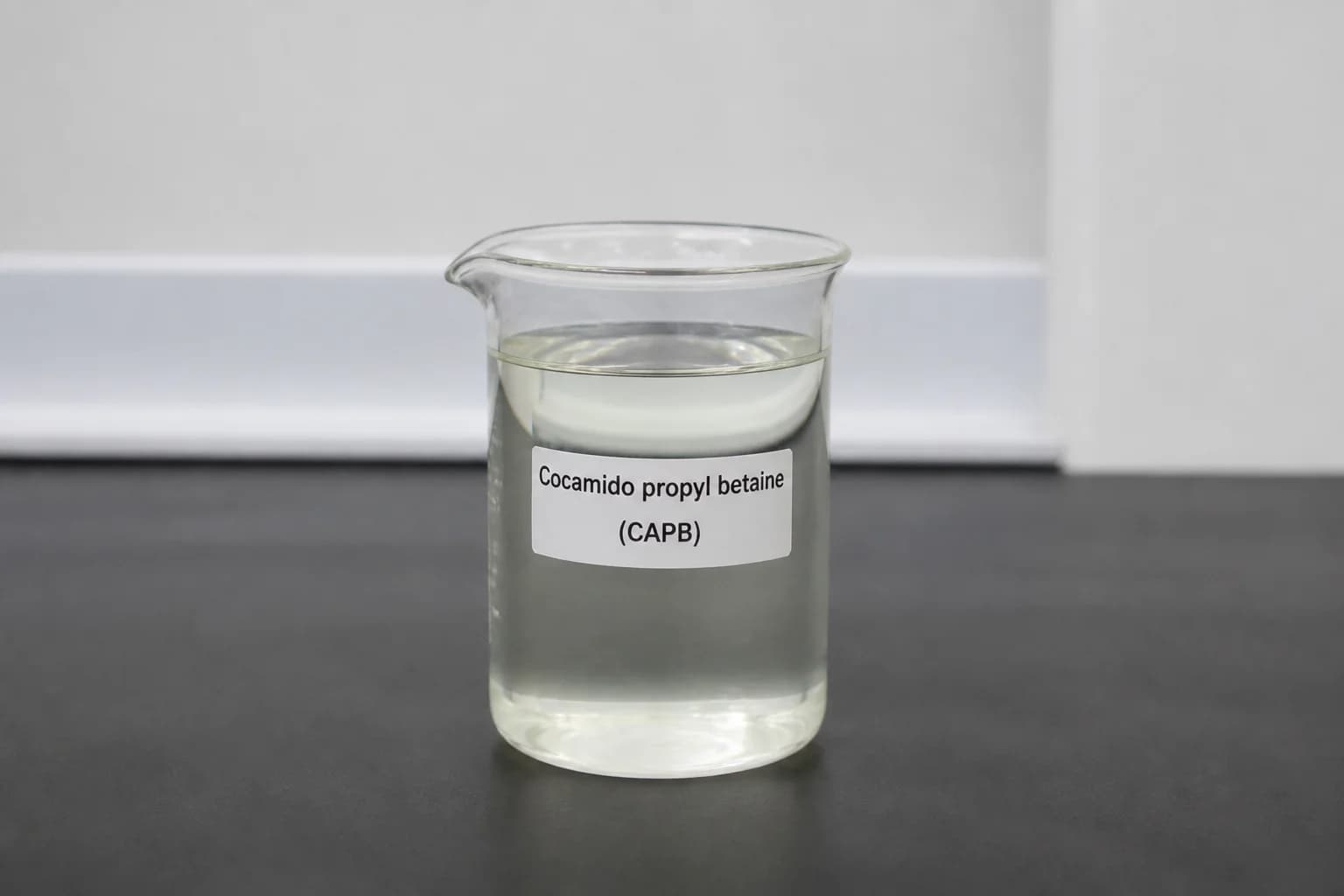
Cocamido propyl betaine (CAPB)
ELSURFAC™TM – CAB45
Get Pricing For This Product
Skip the quote. Sign up now and see pricing instantly
Speed Up Your Sample Testing Process
Express Delivery in 24–48 Hours
Elchemy supplies ELSURFAC™-CAB35 Cocamidopropyl Betaine (CAPB) in bulk to personal care and cosmetic manufacturers across 40+ countries. CAPB is a coconut-derived amphoteric surfactant widely used as…
CAS Number
61789-40-0
HS Code
3402.19.00
INCI Name
Coco Amido Propyl Betaine
Molecular Formula
C₁₉H₃₈N₂O₃
Cocamido propyl betaine (CAPB)
ELSURFAC™TM – CAB45
Elchemy supplies ELSURFAC™-CAB35 Cocamidopropyl Betaine (CAPB) in bulk to personal care and cosmetic manufacturers across 40+ countries. CAPB is a coconut-derived amphoteric surfactant widely used as a secondary surfactant in shampoos, body washes, facial cleansers, baby care…
CAS Number
61789-40-0
INCI Name
Coco Amido Propyl Betaine
HS Code
3402.19.00
Molecular Formula
C₁₉H₃₈N₂O₃
Get Pricing For This Product
Skip the quote. Sign up now and see pricing instantly
Speed Up Your Sample Testing Process
We deliver domestic samples within 24 - 48 hours, helping you evaluate product without delays.
Product Specification
Physical Properties
| Property | Specification |
|---|---|
| Appearance | Colorless to pale yellow liquid |
| Odor | Faint |
| Molecular Weight (G/Mol) | 342.5 |
| Density Or Specific Gravity | 1.05 – 1.07 g/cm³ at 25°C |
| Viscosity | 300-600 cps at (30°C) |
| Refractive Index | 1.308 – 1.395 at 20°C |
| Ph (If Aqueous Solution) | 4-8 (1% aqueous solution) 25°C |
Chemical Properties
| Property | Specification |
|---|---|
| Incompatibilities | Strong acids and oxidizers |
| Hazardous Reactions | May cause skin irritation or allergic reactions due to impurities |
Thermal Properties
| Property | Specification |
|---|---|
| Melting Point | < −10 °C |
| Boiling Point | 104.3℃ |
Processing Methods & Reference Formulations
A. Shampoo
Add CAPB slowly after SLES under gentle stirring to prevent excess foaming and ensure homogeneous blending. Use at 2-5% to enhance foam richness, viscosity, and mildness. It also helps reduce irritation from anionic surfactants.
| Key Ingredients | Indicative Dosage (% w/w) |
|---|---|
| Primary surfactants (SLS, SLES, ALES, SCI etc.) | 8-12% |
| Secondary surfactants (CAPB, CAO, CMEA, CDEA etc.) | 2-5% |
| Thickeners | 2-3% |
| Opacifiers/ Pearlizers | 1-2% |
| Water | 60-70% |
B. Body Wash
Incorporate Cocamidopropyl Betaine as a secondary surfactant after dissolving the primary surfactant (e.g., SLES) in water. Use at 2–8% to improve foam creaminess, enhance viscosity, and boost mildness.
| Key Ingredients | Indicative Dosage (% w/w) |
|---|---|
| Primary surfactants (SLS, SLES etc.) | 10-20% |
| Secondary surfactants (CAPB, CAO, CDEA etc.) | 2-8% |
| Thickening agents | 0.1-3% |
| Fragrances and Essential oils | 0.1-1% |
| Water | 60-70% |
C. Liquid Soap
In liquid soap production, add Cocamidopropyl Betaine after primary surfactants to boost foam and mildness. It enhances foam stability, improves skin feel, and helps thicken the formula when combined with electrolytes (e.g., NaCl).
| Key Ingredients | Indicative Dosage (% w/w) |
|---|---|
| Sodium Laureth Sulfate (SLES 70%) | 5% |
| Sodium Lauryl Sulfate (SLS 92%) | 1.5% |
| Cocamidopropyl Betaine | 5% |
| Cocamide DEA (CDEA) | 1% |
| Glycerin | 1% |
| EDTA-2Na | 0.1% |
| Salt | 2% |
| Deionized Water | 70-80% |
D. Cleansers
In cleanser production, add Cocamidopropyl Betaine after the surfactants to enhance foam and reduce irritation. Mix it in slowly under gentle agitation to prevent aeration and ensure a homogeneous formulation.
| Key Ingredients | Indicative Dosage (% w/w) |
|---|---|
| Cocamidopropyl Betaine | 5-15% |
| Primary surfactant | 5-15% |
| Glycerin | 1-5% |
| Preservative | 0.5-1% |
| Water | 50-60% |
Dosing Guidelines
A. Dosing by Application
| Products | Authorized dosage |
|---|---|
| Shampoo | 5-30% |
| Body Wash | 5-15% |
| Baby products | 2-6% |
| Deodorant (underarm) | 2% |
About Cocamido propyl betaine (CAPB)
Cocamidopropyl Betaine is an amphoteric surfactant produced from coconut oil fatty acids. It carries a net-neutral charge profile that lets it sit comfortably alongside anionic, cationic, and non-ionic surfactants in mixed-system formulations, which is why it has become the default secondary surfactant in modern personal care.
The product's commercial value comes from a specific balance: enough cleansing and foaming power to support performance claims, but mild enough to use in baby care and sensitive-skin products. As consumer demand has shifted toward sulfate-free, "clean beauty", and naturally-derived ingredient stories over the past decade, CAPB has moved from a supporting role to a centerpiece in many cleansing formulations.
Cocamidopropyl Betaine (CAS 61789-40-0) is listed on the US TSCA Chemical Substance Inventory and is widely used across cosmetic-grade formulations aligned with FDA 21 CFR requirements. Formulators planning bulk procurement also watch the price of caustic soda trend, since sodium hydroxide is one of the inputs in CAPB neutralization steps and shifts in upstream chemistry feed into final grade economics.
Manufacturing Process of Cocamidopropyl Betaine
CAPB is produced through a two-step reaction. First, coconut fatty acids are reacted with dimethylaminopropylamine (DMAPA) to form an amide intermediate. The intermediate is then quaternized with sodium monochloroacetate in an alkaline medium to produce the final amphoteric surfactant.
Modern producers control reaction temperature, pH, and dwell time closely to keep residual amidoamine and free DMAPA at low levels, which is important for cosmetic-grade quality and skin compatibility.
Every shipment Elchemy supplies is tested for active matter, free amine, sodium chloride, and pH before dispatch, with a Certificate of Analysis travelling alongside each order.
CAPB Price: Bulk Pricing for Personal Care and Cosmetic Buyers
If you're looking for current cocamidopropyl betaine pricing for bulk procurement, Elchemy provides quotes based on your specific formulation requirements. Fill out the quote request form with the required details, such as volume, active matter grade, destination, and any other relevant information about your procurement, and our team will revert with a detailed offer within 24 to 48 hours.
Unlike commodity inorganic chemicals where pricing tracks one or two major inputs, CAPB pricing reflects a stack of factors: coconut oil and DMAPA feedstock costs, active matter percentage of the supplied grade, demand cycles in the personal care sector, certifications required (Halal, Kosher, vegan), and logistics.
The cocamidopropyl betaine price that buyers see in trade references typically reflects 30% active grade in HDPE drums at a benchmark destination, which is useful as an indicative number but rarely the rate any specific buyer actually pays.
For comparison-shopping, procurement teams often look at the cocamidopropyl betaine price per kg of active matter, since two suppliers quoting different active levels are not on a like-for-like basis unless normalized this way.
Some references also report coco betaine price under the shorter trade name, which appears in trade publications and supplier directories interchangeably with the longer name. Either nomenclature points to the same CAS number and the same product family.
The coco betaine price per kg likewise tracks the same active-matter logic, with the slight difference that "coco betaine" listings sometimes refer to coco-betaine variants from slightly different production routes; always confirm the spec sheet matches CAPB specifically.
For an exact rate matched to your formulation, none of these references replace a direct quote. Final pricing depends on grade, volume, certifications, contract structure, destination, and dispatch timing, all of which the quote process captures.
Packaging & Logistics
CAPB ships in HDPE drums for standard orders, with IBC totes (1,000 L) and bulk tankers available for larger commercial volumes, based on buyer requirements.
For US-bound orders, domestic stock from our US warehouses supports faster fulfillment. If sourcing is required from India or other origin countries, transit times typically run 24 to 28 days to the
US East Coast and 18 to 22 days to the West Coast. Elchemy offers FOB, CIF US port, and DDP terms, depending on how your procurement team prefers to handle landed cost and customs.
Store CAPB in tightly sealed containers in a cool, dry, well-ventilated area, away from direct sunlight, heat, and freezing temperatures, since prolonged extreme conditions can affect clarity and active content. Standard dispatch follows agreed contract terms, with expedited timelines available where needed.
Safety & Handling
CAPB is generally well-tolerated in finished cosmetic formulations but should be handled with standard chemical safety practices in its concentrated supplied form. The concentrated 30 to 35% solution can cause mild skin and eye irritation on direct contact, and is classified per OSHA HazCom 2012 (GHS) with appropriate hazard category labeling.
Handlers should wear chemical-resistant gloves, splash goggles, and protective clothing during dispensing and transfer. If contact occurs, flush the affected area with water and seek medical attention if irritation persists.
Store in tightly sealed HDPE containers in a cool, dry, well-ventilated space, away from direct sunlight, heat, and freezing temperatures. The product is not classified as DOT hazardous for transport under typical commercial concentrations, though local transport rules should always be confirmed at the point of dispatch.
The full 16-section GHS-aligned SDS is available alongside material orders for reference by EHS and formulation teams.
Why Choose Elchemy as a Trusted Cocamidopropyl Betaine Supplier?
Elchemy makes a cocamidopropyl betaine buy straightforward for personal care and cosmetic formulators. That means coconut-derived material at consistent active content, low free-amine levels, and a Certificate of Analysis for every batch.
For US buyers, domestic stock from our US warehouses cuts lead time when timelines are tight. CAPB is TSCA-listed and ships with a GHS-aligned SDS (OSHA HazCom 2012). Halal, Kosher, and vegan-compliant grades are available on request for formulators serving specific market segments. Flexible Incoterms (FOB, CIF, or DDP) give your procurement team room to structure the deal the way it works best.
Elchemy ships into 40+ countries with samples available for qualification before any bulk order, and pricing based on volume, active matter grade, certifications, destination, and contract terms.
- Effective Surfactant: Excellent foaming and cleansing with competitive cocamidopropyl betaine price
- Gentle on Skin: Suitable for sensitive and baby care products with stable coco betaine price per kg
- Natural Origin: Derived from coconut oil ensuring eco-friendly sourcing
- Highly Soluble: Easy to formulate across applications
- Versatile Use: Personal care, cosmetics, and cleaning products with optimized cocamidopropyl betaine price per kg
About Cocamido propyl betaine (CAPB)
Cocamidopropyl Betaine is an amphoteric surfactant produced from coconut oil fatty acids. It carries a net-neutral charge profile that lets it sit comfortably alongside anionic, cationic, and non-ionic surfactants in mixed-system formulations, which is why it has become the default secondary surfactant in modern personal care.
The product's commercial value comes from a specific balance: enough cleansing and foaming power to support performance claims, but mild enough to use in baby care and sensitive-skin products. As consumer demand has shifted toward sulfate-free, "clean beauty", and naturally-derived ingredient stories over the past decade, CAPB has moved from a supporting role to a centerpiece in many cleansing formulations.
Cocamidopropyl Betaine (CAS 61789-40-0) is listed on the US TSCA Chemical Substance Inventory and is widely used across cosmetic-grade formulations aligned with FDA 21 CFR requirements. Formulators planning bulk procurement also watch the price of caustic soda trend, since sodium hydroxide is one of the inputs in CAPB neutralization steps and shifts in upstream chemistry feed into final grade economics.
Manufacturing Process of Cocamidopropyl Betaine
CAPB is produced through a two-step reaction. First, coconut fatty acids are reacted with dimethylaminopropylamine (DMAPA) to form an amide intermediate. The intermediate is then quaternized with sodium monochloroacetate in an alkaline medium to produce the final amphoteric surfactant.
Modern producers control reaction temperature, pH, and dwell time closely to keep residual amidoamine and free DMAPA at low levels, which is important for cosmetic-grade quality and skin compatibility.
Every shipment Elchemy supplies is tested for active matter, free amine, sodium chloride, and pH before dispatch, with a Certificate of Analysis travelling alongside each order.
CAPB Price: Bulk Pricing for Personal Care and Cosmetic Buyers
If you're looking for current cocamidopropyl betaine pricing for bulk procurement, Elchemy provides quotes based on your specific formulation requirements. Fill out the quote request form with the required details, such as volume, active matter grade, destination, and any other relevant information about your procurement, and our team will revert with a detailed offer within 24 to 48 hours.
Unlike commodity inorganic chemicals where pricing tracks one or two major inputs, CAPB pricing reflects a stack of factors: coconut oil and DMAPA feedstock costs, active matter percentage of the supplied grade, demand cycles in the personal care sector, certifications required (Halal, Kosher, vegan), and logistics.
The cocamidopropyl betaine price that buyers see in trade references typically reflects 30% active grade in HDPE drums at a benchmark destination, which is useful as an indicative number but rarely the rate any specific buyer actually pays.
For comparison-shopping, procurement teams often look at the cocamidopropyl betaine price per kg of active matter, since two suppliers quoting different active levels are not on a like-for-like basis unless normalized this way.
Some references also report coco betaine price under the shorter trade name, which appears in trade publications and supplier directories interchangeably with the longer name. Either nomenclature points to the same CAS number and the same product family.
The coco betaine price per kg likewise tracks the same active-matter logic, with the slight difference that "coco betaine" listings sometimes refer to coco-betaine variants from slightly different production routes; always confirm the spec sheet matches CAPB specifically.
For an exact rate matched to your formulation, none of these references replace a direct quote. Final pricing depends on grade, volume, certifications, contract structure, destination, and dispatch timing, all of which the quote process captures.
Packaging & Logistics
CAPB ships in HDPE drums for standard orders, with IBC totes (1,000 L) and bulk tankers available for larger commercial volumes, based on buyer requirements.
For US-bound orders, domestic stock from our US warehouses supports faster fulfillment. If sourcing is required from India or other origin countries, transit times typically run 24 to 28 days to the
US East Coast and 18 to 22 days to the West Coast. Elchemy offers FOB, CIF US port, and DDP terms, depending on how your procurement team prefers to handle landed cost and customs.
Store CAPB in tightly sealed containers in a cool, dry, well-ventilated area, away from direct sunlight, heat, and freezing temperatures, since prolonged extreme conditions can affect clarity and active content. Standard dispatch follows agreed contract terms, with expedited timelines available where needed.
Safety & Handling
CAPB is generally well-tolerated in finished cosmetic formulations but should be handled with standard chemical safety practices in its concentrated supplied form. The concentrated 30 to 35% solution can cause mild skin and eye irritation on direct contact, and is classified per OSHA HazCom 2012 (GHS) with appropriate hazard category labeling.
Handlers should wear chemical-resistant gloves, splash goggles, and protective clothing during dispensing and transfer. If contact occurs, flush the affected area with water and seek medical attention if irritation persists.
Store in tightly sealed HDPE containers in a cool, dry, well-ventilated space, away from direct sunlight, heat, and freezing temperatures. The product is not classified as DOT hazardous for transport under typical commercial concentrations, though local transport rules should always be confirmed at the point of dispatch.
The full 16-section GHS-aligned SDS is available alongside material orders for reference by EHS and formulation teams.
Why Choose Elchemy as a Trusted Cocamidopropyl Betaine Supplier?
Elchemy makes a cocamidopropyl betaine buy straightforward for personal care and cosmetic formulators. That means coconut-derived material at consistent active content, low free-amine levels, and a Certificate of Analysis for every batch.
For US buyers, domestic stock from our US warehouses cuts lead time when timelines are tight. CAPB is TSCA-listed and ships with a GHS-aligned SDS (OSHA HazCom 2012). Halal, Kosher, and vegan-compliant grades are available on request for formulators serving specific market segments. Flexible Incoterms (FOB, CIF, or DDP) give your procurement team room to structure the deal the way it works best.
Elchemy ships into 40+ countries with samples available for qualification before any bulk order, and pricing based on volume, active matter grade, certifications, destination, and contract terms.
- Effective Surfactant: Excellent foaming and cleansing with competitive cocamidopropyl betaine price
- Gentle on Skin: Suitable for sensitive and baby care products with stable coco betaine price per kg
- Natural Origin: Derived from coconut oil ensuring eco-friendly sourcing
- Highly Soluble: Easy to formulate across applications
- Versatile Use: Personal care, cosmetics, and cleaning products with optimized cocamidopropyl betaine price per kg
Regulatory Compliance
| Region | Max Allowed Level | Notes | Certification Body |
|---|---|---|---|
| Australia | - | No explicit maximum | - |
| China | - | No explicit maximum | NMPA - National Medical Products Administration |
| India | - | No explicit maximum concentration for CAPB is set by Indian authorities for cosmetics. | - |
| Japan | - | No explicit maximum | MHLW – Ministry of Health, Labour and Welfare |
| Republic of Korea | - | No explicit maximum | MFDS - Ministry of Food and Drug Safety |
| United States | 3% | Expert Panel recommended that for cosmetic products intended to remain on the skin for long periods of time (i.e., leave-on products), the concentration of CAPB should not exceed 3%. | FDA |
| ASEAN | - | No explicit maximum | - |
| European Union | - | No explicit maximum; typical use up to 4–10% in rinse-off products | - |
FAQs - Cocamido propyl betaine (CAPB)
Related Products
Related Products
Streamline
Your Chemical
Procurement
Get fast responses from real experts