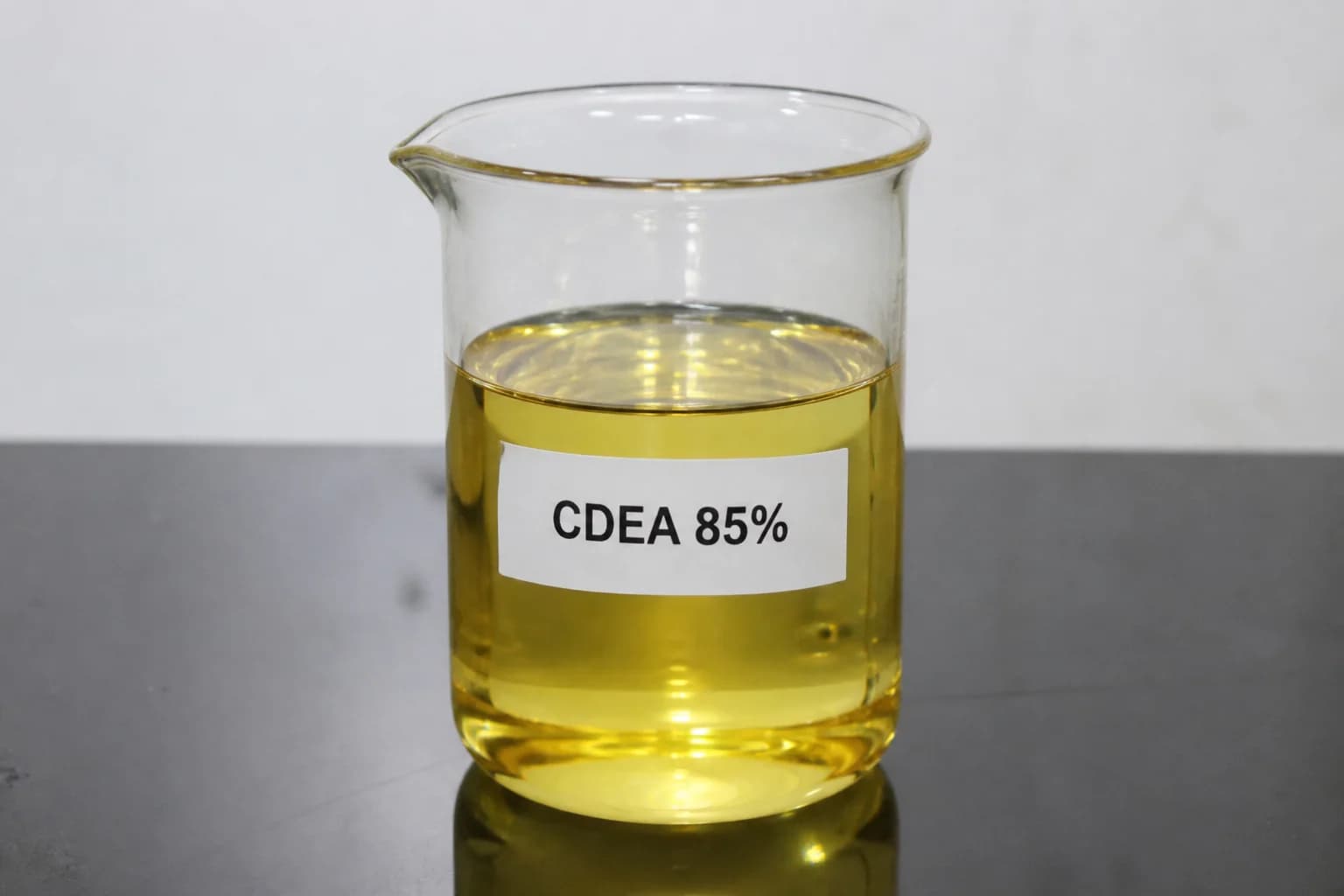
CDEA 85%
ELSURFAC™TM – CDN85
Get Pricing For This Product
Skip the quote. Sign up now and see pricing instantly
Speed Up Your Sample Testing Process
Express Delivery in 24–48 Hours
Coconut Diethanolamide (CDEA) is a non-ionic surfactant derived from coconut oil and diethanolamine. It is widely used in personal care, home care, and industrial formulations due to its excellent…
CAS Number
68603-42-9
HS Code
3402.13.00.00
INCI Name
Coconut Diethanolamide (CDEA)
Molecular Formula
C11H23CON(CH2CH2OH)2
CDEA 85%
ELSURFAC™TM – CDN85
Coconut Diethanolamide (CDEA) is a non-ionic surfactant derived from coconut oil and diethanolamine. It is widely used in personal care, home care, and industrial formulations due to its excellent foaming, thickening, and stabilizing properties. CDEA enhances foam stability,…
CAS Number
68603-42-9
INCI Name
Coconut Diethanolamide (CDEA)
HS Code
3402.13.00.00
Molecular Formula
C11H23CON(CH2CH2OH)2
Get Pricing For This Product
Skip the quote. Sign up now and see pricing instantly
Speed Up Your Sample Testing Process
We deliver domestic samples within 24 - 48 hours, helping you evaluate product without delays.
Product Specification
Physical Properties
| Property | Specification |
|---|---|
| Appearance | Light yellow to amber viscous liquid. |
| Odor | Mild, characteristic fatty odor. |
| Density / Specific Gravity | ~0.99 g/cm³ |
| Viscosity | 3000 – 6000 cP at 25 °C |
| Refractive Index | 1.4697-1.4816 |
| Ph (Aqueous Solution) | 9.5 - 10.7 |
| Assay / Purity | 85% |
| Hlb Value | 12.56 |
| Hlb Comparison | Cocamide DEA: 12.56 Cocamide MEA: 13.5 Lauramide DEA: 15 ± 1 Linoleamide DEA: 10 ± 1 |
Chemical Properties
| Property | Specification |
|---|---|
| Ionic Nature | Non-ionic. |
| Incompatibilities | Incompatible with strong, concentrated oxidizing agents. |
| Hazardous Reactions / Decomposition Products | Under fire conditions, may produce carbon oxides (carbon monoxide, carbon dioxide). |
Thermal Properties
| Property | Specification |
|---|---|
| Melting Point | < 10 °C |
| Boiling Point | 168-274 °C |
| Flash Point | > 100 °C |
| Autoignition Temperature | 662 °C |
| Thermal Stability | Stable under ordinary conditions. |
Processing Methods & Reference Formulations
A. Economic Liquid Hand Soap
This formulation produces a high-performance liquid hand soap with good washing properties and a thick, pleasant foam. Combine ingredients of phase A and mix until uniform. Add phase B ingredients and mix. Finally, add Sodium Chloride while mixing to thicken. Control final viscosity and pH.
| Key Ingredients | Indicative Dosage (% w/w) |
|---|---|
| Water | to 100 |
| Sodium Laureth Sulfate (and) Cocamidopropyl Betaine (and) Coco-Glucoside | 8.0 |
| Sodium Benzoate, Potassium Sorbate | 0.5 |
| Betaine | 0.5 |
| Lactic Acid | 0.15 |
| Coconut Diethanolamide (CDEA) | 0.5 |
| Fragrance | 0.5 |
| Colorants | q.s. |
| Sodium Chloride | 2.5 |
B. Moisturizing Shampoo
A typical moisturizing shampoo formulation where Coconut Diethanolamide acts as a thickener and foam stabilizer. Disperse Polyquaternium-7 in water. Add remaining ingredients of Phase A and heat to 70-75°C. In a separate vessel, combine and heat Phase B ingredients to 70-75°C. Add Phase B to Phase A with mixing. Cool to 40°C and add Phase C ingredients. Adjust pH to 5.5-6.0 with Citric Acid solution. Viscosity can be increased with a 10% Sodium Chloride solution.
| Key Ingredients | Indicative Dosage (% w/w) |
|---|---|
| Water | q.s. to 100 |
| Polyquaternium-7 | 0.05 |
| Sodium Laureth Sulfate | 35.00 |
| Disodium Laureth Sulfosuccinate | 5.00 |
| Coconut Diethanolamide (CDEA) | 3.00 |
| Glycol Distearate | 1.50 |
| Preservative | q.s. |
| Fragrance | q.s. |
| Citric Acid (25% solution) | to pH 5.5-6.0 |
| Sodium Chloride (optional) | q.s. for viscosity |
Dosing Guidelines
A. Dosing by Application
| Application | Recommended / Max Dosage |
|---|---|
| Shampoos | 1 - 10% |
| Shampoos | 2 - 3% |
| Body Washes / Bubble Baths | 5 - 10% |
| Body Washes / Bubble Baths | 3 - 4% |
| Liquid Hand Soaps | 2 - 3% |
| Hair Conditioners | 1 - 10% |
| Face, Body & Hand Skin Care | 1 - 5% |
| Detergents / Industrial Cleaners | 4 - 5% |
| Cosmetics (e.g., Lipstick) | 1 - 5% |
About CDEA 85%
Coconut Diethanolamide (CDEA) is a highly versatile and widely used surfactant, valued for its excellent thickening, emulsifying, and foaming characteristics. Derived from naturally sourced coconut oil, CDEA delivers a perfect balance of performance and mildness, making it suitable for both personal care and industrial applications.
Its high compatibility with anionic, non-ionic, and amphoteric surfactants allows formulators to develop high-quality shampoos, soaps, and detergents with improved texture and stability. CDEA also reduces irritation potential in formulations, enhancing the sensory profile of final products.
One of the core strengths of CDEA is its ability to enhance viscosity and create rich, stable foam without significantly increasing cost. This makes it a preferred choice for manufacturers looking for both performance and value.
Industries rely on trusted coconut diethanolamide cdea manufacturers who ensure consistent quality, purity, and compliance with international standards. With its strong performance profile and broad formulation compatibility, CDEA continues to be a critical ingredient in home care, personal care, and industrial cleaning products.
Whether used for foam boosting, thickening, or stabilization, Coconut Diethanolamide remains an essential and reliable surfactant for numerous chemical formulations.
- Excellent Foaming Ability: Creates rich, stable, and luxurious foam in detergents and personal care products with competitive cdea chemical price.
- Function: Surfactant (Foam Booster, Cleansing, Emulsifying), Viscosity Increasing Agent, Emulsion Stabilizer.
- Strong Thickening Properties: Increases viscosity and improves product texture while maintaining optimal coco diethanolamide price.
- Excellent foam boosting and stabilizing capabilities.: Excellent foam boosting and stabilizing capabilities.
- Mild & Skin-Friendly: Reduces irritation and enhances formulation gentleness.
- Effective viscosity builder, thickening aqueous solutions.: Effective viscosity builder, thickening aqueous solutions.
- High Stability: Maintains performance under a wide range of temperatures and pH levels.
- Acts as an emulsifier, helping to mix oil and water.: Acts as an emulsifier, helping to mix oil and water.
- Broad Compatibility: Works effectively with various surfactants and ingredients for versatile formulation use.
- Compatible with anionic, cationic, amphoteric, and non-ionic surfactants.: Compatible with anionic, cationic, amphoteric, and non-ionic surfactants.
About CDEA 85%
Coconut Diethanolamide (CDEA) is a highly versatile and widely used surfactant, valued for its excellent thickening, emulsifying, and foaming characteristics. Derived from naturally sourced coconut oil, CDEA delivers a perfect balance of performance and mildness, making it suitable for both personal care and industrial applications.
Its high compatibility with anionic, non-ionic, and amphoteric surfactants allows formulators to develop high-quality shampoos, soaps, and detergents with improved texture and stability. CDEA also reduces irritation potential in formulations, enhancing the sensory profile of final products.
One of the core strengths of CDEA is its ability to enhance viscosity and create rich, stable foam without significantly increasing cost. This makes it a preferred choice for manufacturers looking for both performance and value.
Industries rely on trusted coconut diethanolamide cdea manufacturers who ensure consistent quality, purity, and compliance with international standards. With its strong performance profile and broad formulation compatibility, CDEA continues to be a critical ingredient in home care, personal care, and industrial cleaning products.
Whether used for foam boosting, thickening, or stabilization, Coconut Diethanolamide remains an essential and reliable surfactant for numerous chemical formulations.
- Excellent Foaming Ability: Creates rich, stable, and luxurious foam in detergents and personal care products with competitive cdea chemical price.
- Function: Surfactant (Foam Booster, Cleansing, Emulsifying), Viscosity Increasing Agent, Emulsion Stabilizer.
- Strong Thickening Properties: Increases viscosity and improves product texture while maintaining optimal coco diethanolamide price.
- Excellent foam boosting and stabilizing capabilities.: Excellent foam boosting and stabilizing capabilities.
- Mild & Skin-Friendly: Reduces irritation and enhances formulation gentleness.
- Effective viscosity builder, thickening aqueous solutions.: Effective viscosity builder, thickening aqueous solutions.
- High Stability: Maintains performance under a wide range of temperatures and pH levels.
- Acts as an emulsifier, helping to mix oil and water.: Acts as an emulsifier, helping to mix oil and water.
- Broad Compatibility: Works effectively with various surfactants and ingredients for versatile formulation use.
- Compatible with anionic, cationic, amphoteric, and non-ionic surfactants.: Compatible with anionic, cationic, amphoteric, and non-ionic surfactants.
Regulatory Compliance
| Region | Max Allowed Level | Notes | Certification Body |
|---|---|---|---|
| Australia | - | Listed on the Australian Inventory of Industrial Chemicals (AICIS). No specific restrictions found. | AICIS Registration |
| Canada | 2% | Permitted for use in cosmetics. To mitigate risks from potential DEA impurities, it is unacceptable for use in combination with nitrosating agents. The Natural Health Products Ingredients Database (NHPID) specifies limits for topical use when formulated to be non-irritating. | - |
| China | - | Listed in the Inventory of Existing Cosmetic Ingredients in China (IECIC). No specific restrictions found. | NMPA |
| United States | 10% | The Cosmetic Ingredient Review (CIR) panel concluded it is safe for use in rinse-off products and in leave-on products at concentrations up to 10%. It should not be used in products containing nitrosating agents. Listed under California Proposition 65 as a chemical known to cause cancer. | TSCA Inventory |
| European Union | - | Subject to restrictions in Annex III of the EC Cosmetics Regulation. Must not be used with nitrosating systems. Maximum secondary amine content: 0.5%. Maximum nitrosamine content: 50 µg/kg. Must be stored in nitrite-free containers. | REACH |
FAQs - CDEA 85%
Related Products
Related Products
Streamline
Your Chemical
Procurement
Get fast responses from real experts