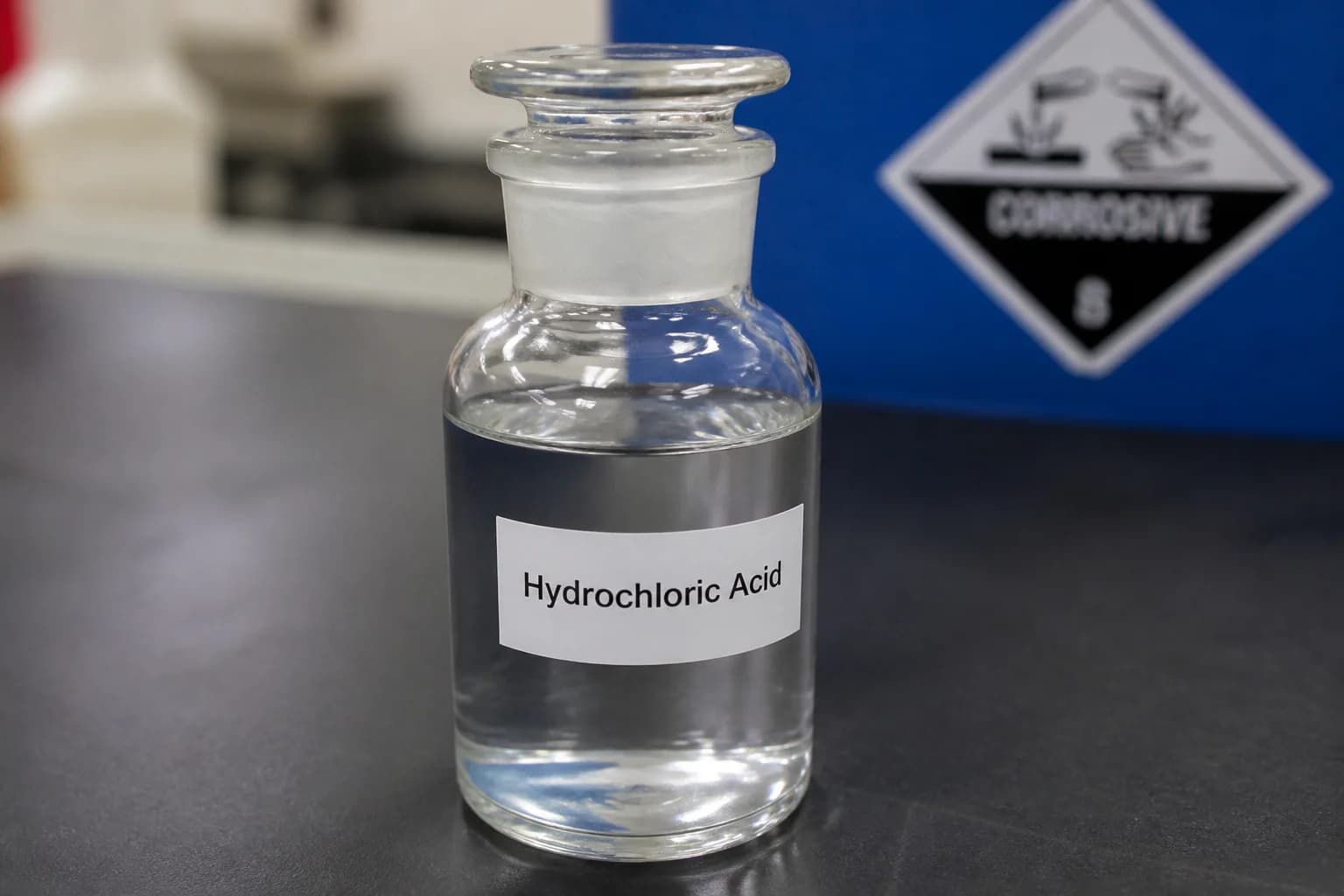
Hydrochloric Acid
ELRASATM – ELRASA – HCA35
Get Pricing For This Product
Need pricing? Request a quote for this product and we'll get back to you shortly.
Speed Up Your Sample Testing Process
Express Delivery in 24–48 Hours
Hydrochloric Acid is a strong mineral acid supplied as a clear to pale-yellow aqueous solution, typically at 30–35% concentration. It functions as a strong acid, pickling agent, pH regulator, raw…
CAS Number
7647-01-0
HS Code
28061000
INCI Name
Hydrochloric Acid
Molecular Formula
HCl
Hydrochloric Acid
ELRASATM – ELRASA – HCA35
Hydrochloric Acid is a strong mineral acid supplied as a clear to pale-yellow aqueous solution, typically at 30–35% concentration. It functions as a strong acid, pickling agent, pH regulator, raw material across steel & metals, chemicals, oil & gas, water treatment, food,…
CAS Number
7647-01-0
INCI Name
Hydrochloric Acid
HS Code
28061000
Molecular Formula
HCl
Get Pricing For This Product
Need pricing? Request a quote for this product and we'll get back to you shortly.
Speed Up Your Sample Testing Process
We deliver domestic samples within 24 - 48 hours, helping you evaluate product without delays.
Product Specification
Physical Properties
| Property | Specification |
|---|---|
| Appearance | Colourless clear liquid |
| Odor | Pungent, irritating odor. |
| Molecular Weight | 36.46 g/mol. |
| Density / Specific Gravity | 1.159 g/cm³ |
| Ph (Aqueous Solution) | <1.0. |
| Assay / Purity | 35% |
Chemical Properties
| Property | Specification |
|---|---|
| Pka | -5.9. |
| Ionic Nature | Strong acid, completely ionized in aqueous solution. |
| Incompatibilities | Bases, amines, metals, oxidizing agents (e.g., permanganates, chlorates), metal acetylides, hexalithium disilicide, acetic anhydride, chlorosulfonic acid, oleum, sulfuric acid, vinyl acetate. |
| Hazardous Reactions / Decomposition Products | Contact with metals may evolve flammable hydrogen gas. Decomposes under heat to form hydrogen chloride and chlorine gas. |
Thermal Properties
| Property | Specification |
|---|---|
| Melting Point | -43 °C |
| Boiling Point | 84 °C |
| Flash Point | Non-flammable. |
| Autoignition Temperature | Not flammable. |
| Thermal Stability | High thermal stability. |
Dosing Guidelines
A. Dosing by Application
| Application | Recommended / Max Dosage |
|---|---|
| Steel Pickling (Hot-rolled steel) | 15 - 20% |
| Steel Pickling (Cold-rolled steel) | 8 - 12% |
| Steel Pickling (General) | 3 - 15% |
| Oil Well Acidizing | 15% |
| Ion Exchange Resin Regeneration | 4 - 8% |
| pH Control (Municipal Water) | 5 - 10% |
| Food Processing (e.g., corn syrup, gelatin) | 3 - 10% |
| RO Membrane Cleaning | 2 - 3% |
About Hydrochloric Acid
Hydrochloric acid (HCl) is a strong, versatile mineral acid supplied as an aqueous solution, most commonly at 30–35%. It is one of the most widely used acids in industry, essential for steel pickling, chemical manufacture, oil-well acidising, water treatment, pH control, food processing (as E507) and the production of chlorides and many other chemicals. Much of the world's hydrochloric acid is recovered as a co-product of other chemical processes (such as the chlorination of organics), making it both widely available and cost-effective. It is graded by concentration and purity - technical grade for industrial use and food grade (E507) for food and pharmaceutical applications. Industrial buyers sourcing Hydrochloric Acid in bulk also track hydrochloric acid pricing closely, since it feeds directly into their downstream costs - which is why working with an established hydrochloric acid supplier and distributor like Elchemy matters.
Manufacturing Process of Hydrochloric Acid
Hydrochloric acid is produced by two main routes: direct synthesis, in which hydrogen and chlorine are burned together to form hydrogen chloride gas that is absorbed in water; and, more commonly, as a by-product of the chlorination of organic compounds, where the evolved HCl gas is absorbed into water to form the acid. The gas is absorbed in a falling-film absorber to the target concentration (typically 30–35%) and purified for food or technical grade. As a quality-focused hydrochloric acid manufacturer and sourcing partner, Elchemy tests every shipment for assay (concentration), iron, free chlorine and heavy metals before dispatch, with a Certificate of Analysis travelling alongside each order.
Hydrochloric acid price: Bulk Pricing for Industrial Buyers
If you are comparing hydrochloric acid price for bulk procurement, Elchemy provides quotes based on your exact requirements. Share your volume, grade, destination and packaging on the quote form and our team reverts with a detailed offer within 24 to 48 hours. Pricing is quoted rather than published because the cost is driven by chlor-alkali economics and the availability of by-product HCl from organic chlorination, not a fixed list. This is why a live quote from a hydrochloric acid supplier is always more accurate than any headline figure. Beyond that, several factors shape the final hydrochloric acid price: grade, committed volume, origin country, packaging format, freight, Incoterm (FOB, CIF or DDP) and import duty (HTS 2806.10 for US-bound shipments). For an approximate read on where the market sits, procurement teams often reference chlor-alkali and hydrochloric acid price indices. Trade publications also report the hydrochloric acid price per kg as a unit-level benchmark, useful for spotting short-term regional shifts. At bulk procurement scale, the hydrochloric acid price per ton (or per MT) is the most relevant commercial unit, since contracts are negotiated at that level. For an exact rate, none of these replaces a direct quote. Your final price depends on contract structure, destination, volume and timing - so a quote from our team is always the most accurate number for your procurement.
Packaging & Logistics for Bulk Hydrochloric Acid
Hydrochloric Acid ships in standard export packaging - bags, drums, IBCs or bulk as the material requires - with both metric and imperial weights, supplied to your specification. A typical 20' container holds a full commercial load depending on packaging. For US, UK and UAE buyers, Elchemy arranges compliant freight and customs documentation, offering EXW, FOB, CIF and DDP terms. Transit times and stock position are confirmed at quotation, and samples are dispatched within 24 to 48 hours. Store per the conditions on the TDS. As a global hydrochloric acid distributor, Elchemy ships to 40+ countries with the documentation each destination market requires.
Why Choose Elchemy as a Trusted Hydrochloric Acid Supplier
Elchemy makes sourcing Hydrochloric Acid straightforward for industrial buyers. Every order ships with a Certificate of Analysis, TDS and GHS-aligned SDS as standard, across the grades listed above. Because we source across multiple origins, we quote the best landed cost for your destination rather than a single hydrochloric acid manufacturer's list price. Partner plants operate to recognised quality standards (ISO 9001, plus food/pharma certifications where relevant), with Halal and Kosher documentation on request. From the USA and UK to the UAE and beyond, Elchemy serves as a single hydrochloric acid supplier, manufacturer and distributor relationship - with samples before bulk and pricing tailored to your volume and contract terms.
Safety & Handling
Classified under GHS as Skin Corrosive Category 1B (H314), STOT SE 3 (H335). DOT/UN: UN1789, Class 8 Corrosive, Packing Group II–III (concentration-dependent). Hydrochloric acid is corrosive and hazardous. It causes severe burns to skin and eyes and its pungent, fuming vapour damages the respiratory tract and, over time, tooth enamel. It reacts with metals to release flammable hydrogen gas, and with oxidisers (e.g. bleach) to release toxic chlorine gas - the two must never be mixed. Handle with full chemical PPE and strong ventilation, store in acid-resistant, vented containers, and always add acid to water when diluting. It is a listed explosives precursor with consumer-supply restrictions in several markets. The full 16-section GHS-aligned SDS is available alongside every Hydrochloric Acid order.
Production Technique and Raw Materials
Hydrochloric acid is produced by two main routes: direct synthesis, in which hydrogen and chlorine are burned together to form hydrogen chloride gas that is absorbed in water; and, more commonly, as a by-product of the chlorination of organic compounds, where the evolved HCl gas is absorbed into water to form the acid. The gas is absorbed in a falling-film absorber to the target concentration (typically 30–35%) and purified for food or technical grade.
Tentative Side Effects
Hydrochloric acid is corrosive and hazardous. It causes severe burns to skin and eyes and its pungent, fuming vapour damages the respiratory tract and, over time, tooth enamel. It reacts with metals to release flammable hydrogen gas, and with oxidisers (e.g. bleach) to release toxic chlorine gas - the two must never be mixed. Handle with full chemical PPE and strong ventilation, store in acid-resistant, vented containers, and always add acid to water when diluting. It is a listed explosives precursor with consumer-supply restrictions in several markets.
- Chemical Processing: Essential for producing various chemicals like vinyl chloride and fertilizers.
- Metal Cleaning: Efficiently removes rust and scale from metal surfaces.
- Water Treatment: Neutralizes alkaline substances and controls pH in water treatment.
- Industrial Cleaning: Used in cleaning and descaling industrial equipment.
- High Purity: Provides consistent and reliable results in manufacturing processes.
- Safe Storage: Packaged for secure handling and long-term storage.
About Hydrochloric Acid
Hydrochloric acid (HCl) is a strong, versatile mineral acid supplied as an aqueous solution, most commonly at 30–35%. It is one of the most widely used acids in industry, essential for steel pickling, chemical manufacture, oil-well acidising, water treatment, pH control, food processing (as E507) and the production of chlorides and many other chemicals. Much of the world's hydrochloric acid is recovered as a co-product of other chemical processes (such as the chlorination of organics), making it both widely available and cost-effective. It is graded by concentration and purity - technical grade for industrial use and food grade (E507) for food and pharmaceutical applications. Industrial buyers sourcing Hydrochloric Acid in bulk also track hydrochloric acid pricing closely, since it feeds directly into their downstream costs - which is why working with an established hydrochloric acid supplier and distributor like Elchemy matters.
Manufacturing Process of Hydrochloric Acid
Hydrochloric acid is produced by two main routes: direct synthesis, in which hydrogen and chlorine are burned together to form hydrogen chloride gas that is absorbed in water; and, more commonly, as a by-product of the chlorination of organic compounds, where the evolved HCl gas is absorbed into water to form the acid. The gas is absorbed in a falling-film absorber to the target concentration (typically 30–35%) and purified for food or technical grade. As a quality-focused hydrochloric acid manufacturer and sourcing partner, Elchemy tests every shipment for assay (concentration), iron, free chlorine and heavy metals before dispatch, with a Certificate of Analysis travelling alongside each order.
Hydrochloric acid price: Bulk Pricing for Industrial Buyers
If you are comparing hydrochloric acid price for bulk procurement, Elchemy provides quotes based on your exact requirements. Share your volume, grade, destination and packaging on the quote form and our team reverts with a detailed offer within 24 to 48 hours. Pricing is quoted rather than published because the cost is driven by chlor-alkali economics and the availability of by-product HCl from organic chlorination, not a fixed list. This is why a live quote from a hydrochloric acid supplier is always more accurate than any headline figure. Beyond that, several factors shape the final hydrochloric acid price: grade, committed volume, origin country, packaging format, freight, Incoterm (FOB, CIF or DDP) and import duty (HTS 2806.10 for US-bound shipments). For an approximate read on where the market sits, procurement teams often reference chlor-alkali and hydrochloric acid price indices. Trade publications also report the hydrochloric acid price per kg as a unit-level benchmark, useful for spotting short-term regional shifts. At bulk procurement scale, the hydrochloric acid price per ton (or per MT) is the most relevant commercial unit, since contracts are negotiated at that level. For an exact rate, none of these replaces a direct quote. Your final price depends on contract structure, destination, volume and timing - so a quote from our team is always the most accurate number for your procurement.
Packaging & Logistics for Bulk Hydrochloric Acid
Hydrochloric Acid ships in standard export packaging - bags, drums, IBCs or bulk as the material requires - with both metric and imperial weights, supplied to your specification. A typical 20' container holds a full commercial load depending on packaging. For US, UK and UAE buyers, Elchemy arranges compliant freight and customs documentation, offering EXW, FOB, CIF and DDP terms. Transit times and stock position are confirmed at quotation, and samples are dispatched within 24 to 48 hours. Store per the conditions on the TDS. As a global hydrochloric acid distributor, Elchemy ships to 40+ countries with the documentation each destination market requires.
Why Choose Elchemy as a Trusted Hydrochloric Acid Supplier
Elchemy makes sourcing Hydrochloric Acid straightforward for industrial buyers. Every order ships with a Certificate of Analysis, TDS and GHS-aligned SDS as standard, across the grades listed above. Because we source across multiple origins, we quote the best landed cost for your destination rather than a single hydrochloric acid manufacturer's list price. Partner plants operate to recognised quality standards (ISO 9001, plus food/pharma certifications where relevant), with Halal and Kosher documentation on request. From the USA and UK to the UAE and beyond, Elchemy serves as a single hydrochloric acid supplier, manufacturer and distributor relationship - with samples before bulk and pricing tailored to your volume and contract terms.
Safety & Handling
Classified under GHS as Skin Corrosive Category 1B (H314), STOT SE 3 (H335). DOT/UN: UN1789, Class 8 Corrosive, Packing Group II–III (concentration-dependent). Hydrochloric acid is corrosive and hazardous. It causes severe burns to skin and eyes and its pungent, fuming vapour damages the respiratory tract and, over time, tooth enamel. It reacts with metals to release flammable hydrogen gas, and with oxidisers (e.g. bleach) to release toxic chlorine gas - the two must never be mixed. Handle with full chemical PPE and strong ventilation, store in acid-resistant, vented containers, and always add acid to water when diluting. It is a listed explosives precursor with consumer-supply restrictions in several markets. The full 16-section GHS-aligned SDS is available alongside every Hydrochloric Acid order.
Production Technique and Raw Materials
Hydrochloric acid is produced by two main routes: direct synthesis, in which hydrogen and chlorine are burned together to form hydrogen chloride gas that is absorbed in water; and, more commonly, as a by-product of the chlorination of organic compounds, where the evolved HCl gas is absorbed into water to form the acid. The gas is absorbed in a falling-film absorber to the target concentration (typically 30–35%) and purified for food or technical grade.
Tentative Side Effects
Hydrochloric acid is corrosive and hazardous. It causes severe burns to skin and eyes and its pungent, fuming vapour damages the respiratory tract and, over time, tooth enamel. It reacts with metals to release flammable hydrogen gas, and with oxidisers (e.g. bleach) to release toxic chlorine gas - the two must never be mixed. Handle with full chemical PPE and strong ventilation, store in acid-resistant, vented containers, and always add acid to water when diluting. It is a listed explosives precursor with consumer-supply restrictions in several markets.
- Chemical Processing: Essential for producing various chemicals like vinyl chloride and fertilizers.
- Metal Cleaning: Efficiently removes rust and scale from metal surfaces.
- Water Treatment: Neutralizes alkaline substances and controls pH in water treatment.
- Industrial Cleaning: Used in cleaning and descaling industrial equipment.
- High Purity: Provides consistent and reliable results in manufacturing processes.
- Safe Storage: Packaged for secure handling and long-term storage.
Regulatory Compliance
| Region | Max Allowed Level | Notes | Certification Body |
|---|---|---|---|
| United States | - | Generally Recognized as Safe (GRAS) as a buffer and neutralizing agent in food. Not specifically restricted in cosmetics for pH adjustment. It is listed on the TSCA inventory. | For food use, compliance with FDA 21 CFR 182.1057 is required. For industrial use, compliance with TSCA is necessary. |
| European Union | - | Used as a buffering/pH adjuster in cosmetics. Not listed in the annexes of prohibited or restricted substances in Regulation (EC) No 1223/2009. | Must be registered under REACH (Registration, Evaluation, Authorisation and Restriction of Chemicals) for manufacture or import >1 tonne/year. |
| Canada | - | Permitted as a pH adjusting agent in unstandardized foods. In cosmetics, it is not on the Cosmetic Ingredient Hotlist. It is listed on the Domestic Substances List (DSL). | For food use, compliance with Health Canada's List of Permitted pH Adjusting Agents is required. For industrial use, compliance with DSL is necessary. |
| India | - | Permitted as a food additive (acidifying agent) under the Food Safety and Standards Regulations. | FSSAI approval for use in food products. |
| Japan | - | Used as a pH adjuster in cosmetics. It is listed on the ENCS (Existing and New Chemical Substances) inventory. It is designated as a "Deleterious Substance" under the Poisonous and Deleterious Substances Control Act, requiring strict handling. | Compliance with the Chemical Substances Control Law (CSCL) and the Industrial Safety and Health Act (ISHL) is required. |
| Australia | - | Listed on the Australian Inventory of Industrial Chemicals (AIIC). Not specifically restricted for use in cosmetics as a pH adjuster. | Compliance with AIIC listing requirements. |
| China | - | Permitted for use in cosmetics as a pH regulator. It is listed on the Inventory of Existing Chemical Substances in China (IECSC). It is also classified as a precursor chemical, which may require licenses for production and trade. | Compliance with IECSC listing. May require specific licenses for handling as a precursor chemical. |
| Republic of Korea | - | Used as a pH adjuster in cosmetics. It is listed on the Korean Existing Chemicals Inventory (KECI). | Compliance with K-REACH and the Act on the Safety of Consumer Chemical Products and Biocides (K-BPR). |
| ASEAN | - | Not listed on the Annexes of prohibited or restricted substances in the ASEAN Cosmetic Directive for its function as a pH adjuster. | - |
FAQs - Hydrochloric Acid
Related Products
Related Products
Streamline
Your Chemical
Procurement
Get fast responses from real experts