

At a Glance
- Ingredient role: Shea butter can contribute a skin-conditioning, emollient and occlusive role in lip balm. The finished feel depends on the full formula.
- Basic structure: A typical anhydrous balm balances a butter, liquid oils and a wax or other structurant. Each affects glide, firmness and payoff.
- Texture choice: Choose the balance for the package, target feel, climate and prototype results, rather than relying on one universal recipe.
- Key formulation check: Compare controlled batches and assess hardness, glide, graininess, softening, fill and package compatibility.
- Claims boundary: Ingredient function does not establish healing, SPF, shelf-life or finished-product performance claims.
- Before scale-up: Confirm the material’s specification, grade, documentation and application fit with the supplier.
What you’ll learn
You’ll learn how shea butter fits into an anhydrous lip-balm system, how to plan a controlled prototype around texture and packaging, and what to verify before scaling a commercial product.
Introduction
Shea butter lip balm is more than a list of oils and waxes. Shea butter can act as a solid lipid and skin-conditioning ingredient, but it does not determine the balm’s texture or performance on its own. The wax, liquid oils, package, processing and storage conditions all shape whether a balm feels firm, glides comfortably and dispenses as intended.
Online recipes can show the basic idea, but a home batch is not a validated commercial formula. Product developers need to compare prototypes, document the raw materials and review claims before setting a specification. If you are evaluating an ingredient, start with the live Elchemy Shea Butter product page, then confirm the grade and documentation available for your application.
What does shea butter contribute to lip balm?
Shea butter can contribute a skin-conditioning and occlusive role, along with body to an anhydrous balm. Formulators can test how its barrier-support role affects the conditioning target. The Cosmetic Ingredient Review (CIR) lists shea butter as a skin-conditioning agent, an occlusive skin-conditioning agent and a nonaqueous viscosity-increasing agent. These are ingredient-function descriptions, not proof that every balm will produce a specific result or that shea butter alone treats dry or chapped lips. (CIR safety assessment)
For a product developer, ask what the butter contributes to the complete formula. Cushion, glide, after-feel and clean dispensing are targets to test, not guaranteed results from the raw material.
The desired sensory profile also affects ingredient selection. Color and odor may matter in an unflavored balm, while a flavored product has different constraints. Review the specification and sample instead of assuming every shea butter grade behaves the same. For broader context, see this broader shea butter ingredient overview.
Which ingredients build a shea butter lip balm?
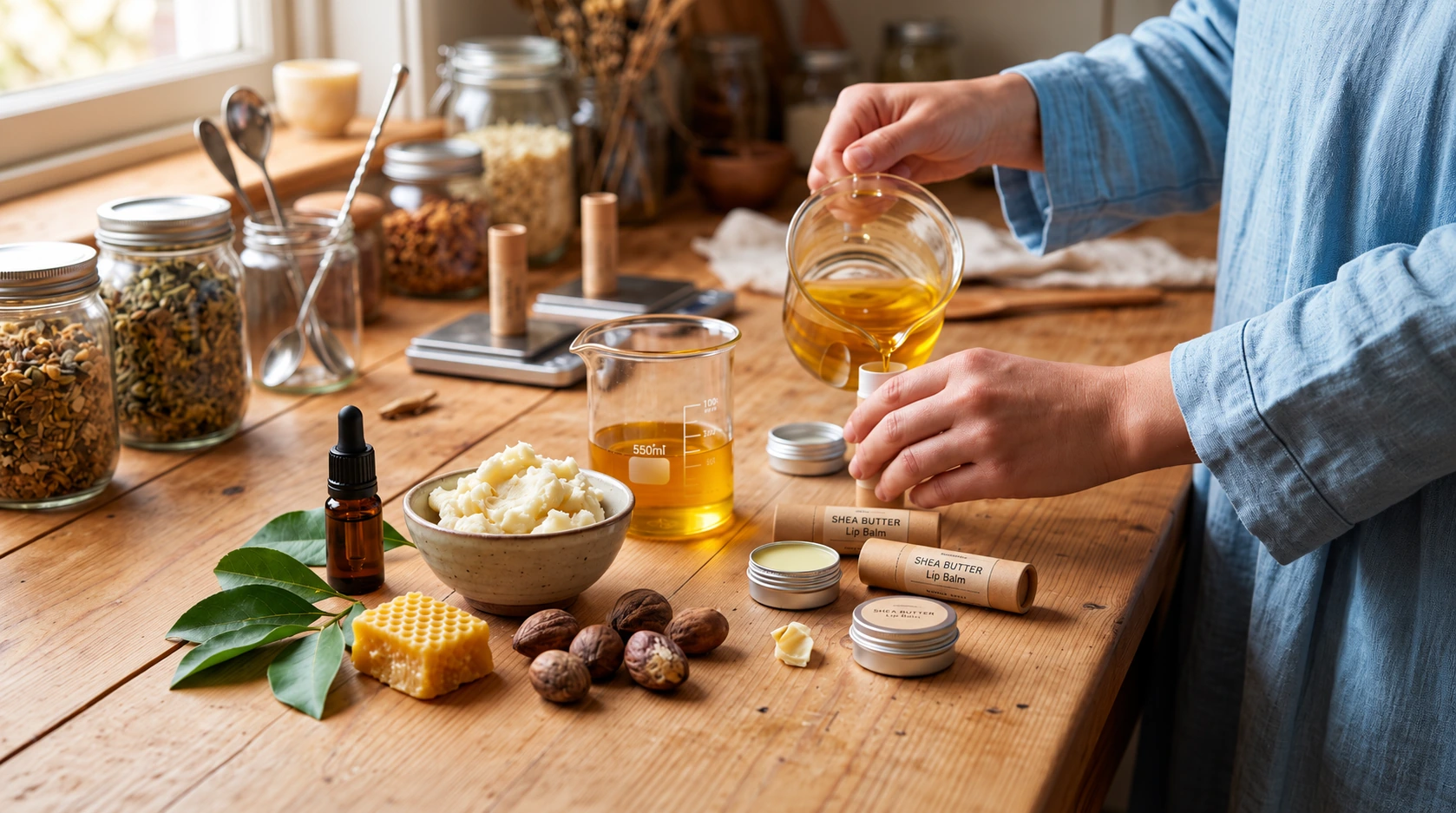
A simple anhydrous lip balm generally uses a solid lipid such as shea butter, one or more liquid oils and a structuring ingredient such as wax. Optional ingredients may support a sensory, color or oxidation-control goal, but each addition brings its own compatibility and labeling questions. The table shows common ingredient roles to evaluate, not a required formula.
| Ingredient group | Potential role | What to evaluate |
| Shea butter | Solid lipid and skin-conditioning contribution | Grade, odor, color, consistency and compatibility |
| Liquid oils | Adjust spread, glide and softness | Sensory profile, oxidation stability and compatibility |
| Beeswax or plant wax | Structure and firmness | Hardness, drag, payoff and package performance |
| Other butters, such as cocoa butter | Modify body and sensory profile | Crystallization, firmness and interaction with the other lipids |
| Flavor or fragrance | Add a sensory note when suitable | Lip-use suitability, restrictions, compatibility and labeling |
| Antioxidant, if needed | May help address oxidation in a suitable system | Ingredient-specific evidence, use conditions and test results |
Define the desired result first. Wax and oil balance can affect firmness, payoff, glide and softness, but compare prototypes because outcomes depend on the materials and proportions.
If comparing solid fats, the live guide to compare shea and cocoa butter offers adjacent context. It covers skincare, so assess lip-balm suitability separately. Elchemy’s Cocoa Butter ingredient product page is a product reference, not a substitute for a matched trial.
How should a formulator choose a grade and package?
Choose the shea butter and package against the product brief, then verify the specification with the supplier. Tubes need enough structure to hold and dispense the balm; tins or pots can accommodate a softer product. Choose by intended use, climate and target feel.
Record hardness, glide, payoff, appearance and odor targets, along with storage and use conditions. Include the package and distribution environment because a balm may soften in warmer conditions.
Refined and unrefined are not quality rankings. Select by specification, color, odor, sensory needs and confirmed application fit. Verify grade and origin claims with supplier documents; how shea butter is processed provides background.
Check fill, set, dispensing and container compatibility in the final package. A tube may expose drag or breakage that is less noticeable in a pot.
How can teams design a controlled lip-balm trial?
Begin with a documented base and change one structural variable at a time. This isolates the effect of grade, wax or oil blend without treating a home recipe as a commercial specification.
- Write the product brief. Record the target user and use occasion, stick or pot format, desired sensory profile, package, storage conditions, claims concept and review owner.
- Confirm material identity. Record the precise shea butter grade, specification, supplier lot and applicable handling information. Use current documents rather than a generic ingredient description.
- Select trial variables with a formulator. Decide whether to compare grade, butter-to-wax balance, oil blend or another controlled variable. Use a qualified formulator’s design; do not copy an unreviewed online percentage as a commercial formula.
- Document the process. Record weights, heating and mixing approach, pour or fill conditions, cooling, set time and observations for each prototype.
- Compare against a control. Keep the evaluation method and package consistent. Describe results only for the prototypes and conditions actually assessed.
| Prototype | Shea butter grade | Butter, wax and oil design | Package | Process notes | Texture and payoff | Follow-up checks |
| Control | Selected reference grade | Approved baseline formula; record actual proportions in the lab record | Intended final package | Use the approved baseline process | Record appearance, hardness, glide and payoff against the product brief | Establish baseline for repeatability, temperature exposure and package compatibility |
| Variant A | Alternate grade, if available | Same formula as control; change grade only | Same package as control | Keep all process conditions constant | Compare color, odor, hardness, glide and payoff with control | Check whether grade changes alter package performance or storage observations |
| Variant B | Same grade as control | Formulator-designed wax adjustment; keep other ingredients constant | Same package as control | Keep process conditions constant | Compare firmness, drag, glide and payoff with control | Assess dispensing, shape retention and texture under the planned conditions |
This is a proposed trial design, not test data or a formula. Set all proportions with a qualified formulator. For production context, see this cosmetic manufacturing process guide.
What should be evaluated before scaling?
A smooth appearance after pouring does not establish performance, package compatibility or shelf life. The technical team should set an evaluation plan for the product and package.
- Physical and sensory checks: appearance, odor, hardness, glide, payoff, graininess, separation and changes over time.
- Warm and cool conditions: observe softening and shape retention under relevant storage and distribution conditions.
- Packaging: assess filling, closure, leakage, dispensing, breakage and compatibility in the intended container.
- Quality and safety: assess raw-material documentation and product-specific risks with qualified reviewers. An anhydrous design does not remove the need to consider quality, safety and the final product’s use conditions.
- Claims: match each proposed benefit statement to evidence for the finished product, not only the known function of one ingredient.
Do not set shelf life from one fresh batch or an online recipe. Product-specific evaluation is needed, and formula changes may affect prior evidence.
If considering water-compatible ingredients in an anhydrous balm, review their roles and compatibility first. This humectants and emollients explained resource clarifies the terms, but does not provide a tested lip-balm formula.
For a contrasting water-based format, see <u>shea butter body lotion guide</u> [Shea Butter Body Lotion and Moisturizer: Formulation Guide].
Which U.S. claims and label details need review?
The product’s intended use and claims affect its regulatory category, so review the finished product and label together. FDA distinguishes cosmetic claims such as moisturizing from drug intended uses such as treating or preventing disease; sunscreen claims can make a product both. (FDA: Is It a Cosmetic, a Drug, or Both?)
Avoid claims such as “heals cold sores,” “treats chapped lips,” “repairs damaged lips” or “provides SPF” unless the product is being developed and reviewed for the applicable regulatory pathway. Shea butter itself does not establish an SPF value. The Cosmetic Ingredient Review’s safety assessment also should not be presented as a guarantee that every person will tolerate every finished product.
For a U.S. launch, have a qualified regulatory reviewer check the final ingredient declaration, product identity, warnings and claims. The FDA’s cosmetic labeling guide explains the labeling framework; it is a starting reference, not a product-specific legal review.
What should buyers confirm with a shea butter supplier?
Confirm material suitability and supply terms before locking a formula. A listing alone does not establish either.
- What is the exact product identity and grade under consideration?
- Which current specification and quality documents are available for that grade?
- Has the product team confirmed lip-care suitability?
- What packaging, quantity, origin, availability and lead time apply?
- Which certifications and documents cover the material and lot?
- What inquiry process applies to this quantity and destination?
Do not treat a certification, documentation package or supply capability as universal across all grades and lots. For additional procurement considerations, see this personal care ingredient supplier guide. Elchemy’s Personal Care and Cosmetics ingredients page provides a broader category path for buyers reviewing related materials.
Frequently asked questions
1. What does shea butter do in lip balm?
Shea butter can contribute a skin-conditioning and occlusive role, as well as body to an anhydrous balm. The final texture and user experience depend on the full formula, processing, package and use conditions. Ingredient function alone does not prove that a finished product will treat or heal dry lips.
2. How do you make shea butter lip balm?
At a high level, a formulator defines the product brief, weighs documented ingredients, combines them using a reviewed process, fills the intended package and evaluates the set product. That sequence is not a commercial formula. The ingredient proportions and process conditions need to be designed and tested for the specific materials and package.
3. Is refined or unrefined shea butter better for lip balm?
Neither is automatically better. Compare the grades against the project’s specification, color, odor, sensory target, available documentation and supplier confirmation for the intended application. Do not infer grade performance from the name alone; check the current product documents and test a representative material.
4. Why is my shea butter lip balm grainy?
Graininess is an observation to investigate, not proof of one specific cause. Review the ingredient lots, formula, heating and cooling history, and storage conditions with a qualified formulator. Change one variable at a time and compare against a control before selecting a corrective action.
5.How can I make lip balm firmer for a tube?
Tube dispensing depends on the balm’s structure, package and expected use temperature. A formulator can compare controlled variants and assess hardness, glide, payoff and softening in the intended container. Avoid a universal wax adjustment: increasing firmness may also change application feel or product release.
6. Does shea butter lip balm need a preservative?
There is no universal answer that applies to every product. The formula, process, packaging, water exposure and product-specific risk assessment all matter. Have a qualified formulator and safety reviewer assess the finished product rather than assuming that an anhydrous formula either always needs or never needs a particular preservative.
7. Can shea butter lip balm include SPF?
Do not treat shea butter as an SPF ingredient or make a sun-protection claim without developing the product for the applicable sunscreen requirements. In the United States, FDA considers intended use and claims when determining whether a product is a cosmetic, a drug or both. Refer the concept to a qualified regulatory specialist.
Conclusion
Shea butter can be a useful ingredient to evaluate in lip balm, but it is only one part of the system. Wax, liquid oils, material grade, process, package and climate all influence the result. A controlled prototype plan helps teams evaluate the product without mistaking a consumer recipe or ingredient-function statement for a validated commercial formula.
Before scale-up, confirm the material specification, application fit, supporting documents, package performance and claims review. If you are assessing Elchemy’s Shea Butter for a lip-care project, review Elchemy’s Shea Butter page and use its inquiry route to share the intended application, specification, quantity, destination and documentation needs for confirmation.