

Caffeine in Cosmetics: The Science Behind Eye Creams, Hair Serums & Anti-Cellulite Formulas
At a Glance
- Caffeine is an ingredient, not an efficacy claim: finished-formula performance depends on concentration, delivery system, stability, testing, and the claim language used.
- Eye products need an appearance-led approach: position caffeine around the look of puffiness or fatigue only when the final formula supports that claim.
- Scalp-serum evidence is promising but limited: research on topical caffeine and hair loss remains uneven, so “hair growth” claims need careful regulatory review.
- Body formulas require the most claim discipline: “reduces cellulite” can create a higher regulatory burden than cosmetic appearance claims.
- Supplier qualification matters early: review identity, technical documentation, impurities, solubility, batch consistency, and application support before formula scale-up.
What you’ll learn
How to evaluate caffeine for eye, scalp, and body-care applications, select practical starting ranges, and build a claims and sourcing plan around the finished cosmetic formula.
Introduction
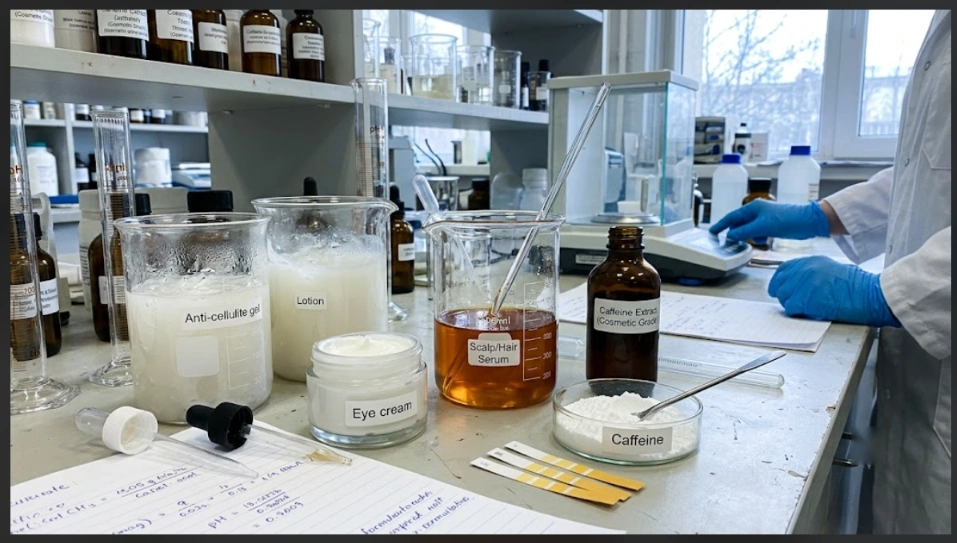
Caffeine in cosmetics can support several familiar product concepts: an under-eye serum designed for a refreshed appearance, a scalp treatment positioned around fuller-looking hair, or a body cream for uneven-looking skin. The challenge for formulators is that these applications have different technical needs, evidence standards, and claims risks.
Caffeine is usually evaluated as a purified active rather than a botanical extract. Teams comparing the ingredient format can start with this caffeine anhydrous form guide, then assess whether its documentation and performance fit the intended formula. This guide focuses on the formulation questions that matter before a product brief becomes a launch claim.
Caffeine’s role depends on the cosmetic application
Caffeine can be useful across eye, scalp, and body-care formulas, but it should not be treated as a universal solution. The ingredient’s relevance comes from its fit with a specific product concept, delivery system, sensory profile, and substantiated consumer-facing claim.
A 2023 review of caffeine in skincare describes caffeine’s broad use in cosmetic and dermatologic products. That does not establish that every caffeine formula delivers the same result. Formulators still need to validate the finished product under its intended conditions of use.
A useful decision rule is:
- Choose caffeine when the concept has a clear cosmetic rationale and the formula can deliver it consistently.
- Use a finished-product test plan before committing to visible-performance language.
- Separate ingredient evidence from claims about puffiness, hair loss, circulation, cellulite, or skin structure.
- Treat concentration as one development variable among many, alongside pH, solvent system, preservative compatibility, packaging, and sensory targets.
Caffeine in eye creams: keep the brief focused on appearance
Caffeine can fit under-eye creams and serums when the brief centers on the appearance of puffiness, tired-looking eyes, or a refreshed eye area. The formula should be designed for the specific skin area and then evaluated using an appropriate finished-product protocol.
The eye area raises practical constraints that are easy to overlook during concept development. A caffeine level that dissolves adequately in a body emulsion may behave differently in a lightweight eye gel, especially when the formula must also meet expectations for texture, non-pilling performance, preservative compatibility, and consumer tolerability.
| Formulation question | Why it matters | What to confirm |
| Ingredient solubility | Undissolved material can affect appearance and texture. | Solvent system, temperature, mixing order |
| Eye-area tolerability | The intended application area has low tolerance for irritation. | Finished-formula safety review and testing plan |
| Claim support | “De-puffing” needs evidence tied to the final product. | Instrumental, expert, or consumer substantiation |
| Packaging fit | Pumps and droppers can change dose consistency. | Dispensing amount and in-use stability |
For an under-eye product, the procurement brief should specify more than an INCI name. It should define the target format, expected concentration range, documentation needs, intended claims, and the development-stage volume required for trials.
Caffeine in hair serums: distinguish scalp care from hair-growth claims
Caffeine can be included in scalp serums, but an ingredient decision should not be mistaken for proof of a hair-growth claim. The most defensible route is to define the product’s cosmetic purpose first, then determine whether the finished formula has enough evidence for stronger language.
A 2025 systematic review of topical caffeine for hair loss identified nine clinical trials involving 684 participants. The review found that much of the evidence was low or very low certainty and called for better-designed studies with clearer concentration data. That makes formulation-specific substantiation essential.
For a cosmetic scalp serum, teams should distinguish these claim directions:
| Product direction | Development focus | Claim consideration |
| Scalp-conditioning serum | Sensory feel, scalp compatibility, routine use | Cosmetic claims may be suitable if substantiated |
| Fuller-looking hair concept | Film-forming, styling, and appearance benefits | Test the finished product’s visual effect |
| Hair-loss treatment concept | Clinical performance and biological effect | Requires specialist regulatory review |
The distinction matters because claims to treat hair loss or affect hair growth can move beyond a conventional cosmetic position. A product team should involve regulatory and legal reviewers before approving copy that implies treatment, prevention, or biological alteration.
Caffeine in anti-cellulite formulas: assess the claim before the ingredient
Caffeine can be considered for body creams targeting the appearance of uneven-looking skin, but “anti-cellulite” is not a simple cosmetic shorthand. The claim direction determines the evidence burden and may determine whether the product remains within a cosmetic framework.
A body formula may be commercially attractive because caffeine is familiar to consumers, but familiarity does not solve the substantiation question. Claims that say a product reduces cellulite, breaks down fat, or changes tissue structure should be reviewed closely. The FDA explains that claims affecting the body’s structure or function can cause a product to be regulated as a drug under U.S. law. See the FDA’s cosmetics claims guidance.
For a body-care project, build the brief around one of these routes:
- Appearance-led cosmetic route: assess language such as “improves the appearance of uneven-looking skin” against finished-product evidence.
- Sensory-led body-care route: focus on massage, texture, hydration, and a smoothing skin feel without suggesting structural change.
- Treatment-led route: pause cosmetic development and obtain specialist regulatory advice before using disease, fat-reduction, or tissue-change claims.
Use concentration ranges as starting points, not formula instructions
Caffeine concentration should be set through formulation work, not copied from an ingredient listing into a production batch. The appropriate level depends on product format, solvent system, claim scope, target market, performance testing, and the formula’s complete ingredient system.
Elchemy’s caffeine listing identifies the following topical starting ranges for technical review. They are useful for framing early development conversations, but they are not finished-formula recommendations.
| Application | Listed topical range | Development question |
| Under-eye cream or serum | 1–3% | Can the formula remain elegant and appropriate for the eye area? |
| Face product for puffiness | 1–2% | What finished-product evidence supports the intended appearance claim? |
| Hair or scalp serum | 0.5–1% | Does the formula support cosmetic scalp-care positioning? |
| Body or cellulite cream | 1–5% | Is the claim limited to cosmetic appearance and properly substantiated? |
Before selecting a range, request the caffeine technical data sheet and compare it with the product’s target specification. The review should cover identity, analytical requirements, storage conditions, documentation format, and any parameters relevant to the formula’s processing method.
Decide whether purified caffeine or a botanical route fits the brief
Purified caffeine and caffeine-containing botanicals answer different product-development questions. A purified ingredient can support clearer dose control, while a botanical route may fit a brand story that requires plant-origin materials, broader extract composition, or a particular label narrative.
Neither route is automatically superior. The correct choice depends on whether the brief prioritises caffeine concentration, sensory impact, formulation consistency, botanical positioning, supply continuity, or additional plant-derived components. Teams exploring a botanical option can compare the sourcing considerations in this green tea extract sourcing guide.
| Selection criterion | Purified caffeine | Botanical caffeine source |
| Active-content control | Usually easier to specify and dose | Depends on extract standardisation |
| Formula complexity | More focused ingredient contribution | Additional extract components may affect colour, odour, and stability |
| Marketing direction | Technical active-led concept | Botanical or plant-origin concept |
| Qualification need | Identity and batch consistency | Identity, standardisation, contaminants, and extract variability |
Choose purified caffeine if the product brief requires a defined caffeine input and controlled formulation work. Choose a botanical source if the wider extract profile and story are valuable enough to justify additional qualification work.
Build a sourcing brief before approving the first trial
A caffeine sourcing decision should combine technical, quality, commercial, and claims requirements in one document. This reduces the risk that procurement secures a suitable raw material while R&D later finds an incompatibility, or that marketing creates a claim the finished formula cannot support.
Use this qualification checklist:
- Define the application. State whether the ingredient is for an eye product, scalp serum, face product, or body cream.
- Set the claims boundary. Identify approved cosmetic language and claims that require further review.
- Request core documentation. Review TDS, SDS, COA format, batch identification, and storage information.
- Confirm formula needs. Include target use level, solvent system, processing temperature, pH range, and sensory requirements.
- Plan finished-product substantiation. Decide how the product team will support any puffiness, appearance, scalp, or body-care claim.
- Qualify commercial fit. Align development quantities, production volumes, packaging needs, and continuity expectations before launch.
For teams developing several product formats, personal care ingredient options can help frame adjacent raw-material requirements. Caffeine should still be qualified against the specific formula and claims plan rather than selected only because it is a familiar active.
A practical decision framework for cosmetic caffeine projects
Caffeine is most suitable when product concept, formula design, evidence plan, and claim language are aligned. It is less suitable when the launch strategy depends on treatment-style promises that the development programme cannot substantiate.
Choose an eye-area caffeine concept if the formula can support a well-defined appearance claim and has an appropriate tolerability plan. Choose a scalp-serum concept if the positioning remains cosmetic unless stronger evidence and regulatory review are available. Choose a body-care concept if the team can clearly separate cosmetic appearance language from claims to reduce cellulite or alter body structure.
The key procurement question is not simply, “Can we buy caffeine?” It is, “Can we obtain the right documented material for a formula and claims package that our team can support?”
Frequently Asked Questions
1. What does caffeine do in cosmetics?
Caffeine is used in cosmetics as an ingredient for product concepts including eye care, scalp care, and body care. Its practical value depends on the complete formula and intended claim. Ingredient-level research can inform development, but it does not replace finished-product testing or claim substantiation.
2. What percentage of caffeine is used in eye cream?
Elchemy’s product listing describes 1–3% as a topical starting range for under-eye creams and serums. The final percentage should be determined through formulation and testing because solubility, product texture, eye-area tolerability, packaging, and the intended appearance claim all influence suitability.
3. Can caffeine in a hair serum claim to treat hair loss?
A cosmetic hair serum should not assume it can claim to treat hair loss because that language may create a drug-regulatory issue. Start with the intended cosmetic benefit, review available evidence for the finished formula, and obtain regulatory advice before using growth or treatment-oriented claims.
4. Does caffeine reduce cellulite in body creams?
Caffeine in a body cream does not automatically support a claim that the product reduces cellulite. Claims about reducing cellulite, fat, or tissue structure can require a higher level of regulatory review. Cosmetic teams should define an appearance-led claim and substantiate it for the finished product.
5. Is purified caffeine better than green tea extract for cosmetics?
Purified caffeine is often easier to control when a formula needs a defined caffeine input. Green tea extract may suit a botanical concept but introduces broader extract variability and more qualification questions. The better option depends on the specification, brand position, and formulation requirements.
6. What documents should a cosmetic caffeine supplier provide?
A sourcing team should request technical and safety documentation appropriate to its qualification process, such as a TDS, SDS, COA format, batch identification, storage information, and relevant analytical details. The required package should match the formula’s risk profile and the organisation’s quality system.
7. How should brands substantiate topical caffeine claims?
Brands should substantiate topical caffeine claims using evidence relevant to the finished formula, intended user, use instructions, and specific wording. Depending on the claim, this may include stability work, safety assessment, instrumental testing, expert evaluation, consumer perception studies, or regulatory review.
Conclusion
Caffeine can support differentiated eye, scalp, and body-care concepts when the ingredient choice follows a clear formulation and claims strategy. Its usefulness comes from fit: the correct material, the right concentration range, a stable delivery system, appropriate documentation, and evidence for the finished product.
For a caffeine project, begin by defining the application and claim boundary, then qualify the ingredient against your technical and quality requirements. Review Elchemy’s caffeine product listing to assess the available technical information for your formulation brief.