

At a Glance
- Global green tea extract market: $1.23 billion (North America, 2025); organic segment growing 115.7% year-over-year
- Standardized potency: 40-98% EGCG (epigallocatechin gallate) with 80-98% total polyphenols; higher concentrations = premium pricing
- Extraction methods determine bioavailability: water extraction (traditional), ethanol (standard), supercritical CO2 (premium, 98% EGCG purity possible)
- Organic certification requirements: USDA Organic, EU Regulation 834/2007, JAS (Japan), or equivalent depending on target market
- Key suppliers: Indena (Italy), Naturex (France, now DSM), Martin Bauer (Germany), NESSO (India), Finlay (USA), Cepham (India)
- Green tea extract vitamin equivalency: One 100 mg dose of 40% EGCG extract = 2-3 cups brewed green tea (EGCG content)
- Quality markers: CoA (Certificate of Analysis), third-party testing, heavy metal limits <0.1 ppm, microbial <1000 CFU/g
- Pricing: Standard 40-50% EGCG $15-25/kg (bulk); organic certified $30-50/kg; premium 98% polyphenols $50-100+/kg
- Supply chain concentration: 60-70% of global supply from China and India; decentralized sourcing reduces single-source risk
- Minimum order quantities: Non-organic 25 kg; organic certified 50 kg minimum; custom standardization adds 4-8 week lead time
The global organic green tea extract market is growing at unprecedented rates, driven by consumer demand for natural ingredients, regulatory tightening around synthetic additives, and documented health benefits. For B2B buyers—supplement manufacturers, functional beverage producers, cosmetic formulators—sourcing becomes a strategic decision rather than a simple procurement transaction.
Understanding extraction methods, standardization levels, certification pathways, supplier stability, and quality verification determines whether your products deliver promised benefits, meet regulatory requirements, and maintain supply chain resilience. This is not a commodity purchase; it’s ingredient sourcing that requires technical due diligence.
Understanding Standardization: EGCG and Beyond
When sourcing organic green tea extract, standardization is everything. “Green tea extract” without specificity is meaningless because EGCG content varies 10-fold depending on source, processing, and extraction method.
The EGCG Standard
EGCG (epigallocatechin gallate) is the primary active compound driving health claims. It comprises 30-40% of total catechins in quality extracts. When suppliers state “40% EGCG,” they mean 40% of the total extract weight is pure EGCG compound.
For buyers, EGCG concentration maps directly to efficacy:
- 20-30% EGCG: Budget/commodity extract; minimal bioactive concentration
- 40-50% EGCG: Standard; meets most formulation requirements
- 70-80% EGCG: Premium; supports higher-potency claims
- 95-98% EGCG: Ultra-premium; reserved for professional supplement lines and clinical formulations
Total Polyphenol Content
Total polyphenols (measured as tannic acid equivalents) represent the collective antioxidant capacity. Quality extracts standardize both EGCG and total polyphenols:
- 70% polyphenols + 35% EGCG: Standard quality
- 80-90% polyphenols + 50% EGCG: Mid-premium quality
- 95%+ polyphenols + 70%+ EGCG: Premium quality
The ratio tells you something: if an extract claims 90% polyphenols with only 25% EGCG, the remaining polyphenols are less bioactive catechins or other compounds. Optimal extracts maintain high proportional EGCG within total polyphenol content.
Catechin Profile Standardization
Premium suppliers standardize four catechins:
| Catechin | Typical % of Extract | Function |
| EGCG | 35-50% | Primary antioxidant; thermogenic |
| ECG (epicatechin gallate) | 5-15% | Supporting antioxidant |
| EGC (epigallocatechin) | 10-20% | Antioxidant; cellular support |
| EC (epicatechin) | 5-10% | Antioxidant precursor |
Suppliers quantifying all four catechins via HPLC (high-performance liquid chromatography) demonstrate technical sophistication. Single-marker (EGCG-only) standardization is cheaper but less informative about overall extract quality.
Caffeine Content Variability
Organic green tea extract arrives in multiple caffeine profiles:
- Full-caffeine: 4-10% caffeine (original tea content; some applications prefer natural caffeine)
- Low-caffeine: 0.5-2% (partial decaffeination via water extraction)
- Decaffeinated: <0.5% caffeine (solvent-based removal; more expensive)
For evening formulations, sleeping aids, or sensitive populations, decaffeination is critical. Verify caffeine content in supplier documentation; don’t assume it’s standardized.
Extraction Methods: How It Impacts Quality and Cost
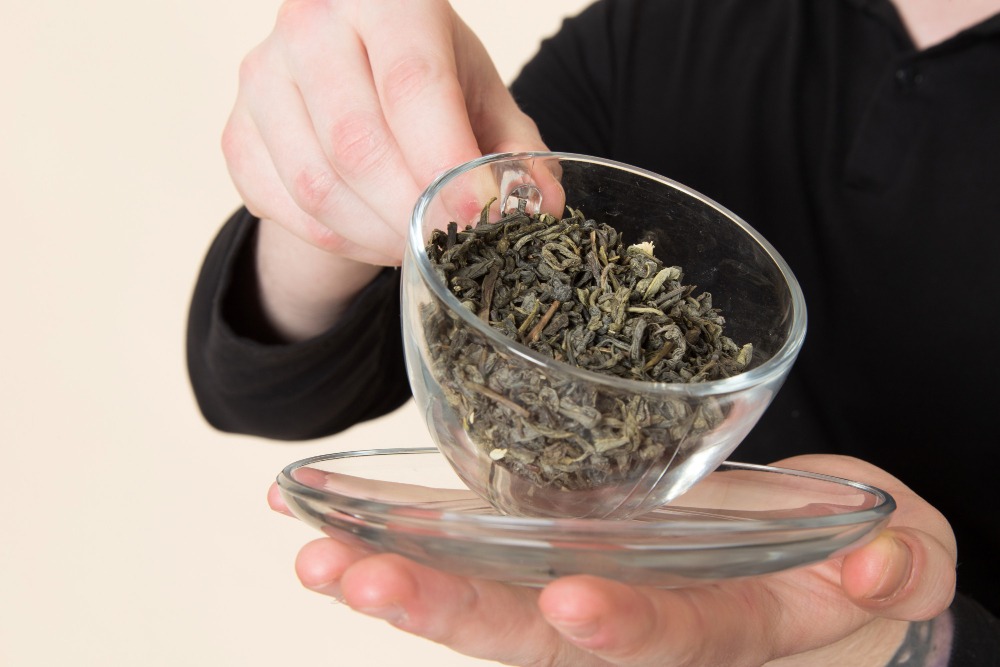
The extraction process determines final EGCG concentration, bioavailability, residual solvent content, and cost structure.
Water Extraction (Traditional, Most Common)
Process: Steeping dried green tea leaves in hot water, filtering, and spray-drying the liquid
Typical yield: 40-50% EGCG; 80-90% total polyphenols
Advantages:
- No toxic solvent residues; minimal regulatory concerns
- Preserves natural catechin balance
- Least expensive method ($15-25/kg wholesale)
- Suitable for certified organic claims globally
Disadvantages:
- Cannot achieve 95%+ EGCG concentrations
- Water-soluble impurities (cellulose, some tannins) remain
- Color and flavor compounds co-extract; may affect product appearance
- Lower bioavailability in some applications (water-based compounds less absorbable)
Ethanol Extraction (Standard Industrial)
Process: Alcoholic solvents (ethanol, ethyl acetate) selectively dissolve EGCG and catechins; alcohol evaporated leaving concentrated extract
Typical yield: 50-70% EGCG; 90-98% total polyphenols
Advantages:
- Higher EGCG concentration than water
- Better bioavailability (ethanol extraction removes some hydrophilic impurities)
- Scalable at industrial volumes
- Price premium modest ($25-40/kg)
Disadvantages:
- Ethanol residue must be tested (<0.5% FDA limit, <10 mg/L EU limit)
- Less “natural” perception; some organic certifications question solvent use
- Requires solvent recovery systems (environmental/safety)
- Flavor profile changes; vegetal notes reduced
Supercritical CO2 Extraction (Premium)
Process: Pressurized CO2 (above critical point: 31°C, 73 bar) acts as non-toxic solvent; precisely tuned pressure/temperature selects target compounds
Typical yield: 95-98% EGCG; 95%+ total polyphenols; minimal contaminants
Advantages:
- Highest purity achievable at industrial scale
- No solvent residues; CO2 leaves no toxic byproducts
- Highest bioavailability; most refined product
- True “natural” extraction; preferred for premium brands
- Minimal heavy metal carry-over (<0.01 ppm achievable)
Disadvantages:
- Capital-intensive equipment ($2-5M industrial units); only large suppliers use
- High operating costs; result in $50-100+/kg pricing
- 4-8 week lead time typical
- Minimum order quantities 100+ kg
- Overkill for commodity applications
Fermentation (Emerging, Niche)
Process: Enzymatic or microbial fermentation increases bioavailability and converts some catechins to more absorbable forms
Typical yield: 40-50% EGCG equivalent bioavailability (actual EGCG %, but enhanced absorption)
Advantages:
- Marketed as “enhanced bioavailability”; commands premium pricing
- Emerging research supports superior absorption
- Naturex’s fermented extract (France) commands 40% price premium
Disadvantages:
- Limited supplier base; 4-12 week production cycles
- Variable batch composition (fermentation is biological process)
- Premium pricing $40-70/kg without proven clinical superiority
- Not suitable for all applications (flavor changes)
For B2B Buyers: Method Selection Matrix
| Your Application | Recommended Method | Reasoning |
| Sports/weight management supplements | Ethanol, 50% EGCG | Cost-effective; sufficient potency; good bioavailability |
| Cosmetics/topical | Water or ethanol, 40-50% EGCG | Topical absorption less dependent on bioavailability; cost-sensitive |
| Clinical/high-potency formulation | Supercritical CO2, 95%+ EGCG | Highest purity; clinical credibility; premium positioning |
| Beverage/RTD products | Water or ethanol, 40-50% EGCG | Flavor compatibility critical; potency secondary to sensory |
| Premium supplement brand | Supercritical CO2 or fermented | Brand positioning around “premium,” “natural,” “advanced” |
| Budget/generic supplement | Water, 40% EGCG | Minimum cost; regulatory compliance sufficient |
Also Read: Replacing Artificial Colors: Non-Artificial Food Coloring in Modern Food Manufacturing
Organic Certification: Regional Requirements and Complexity
“Organic” is not a universal standard. Different certifying bodies impose distinct requirements, and some are mutually recognized while others require separate certification in each market.
USDA Organic Certification
Standard: USDA National Organic Program (NOP)
Requirements:
- Raw material sourced from certified organic tea farms (3-year conversion period for new farms)
- No synthetic pesticides, herbicides, or fertilizers in entire supply chain
- No GMOs
- Extraction must use approved solvents only (water, ethanol; CO2 approved; not certain synthetic solvents)
- Facility processing extract must be NOP-certified
- Annual audits and third-party verification mandatory
Timeline: 6-12 months from application to certification
Cost impact: 15-25% premium over non-organic equivalent
Audit frequency: Annual minimum; quarterly possible if issues arise
Authority: USDA NOSB (National Organic Standards Board) makes decisions on allowable inputs
EU Organic Certification
Standard: EU Regulation 834/2007 and implementing regulation 889/2008
Equivalent to USDA but with key differences:
- Stricter on solvent specifications (some extraction solvents allowed under USDA rejected in EU)
- Recognition of third-party certification bodies (Germany, France, Italy have reputable certifiers)
- Stricter pesticide residue limits (LOD <0.01 ppm for many compounds vs. US tolerance)
- Mandatory traceability documentation through entire supply chain
Cost impact: 10-20% premium; sometimes lower than USDA due to more streamlined certification process in some regions
Authority: EFSA (European Food Safety Authority) and member state agricultural agencies
JAS (Japan) Organic Certification
Standard: Japan’s Organic JAS regulations (equivalent to USDA/EU)
Market significance: Essential for Japanese supplement and beverage market (Asia-Pacific is 30%+ of global market)
Differences:
- Stricter on tea leaf farming practices (shade-grown preferences)
- Smaller acceptable farm sizes; favors smaller producers
- Recognition of traditional tea farming methods
Cost: 20-30% premium; longer timeline (12-18 months)
Non-Certified Suppliers (Cost Advantage, Risk)
Some suppliers claim “organic farming practices” or “pesticide-free” without formal certification. Pricing is 20-30% lower than certified organic.
Risk considerations:
- No third-party audit trail
- Cannot label products as “certified organic” (illegal in regulated markets)
- No recourse if contamination discovered after purchase
- Regulatory agencies increasingly scrutinize non-certified organic claims
Not recommended unless: (1) Domestic non-regulated market, (2) Verified through direct relationship with farmer, (3) Private label with understood risks
Key Quality Markers and Testing Standards
Before committing to supplier contracts, establish testing and verification requirements.
Certificate of Analysis (CoA) Requirements
Every batch must include third-party CoA documenting:
- Identity verification: Botanical confirmation (Camellia sinensis L. via DNA barcoding or HPLC profile matching)
- EGCG concentration: Via HPLC (gold standard); minimum 40% for standard, 50%+ for premium
- Total polyphenols: Via Folin-Ciocalteu method (FDA-recognized)
- Catechin profile: All four catechins (EGCG, ECG, EGC, EC) if premium product
- Caffeine content: Via HPLC (≤2% for “low-caffeine,” <0.5% for “decaffeinated”)
- Microbial testing: Total aerobic count <1000 CFU/g, E. coli absent, Salmonella absent
- Heavy metals: Lead <0.1 ppm, Cadmium <0.05 ppm, Arsenic <0.05 ppm, Mercury <0.01 ppm (stricter than FDA baseline)
- Pesticide residues: <0.01 ppm for 50+ common pesticides (EU standards applied if seeking international markets)
- Solvent residues: Ethanol <0.5% (HPLC); no residual acetone, hexane, or chlorinated solvents
Third-Party Testing Laboratories
Require testing by ISO/IEC 17025-accredited laboratory (independent verification):
- Not supplier’s in-house lab (conflict of interest)
- Minimum: SGS, Eurofins, or equivalent global laboratory
- Cost: $1,500-3,500 per comprehensive CoA
Include CoA verification in contracts; non-compliance triggers rejection.
Contaminant Screening
Heavy metals and pesticides are primary concerns:
- Lead accumulates in green tea plants; source water quality critical
- Cadmium uptake varies 5-fold by tea cultivar and soil pH
- Pesticide residues common in non-organic; rare in organic but possible from environmental drift
Establish baseline testing on first 3-5 orders; annual verification thereafter if supplier relationship stable.
Stability Testing
Organic extracts (no synthetic preservatives) require stability documentation:
- EGCG degrades over time if stored improperly
- Request stability data: EGCG loss <5% over 24 months at room temperature, <2% under 4°C
- Storage recommendation: Vacuum-sealed, nitrogen-flushed, 4°C optimal
- Shelf life: 24-36 months under proper storage
Sourcing Strategy: Suppliers, Pricing, and Supply Chain Resilience
The global green tea extract supply is concentrated (China 40-50%, India 20-30%), creating supply chain vulnerability.
Major Suppliers and Specializations
| Supplier | Origin | Specialty | EGCG Range | Certifications | MOQ | Pricing | Lead Time |
| Indena | Italy | Supercritical CO2; clinical-grade | 95-98% | USDA, EU, cGMP | 100 kg | Premium $60-100/kg | 8-12 weeks |
| Naturex (DSM) | France | Fermented; bioavailability-enhanced | 40% (enhanced bio) | USDA, EU, cGMP | 50 kg | $40-70/kg | 6-8 weeks |
| Martin Bauer | Germany | Water/ethanol blend; cost-effective | 40-50% | USDA, EU, cGMP | 25 kg | $20-35/kg | 4-6 weeks |
| NESSO | India | Standardized 4 catechins; GMP | 40-70% EGCG | USDA, EU, cGMP | 25 kg | $15-40/kg | 3-4 weeks |
| Finlay Extracts | USA | Domestic sourcing; fast delivery | 40-50% | USDA, cGMP | 50 kg | $25-45/kg | 2-3 weeks |
| Cepham | India | Competitive pricing; volume capacity | 40-60% | USDA, EU, cGMP | 25 kg | $12-30/kg | 3-4 weeks |
| Shaanxi Jintai | China | High-volume; cost-competitive | 40-60% | USDA, EU | 500 kg | $8-20/kg | 6-8 weeks (port-dependent) |
Supplier Evaluation Framework
When assessing new suppliers, require:
- Facility credentials: cGMP certification (mandatory), ISO 22000 (food safety), ISO 9001 (quality management)
- Audit history: Request copy of most recent FDA import audit (if US-regulated)
- Insurance: Product liability ($5M+ required), environmental liability
- Financial stability: Dun & Bradstreet rating; at least 5 years operating history
- Reference customers: 3-5 existing major customers (verify independently)
- Supply continuity: Multiple extraction facilities (not single-point failure)
- Traceability system: Farm-to-extract documentation; batch tracking
Supply Chain Risk Mitigation
Single-source dependence is dangerous. Implement:
- Dual sourcing: Two suppliers minimum (Indena + NESSO, or Martin Bauer + Finlay)
- Strategic inventory: 6-12 months supply on hand for critical SKUs
- Supplier redundancy: If primary supplier disrupted, secondary activated within 2 weeks
- Long-term contracts: Lock 2-3 year pricing for core formulations; hedge against inflation
- Regional diversification: Not all supply from China (geopolitical risk); Europe/India/US mix reduces tariff/logistics risk
Applications and Formulation Considerations
Organic green tea extract vitamin profile varies by standardization, affecting application suitability.
Green Tea Extract as Vitamin A Precursor (Limited)
Green tea is NOT a vitamin source; it has NO provitamin A (unlike beta-carotene). This is a key sourcing consideration: some buyers incorrectly think green tea extract replaces vitamin supplementation.
Green tea extract EGCG does offer antioxidant activity theoretically similar to vitamin E, but bioavailability and regulatory treatment are distinct. Do not market green tea extract as replacing vitamin supplementation.
Supplement Applications
Energy/metabolism support: 200-400 mg EGCG (50% extract = 400-800 mg extract) daily
Weight management: 300-500 mg EGCG (standard formulations use 2 capsules × 250 mg extract = 500 mg extract, targeting ~200 mg EGCG if 40% standard)
Cognitive support: 100-200 mg EGCG daily (lower dose than metabolism; L-theanine often co-formulated)
Cardiovascular health: 100-300 mg EGCG daily (emerging category; limited clinical data but growing)
Sports performance: 300-500 mg EGCG pre-workout (thermogenic + antioxidant for exercise recovery)
Beverage Applications
Ready-to-drink (RTD) teas: 20-50 mg EGCG per serving (subtle potency; sensory preference > efficacy)
Functional waters: 50-100 mg EGCG per serving (moderate potency; label-friendly)
Coffee additives: 100-200 mg EGCG per serving (synergy with caffeine from coffee)
Cosmetic Applications
Topical skincare (serums, creams): 2-5% extract by weight (40-50% EGCG products sufficient; penetration limited)
Anti-aging formulations: 3-7% extract; synergizes with vitamin C and niacinamide
Acne-prone skin: 2-3% extract (antimicrobial properties of EGCG; literature supports)
Hair care: 1-2% extract (scalp health formulations; evidence emerging)
Food and Beverage Processing
Flavor integration: Water or ethanol extracts preferred (supercritical CO2 removes flavor compounds; inferior taste)
Color stability: Extract concentration drives green intensity; standardized dosage critical for batch consistency
Clean label positioning: “Organic green tea extract” permissible on labels; communicates premium ingredient
Shelf life: Ethanol extracts more stable in beverage matrices than water-based
Regulatory Compliance and Labeling

Organic green tea extract faces different regulatory treatment depending on application (supplement vs. food vs. cosmetic).
Dietary Supplement (USA)
Classification: Dietary ingredient under DSHEA
Requirements:
- Supplement Facts label must declare “Green Tea Leaf Extract” with amount in mg
- If standardized, declare EGCG content: “…standardized to 40% EGCG (X mg per serving)”
- Structure-function claims permitted: “supports antioxidant activity,” “supports healthy metabolism”
- Disease claims prohibited: “prevents cancer,” “cures heart disease” (violate drug definition)
Cosmetic (USA)
Classification: Cosmetic ingredient; not requiring pre-approval
Requirements:
- Ingredient declaration as “Camellia sinensis Leaf Extract” (INCI nomenclature)
- No health claims permitted on label
- Advertising can discuss “supports skin health” (cosmetic claims only)
Food Ingredient (USA, EU)
Food additive classification varies:
- USA: GRAS status for flavoring agent; regulatory acceptance established
- EU: Approved food additive E400-complex (polyphenols); specific restrictions per product category
Requirements:
- Beverage: Ingredient declaration sufficient; no health claims without substantiation
- Fortified products: Nutrient content claims require FDA pre-approval (high bar)
- Organic label: All organic ingredients listed with % organic content
International Compliance
If exporting:
- China: Strict requirements for botanical supplements; liaison with NMPA
- Japan: JAS organic certification near-mandatory for health claims
- Australia: TGA (Therapeutic Goods Administration) evaluation required for therapeutic claims
- Canada: Novel food assessment possible depending on processing/origin
Work with regulatory consultant if multi-market launch planned; compliance costs $20-50k.
Pricing and Cost Considerations
Understanding pricing structure helps B2B buyers negotiate effectively and avoid overpaying.
Wholesale Pricing Model (FOB Origin, Early 2026)
Non-organic, water-extracted, 40% EGCG, bulk (1 MT):
- China supplier: $10-15/kg
- Indian supplier: $12-18/kg
- European supplier: $18-25/kg
Organic-certified, ethanol-extracted, 50% EGCG, bulk (500 kg):
- Indian supplier: $25-35/kg
- European supplier: $35-50/kg
- USA domestic: $40-60/kg
Premium/clinical-grade, supercritical CO2, 95%+ EGCG, (100 kg minimum):
- European (Indena): $70-100/kg
- Specialized extractors: $80-120/kg
Hidden Costs and Negotiations
Shipping: FOB pricing doesn’t include freight
- Container shipping (20 ft): $2,000-5,000 from Asia; $1,000-2,500 from Europe
- Air freight: 2-3x container cost; 4-6 week lead time reduction
Insurance and Duties:
- Import tariffs: 5-15% depending on origin (China higher due to tariffs; EU lower)
- Insurance: 1-2% of shipment value
- Port fees/logistics: $500-1,500 per container
Testing and Certification:
- CoA (third-party): $1,500-3,500 per batch
- Initial certification (if new supplier): $3,000-8,000
- Recurring annual audit: $2,000-4,000
Long-term Purchase Agreements (Price Locks):
Negotiate volume discounts and price stability:
- 100 MT/year commitment: 10-15% discount vs. spot pricing
- 2-year fixed pricing: 5-10% discount (hedges inflation risk)
- 500 kg initial order + growth commitment: 8-12% discount
Total Cost of Ownership for 1 MT annual consumption:
- Commodity (China, 40% EGCG): $15-20/kg material + $5-8/kg logistics/duties = $20-28/kg total
- Mid-market (India organic, 50% EGCG): $30-40/kg + $6-10/kg = $36-50/kg total
- Premium (Indena supercritical, 95% EGCG): $80-100/kg + $8-10/kg = $88-110/kg total
Wrapping Up
Green tea extract vitamin-like antioxidant activity makes it valuable across supplements, cosmetics, and functional foods, but clarity on applications determines optimal standardization. Supplement manufacturers need 40-50% EGCG minimum; cosmetic formulators can use lower concentrations; clinical/premium brands justify supercritical CO2 extraction at 95%+ purity.
Supply chain concentration in China and India creates vulnerability; dual sourcing and strategic inventory (6-12 months) mitigate disruption risk. Organic certification adds 15-30% cost premium but expands market access and enables premium brand positioning.
For B2B buyers implementing sustainable sourcing, Elchemy provides organic-certified green tea extracts across standardization levels (40-95% EGCG), verified third-party testing, compliance documentation, supply chain transparency, and technical support for formulation optimization across supplement, cosmetic, and food applications.