

Food Grade vs Pharma Grade White Mineral Oil: USP, BP & FDA
At a Glance
- Start with the intended use: direct food use, food-contact use, and pharmaceutical use follow different qualification routes.
- Food grade is not a complete specification: the buyer still needs the applicable regulation, permitted use, viscosity, and current documentation.
- USP and BP are separate references: a supplier’s claim needs support from the applicable current monograph and product-specific evidence.
- 21 CFR 172.878 is application-specific: it permits white mineral oil in food under defined conditions and use limitations.
- The right grade is conditional: choose the specification that matches the product, process, market, and quality-system requirement.
What you’ll learn
How to evaluate white mineral oil for food, food-contact, and pharmaceutical applications without treating broad grade labels as proof of suitability.
Introduction
A white mineral oil requirement can look straightforward until procurement, quality, and regulatory teams ask different questions. The buyer may need an oil used directly in or on food, a lubricant or component in a food-contact system, or an excipient for a pharmaceutical product. Those uses may share a material name, but they do not share one automatic regulatory route.
The practical decision is not whether a supplier calls the material food grade or pharma grade. It is whether the offered lot, specification, and documentation support the intended application. Start by reviewing white mineral oil technical data, then define the exact use, viscosity requirement, governing standard, and evidence package before approving a source.
What food grade and pharma grade mean in a purchase specification
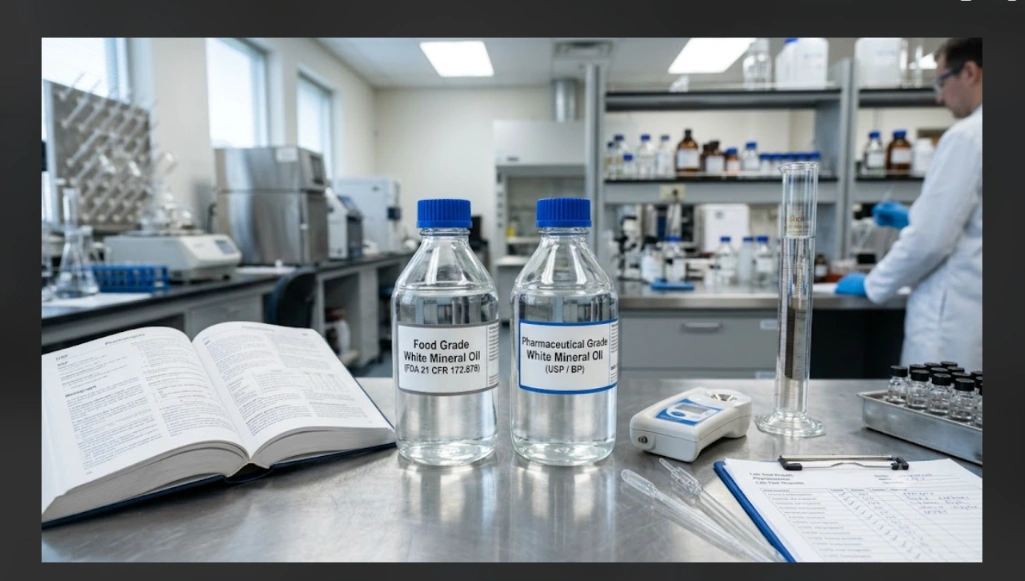
Food grade and pharma grade describe different qualification routes, so neither label is sufficient without an intended-use statement. White mineral oil may also be called white oil, liquid paraffin, or paraffin oil, but commercial naming does not establish regulatory status or pharmacopeial compliance.
A buyer should treat the product name as the starting point for a specification review. The purchase requirement should identify the application, target standard, physical-property limits, required documents, and lot-release expectations.
| Term on a specification | What it may indicate | What the buyer must verify |
| Food grade | Intended suitability for a food-related use | Applicable regulation and listed use |
| USP / NF | A pharmacopeial claim | Current monograph and supplier declaration |
| BP | A British Pharmacopoeia claim | Current monograph, edition, and market need |
| Pharma grade | A commercial positioning term | Actual pharmacopeial and quality evidence |
| White oil / liquid paraffin | A naming variant | CAS, viscosity, specification, and intended use |
Some buyers use “white mineral oil” and “mineral oil” interchangeably. The mineral oil product details page can help establish the commercial product context, but the final qualification should always use the offered material’s current TDS, SDS, COA, and compliance statement.
Route the application before choosing a regulation
The intended use determines whether a buyer should begin with food-additive rules, food-contact rules, or pharmaceutical-quality requirements. A white mineral oil that is suitable for one application cannot be assumed suitable for another simply because it has the same CAS number or general description.
Use the application as the first filter. This avoids a common sourcing failure: asking for “food grade mineral oil” when the real requirement is a release agent used directly on food, a lubricant in incidental food contact, or a pharmaceutical processing aid.
| Intended use | Starting question | Evidence to request | Do not assume |
| In or on food | Is the exact use listed and permitted? | Regulation review, TDS, COA, use statement | Food contact covers direct food use |
| Food release or polishing | Does the use and limit match the process? | Regulation review and process details | Any release application is permitted |
| Food-contact article | Is the oil part of a nonfood article that contacts food? | Food-contact route and product documents | A food-use rule applies automatically |
| Pharmaceutical product | Does the product need current pharmacopeial evidence? | Current monograph review, COA, quality documents | “Pharma grade” proves compliance |
| Personal care or industrial use | Which technical and safety requirements apply? | TDS, SDS, specification, process review | Food or pharma evidence is required |
The terminology can create additional confusion because paraffin oil white may describe the same broad material family in a different commercial context. Review the paraffin oil white overview as a naming reference, then qualify the exact offered product rather than relying on an alias.
FDA 21 CFR 172.878 covers defined food uses
FDA 21 CFR 172.878 addresses white mineral oil used in food under defined conditions, not every food-related application. The current regulation describes white mineral oil as a mixture of essentially paraffinic and naphthenic liquid hydrocarbons obtained from petroleum and sets specification requirements for this food-use route.
The regulation also identifies permitted uses and limitations. For example, it includes specific provisions for use as a release, sealing, or polishing agent in confectionery, and for defined grain dust-control applications. The buyer must check the complete regulation against the intended process rather than transferring one listed use to another product or plant operation.
21 CFR 172.878 incorporates particular historical USP test requirements for readily carbonizable substances and sulfur compounds, together with an incorporated analytical specification. That reference does not mean a supplier can automatically claim current USP–NF compliance for every material or application.
For a direct food-use project, the sourcing brief should state:
- The food or process involved.
- The technical purpose of the oil.
- The relevant permitted use and limitation.
- The required viscosity or physical-property range.
- The documentation and lot-release evidence required by the buyer’s quality system.
FDA 21 CFR 178.3620 is a separate food-contact decision
FDA 21 CFR 178.3620 applies to mineral oil used as a component of nonfood articles intended for food contact. This is a different question from whether white mineral oil may be added directly to food or applied directly on food.
The distinction matters for equipment lubrication, coatings, packaging-related systems, adhesives, and other food-contact situations. A buyer should not use “food grade,” “food contact,” “incidental contact,” and “direct food addition” as interchangeable procurement terms.
21 CFR 178.3620 states that white mineral oil meeting the specifications in 21 CFR 172.878 may be used as a component of nonfood articles, subject to applicable limitations. It also addresses technical white mineral oil for specified food-contact uses.
| Question | Direct food use: 21 CFR 172.878 | Food-contact route: 21 CFR 178.3620 |
| What is being assessed? | White mineral oil used in food | Mineral oil in nonfood articles contacting food |
| Does the exact use matter? | Yes, listed uses and limits apply | Yes, the article and applicable provisions matter |
| What should procurement request? | Use statement, specification, COA | Food-contact applicability and product documents |
| Can one label settle the decision? | No | No |
For adjacent food-processing needs, the food processing product portfolio provides a broader ingredient navigation path. It does not replace an application-specific regulatory assessment.
USP, BP, and current pharmacopeial claims require separate confirmation
A USP or BP claim should be verified against the current applicable monograph and the actual supplied lot. Historical USP tests referenced in a food regulation are not the same thing as a current pharmacopeial declaration for pharmaceutical use.
USP and FDA food rules are related but not identical
FDA 21 CFR 172.878 incorporates named historical USP tests as part of its white mineral oil specification. That is a regulatory reference within a food-use provision, not a shortcut around a current USP–NF review for pharmaceutical manufacturing.
If a pharmaceutical customer requires USP–NF status, the sourcing team should confirm the applicable current monograph, edition, test methods, specification limits, and supplier declaration. It should also establish whether the finished product, market, and quality agreement impose further controls.
The mineral oil technical data page can support an initial document review. It cannot, on its own, establish that a material meets the buyer’s current pharmacopeial requirement.
BP is a separate pharmacopeial requirement
BP is a separate pharmacopeial standard and should not be used as a general synonym for pharmaceutical grade. A buyer supplying the United Kingdom or another BP-relevant market should identify the applicable current monograph, edition, naming convention, and product-specific supplier evidence.
This distinction is useful when a procurement team receives a generic “USP/BP” supplier statement. The correct response is to ask which monographs apply, whether the offered lot is covered, which test methods were used, and whether the evidence fits the finished product’s target market.
For terminology alignment, the white oil product overview can help readers compare commercial names. It should not be used as proof of BP or USP compliance without current supporting documents.
Compare the evidence package, not the grade label
The practical difference between food and pharmaceutical white mineral oil is the evidence package needed for the intended application. Purity language may be relevant, but it does not replace a documented link between the material, the standard, the application, and the specific lot.
| Evaluation criterion | Food-use requirement | Pharmaceutical-use requirement | Buyer action |
| Intended use | Listed food use or food-contact route | Finished-product and market requirement | Define the use before quoting |
| Governing source | Applicable FDA regulation | Current pharmacopeial and quality requirements | Obtain QA confirmation |
| Product specification | Must fit the permitted use | Must fit the monograph and formulation need | Compare line by line |
| COA requirement | Supports lot conformance | Supports lot and compendial review | Request current COA format |
| Viscosity | Must fit process performance | Must fit formulation or process need | State the acceptable range |
| Traceability | Needed for quality review | Often more extensive quality-system need | Define lot and change controls |
| Supplier declaration | Use-specific compliance statement | Monograph-specific declaration | Avoid generic grade wording |
This comparison also explains why a lower-cost quote may not be commercially comparable. Two materials can both be called white mineral oil while differing in viscosity, analytical controls, documentation, packaging, producer, origin, and approved-use evidence.
Build a supplier-qualification checklist before the first order
A compliant white mineral oil purchase begins with a defined application and a documented evidence request. The checklist should be completed before a production order, especially where the material enters food, pharmaceutical, or tightly controlled manufacturing.
- Define the application. State whether the oil is used directly in food, in a food-contact system, in a pharmaceutical product, or in another process.
- Name the governing requirement. Identify the relevant FDA section, pharmacopeial monograph, customer specification, or internal quality standard.
- Set physical-property needs. Define viscosity, appearance, odour, storage, and processing requirements.
- Request core documents. Review the TDS, SDS, COA format, lot identification, and storage information.
- Request an application statement. Ask the supplier to connect the specific offered material to the intended use.
- Verify pharmacopeial claims. Confirm the applicable current USP–NF or BP monograph rather than accepting generic wording.
- Check change controls. Confirm how changes to source, process, specification, or documentation are communicated.
- Obtain formal approval. Route the package through procurement, QA, regulatory, and technical stakeholders before release.
For safety-document review, the white oil safety data page is a useful starting point. The final assessment should use the SDS issued for the exact product and lot route under consideration.
Choose the route that matches the application
The correct white mineral oil specification is the one that matches the intended use and evidence burden. A material marketed for several industries may still need separate qualification before it is accepted for a particular food, pharmaceutical, or food-contact process.
Choose a food-use route if the oil is used directly in or on food and the exact use is supported by the applicable regulation. Pick a food-contact route if the oil is part of a nonfood article intended to contact food. Choose a pharmaceutical route if the product and market require current pharmacopeial evidence and pharmaceutical quality-system controls.
Pause the purchase when the supplier cannot connect the exact material, application, standard, and documentation. That pause is usually less costly than qualifying an unsuitable grade after a formulation, process, or customer audit identifies the gap.
The food and nutrition industry page can help food-sector buyers explore related ingredient categories. It should sit alongside, rather than replace, the specification and regulatory review described above.
Frequently Asked Questions
1. Is food-grade white mineral oil the same as USP mineral oil?
No. Food-grade white mineral oil and USP mineral oil may overlap in some product offerings, but they answer different compliance questions. Food use depends on the applicable regulation and permitted application. A current USP–NF claim requires confirmation against the relevant monograph and supplier documentation for the supplied material.
2. Does 21 CFR 172.878 approve every food application?
No. FDA 21 CFR 172.878 permits white mineral oil in food under defined conditions, specifications, uses, and limitations. A buyer should identify the exact food or process use and check it against the current regulation. A general food-grade statement does not replace that application-specific review.
3. What is the difference between 21 CFR 172.878 and 21 CFR 178.3620?
21 CFR 172.878 addresses white mineral oil used in food, while 21 CFR 178.3620 addresses mineral oil used as a component of nonfood articles intended to contact food. The correct route depends on whether the material enters or contacts food directly, and on the exact process involved.
4. Does a USP claim automatically mean BP compliance?
No. USP and BP are distinct pharmacopeial references. A supplier’s USP declaration does not automatically establish BP compliance, and vice versa. Buyers should identify the relevant current monograph, edition, market requirement, test methods, and product-specific evidence before approving a pharmaceutical-use material.
5. What documents should a buyer request for pharma-grade white mineral oil?
A buyer should request a current TDS, SDS, COA format, lot traceability information, applicable pharmacopeial declaration, specification, storage guidance, and change-notification process. The quality team should then compare those documents with the current monograph, customer specification, and finished-product requirements before material approval.
6. Is white mineral oil the same as liquid paraffin?
White mineral oil and liquid paraffin are often used as related or overlapping commercial names for highly refined petroleum-derived liquid hydrocarbons. However, naming does not prove identical viscosity, specification, regulatory status, or pharmacopeial compliance. Buyers should qualify the exact offered material rather than relying on a name alone.
7. How does viscosity affect white mineral oil selection?
Viscosity affects processing, lubrication, coating behaviour, dosing, and finished-product performance. It can also influence whether a material fits a specific regulated use or customer specification. Procurement should state the required viscosity range and test method in the RFQ instead of accepting a generic white mineral oil offer.
Conclusion
Food grade and pharma grade are useful starting descriptions, but neither replaces a specification matched to the intended application. For white mineral oil, the key distinction is whether the material is used directly in food, in a food-contact system, or in a pharmaceutical product requiring current pharmacopeial evidence.
Define the use first, then verify the regulation, monograph, viscosity, and lot documentation with the appropriate internal reviewers. Review Elchemy’s White Mineral Oil product listing to request application-specific pricing and documentation for your sourcing brief.