

At a Glance
- Acid is sulfur’s main use. In its US summary, USGS reports that about 90% of the sulfur consumed was in the form of sulfuric acid.
- Concentration drives both use and transport class. Battery electrolyte runs near 37%, concentrated acid is 98%, and acid above 51% ships as UN1830.
- Producers come in three types. Sulfur-burning plants, smelters that recover acid as a byproduct, and reclaimers of spent acid.
- Specify more than the percentage. Ask for assay, iron, chloride and heavy metals, plus a COA, TDS and SDS.
- Sulfur is volatile, so acid pricing is too. USGS puts sulfur’s 2025 average value at $180 per metric ton, up from $46.42 in 2024.
What You’ll Learn
You will learn which concentration fits each use, what to verify, and how to source sulphuric acid in bulk.
Introduction
Sulphuric acid manufacturers and suppliers are easy to find, but a quote only helps once your specification is clear. A fertiliser plant, a battery line and a water treatment site buy the same chemical in very different forms. Mixing them up wastes time at the quoting stage and risks specifying the wrong grade.
This guide is for procurement, plant and EHS teams that buy or specify industrial acid. It covers industrial uses, producer types, specifications, safety, transport and quote comparison. It also shows how concentration changes handling and transport rules.
For how the acid is made, read our contact process guide. Figures come from named sources. Where a source gives no number, this guide says so instead of estimating one.
Sulphuric acid manufacturers: three producer types
Sulphuric acid comes from three kinds of producer. Each starts from a different feedstock, so each suits a different buyer. Knowing which one made your acid also tells you what to ask for.
USGS estimates US sulfur production at 8.1 million metric tons in 2025. Of that, 7.6 million was recovered elemental sulfur from refineries, gas-processing plants and coking plants.
| Producer type | Where the acid comes from | Ask the supplier |
| Sulfur-burning plant | Sulfur is burned to SO₂, converted to SO₃ and absorbed in acid | Sulfur source and the grade range offered |
| Smelter byproduct | Acid recovered at nonferrous metal smelters, five in four US states per USGS | Impurity profile and continuity of supply |
| Spent acid reclaimer | Used acid from refining and chemical processes, 2.5 to 5 million tons reclaimed yearly | Which grade the reclaimed acid meets |
Manufacturers of sulfuric acid differ from the distributors and sourcing partners that resell their output. Producers make the acid, while distributors hold stock and arrange delivery. Our manufacturer vs distributor guide compares the routes.
Elchemy lists sulphuric acid as a supplier, manufacturer partner and distributor. Confirm the producer and origin on any quote you receive, from Elchemy or anyone else.
Sulphuric acid uses by industry and concentration
Concentration decides what sulphuric acid can do. Concentrated acid at 98% serves fertiliser, chemical synthesis and metal pickling, while weaker solutions serve batteries and water treatment. The table follows the grade list on Elchemy’s product page, which names phosphate fertiliser as the largest use.
| Use | Typical form | What to check |
| Phosphate fertiliser | Concentrated, 98% | Assay and supply continuity |
| Chemical synthesis and metal pickling | Concentrated, minimum 98.5% | Impurity limits set by your process |
| Petroleum refining and ore processing | Concentrated or dilute | Concentration your process specifies |
| Battery electrolyte | About 37%, or 98% high purity | Low iron, chloride and heavy metals |
| Water treatment | Dilute solution | Dose set by a lab trial |
| Oleum applications | Above 100% with free SO₃ | Whether your process needs free SO₃ |
Fertiliser is the clearest example. Elchemy’s product page says the acid digests phosphate rock to make phosphoric acid and single superphosphate. Battery electrolyte uses 29 to 50% acid by weight, and the page gives 50% as one pickling example.
How to choose a grade
A grade is a promise about concentration and impurities. Pick the lightest grade your process allows, then confirm it on the COA.
- Choose concentrated 98% acid if you make fertiliser or synthesis products, or pickle metal, and can dilute on site.
- Choose battery grade if iron, chloride and heavy metal limits matter, as they do for electrolyte.
- Choose dilute acid if your process doses weaker solutions and you want to avoid on-site dilution.
- Choose oleum if your process needs free SO₃ and your site can handle fuming acid.
Specifications and documents to request
A concentration is not a specification. Two suppliers can both offer 98% acid and still differ in impurities and documents. Ask each one for the same data.
| Property | Value on Elchemy’s product page |
| Appearance | Colourless viscous liquid |
| Density | 1.8302 g/cm³ |
| Assay | Minimum 98.50% |
| pH | Below 0.1 for a 93% solution |
| Boiling point | 337 °C |
A US distributor’s product page states the same density. Melting point figures vary with concentration, so request the value for your grade.
- Concentration and assay, with the test method.
- Impurities: iron, chloride and heavy metals against your limits.
- Packaging: material, size and closure.
- Documents: a COA, TDS and SDS for the batch.
- Transport paperwork that matches the concentration.
Elchemy’s product page lists a COA, TDS and SDS with every order. Before a first order, Request a Sample and compare it with the batch COA.
Safety and handling for sulphuric acid
Sulphuric acid is corrosive and reacts violently with water, releasing heat. The NIOSH Pocket Guide lists both an OSHA PEL and a NIOSH REL of 1 mg/m³ as a time-weighted average. The IDLH value is 15 mg/m³.
Always add acid to water, never the reverse. Wear acid-resistant gloves, a face shield, goggles and acid-rated clothing. NIOSH advises eyewash and quick-drench facilities where acid above 1% is handled.
NIOSH lists organic materials, chlorates, carbides, fulminates, water and powdered metals as incompatible. Elchemy’s product page gives the GHS classification as Skin Corrosion 1A, H314. For storage practice, see our storage guide, and have qualified safety staff review the SDS for your site.
Bulk transport and receiving
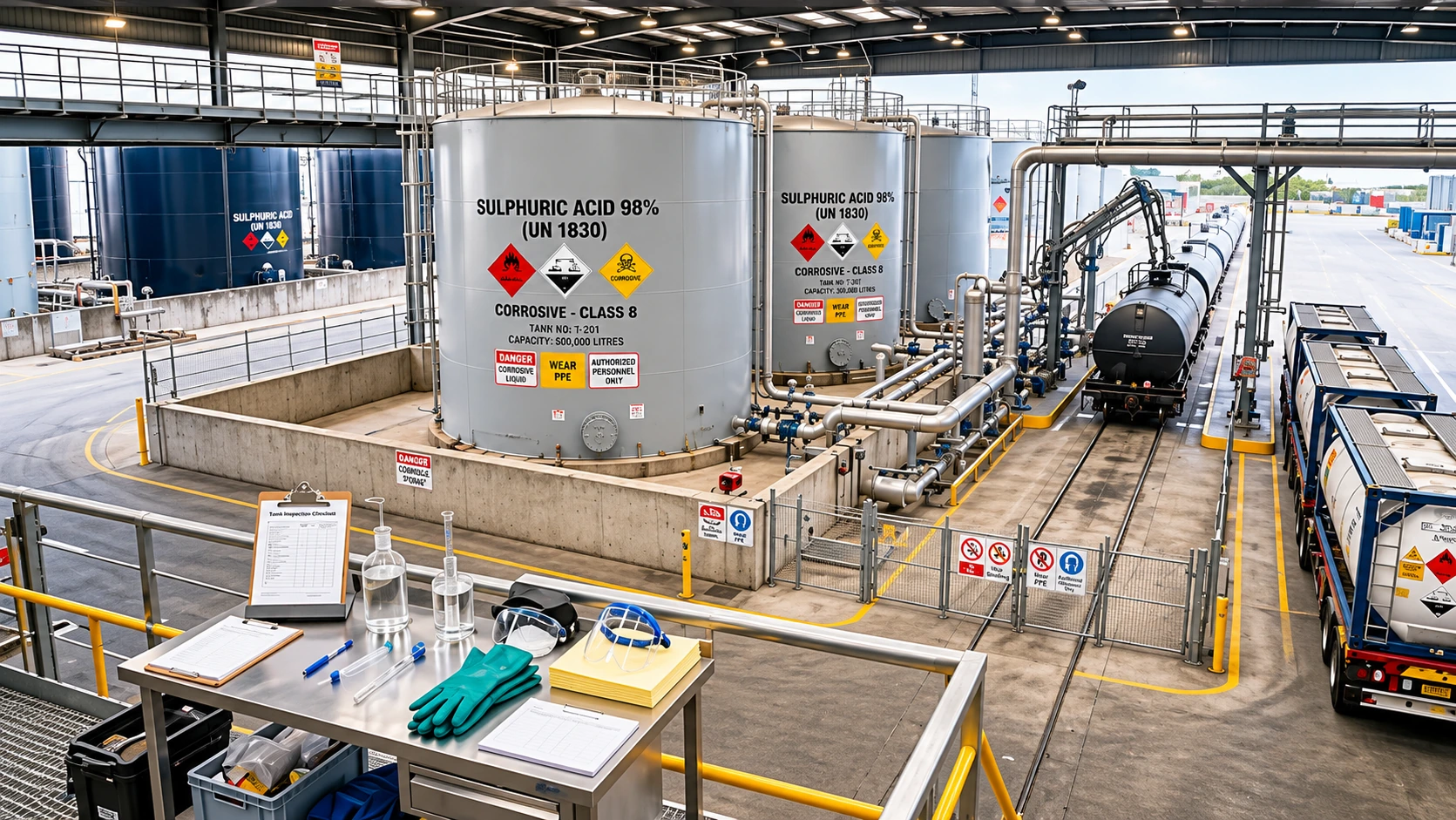
Concentration also sets the transport rules. NOAA CAMEO lists UN1830 for sulfuric acid with more than 51 percent acid, Class 8. Acid of 51% or less ships as UN2796, also Class 8, according to the same database.
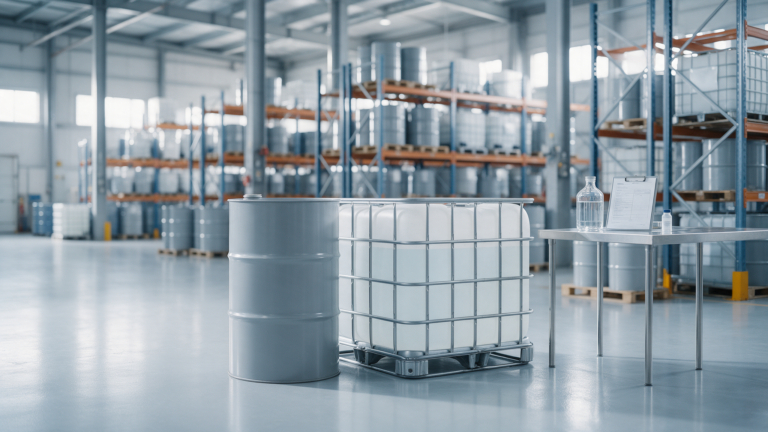
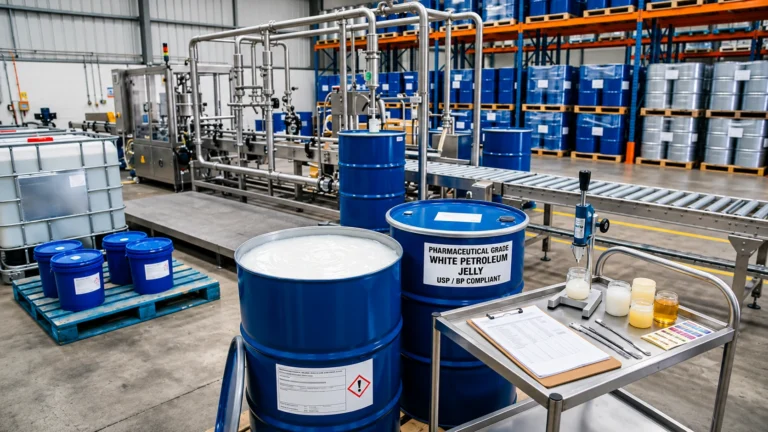
Elchemy’s product page lists HDPE drums, jerry cans, IBC totes and road or rail tankers, without stating sizes. For sulphuric acid bulk deliveries, tanks and IBC liners must be compatible.
The page says carbon steel should never be used with dilute acid. It also says commercial orders typically start from 1 MT, so ask for the exact minimum for your grade.
| Delivery format | Check before accepting |
| Drums and jerry cans | HDPE material and safe handling points |
| IBC totes | Compatible liner and discharge fitting |
| Road or rail tanker | Receiving tank material and unloading equipment |
| Any format | Which Incoterm applies: FOB, CIF or DDP |
Receiving checklist
Receiving is where mismatches show up. A short checklist at the dock helps catch them before the acid reaches a tank.
- Match the COA concentration to the purchase order.
- Confirm the UN number on the paperwork fits the concentration.
- Check that tanks, liners and fittings use compatible materials.
- Confirm eyewash and quick-drench facilities are in place.
- Keep the current SDS at the point of use.
What drives sulphuric acid pricing
Elchemy’s product page says acid pricing follows the cost of sulphur and energy. USGS data show how volatile the sulfur input has been. Its average unit value was $180 per metric ton in 2025, up from $46.42 in 2024.
Tampa contract prices ran from $116 per long ton at the start of 2025 to $310 in early October. Sulfur is a feedstock, not the acid itself, so these are not acid prices.
Feedstock origin affects supply continuity. USGS estimates net import reliance for sulfur at 14% of apparent consumption in 2025. Canada supplied 53% of sulfur imports from 2021 to 2024.
We publish no per-ton acid price here, because none of the sources we read gives a dated, sourced one. Any quote also depends on concentration, pack format, freight, volume and destination. Our sulphuric acid buying guide shows how to structure the request.
| Confirm in every quote | Why it matters |
| Concentration and grade | Prices differ by grade |
| Pack format and size | Price per ton changes by unit |
| Incoterm and destination | Freight can change the ranking |
| Volume and schedule | Both affect unit price |
| Validity period | Feedstock costs can move |
| Documents included | Confirms the COA, TDS and SDS |
Choosing a sulphuric acid supplier
A sulphuric acid supplier should prove grade, documents and delivery capability before price is discussed. The checks apply to sulphuric acid manufacturers, distributors and sourcing partners alike. Sulfuric acid distributors often add stock and local delivery, while producers offer direct supply.
- Choose a producer if you buy regular full loads and can qualify the plant and manage logistics yourself.
- Choose a distributor if you need smaller lots, mixed grades or local delivery.
- Choose a sourcing partner if you want one contact across several origins and grades.
Whichever route you choose, verify the producer, the COA process and the SDS before approval. Our supplier approval checklist lists the checks.
Common buying mistakes
Most sourcing problems start with an incomplete request. These mistakes are easy to avoid once you know them.
- Naming a percentage without impurity limits.
- Ignoring the 51% transport rule.
- Using carbon steel with dilute acid.
- Reading a sulfur price as an acid price.
- Approving a supplier without a batch COA.
FAQs
1. Is oil of vitriol the same as sulphuric acid?
Yes, oil of vitriol is the historical name for sulphuric acid, CAS 7664-93-9. Battery acid is the same substance diluted to about 37%. Always check the stated concentration on the label or COA before you treat two products as interchangeable.
2. Are top 10 lists of sulphuric acid manufacturers reliable?
Treat them with care, because ranking methods are rarely disclosed. The lists we reviewed gave no method, and one listed its publisher first. Check any name against the SDS manufacturer details, the COA and a supplier audit before relying on it.
3. Is it sulphuric or sulfuric acid?
Both spellings name the same chemical, CAS 7664-93-9, so they are interchangeable in searches. Sulfuric is the usual US spelling, and sulphuric is common in other regions. Search with both spellings when you compare suppliers, and match the chemical name to the SDS you receive.
4. What is oleum?
Oleum is fuming sulphuric acid with free sulphur trioxide, listed above 100% on Elchemy’s grade list. It differs from standard acid, so it needs its own SDS and a separate handling plan for your site. Request it only if your process specifically needs free SO₃.
5. Can I store dilute acid in a carbon steel tank?
No, because Elchemy’s product page advises that carbon steel should never be used with dilute acid. Compatible materials include HDPE, FRP, PTFE-lined equipment and specific stainless steels. Confirm the choice for your concentration with your supplier and qualified safety staff.
6. How do I dilute concentrated sulphuric acid safely?
Always add acid to water, never the reverse, because the reaction releases heat. Wear acid-resistant gloves, a face shield, goggles and acid-rated clothing. Follow your SDS and site procedure, and have qualified staff approve the dilution method before work starts.
7. Can I get a sample, and what is the minimum order?
Elchemy’s product page lists free samples and says commercial orders typically start from 1 MT, with full container loads available. Confirm the exact minimum for your grade and destination. Send your concentration, packaging and destination with the request so the quote matches your process.
8. How does sulphuric acid differ from hydrochloric acid?
Sulphuric acid is a dense, diprotic acid with strong water reactivity, so its handling differs from hydrochloric acid. Each suits different processes, concentrations and equipment materials, which changes the choice. Our acid comparison guide explains how to choose between them.
Conclusion
The right sulphuric acid starts with the use. Match the concentration to your process, then confirm assay, impurities, documents and transport class before you compare any price.
Treat lists of sulphuric acid manufacturers with caution, and verify the producer behind every quote. The 51% transport rule, compatible materials and a current SDS matter as much as the acid itself. Use the checklists above with every supplier so quotes compare on equal terms.
When your specification is ready, Request a Quote with your concentration, pack format and destination.