

At a Glance
- Grade follows your claim: Cosmetic, pharmaceutical (USP/BP), technical and snow-white grades exist. Your finished product decides which fits.
- Read the COA, not the color: USP status is proven by test results, not by a white appearance.
- US rules follow your claim: Skin protectant claims bring FDA monograph rules, and cosmetic makers have MoCRA duties.
- Bulk means pails and drums: Pails hold 35 to 55 lb (16 to 25 kg). Drums hold about 170 kg (375 lb).
- Price is quoted per spec: Pack size, grade, origin and freight move the quote. Compare landed cost on one spec.
- Decision rule: Fix the grade and documents first, then compare suppliers on identical terms.
What You’ll Learn
Learn how to choose a grade, read COA tests, meet US rules, compare landed cost and shortlist a supplier.
Introduction
A petroleum jelly bulk buy looks simple until the quotes arrive. One supplier lists retail tubs by the case. Another offers 170 kg drums with a certificate of analysis. These are different formats with different paperwork, and mixing them up can cost you a batch or an audit.
This guide is for US procurement teams and formulators who need pails or drums, not consumer jars. It covers grades, the specifications that matter, US regulatory points, price drivers and supplier checks. If you are new to buying chemicals in bulk, the same discipline applies here.
Branded consumer products and home use are outside its scope. You will also find a supplier checklist, a decision framework and a six-point RFQ list to use with any supplier.
What Is Bulk Petroleum Jelly (Petrolatum)?
Petroleum jelly is a semi-solid mixture of hydrocarbons obtained from petroleum. On ingredient lists it appears as petrolatum, and its CAS number is 8009-03-8.
Suppliers use several labels for the same material family, such as white petrolatum or petrolatum USP. Vaseline is a consumer brand, not a grade.
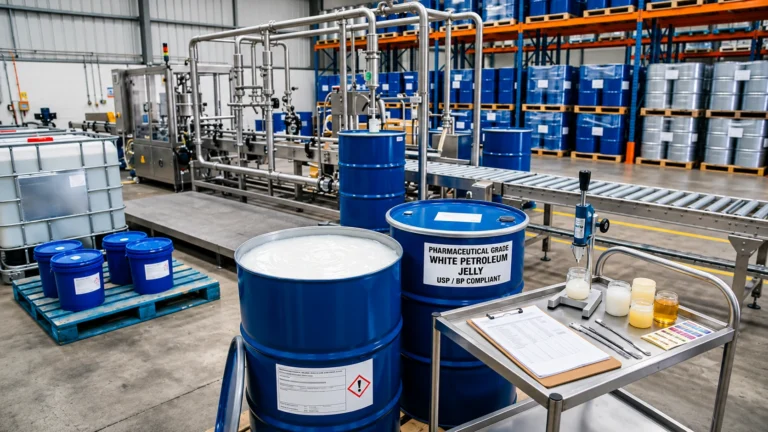
In chemical supply, bulk means pails, drums or IBCs. They come with a spec sheet and a lot-specific certificate of analysis (COA). Retail tubs sold by the case are a different format, aimed at resellers.
Grades of Petroleum Jelly
Grade is set by purity and end use, not by color alone. Elchemy’s product page lists cosmetic, pharmaceutical (USP/BP), technical and snow-white or high-drop-point grades.
White Grades and Color
Suppliers sell white, blond and amber petrolatum as separate products. Color alone does not prove quality, so ask which pharmacopoeia standard each lot meets. Many skin-care formulas start with white petroleum jelly, although yellow USP petrolatum is also sold for topical use.
USP, BP, Cosmetic and Technical Grades
USP and BP grades follow pharmacopoeia monographs and suit pharmaceutical and over-the-counter use. Cosmetic grades suit lip care and creams. Technical grades suit lubrication and corrosion protection where skin contact is not intended. The same grade logic applies to related oils, as this guide to pharma-grade white mineral oil shows.
Grade | Typical color | Standard | Typical use | Documents to request |
Cosmetic | Colorless to white paste | Supplier cosmetic spec | Lip balm, lipstick, creams | TDS, SDS, COA |
Pharmaceutical | White | USP/BP | Ointment base, OTC skin protectant | TDS, SDS, COA |
Technical | White to yellow or amber | Supplier technical spec | Lubrication, corrosion protection, cable filling | TDS, SDS |
Snow-white / high drop point | Very white | Supplier spec | Confirm on the TDS | TDS |
Choosing the Right Grade
Match the grade to the claim on your finished product, then to the spec your process needs. When two grades both meet your spec, compare quotes on landed cost.
- Choose a pharmaceutical grade if your product makes skin protectant claims.
- Choose a cosmetic grade if the claim is cosmetic and the supplier spec fits your formula.
- Choose a technical grade if the product will not touch skin.
Elchemy also lists a separate petrolatum range you can review against these needs.
Specifications and Incoming Checks
The certificate of analysis is where a grade is proven. Ask for a lot-specific COA before your first order, and check it against your own limits.
The reference values below come from a representative supplier COA for USP petrolatum. Limits vary by lot and supplier, so confirm them against your COA and the current USP-NF monograph.
Parameter | What it tells you | Reference value | Ask the supplier for |
Melting range (Class III) | Heat handling and stability | 38 to 60°C | Result for each lot |
Specific gravity at 60°C | Identity check | 0.815 to 0.880 | Result for each lot |
Consistency | Spreadability and texture | 100 to 300 | Result for each lot |
Residue on ignition | Inorganic impurities | 0.05% maximum | Result for each lot |
Acidity, alkalinity, organic acids | Purity | Conforms to USP/NF | Pass or fail for each lot |
Run simple incoming checks on every lot:
- Compare color and appearance with a retained sample.
- Check odor against the same retained sample.
- Test consistency and melt behavior.
- Match the paperwork to the COA values.
Common Applications by Grade
Grade follows the application and the claims you make. These are the main uses US buyers ask about.
Personal Care and Cosmetics
Petroleum jelly acts as an emollient and skin barrier in lip balms, lipsticks, creams, lotions and hair pomades. Use levels vary widely by product type, so take the range from your supplier’s TDS. Formulators can read more in this guide to sourcing cosmetic raw materials.
Pharmaceutical and OTC Skin Protectants
Petrolatum is a common ointment base, and FDA lists it as a skin protectant active ingredient. The claims on your label decide whether drug rules apply.
Food-Related Use
FDA rules allow petrolatum in certain food uses within set limits. Examples include release agents in bakery products and confectionery under 21 CFR 172.880. The material must meet USP or NF standards, so ask your supplier for a compliance statement.
Industrial Uses
Technical grades serve lubrication, corrosion protection and cable filling. Elchemy also lists mineral oil, a related petroleum-derived product.
Application | Suggested grade | Why | Documents |
Lip care and creams | Cosmetic or USP | Skin contact | COA, SDS |
OTC skin protectant | USP/BP | Monograph claims | COA, TDS |
Food release agent | Food-compliant white grade | 21 CFR 172.880 | Compliance statement |
Industrial | Technical | No skin contact | TDS |
To test fit against your spec, Request a Sample.
Which Format Fits You?
Retail tubs, pails and drums serve different buyers. Elchemy’s product page says commercial orders typically start from 1 MT, so it suits production volumes, not small pails.
Buyer | Typical format | Where it fits |
Reseller | Cases of retail tubs | Wholesale distributors |
Small formulator or R&D | Pails of 16 to 25 kg (35 to 55 lb) | Chemical catalogs |
Production manufacturer | Drums of 165 to 175 kg | Distributors such as Elchemy |
Very large user | IBC or heated bulk | Direct or large distributors |
If you need a smaller domestic source, start with this overview of US chemical suppliers.
US Regulation and Documents
In the US, the claim on your finished product decides which rules apply. The ingredient name alone does not decide it.
FDA Skin Protectant Rules
Over-the-counter skin protectant drugs fall under 21 CFR Part 347. It lists petrolatum and white petrolatum as skin protectant active ingredients at 30 to 100 percent. A skin protectant claim therefore brings drug rules, not only cosmetic rules. For a wider view, see this cosmetic regulations guide. Qualified regulatory review is required for your product.
MoCRA for Cosmetic Makers
The Modernization of Cosmetics Regulation Act (MoCRA) adds duties for cosmetic makers. FDA’s MoCRA page says facilities must register and renew every two years. Responsible persons must list products, substantiate safety and report serious adverse events within 15 business days. FDA also exempts certain small businesses from some requirements, so confirm how the rules apply to you.
Customs Classification
US customs classifies petroleum jelly under HTS heading 2712.10. Duties and added tariffs change, so confirm current rates with your customs broker. Our guide to importing chemicals to USA covers the wider process.
Documents to Request
Ask for a technical data sheet, a safety data sheet and a lot-specific COA before you commit. Elchemy provides a technical data sheet and an SDS for its white petroleum jelly, plus a COA with every order. For current SDS formats, see this guide to SDS requirements.
Pack Sizes, MOQ and Ordering
Pack format drives handling and unit cost. Pails suit trials and small runs, while drums suit regular production.
Format | Typical size | Best for | Handling notes |
Pail or carton | 16 to 25 kg (35 to 55 lb) | R&D and small runs | More labor and packaging waste |
Drum | 165 to 175 kg (365 to 385 lb) | Regular production | Better unit economics |
IBC or tote | Confirm with supplier | High throughput | May need heated handling |
Heated bulk | Tank transfer | Very large users | Needs specialized logistics |
Sizes reflect formats listed by chemical suppliers and catalogs, so confirm exact sizes with your supplier.
Handling and Storage
A representative COA lists a 24-month expiry from the production date. Store the material in a closed container in a dry place at room temperature. IBCs may need heated handling, so ask the supplier about transfer equipment.
Samples, Lead Time and Terms
Elchemy’s product page lists EXW, FOB, CIF and DDP terms and offers samples. Lead time depends on origin, pack and destination, so request it in writing. Duty treatment also varies by product, as this guide to paraffin wax in bulk shows for a related wax.
What Affects Petroleum Jelly Price
No single price exists for petroleum jelly. Price follows grade, pack size, origin, freight and terms. Elchemy quotes against your specification and volume rather than publishing a list price.
Cost driver | Effect on price | What to state in your RFQ |
Grade and refining level | Higher purity or tighter specs can raise the quote | Standard and color |
Pack size and volume | Unit price usually falls as volume rises | Pack format and annual volume |
Origin and freight | Shifts the landed cost | Destination and delivery terms |
Catalog Price Illustration
Public catalogs show how pack size changes unit price. On 9 November 2026, one chemical catalog listed white USP petrolatum in two pack sizes. The 2.5 kg pack cost $210.99, and the 15.9 kg pack cost $507.99.
Source (viewed 9 Nov 2026) | Pack | Price | Per kg | Per lb |
Zoro chemical catalog | 2.5 kg (5.5 lb) | $210.99 | $84.40 | $38.28 |
Zoro chemical catalog | 15.9 kg (35 lb) | $507.99 | $31.95 | $14.49 |
DollarDays wholesale, 1 to 69 cases | 12 tubs of 13 oz | $70.68 per case | $16.01 | $7.26 |
DollarDays wholesale, 70+ cases | 12 tubs of 13 oz | $52.20 per case | $11.82 | $5.36 |
The catalog price falls about 62 percent per kg between the two pack sizes. The wholesale tub prices are not like-for-like, because pack, documents and supplier type differ. Treat every figure as an indicative catalog price, not a market quote.
Compare Quotes on Landed Cost
Landed cost includes material, packaging, freight, duty and handling, not just the unit price. Compare it for each quote, and keep four things identical:
- Same grade and standard.
- Same pack size.
- Same freight and duty terms.
- Same documents.
Origin changes both freight and duty, as this guide to importing bulk chemicals explains.
To see how a quote compares with these catalog figures, Request a Quote.
How to Choose a Petroleum Jelly Supplier
Supplier type decides support, documents and risk. Start by deciding whether you need a manufacturer, a distributor or a trader.
Manufacturer, Distributor or Trader
A manufacturer controls production. A distributor sources from several plants and adds documents, logistics and support. A trader buys and resells, so technical support varies. See this comparison of manufacturers vs distributors for the trade-offs.
Supplier Checklist
Use this checklist before you shortlist a supplier. For more depth, see these supplier selection checkpoints.
- Request a spec sheet and a sample COA before the quote.
- Confirm the grade and standard in writing.
- Get the SDS before you commit.
- Require a lot-specific COA with each shipment.
- Confirm pack sizes and the minimum order.
- Confirm destination, terms and lead time.
- Ask about the sample policy.
Buying Through Elchemy and Your RFQ
Elchemy supplies petroleum jelly as a distributor, sourcing from partner plants across multiple origins. Its product page lists cosmetic, USP/BP, technical and snow-white grades.
Packs include bags, drums and IBCs, with EXW, FOB, CIF and DDP terms. The page lists shipping to the USA and replies to quote requests within 24 to 48 hours. For the wider case for working with a distributor, see these specialty chemical distributor benefits.
Before any petroleum jelly bulk buy, send your supplier a clear RFQ. Include these six items:
- Grade and standard.
- Per-order and annual volume.
- Pack format.
- Destination and terms.
- Documents required.
- Sample request.
Decision Framework for Your Order
Your best format and supplier path depend on volume, handling capacity and how much import work you can manage. Use these rules to narrow the choice before you request quotes.
- Choose pails if you are testing a formula or running small batches.
- Choose drums if you run regular production and can handle the weight.
- Choose IBCs if throughput is high and you can manage heated transfer.
- Choose a distributor if you want documents, logistics and several origins in one place.
- Choose a direct manufacturer if you buy very large volumes and can manage import steps yourself.
FAQs
What is the difference between petroleum jelly and petrolatum?
They are the same material under two names. Petrolatum is the technical and ingredient-list name, while petroleum jelly is the common name. Suppliers add words such as white or USP to describe grade. Always confirm the standard on the COA.
Does white color mean USP grade?
No. White describes color, while USP describes a pharmacopoeia standard. A white lot may or may not meet USP, and yellow USP petrolatum also exists. Check the COA for the standard and the test results, not the color name, before you approve a lot.
What is the minimum order quantity for petrolatum?
Elchemy’s product page says commercial orders typically start from 1 MT. Minimums vary by supplier and pack format, and retail tubs or small pails follow different terms. State your volume and pack format in your RFQ so the supplier can confirm the minimum.
Can I buy from an overseas supplier, and what customs code applies?
Yes. Elchemy’s product page lists shipping to the USA on EXW, FOB, CIF and DDP terms. US customs classifies petroleum jelly under HTS heading 2712.10, but duties and added tariffs change. Confirm current rates with a customs broker before you price landed cost.
Do I need FDA registration to use bulk petrolatum?
The answer depends on your finished product and its claims. Skin protectant claims bring OTC drug rules under 21 CFR Part 347. Cosmetic makers face MoCRA registration, listing and safety substantiation, with some small-business exemptions. Get qualified regulatory review before you launch.
Is Vaseline the same as bulk white petrolatum?
Vaseline is a consumer brand sold in retail jars. Bulk petrolatum is an ingredient sold in pails or drums with a spec sheet and COA. Ask your supplier for the grade and COA instead of a brand name, because production needs a documented ingredient lot.
Conclusion
Buying petroleum jelly in bulk comes down to three decisions. Pick the grade that fits your claim. Verify it against a lot-specific COA. Then compare suppliers on the same pack size and terms.
Treat price as the last step, not the first. A quote only means something when grade, format, documents and delivery terms match. If you are still testing a formula, start with a sample before you commit to drums.
Share your grade, volume and destination, and Elchemy will quote against your specification. Request a Quote.