

At a Glance
- Pricing is rarely published, and buyers waste cycles chasing quotes from suppliers who won’t disclose ranges upfront
- Rutile and anatase get confused constantly, even by people who’ve been buying pigment for years
- Supplier, manufacturer, and distributor are not interchangeable terms, and picking the wrong one costs you lead time or margin
- FDA and EU rules diverge sharply on food-grade use, which matters if you sell into both markets
- The real decision comes down to matching grade and process to application, then choosing a sourcing partner who can document both
What you’ll learn
how to price, grade, and source bulk titanium dioxide for coatings, plastics, paper, cosmetics, or food applications, and how to choose between a manufacturer, distributor, or supplier for your order size.
Introduction
Getting titanium dioxide sourcing wrong is expensive in ways that don’t show up until later. Choose the wrong grade, and it shows up as premature chalking on an exterior coating eighteen months after application. Get the wrong process, sulfate instead of chloride, and it shows up as inconsistent tint strength batch to batch. Land on the wrong supplier, and it shows up as a six-week customs delay because nobody asked for the SDS upfront.
Titanium dioxide (TiO2) is the world’s most widely used white pigment, prized for its brightness, opacity, and UV resistance. Global production volumes exceed 8 million metric tonnes annually, and the global market was estimated at USD 22.96 billion in 2025, driven mainly by paints and coatings, plastics, and industrial pigment demand. FactMRFortune Business Insights
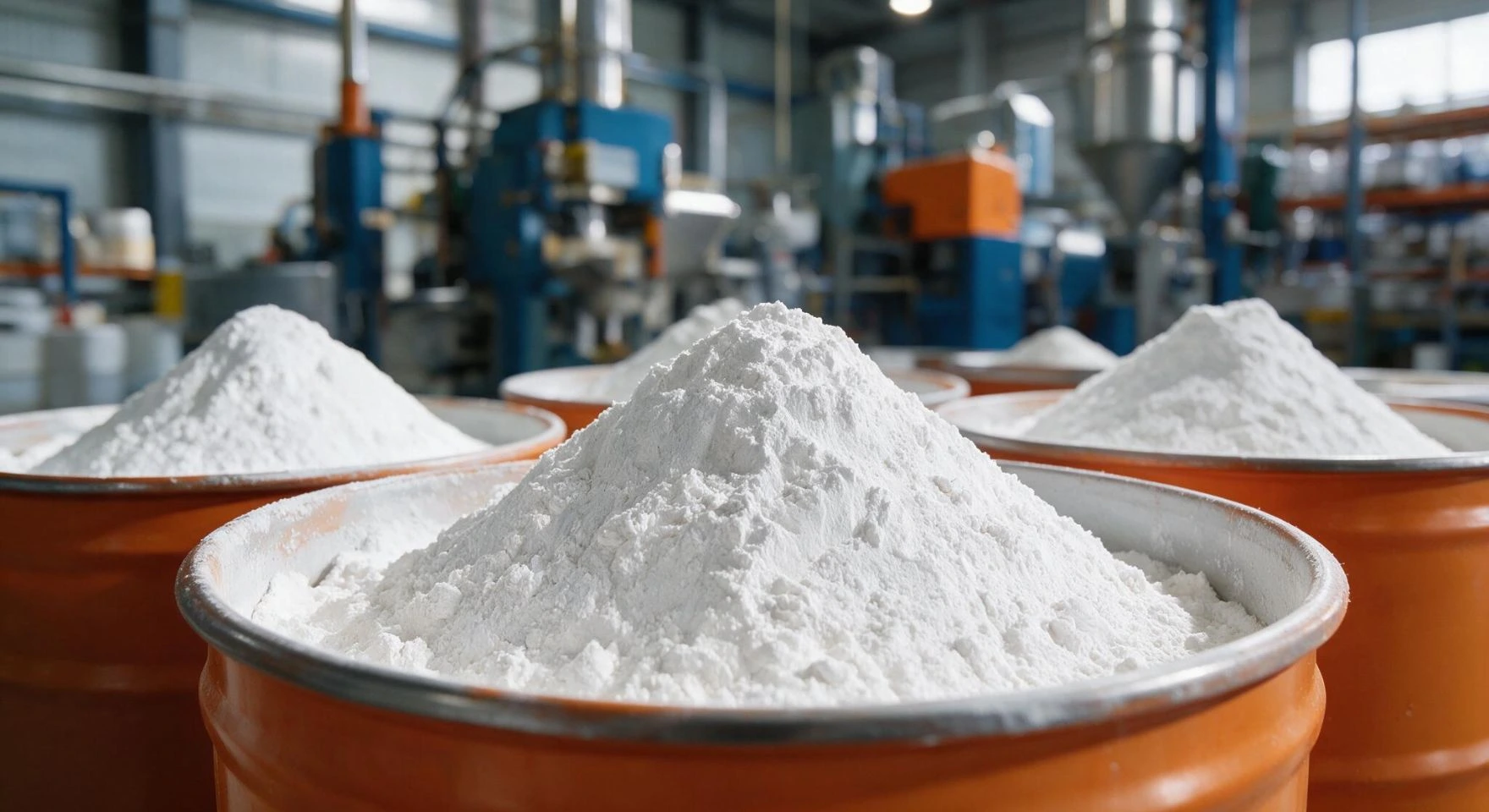
This guide is built for procurement teams, formulators, and distributors buying at bulk volumes, drums, supersacks, totes, or full container loads, not lab-scale quantities. It covers pricing structure, grade selection, regulatory status, and how to evaluate a supplier before you commit to a purchase order. Request a bulk quote if you already know your grade and volume and want to skip ahead.
Titanium Dioxide Pricing Table (by Grade & Order Size)
| Grade | Form | Order Size | Indicative Price Range (USD/kg, FOB) |
| Rutile, chloride process | Powder | Drum (25 kg) | 2.80 to 3.60 |
| Rutile, chloride process | Powder | Supersack (500 to 1,000 kg) | 2.40 to 3.10 |
| Rutile, chloride process | Powder | FCL / bulk tote | 2.00 to 2.70 |
| Anatase, sulfate process | Powder | Drum (25 kg) | 1.90 to 2.50 |
| Anatase, sulfate process | Powder | Supersack / FCL | 1.60 to 2.10 |
| Food/cosmetic-grade TiO2 | Powder | Drum | 3.50 to 5.00 |
These ranges are indicative and move with feedstock cost, freight, and tariff exposure. Because published pricing goes stale within weeks in this market, treat the table as a starting reference and buy titanium dioxide in bulk by requesting a live quote against your exact grade, packaging, and Incoterm.
Three variables move price more than anything else: whether the pigment came from the chloride or sulfate process (chloride commands a premium for purity and consistency), current ilmenite and rutile ore feedstock costs, and freight plus any anti-dumping duties applicable to the country of origin.
Titanium Dioxide Price Trends
TiO2 pricing has been shaped less by demand growth and more by supply-side disruption over the past few years: Chinese export volumes, anti-dumping duties in the US and EU, and the slow shift of global capacity from sulfate to chloride processing.
The chloride route is gaining share over sulfate because it yields higher-purity rutile pigment with less waste and lower energy use per unit, which is gradually widening the price gap between the two process types. Grand View Research
Ore feedstock volatility is the other lever. Ilmenite and rutile ore prices swing with mining output in Australia, South Africa, and China, and those swings pass through to pigment pricing on a lag of roughly one to two quarters.
For the full historical pricing picture, including quarter-by-quarter movement and forward indicators, see Elchemy’s titanium dioxide price trends breakdown rather than relying on a single snapshot.
Rutile vs. Anatase: TiO2 Grade Guide
| Property | Rutile TiO2 | Anatase TiO2 |
| Refractive index | Higher (~2.7) | Lower (~2.5) |
| UV resistance / weathering | Strong, holds up outdoors | Weaker, chalks faster in sunlight |
| Typical applications | Exterior paint, plastics, automotive coatings | Paper, fibers, some interior coatings, catalytic uses |
| Common process | Chloride (also available via sulfate) | Sulfate |
| Cost tier | Higher | Lower |
Choose rutile when the end product faces outdoor exposure, UV, or long service life, exterior architectural coatings, automotive plastics, roofing membranes. Choose anatase when brightness and opacity matter more than weathering resistance and the application stays indoors or short-lived, like paper coating or certain textile fibers.
The chloride process generally produces rutile-grade pigment with tighter particle-size distribution and fewer impurities, while the sulfate process is more commonly (though not exclusively) associated with anatase output and lower production cost. For a full property-by-property comparison, see the rutile vs anatase — grade guide.
TiO2 Industrial Applications
Bulk TiO2 shows up across a wider range of industries than most buyers expect:
- Coatings and paints: the largest application by volume, valued for opacity and weathering resistance
- Plastics and PVC profiles: UV protection and consistent whiteness in window frames, siding, and molded goods
- Paper and paper coatings: brightness and opacity in coated papers
- Inks: opacity in printing applications
- Cosmetics and personal care: sunscreens and foundations rely on TiO2’s UV-blocking and opacifying properties
- Food and pharma: historically used for whiteness in confectionery, tablets, and capsule coatings, though regulatory status varies by market (see below)
- Specialty uses: ceramics, glass, and synthetic fibers
For a deeper look at how demand is split across these categories in the US market specifically, see Elchemy’s guide to TiO2 industrial applications.
FDA & Regulatory Context
Regulatory status is where US and EU buyers diverge most sharply, and it’s worth understanding before you commit to a food or pharma-grade order.
In the United States, titanium dioxide may be used for coloring foods generally, subject to a restriction that it not exceed 1 percent by weight of the food, under 21 CFR 73.575.
That said, this approval isn’t uncontested: the FDA filed a color additive petition in 2023, submitted by several advocacy groups, proposing to repeal that authorization, so buyers in food applications should monitor this status rather than treat it as permanently settled. eCFREnvironmental Working Group
The EU has already moved. The European Commission adopted Regulation (EU) 2022/63 on 14 January 2022, withdrawing authorization to use titanium dioxide (E171) as a food additive, based on an EFSA opinion that the additive could no longer be considered safe for that use.
Notably, TiO2 remains authorized for the time being in medicinal products, to avoid supply shortages, even though it’s banned in food. USDAUSDA
For nano-scale TiO2 specifically, REACH classification and labeling requirements apply separately from the bulk-grade rules above; buyers importing into the EU should confirm particle-size classification with their supplier.
Practically, this means: always request a current SDS, COA, and any FDA or REACH compliance documentation before finalizing a food, pharma, or EU-bound order, don’t assume last year’s paperwork still reflects current status.
MOQ & Ordering: Bag, Drum, Supersack, Bulk Tote, FCL
Order-size tiers generally break down as follows:
- Bag/drum (25 kg): smallest bulk tier, typically used for trial orders or smaller formulators
- Supersack (500 to 1,000 kg): mid-volume tier, common for regional manufacturers
- Bulk tote: larger flexible packaging for high-volume buyers
- FCL (full container load): lowest per-kg cost, best suited to buyers with consistent, high-volume demand
Lead time scales with order size and origin. Domestic US sourcing typically moves faster but at a cost premium; India-origin bulk orders offer better landed cost at FCL volumes but require longer lead times and careful freight/duty planning.
Supplier vs. Manufacturer vs. Distributor: What’s the Difference?
| Manufacturer | Distributor | Supplier (broad term) | |
| Definition | Produces TiO2 directly from feedstock | Buys from manufacturers, resells with logistics/inventory support | Umbrella term, could be either of the above |
| Pros | Best pricing at high volume, direct technical access | Flexible MOQs, faster fulfillment, consolidated freight | N/A, depends entirely on which type you’re actually dealing with |
| Cons | High MOQs, longer lead times, limited flexibility | Slightly higher per-kg cost than going direct | Ambiguous, requires clarification before ordering |
| Best for | Large, consistent-volume buyers | Mid-size buyers needing flexibility and speed | N/A |
Go direct to a manufacturer when your volume is consistent and high enough to justify their MOQ and you have the internal team to manage documentation and logistics yourself.
Use a distributor when you need smaller or variable order sizes, faster turnaround, or support navigating freight, duties, and compliance documentation, which is where most mid-size industrial and cosmetic buyers land.
If sustainability credentials matter for your supply chain, ask specifically about eco-friendly and lower-emission manufacturing processes; this varies significantly between chloride and sulfate producers and isn’t something you can assume by default.
Titanium Dioxide Manufacturers & Suppliers: USA vs. India
USA-based sourcing tends toward chloride-process dominance, with major producers including Chemours, Tronox, and Kronos. Expect faster domestic lead times and easier compliance documentation, at a higher landed cost.
India-based sourcing offers cost advantages, particularly for sulfate-process anatase and mid-grade rutile, along with strong export capability. Buyers should plan for longer transit times and confirm freight, duty, and documentation requirements upfront rather than assuming US-equivalent lead times.
Either way, the same buyer checklist applies: verify grade, process, and documentation before committing volume.
Buyer Checklist: How to Choose a Titanium Dioxide Supplier
- Confirm grade (rutile or anatase) matches your application’s UV and weathering requirements
- Request SDS, COA, and regulatory documentation before placing an order, especially for food, pharma, or cosmetic use
- Compare MOQ and packaging options against your actual volume needs, don’t over-order to hit a price break you don’t need
- Verify chloride vs. sulfate process if performance (weathering, tint strength) is critical to your end product
- Check delivery lead time and freight/logistics terms, particularly for FCL or cross-border orders
- Ask about sustainability and ESG credentials if that’s a requirement in your supply chain
Compliance & Sourcing
Compliance and sourcing are the same decision, not two separate steps. A supplier who can’t produce a current SDS, COA, and FDA/regulatory context documentation on request is a sourcing risk, no matter how good the price looks. Go direct to a manufacturer if your volumes justify FCL-level MOQs and your team can handle documentation and freight in-house.
Go through a distributor if order sizes vary or you’d rather have freight and compliance paperwork handled as part of the process, the more common fit for mid-size buyers sourcing across US and EU markets with different regulatory rules. Either way, treat documentation as a filter. A supplier who hesitates on paperwork before the order is placed will hesitate after it too.
Where to Buy Titanium Dioxide
Once you’ve confirmed grade, process, and packaging, the fastest next step is getting a live number against your specific volume rather than working off indicative ranges. Elchemy sources bulk industrial titanium dioxide globally, with documentation, freight, and compliance handled as part of the order, not as an afterthought.
FAQs
Is titanium dioxide FDA approved?
Yes, for food use up to 1% by weight under 21 CFR 73.575, though the FDA is currently reviewing a 2023 petition to repeal that approval, so buyers in food applications should confirm current status before finalizing formulations.
What’s the difference between rutile and anatase titanium dioxide?
Rutile has a higher refractive index and stronger UV/weathering resistance, making it the default for exterior and outdoor applications. Anatase is lower-cost and works well where weathering resistance matters less, such as paper coating.
What is the minimum order quantity for bulk titanium dioxide?
MOQs vary by supplier type. Distributors often accommodate drum or supersack quantities (25 kg to 1,000 kg), while manufacturers typically require FCL-level volume commitments.
Are there eco-friendly or sustainable titanium dioxide manufacturers?
Some producers, particularly newer chloride-process plants, market lower-emission production. This isn’t universal, so ask specifically rather than assuming.
Is titanium dioxide safe in food and cosmetics?
The US currently permits food use under FDA restrictions, while the EU banned it as a food additive in 2022 following an EFSA safety opinion. Cosmetic use remains permitted in both markets. Buyers should track regulatory status by destination market rather than assuming uniform rules.
Where can I buy titanium dioxide powder in bulk in the USA?
Through direct manufacturers (Chemours, Tronox, Kronos) for high-volume, consistent demand, or through a distributor like Elchemy for more flexible MOQs, faster fulfillment, and documentation support.
Conclusion
Three decisions drive a good titanium dioxide purchase: getting real pricing instead of guessing from stale ranges, matching rutile or anatase to what your application actually needs, and picking a manufacturer or distributor based on your volume and documentation needs rather than habit. Get those three right and the rest, freight, packaging, lead time, falls into place. Request bulk quote to get current pricing against your exact grade and volume.