

At a Glance
- Output: World phosphate rock output was an estimated 250 million metric tons in 2025, about 5% above 2024.
- Process: Most ore is surface mined, screened, washed and floated, and some rock is calcined before grinding.
- Main use: In the US, more than 95% of rock goes into wet-process phosphoric and superphosphoric acid.
- Concentration: China mined about 44% of 2025 output, and Morocco holds about 68% of reserves.
- Buying: Most buyers need phosphoric acid or a phosphate salt, not rock. The form you need decides the supplier.
What You’ll Learn
Learn how phosphate rock is mined, processed, used and sourced, and how to choose between rock, acid and phosphate salts.
Introduction
Phosphate rock production starts at a mine and ends in a fertilizer bag, a feed premix or a food-grade acid. Most buyers only see the last step, but the steps in between decide supply, grade and risk. Each step also changes who can supply the product.
This guide follows the rock from ore to product. It covers mining, beneficiation, the wet and thermal conversion routes, and the main producing countries. It also explains why sulfuric acid production matters, because that acid turns rock into phosphoric acid.
It suits procurement, sourcing and technical teams that buy phosphate products or assess their supply risk. It ends with a framework for choosing between rock, acid and phosphate salts. Figures come from US government sources, and the guide shows both numbers where sources disagree.
What is phosphate rock?
Phosphate rock is a naturally occurring rock rich in apatite, a calcium phosphate mineral. The US Geological Survey (USGS) calls it the only significant global source of phosphorus. Geologists also call it phosphorite, and buyers often search for it as rock phosphate.
Raw ore is rarely sold as mined. Miners concentrate it into marketable rock. USGS defines that as beneficiated rock with a phosphorus pentoxide (P2O5) content suited to making phosphoric acid or elemental phosphorus.
Published grade figures vary. A 2007 USGS note puts marketable rock above 28% P2O5, while Statista cites up to 41%. Treat any grade figure as indicative and use the certificate of analysis (CoA) for the lot you buy.
Phosphate rock production from mine to market
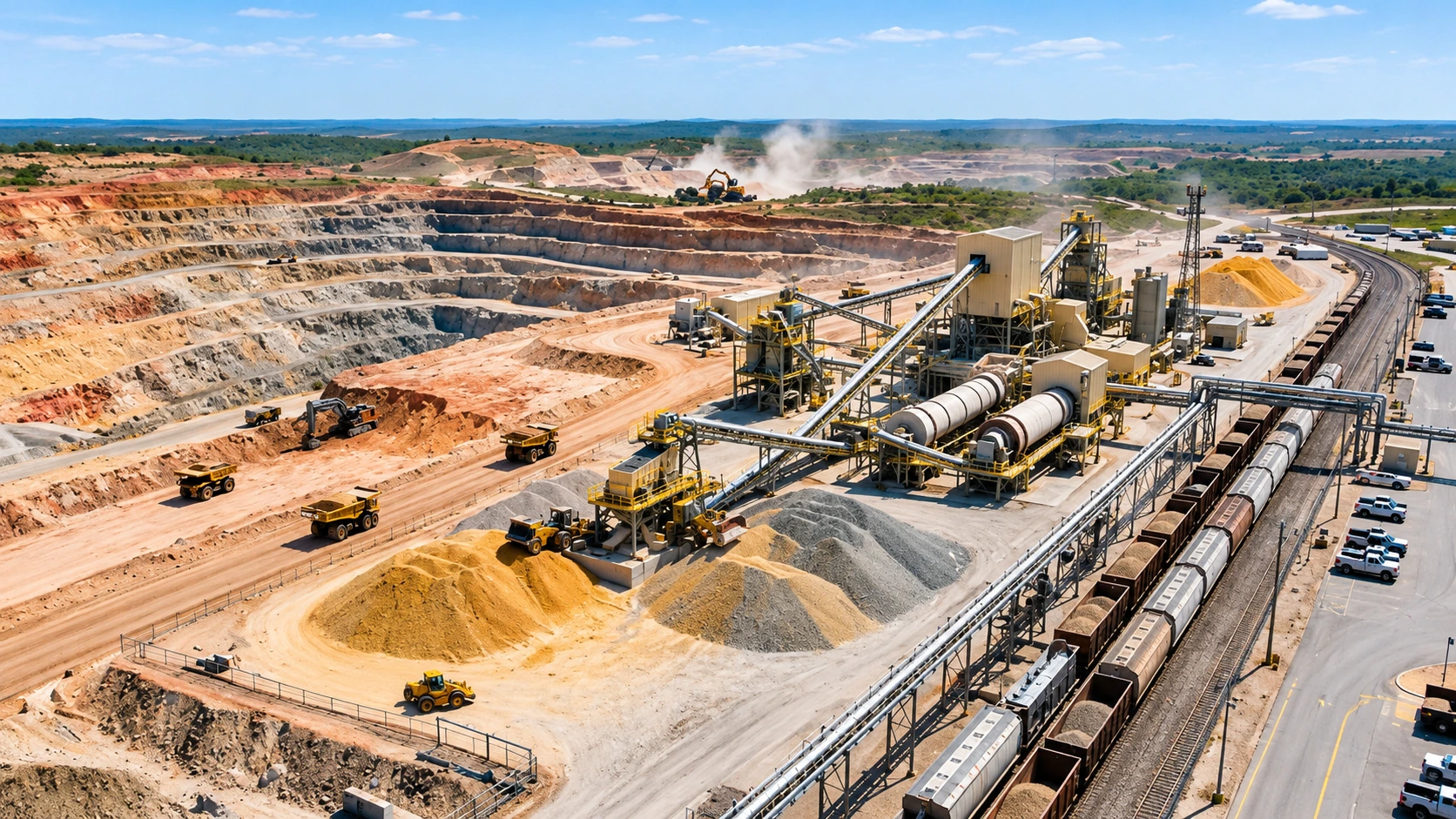
Phosphate rock production has three broad stages: mining, beneficiation and preparation for the chemical plant. Phosphate mining is mostly done at the surface rather than underground.
- Mine the ore. Crews remove overburden, then lift the phosphate-bearing matrix with draglines or shovels.
- Screen and wash. Wet screening separates coarse pebble rock from sand, clay and finer particles.
- Float the fines. In Florida, fine material goes through two-stage flotation using chemical reagents and aeration.
- Dry or calcine. Rock low in organics may only be dried. Rock with more organics is calcined at 760 to 870°C.
- Grind. Rock is ground to a uniform size, at the mine or at the chemical plant.
Methods differ by deposit. The EPA AP-42 section on phosphate rock processing describes how Florida, North Carolina, Idaho and Utah routes differ. It dates from 1993, so use it for the sequence of steps, not for current plant settings.
How phosphate rock becomes phosphoric acid
Phosphate rock is usually converted into phosphoric acid or elemental phosphorus before it reaches an end user. The US Environmental Protection Agency (EPA) describes two routes. The wet process uses sulfuric acid, and the thermal process uses an electric furnace.
| Route | Inputs | Outputs | Main downstream use |
| Wet process | Ground rock and sulfuric acid | Phosphoric acid and phosphogypsum | Ammonium phosphates and feed supplements |
| Thermal process | Rock, coke and silica in an electric furnace | Elemental phosphorus and slag | Phosphorus compounds, mainly for glyphosate |
The wet process creates a large waste stream. Industry estimates put it at about 5.2 tons of phosphogypsum per ton of phosphoric acid, according to EPA. The process also consumes sulfuric acid, so acid availability matters alongside rock supply.
Where phosphate rock is produced
China leads output by a wide margin, while Morocco holds most of the world’s reserves. The USGS Mineral Commodity Summaries estimate 2025 world output at 250 million metric tons and reserves at 73 billion tons. Dividing the country figures gives China about 44% of output and Morocco about 68% of reserves.
| Country | 2025 production (million tons) | Reserves (billion tons) |
| China | 110 | 3.4 |
| Morocco | 36 | 50 |
| United States | 20 | 1.0 |
| Russia | 14 | 2.4 |
| Jordan | 12 | 0.82 |
| Saudi Arabia | 10 | 1.0 |
| Egypt | 5.5 | 2.8 |
| Brazil | 5.0 | 1.6 |
| Peru | 4.8 | 0.21 |
| Tunisia | 3.3 | 2.5 |
Source: USGS Mineral Commodity Summaries 2026. Production figures are estimates for 2025.
USGS revised its 2024 world estimate from 240 million tons to 239 million tons between editions. Statista lists about 230 million tons for 2024, and USGS raised Morocco’s 2024 output from 30 to 35.3 million tons. These gaps show why a single production number should not anchor a contract.
USGS does not say whether its tonnages are gross weight or P2O5, and China’s data covers large mines only. Use the table to see the shape of the market, not to set contract terms.
What is phosphate rock used for?
Phosphate rock is used mainly to make phosphate fertilizer, with smaller volumes going to animal feed and industrial chemicals. In the US, more than 95% of output goes into wet-process phosphoric and superphosphoric acid.
- Fertilizer: Phosphoric acid feeds ammonium phosphates such as diammonium phosphate (DAP) and monoammonium phosphate, known as MAP.
- Animal feed: Acid also supports feed supplements. The monocalcium phosphate guide compares feed, food and fertilizer grades.
- Industrial chemicals: In the US, elemental phosphorus goes mainly into compounds for glyphosate herbicide.
- Battery materials: Purified phosphoric acid supplies the phosphorus in lithium iron phosphate (LFP) cathodes. Benchmark Mineral Intelligence reports that battery use needs acid purified to food grade or higher.
About 25% of US wet-process acid is exported as products such as DAP and MAP. World P2O5 consumption in fertilizers was an estimated 47.8 million tons in 2025. USGS projects 51.5 million tons by 2029, with growth expected mainly in Asia and South America.
To check a listed phosphate product such as MAP against your specification, Request a Sample.
How the phosphate rock supply chain works
The supply chain runs from a few mining regions to acid and fertilizer plants, then to distributors and end users. China, Morocco, the US and Russia were the leading producers in 2025, according to USGS.
- Mining regions. Mines sit in a limited set of countries, and they often supply nearby processing plants.
- Beneficiation. Mines or nearby plants wash, float and sometimes calcine the rock into marketable grades.
- Chemical plants. Rock is converted into phosphoric acid or elemental phosphorus.
- Product plants. Acid becomes DAP, MAP, triple superphosphate and other phosphate products.
- Distribution. Traders and distributors move acid, salts and some rock to end users.
Import reliance shows how exposed a large producer can be. The US had a net import reliance of 16% in 2025, and USGS says Florida reserves are declining. Peru supplied more than 99% of US imports from 2021 to 2024.
Capacity is growing. USGS projects global P2O5 capacity rising from 63.7 million tons in 2025 to 71.7 million tons in 2029. Expansions are under way in Brazil, Kazakhstan, Mexico, Morocco and Russia.
Phosphate rock supplier or rock phosphate manufacturers: who does what
Mine operators produce phosphate rock, and most buyers purchase a processed form instead. Before you contact any supplier, decide whether you need rock, acid or a phosphate salt.
Three types of company appear in this chain. Mine operators extract and beneficiate rock. Chemical producers convert it into acid and salts.
Distributors then source those products and sell them in smaller lots. A rock phosphate manufacturer, in the loose sense buyers use, is usually a mine operator that also beneficiates the rock.
Elchemy lists phosphate derivatives such as phosphoric acid and MAP. If your requirement is phosphate rock itself, send the grade, volume and destination with your enquiry. [Elchemy verification needed]
Use this framework to match the product to your plant or application.
| Choose this if you… | Product | Confirm before ordering |
| Operate an acidulation or processing plant | Phosphate rock | P2O5 range, moisture, impurities and the lot CoA |
| Need acid for fertilizer, food, technical or lab use | Phosphoric acid | Grade, concentration, packaging and SDS |
| Need a nutrient source for fertilizer, fire suppression or food use | MAP | Specification and technical data sheet (TDS) |
| Need a calcium phosphate for feed, food or fertilizer | Monocalcium phosphate | Grade and supporting documents |
Ask any supplier for the CoA, TDS and safety data sheet (SDS) before you commit. Match each document to the grade and lot you will receive, not to a generic product.
Elchemy’s phosphoric acid buying guide explains how to compare quotes for the acid.
Safety and environmental points to review
Phosphate rock contains naturally occurring radionuclides, and the levels vary by deposit. Processing can concentrate them in waste streams such as phosphogypsum.
In the wet process, about 80% of the radium-226 ends up in phosphogypsum, according to EPA TENORM guidance. A 1992 EPA rule limits certified average radium-226 in agricultural phosphogypsum to 10 pCi/g.
These points are context, not compliance advice. Handling, transport, worker exposure and waste rules depend on your site and jurisdiction. Qualified review is required, and the SDS for the product you buy is the reference.
FAQs
1. How is phosphate rock formed?
Most phosphate rock deposits are sedimentary and formed in marine settings. Smaller igneous deposits formed from magma and occur in Brazil, Canada, Finland, Russia and South Africa. USGS places major sedimentary deposits in northern Africa, the Middle East, China and the United States.
2. Is phosphate rock renewable, and will it run out?
Phosphate rock is a finite mined resource, so it is not renewable on human timescales. USGS puts world resources above 300 billion tons and states there are no imminent shortages. Reserves, the economically mineable part, are an estimated 73 billion tons. USGS also notes that agriculture has no substitute for phosphorus.
3. What does P2O5 mean on a specification?
P2O5 is phosphorus pentoxide, the standard way to state phosphorus content in rock and fertilizer. USGS reports capacity and fertilizer use on a P2O5 basis. It does not state the basis for its rock tonnages. Confirm whether any quote or statistic uses gross weight or P2O5 before you compare figures.
4. Is phosphate rock a critical mineral?
Yes, in the United States. USGS reports that phosphate rock was added to the 2025 critical minerals list after public comment. Boron, metallurgical coal and uranium were added in the same step. Other regions keep their own lists, so check the one that applies to your market.
5. Does the US export phosphate rock?
No. US producers stopped exporting phosphate rock in 2003, according to USGS. They sell rock domestically and export processed products instead. That makes the US a net importer of rock and an exporter of acid-based products such as DAP and MAP.
6. Where can I find official phosphate rock statistics?
The USGS National Minerals Information Center publishes monthly marketable rock data and Minerals Yearbook tables. It has issued annual Mineral Commodity Summaries since 1996. Figures are revised between editions, so cite the edition and year you use. USGS is also moving datasets to ScienceBase, so file locations may change.
Conclusion
Phosphate rock moves from a few mining regions through beneficiation and chemical plants. Most buyers meet it only as a derivative. That route explains why supply is concentrated, why published figures differ and why the form you buy matters.
Start with your specification: product form, grade, volume, destination and the documents you need. Ask for the CoA, TDS and SDS, and confirm the P2O5 basis of any figure you compare. Treat every number in this guide as a starting point, then send those details and Request a Quote.