

At a Glance
- Start with the specification: Define the application, grade, concentration, packaging, and documentation before comparing suppliers.
- 75% and 85% are concentration choices: Neither concentration alone proves that a material is food grade, technical grade, or suitable for a specific process.
- Supplier route should match demand: Distributors, specialty suppliers, and direct producer channels serve different volume, quality, and logistics needs.
- Documentation is part of the purchase: A current COA, TDS, and SDS should be reviewed alongside price and delivery terms.
- Delivered cost matters more than unit price: Freight, hazardous-material handling, packaging, unloading, and storage can change the real cost of supply.
- The practical next step: Send suppliers a complete RFQ containing your use case, grade, concentration, volume, packaging, destination, and documentation needs.
What you’ll learn
This guide helps industrial buyers identify the right phosphoric-acid specification, assess supplier channels, and prepare a complete enquiry for a comparable bulk-buying decision.
Introduction
Knowing where to buy phosphoric acid is only the first step. A plant buyer may need a technical solution for metal treatment, a food-grade material for a beverage process, or a tightly controlled grade for laboratory work. Those are different purchases, even when the material name and concentration look similar on a quotation.
For most B2B buyers, the best source is the supplier that can meet the required specification, provide current supporting documents, and deliver in a package that fits the receiving site. Buyers who already know their core requirement can review bulk phosphoric acid product options. Teams that need to validate material before a larger order can also review the chemical sample request process.
This guide focuses on industrial procurement. It does not recommend a universal supplier or assume that one grade, concentration, or delivery format fits every application.
Where should a business buy phosphoric acid?
Businesses should buy phosphoric acid from the supplier channel that can document the required grade, concentration, packaging, and delivery conditions. The right route depends on whether the buyer needs a small qualification quantity, regular drum or IBC deliveries, high-purity material, or large recurring volumes.
A direct producer relationship may make sense for qualified buyers with large, consistent demand and compatible logistics. Chemical distributors are often better suited to buyers who need packaged material, flexible delivery arrangements, technical coordination, or a broader chemical portfolio. Specialty and reagent suppliers may be more appropriate when analytical, laboratory, or high-purity requirements drive the decision.
| Supplier route | Best fit | Buyer should confirm | Evidence to request |
| Producer or direct channel | Large, predictable volume | Volume commitment, logistics, qualification requirements | Product specification, supply terms, current documents |
| Chemical distributor | Drums, IBCs, recurring industrial demand | Packaging, delivery coverage, receiving requirements | COA, TDS, SDS, quotation basis |
| Specialty or reagent supplier | Laboratory, analytical, or high-purity use | Purity limits, method suitability, small-pack availability | Grade specification, impurity limits, COA |
The question is not simply “Who sells phosphoric acid?” It is “Who can supply the exact material, evidence, and delivery model this process requires?”
Specify the acid before requesting a quote
A complete phosphoric-acid RFQ identifies the intended application, grade, concentration, packaging, quantity, destination, and documentation requirements. Without those details, suppliers may return quotations that cannot be compared fairly.
Phosphoric acid is commonly described by concentration, grade, and end use. These terms are related but not interchangeable. A concentration describes the proportion of phosphoric acid in solution. A grade describes a quality or suitability framework. The buyer should define both.
Match the grade to the application
The correct grade is determined by the process and its acceptance criteria, not by a general label on a catalogue page. Food and beverage, fertilizer, metal treatment, water treatment, laboratory, and electronics applications can have very different quality expectations.
For food-related use, buyers should ask for the exact food-use specification and documentation required by their product, customer, and market. For technical applications, the relevant questions may concern impurities, colour, process compatibility, or batch consistency. Laboratory and analytical uses may require limits that are inappropriate or unnecessary for a general industrial process.
Use the following framework before sending an enquiry:
- Food or beverage use: Confirm the applicable food-grade specification and any customer-required declarations.
- Technical or industrial use: Define performance needs, impurity limits, and compatibility with the process.
- Fertilizer use: Confirm whether purchasing is specified in H₃PO₄ concentration, P₂O₅ basis, or another commercial convention.
- Laboratory or analytical use: Define the grade, purity criteria, trace-impurity limits, and relevant method requirements.
- Water-related use: Confirm all applicable local standards and site-specific approval requirements before purchase.
Buyers working across multiple applications can also explore industrial chemical sourcing support when they need a more structured supplier and logistics conversation.
Choose between 75% and 85% phosphoric acid
The choice between 75% and 85% phosphoric acid should reflect process needs, storage conditions, handling capability, and transport economics. Neither option is automatically superior.
An 85% solution can be useful where a process needs a more concentrated feed or where reducing water shipped is valuable. A 75% solution may be considered where the process already involves dilution or where handling characteristics are a priority. The correct choice still depends on the approved product specification, local storage conditions, and the equipment used to transfer or dose the material.
| Decision factor | 75% solution | 85% solution | Buyer validation needed |
| Process concentration | May suit lower-concentration processes | May suit concentrated feed requirements | Confirm process specification |
| On-site dilution | May reduce dilution work | May require controlled dilution | Review operating procedure |
| Storage conditions | Must be assessed for the actual product | Must be assessed for the actual product | Review current TDS and SDS |
| Freight efficiency | Ships more water per unit of active acid | May reduce water transported | Compare delivered cost |
| Grade suitability | Depends on specification | Depends on specification | Confirm grade documents |
Do not use concentration as a shortcut for suitability. For example, 85% material may be available in multiple grades, and a buyer should not assume that all 85% solutions have the same quality controls or approved end uses.
Select packaging and plan site receiving
The best packaging option is the one that matches demand, storage capacity, handling equipment, and safety controls. A lower unit price can become more expensive if the site cannot receive, store, transfer, or consume the material efficiently.
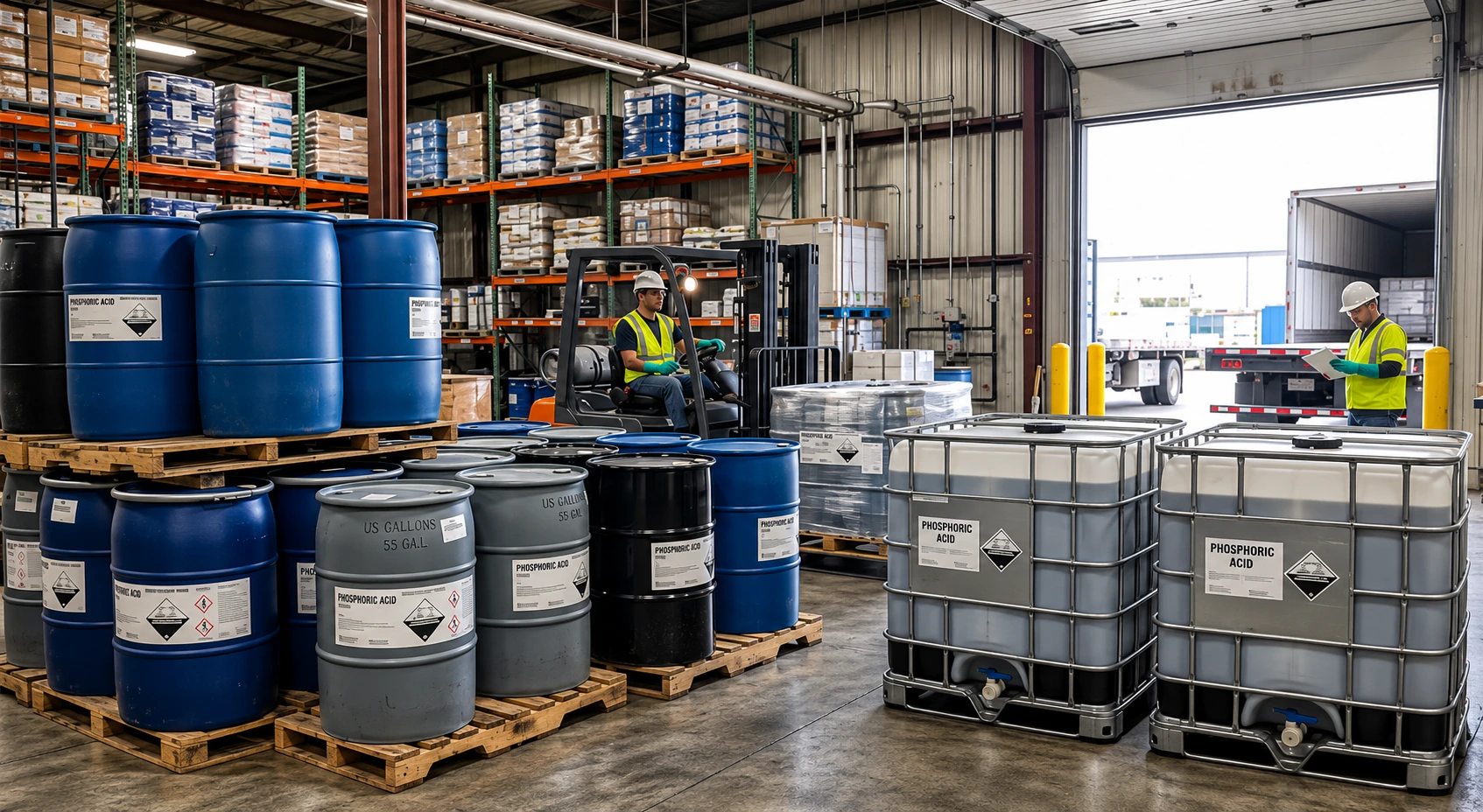
Common purchasing formats include small packs, drums, IBC totes, and bulk deliveries. The commercial and operational fit of each format depends on consumption rate, available space, unloading equipment, waste handling, and replenishment frequency. Buyers should involve operations and EHS stakeholders before committing to a larger pack size.
Before approving a packaging format, confirm:
- The site has compatible storage and transfer equipment.
- Secondary containment and local safety procedures are in place.
- The unloading area can safely receive the delivery vehicle.
- The receiving team has the right material-handling equipment.
- Storage temperatures and exposure conditions are compatible with the supplier’s current documentation.
- The delivery quotation clearly states freight and accessorial assumptions.
For buyers sourcing into treatment operations, the water treatment chemical applications page may help place phosphoric acid within a broader industrial-chemical context. It does not replace process-specific technical approval.
Request documentation that matches the risk
A complete phosphoric-acid purchase decision requires current quality and safety documents, not only a product description or a price quotation. The documentation package should be agreed before order placement, especially when QA, customer, regulatory, or audit requirements apply.
A Certificate of Analysis, or COA, is typically used to review lot-specific quality results. A Technical Data Sheet, or TDS, describes standard product information. A Safety Data Sheet, or SDS, addresses hazards, handling, storage, transport, and emergency measures for the specific material. These documents serve different purposes and should not be treated as interchangeable.
| Document | What it helps verify | When to request it | Primary reviewer |
| COA | Lot-specific results against the specification | Before release or receipt | QA or technical team |
| TDS | Standard product characteristics | During supplier qualification | Procurement and technical team |
| SDS | Hazard, handling, storage, and transport information | Before site approval and receipt | EHS and operations |
| Application declaration | Use-specific compliance evidence | When required by the application | QA, regulatory, or customer team |
For general occupational-health context, consult the NIOSH Pocket Guide for phosphoric acid. For emergency-response and transport-reference context, consult NOAA CAMEO Chemicals guidance. In both cases, the supplier’s current SDS remains the controlling document for the material being purchased.
Compare supplier quotes on delivered fit
The best quotation is the one that meets the full requirement at an acceptable delivered cost and risk profile. A low unit price does not compensate for the wrong grade, unclear freight basis, missing documentation, unsuitable packaging, or a delivery model the site cannot support.
Use one written RFQ for every shortlisted supplier. This gives procurement, QA, and operations a common basis for comparison. It also reduces the risk that one quotation covers a 75% technical product in drums while another covers an 85% application-specific product in an IBC.
Compare each quotation against these criteria:
- Exact grade and concentration
- Packaging and net quantity
- Quantity basis and delivery schedule
- Delivery point, freight basis, and accessorial assumptions
- Included COA, TDS, SDS, and any required declarations
- Sample or qualification process
- Receiving and storage implications
- Change-control or batch-consistency expectations
Teams managing a broad set of smaller purchases may also benefit from tools that manage fragmented chemical purchases. The purpose is not to centralise every purchase automatically, but to make repeated sourcing decisions more visible and comparable.
Use a six-step buying checklist
A disciplined buying process prevents the most common source of delay: asking for price before confirming what must be supplied. The checklist below gives procurement, technical, and operations teams a shared sequence.
- Define the end use. State the process, product, or application the acid will support.
- Confirm the specification. Identify grade, concentration, critical parameters, and required documentation.
- Set the demand profile. Provide trial quantity, recurring consumption, packaging preference, and expected order pattern.
- Validate site readiness. Confirm storage, transfer equipment, receiving access, and safety controls.
- Request qualification evidence. Review the COA, TDS, SDS, and any use-specific documents before approval.
- Compare delivered offers. Evaluate the same specification across price, freight, packaging, documentation, and supply conditions.
This framework is especially important when phosphoric acid is one of several inputs. Readers assessing adjacent sourcing needs can explore an industrial acid sourcing comparison, while keeping each acid’s specification and hazard profile separate.
When Elchemy may be a fit
Elchemy may be a fit for buyers who need a B2B phosphoric-acid enquiry supported by product, documentation, packaging, and delivery discussions. Fit should be confirmed against the current application, grade, concentration, destination, volume, and commercial requirements.
Elchemy’s phosphoric-acid product page describes sourcing routes for food, technical, fertilizer, and laboratory applications. That information should be treated as a starting point for qualification, not as a substitute for grade-specific technical review. Buyers in food-related supply chains can also explore food ingredient sourcing requirements to understand the wider procurement context.
Elchemy may not be the right route when a buyer needs a locally available retail quantity, a very specific proprietary reagent, or a direct producer arrangement outside the available supply model. In those cases, the most appropriate supplier is the one that can transparently meet the required specification and delivery conditions.
Frequently Asked Questions
1. Where can I buy phosphoric acid in bulk?
Buy bulk phosphoric acid from a qualified chemical distributor, specialty supplier, or direct producer channel, depending on your required grade and volume. Start by defining the application, concentration, packaging, and documentation requirements. Then compare suppliers on the same written specification rather than comparing headline prices alone.
2. What is the difference between 75% and 85% phosphoric acid?
The difference is concentration by weight, not an automatic difference in grade or suitability. An 85% solution contains more active phosphoric acid than a 75% solution, but the right choice depends on process concentration, dilution capability, storage conditions, handling procedures, and the approved product specification.
3. Is 85% phosphoric acid automatically food grade?
No. “85%” describes concentration, while food grade describes a quality and compliance requirement. A buyer should request the applicable food-use specification, current documentation, and any customer-required declarations. Never assume that an 85% solution is suitable for food or beverage use without verifying the exact product.
4. What documents should come with a phosphoric acid order?
At minimum, buyers should review a current SDS and TDS during qualification and request a COA where lot-specific quality evidence is required. Additional declarations may be needed for certain end uses, markets, or customer standards. Confirm the required document package before issuing a purchase order.
5. How do I choose between a drum, IBC, and bulk delivery?
Choose the package that matches your consumption rate, storage capacity, handling equipment, and receiving process. Drums may suit lower-volume or segmented use, while IBCs or bulk delivery may suit higher and more regular demand. Confirm unloading, containment, and transfer requirements before committing.
6. Is phosphoric acid hazardous to transport?
Phosphoric acid solution may be regulated for transport, and the exact classification can depend on the material supplied. Buyers should review the supplier’s current SDS and shipping documentation for the grade and concentration being ordered. Site receiving teams should use those documents to plan safe unloading and handling.
7. What should I include in a phosphoric acid RFQ?
Include the application, requested grade, concentration, packaging, quantity, delivery destination, expected order frequency, and required documentation. Add any critical quality parameters, customer requirements, or site limitations. A complete RFQ helps suppliers return comparable quotations and reduces the risk of ordering an unsuitable material.
8. Can I request a sample before buying in bulk?
A sample can be a useful qualification step where process, quality, or customer approval is still pending. Availability and conditions depend on the product and requirement. Use the sample request to communicate the intended application, expected specification, and evaluation criteria, not merely the material name.
Conclusion
The right place to buy phosphoric acid is the supplier route that can meet your documented technical, quality, packaging, and delivery requirements. The material name, concentration, and unit price are only part of the decision.
Start by defining the application and required evidence. Then compare suppliers on the same specification, including the COA, TDS, SDS, packaging, freight basis, and site-readiness assumptions.
When you are ready to evaluate a supply option, review phosphoric acid sourcing requirements and submit a complete requirement for qualification.