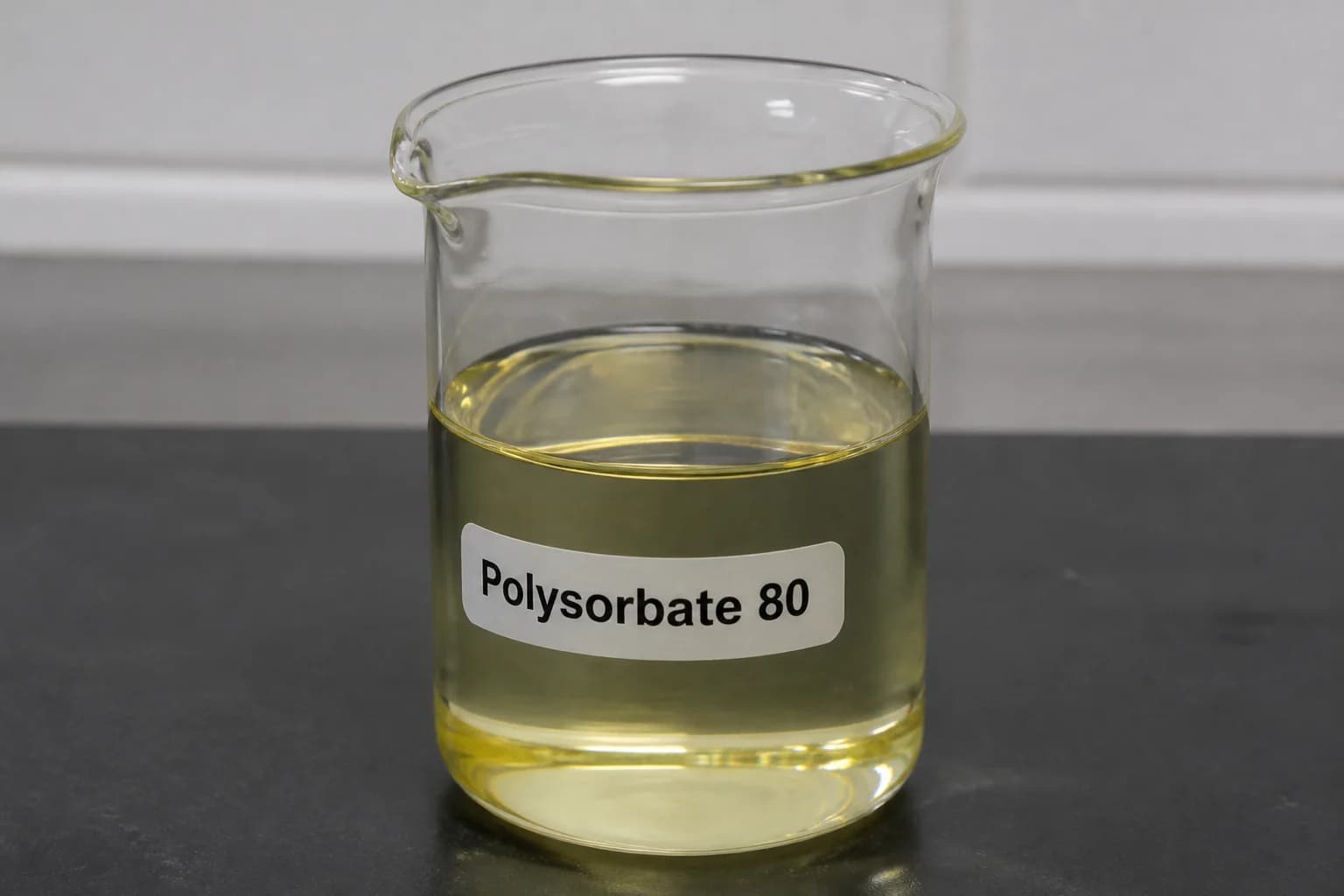
Polysorbate 80
ELSURFACTM – PSB80
Get Pricing For This Product
Need pricing? Request a quote for this product and we'll get back to you shortly.
Speed Up Your Sample Testing Process
Express Delivery in 24–48 Hours
Polysorbate 80 (Tween 80) is a versatile, water-soluble non-ionic surfactant and emulsifier used across the pharmaceutical, cosmetic, personal care and food industries. Derived from sorbitol and oleic…
CAS Number
9005-65-6
HS Code
34021900
INCI Name
-
Molecular Formula
C64H124O26
Polysorbate 80
ELSURFACTM – PSB80
Polysorbate 80 (Tween 80) is a versatile, water-soluble non-ionic surfactant and emulsifier used across the pharmaceutical, cosmetic, personal care and food industries. Derived from sorbitol and oleic acid, this amber viscous liquid blends oil and water phases into smooth, stable…
CAS Number
9005-65-6
INCI Name
-
HS Code
34021900
Molecular Formula
C64H124O26
Get Pricing For This Product
Need pricing? Request a quote for this product and we'll get back to you shortly.
Speed Up Your Sample Testing Process
We deliver domestic samples within 24 - 48 hours, helping you evaluate product without delays.
About Polysorbate 80
Polysorbate 80, also known as Tween 80 or Kolliphor PS 80, is a non-ionic surfactant and emulsifier valued for its ability to blend oil and water into stable, uniform systems. With a hydrophilic-lipophilic balance (HLB) of about 15, it is one of the most effective oil-in-water emulsifiers available, which is why it appears in everything from creams and lotions to vaccines, oral medicines, ice cream and fragrance sprays.
Elchemy is a trusted Polysorbate 80 supplier and sourcing partner, delivering high-purity material in technical, food (E433) and USP/NF pharmaceutical grades to manufacturers worldwide. As a non-ionic emulsifier it works across a wide pH range and is compatible with anionic, cationic and non-ionic systems, making it a dependable choice for formulators who need consistent texture, solubility and shelf stability.
Because Polysorbate 80 is a polymeric surfactant, its performance depends on tight control of saponification value, hydroxyl value, acid value and peroxide value. Every batch Elchemy supplies ships with a Certificate of Analysis so procurement and QA teams can qualify material against their own specifications before it enters production.
Buyers sourcing in volume also track Polysorbate 80 price closely, since the emulsifier feeds directly into the cost of the finished products it stabilises. Elchemy provides quote-based pricing tailored to grade, volume and destination, with samples available before any bulk commitment.
Manufacturing Process of Polysorbate 80
Polysorbate 80 is produced in two stages. First, sorbitol (a plant-derived sugar alcohol) is dehydrated to form sorbitan, a cyclic ether, which is then esterified with oleic acid - a fatty acid typically obtained from vegetable oils - to give sorbitan monooleate (Span 80).
In the second stage, this intermediate is ethoxylated with approximately 20 units of ethylene oxide under controlled temperature and pressure. The resulting polyoxyethylene chains form the hydrophilic head of the molecule, giving Polysorbate 80 its HLB of ~15 and its strong oil-in-water emulsifying power.
The finished liquid is neutralised and purified. Every shipment Elchemy supplies is tested for saponification value, hydroxyl value, acid value, peroxide value and moisture, with a Certificate of Analysis travelling alongside each order.
Polysorbate 80 Price: Bulk Pricing for Buyers
If you're looking for current Polysorbate 80 pricing for bulk procurement, Elchemy provides quotes based on your specific requirements. Fill out the quote request form with details such as grade, volume, packaging and destination, and our team will revert with a detailed offer within 24 to 48 hours.
Pricing works on a quote basis rather than a published rate because the Polysorbate 80 price moves with several factors: the grade (technical, food/E433, or USP/NF pharmaceutical), order volume, packaging format, the cost of oleic-acid and ethylene-oxide feedstock, Incoterm choice (FOB, CIF or DDP) and destination.
For an approximate read on the market, procurement teams often reference the Polysorbate 80 price per kg as a unit benchmark, useful for spotting short-term regional shifts. At bulk scale, the price per ton is the more relevant commercial unit, since contracts are typically committed at that level.
For an exact rate, none of these references replace a direct quote. The actual price depends on your grade, contract structure, destination, committed volume and timing of dispatch - which is why a quote from our team will always be the most accurate number for your procurement.
Packaging & Logistics
Polysorbate 80 ships in 25 kg and 50 kg HDPE carboys, 220 kg drums, or 1,000 kg IBC totes, supplied as per buyer requirements. A typical 20' container holds roughly 18–20 MT depending on packaging.
For US-bound orders, domestic stock supports faster fulfilment. Where material is sourced from India or other origin countries, transit times typically run 24–28 days to the US East Coast and 18–22 days to the West Coast. Elchemy offers FOB, CIF and DDP terms depending on how your procurement team prefers to handle landed cost and customs.
Store in tightly sealed containers in a cool, dry, well-ventilated area, away from direct light, heat and oxidising agents. Kept properly, Polysorbate 80 has a typical shelf life of 24 months.
Why Choose Elchemy as a Trusted Polysorbate 80 Supplier?
Elchemy makes Polysorbate 80 procurement straightforward. That means high-purity material across technical, food (E433) and USP/NF pharmaceutical grades, with other grades sourced on request, and a Certificate of Analysis for every batch.
- Verified supplier network - every manufacturer is pre-audited for quality, capacity and compliance before onboarding
- Full documentation as standard - COA, TDS and GHS-compliant SDS with every order; REACH, Halal and Kosher on request
- Samples in 24–48 hours - qualify material before any bulk commitment
- 40+ countries served - a global base that keeps pricing competitive, with domestic stock for faster US fulfilment
- Custom manufacturing - tailored viscosity, packaging or grade for specific formulation needs
Safety & Handling
Polysorbate 80 is a low-hazard, non-corrosive liquid widely regarded as safe at the levels used in cosmetics, food and pharmaceuticals. It is not classified as dangerous for transport under most frameworks, and is recognised by the FDA as GRAS for food use under 21 CFR 172.840.
As with any surfactant, it may cause mild eye or skin irritation on prolonged contact. Handlers should wear gloves and safety goggles and work in a ventilated area. Flush affected areas with water in case of contact. Store away from strong oxidisers, heat and direct light to prevent peroxide formation. The full 16-section GHS-aligned SDS is available alongside material orders.
Production Technique and Raw Materials
Manufactured by esterifying sorbitol-derived sorbitan with oleic acid to form sorbitan monooleate, then ethoxylating it with approximately 20 moles of ethylene oxide. Key raw materials: sorbitol, oleic acid (vegetable-derived) and ethylene oxide.
Tentative Side Effects
Polysorbate 80 is generally well tolerated. In rare cases it may cause mild skin or eye irritation, or hypersensitivity in sensitive individuals. At high oral intake it can cause mild gastrointestinal effects, but within regulatory limits (EFSA/JECFA ADI of 25 mg/kg body weight per day) it is considered safe for its approved uses.
- Non-ionic emulsifier - works across a wide pH range and is compatible with anionic, cationic and non-ionic systems
- High HLB (~15) - strong, reliable oil-in-water emulsification
- Effective solubiliser - disperses essential and fragrance oils into clear water-based systems
- Multi-grade - technical, food (E433) and USP/NF pharmaceutical grades available
- Low toxicity - FDA-recognised GRAS under 21 CFR 172.840; suitable for food, cosmetic and pharma use
- Documented quality - COA, TDS and SDS supplied with every order
About Polysorbate 80
Polysorbate 80, also known as Tween 80 or Kolliphor PS 80, is a non-ionic surfactant and emulsifier valued for its ability to blend oil and water into stable, uniform systems. With a hydrophilic-lipophilic balance (HLB) of about 15, it is one of the most effective oil-in-water emulsifiers available, which is why it appears in everything from creams and lotions to vaccines, oral medicines, ice cream and fragrance sprays.
Elchemy is a trusted Polysorbate 80 supplier and sourcing partner, delivering high-purity material in technical, food (E433) and USP/NF pharmaceutical grades to manufacturers worldwide. As a non-ionic emulsifier it works across a wide pH range and is compatible with anionic, cationic and non-ionic systems, making it a dependable choice for formulators who need consistent texture, solubility and shelf stability.
Because Polysorbate 80 is a polymeric surfactant, its performance depends on tight control of saponification value, hydroxyl value, acid value and peroxide value. Every batch Elchemy supplies ships with a Certificate of Analysis so procurement and QA teams can qualify material against their own specifications before it enters production.
Buyers sourcing in volume also track Polysorbate 80 price closely, since the emulsifier feeds directly into the cost of the finished products it stabilises. Elchemy provides quote-based pricing tailored to grade, volume and destination, with samples available before any bulk commitment.
Manufacturing Process of Polysorbate 80
Polysorbate 80 is produced in two stages. First, sorbitol (a plant-derived sugar alcohol) is dehydrated to form sorbitan, a cyclic ether, which is then esterified with oleic acid - a fatty acid typically obtained from vegetable oils - to give sorbitan monooleate (Span 80).
In the second stage, this intermediate is ethoxylated with approximately 20 units of ethylene oxide under controlled temperature and pressure. The resulting polyoxyethylene chains form the hydrophilic head of the molecule, giving Polysorbate 80 its HLB of ~15 and its strong oil-in-water emulsifying power.
The finished liquid is neutralised and purified. Every shipment Elchemy supplies is tested for saponification value, hydroxyl value, acid value, peroxide value and moisture, with a Certificate of Analysis travelling alongside each order.
Polysorbate 80 Price: Bulk Pricing for Buyers
If you're looking for current Polysorbate 80 pricing for bulk procurement, Elchemy provides quotes based on your specific requirements. Fill out the quote request form with details such as grade, volume, packaging and destination, and our team will revert with a detailed offer within 24 to 48 hours.
Pricing works on a quote basis rather than a published rate because the Polysorbate 80 price moves with several factors: the grade (technical, food/E433, or USP/NF pharmaceutical), order volume, packaging format, the cost of oleic-acid and ethylene-oxide feedstock, Incoterm choice (FOB, CIF or DDP) and destination.
For an approximate read on the market, procurement teams often reference the Polysorbate 80 price per kg as a unit benchmark, useful for spotting short-term regional shifts. At bulk scale, the price per ton is the more relevant commercial unit, since contracts are typically committed at that level.
For an exact rate, none of these references replace a direct quote. The actual price depends on your grade, contract structure, destination, committed volume and timing of dispatch - which is why a quote from our team will always be the most accurate number for your procurement.
Packaging & Logistics
Polysorbate 80 ships in 25 kg and 50 kg HDPE carboys, 220 kg drums, or 1,000 kg IBC totes, supplied as per buyer requirements. A typical 20' container holds roughly 18–20 MT depending on packaging.
For US-bound orders, domestic stock supports faster fulfilment. Where material is sourced from India or other origin countries, transit times typically run 24–28 days to the US East Coast and 18–22 days to the West Coast. Elchemy offers FOB, CIF and DDP terms depending on how your procurement team prefers to handle landed cost and customs.
Store in tightly sealed containers in a cool, dry, well-ventilated area, away from direct light, heat and oxidising agents. Kept properly, Polysorbate 80 has a typical shelf life of 24 months.
Why Choose Elchemy as a Trusted Polysorbate 80 Supplier?
Elchemy makes Polysorbate 80 procurement straightforward. That means high-purity material across technical, food (E433) and USP/NF pharmaceutical grades, with other grades sourced on request, and a Certificate of Analysis for every batch.
- Verified supplier network - every manufacturer is pre-audited for quality, capacity and compliance before onboarding
- Full documentation as standard - COA, TDS and GHS-compliant SDS with every order; REACH, Halal and Kosher on request
- Samples in 24–48 hours - qualify material before any bulk commitment
- 40+ countries served - a global base that keeps pricing competitive, with domestic stock for faster US fulfilment
- Custom manufacturing - tailored viscosity, packaging or grade for specific formulation needs
Safety & Handling
Polysorbate 80 is a low-hazard, non-corrosive liquid widely regarded as safe at the levels used in cosmetics, food and pharmaceuticals. It is not classified as dangerous for transport under most frameworks, and is recognised by the FDA as GRAS for food use under 21 CFR 172.840.
As with any surfactant, it may cause mild eye or skin irritation on prolonged contact. Handlers should wear gloves and safety goggles and work in a ventilated area. Flush affected areas with water in case of contact. Store away from strong oxidisers, heat and direct light to prevent peroxide formation. The full 16-section GHS-aligned SDS is available alongside material orders.
Production Technique and Raw Materials
Manufactured by esterifying sorbitol-derived sorbitan with oleic acid to form sorbitan monooleate, then ethoxylating it with approximately 20 moles of ethylene oxide. Key raw materials: sorbitol, oleic acid (vegetable-derived) and ethylene oxide.
Tentative Side Effects
Polysorbate 80 is generally well tolerated. In rare cases it may cause mild skin or eye irritation, or hypersensitivity in sensitive individuals. At high oral intake it can cause mild gastrointestinal effects, but within regulatory limits (EFSA/JECFA ADI of 25 mg/kg body weight per day) it is considered safe for its approved uses.
- Non-ionic emulsifier - works across a wide pH range and is compatible with anionic, cationic and non-ionic systems
- High HLB (~15) - strong, reliable oil-in-water emulsification
- Effective solubiliser - disperses essential and fragrance oils into clear water-based systems
- Multi-grade - technical, food (E433) and USP/NF pharmaceutical grades available
- Low toxicity - FDA-recognised GRAS under 21 CFR 172.840; suitable for food, cosmetic and pharma use
- Documented quality - COA, TDS and SDS supplied with every order
FAQs - Polysorbate 80
Related Products

Related Products
Streamline
Your Chemical
Procurement
Get fast responses from real experts