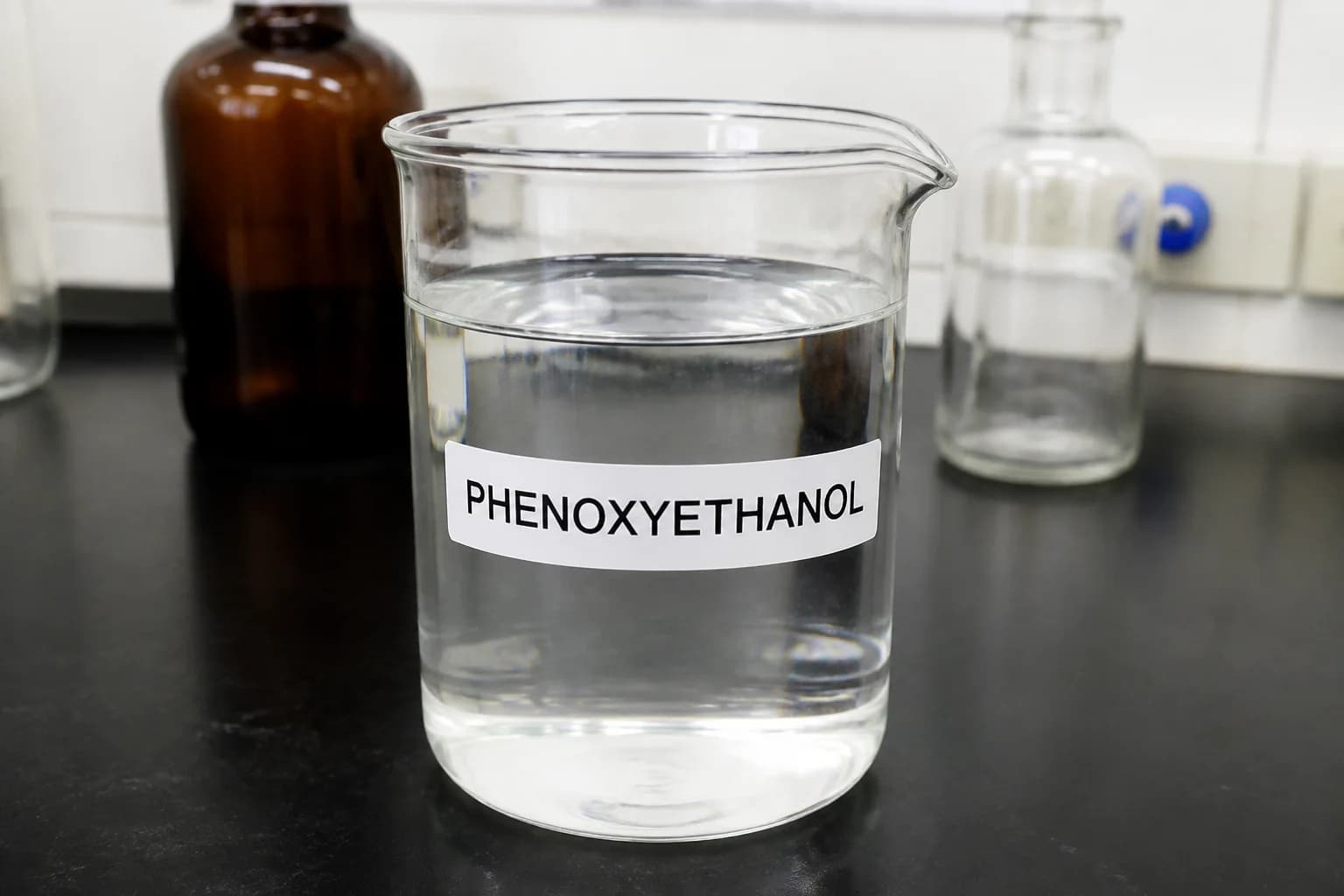
Phenoxyethanol
ELPROTECTTM – PEO10
Get Pricing For This Product
Need pricing? Request a quote for this product and we'll get back to you shortly.
Speed Up Your Sample Testing Process
Express Delivery in 24–48 Hours
Phenoxyethanol is primarily employed as a preservative in various formulations to inhibit the growth of bacteria, yeast, and mold. It is particularly effective against Gram-negative bacteri It…
CAS Number
122-99-6
HS Code
2909.49.90 / 2909.49.10
INCI Name
Phenoxy Ethanol
Molecular Formula
C₈H₁₀O₂
Phenoxyethanol
ELPROTECTTM – PEO10
Phenoxyethanol is primarily employed as a preservative in various formulations to inhibit the growth of bacteria, yeast, and mold. It is particularly effective against Gram-negative bacteri It consists of a benzene ring connected to a hydroxyl group and an ether linkage. This…
CAS Number
122-99-6
INCI Name
Phenoxy Ethanol
HS Code
2909.49.90 / 2909.49.10
Molecular Formula
C₈H₁₀O₂
Get Pricing For This Product
Need pricing? Request a quote for this product and we'll get back to you shortly.
Speed Up Your Sample Testing Process
We deliver domestic samples within 24 - 48 hours, helping you evaluate product without delays.
Product Specification
Physical Properties
| Property | Specification |
|---|---|
| Appearance | Colorless liquid |
| Odor | Faint aromatic odor |
| Molecular Weight (G/Mol) | 138.16 |
| Density Or Specific Gravity | 1.104 g/ Ml |
| Viscosity | 20.5 centistokes at 25 °C |
| Refractive Index | 1.534 at 20 °C/D |
| Ph (If Aqueous Solution) | 7 at 10 g/l at 23 °C |
Chemical Properties
| Property | Specification |
|---|---|
| Water Solubility | 30 g/L (20 ºC) |
| Incompatibilities | Nonionic surfactants |
| Hazardous Reactions | Oxidizes in air to form unstable peroxides |
Thermal Properties
| Property | Specification |
|---|---|
| Melting Point | 57 °F |
| Boiling Point | 473.4 °F at 760 mmHg |
| Flash Point | 250 °F |
| Autoignition Temperature | 500 °C |
Processing Methods & Reference Formulations
A. Cosmetic moisturizing cream
When adding Phenoxyethanol in cream formulations, incorporate it during the cool-down phase below 40°C to maintain its preservative effectiveness. Ensure it's fully dissolved in the water or oil phase before emulsification if pre-blended. Mix thoroughly to achieve uniform distribution and stable preservation.
| Key Ingredients | Indicative Dosage (% w/w) |
|---|---|
| Water (Aqua) | 60% |
| Glycerin | 5% |
| Cetearyl Alcohol | 4% |
| Cetyl Alcohol | 2% |
| Caprylic/Capric Triglyceride | 10% |
| Phenoxyethanol | 0.8% |
| Carbomer | 0.5% |
| Triethanolamine | 0.3% |
| Water | 20% |
B. Hair shampoo
When adding Phenoxyethanol in shampoo, include it during the cool-down phase to preserve its antimicrobial activity. Ensure even distribution by mixing thoroughly after all surfactants and additives are incorporated. Avoid adding at high temperatures to prevent degradation and reduced efficacy.
| Key Ingredients | Indicative Dosage (% w/w) |
|---|---|
| Water (Aqua) | 75.8% |
| Sodium Laureth Sulfate | 12% |
| Cocamidopropyl Betaine | 6% |
| Glycerin | 3% |
| Phenoxyethanol | 0.8% |
| Fragrance | 0.4% |
| Preservative | 0.5% |
C. Cleanser
In cleanser formulation, add Phenoxyethanol during the cool-down phase to maintain its preservative efficacy. Ensure gentle, thorough mixing to evenly disperse it and avoid destabilizing the formulation.
| Key Ingredients | Indicative Dosage (% w/w) |
|---|---|
| Glycerin | 4% |
| Sodium Chloride | 0.5% |
| Phenoxyethanol | 0.8% |
| Disodium EDTA | 0.1% |
| Water | 80-90% |
D. Liquid Foundation
In foundation formulation, add Phenoxyethanol during the cool-down phase to preserve its antimicrobial properties. Stir gently to ensure even distribution without affecting emulsion stability or pigment dispersion.
| Key Ingredients | Indicative Dosage (% w/w) |
|---|---|
| Dimethicone | 10% |
| Glycerin | 5% |
| Titanium Dioxide | 3% |
| Phenoxyethanol | 0.8% |
| Triethanolamine | 0.3% |
| Carbomer | 0.5% |
| Water | 70-80% |
Dosing Guidelines
A. Dosing by Application
| Products | Authorized dosage |
|---|---|
| Cosmetic moisturizing cream | Upto 1% |
| Hair shampoo/Conditioners | Upto 1% |
| Lip stick | Upto 1% |
About Phenoxyethanol
Phenoxyethanol is a versatile and widely used preservative in personal care, cosmetic, and industrial applications. It is a colorless liquid with a mild, pleasant odor, known for its role in stabilizing and preserving the efficacy of various products. As a preservative, phenoxyethanol prevents the core ingredients in formulations from spoiling, ensuring the longevity and safety of the final products.
In the cosmetics and personal care industry, phenoxyethanol is frequently used in a range of products, including:
Its primary role in these applications is to act as a stabilizer or antibacterial agent, ensuring that the products remain fresh and potent. Additionally, in fragrances and perfumes, phenoxyethanol serves as a fixative, helping to maintain the scent over time.
Phenoxyethanol is also widely recognized as a glycol ether and is utilized for its chemical stability in various formulations. Its low evaporation rate and lower water solubility make it an ideal ingredient for cosmetic and industrial use. It is chemically stable and can be integrated into a variety of chemical compositions without losing its effectiveness. The production process involves the reaction of ethylene oxide and phenol under high pressure and temperature, resulting in an oily, slightly aromatic liquid.
Beyond personal care products, phenoxyethanol finds applications in diverse industries, including pharmaceuticals, automotive, textiles, paints, healthcare and chemical industry. It is also used as a fish anesthetic in aquaculture and a solvent in inks, such as those used in ballpoint pens. Furthermore, phenoxyethanol can be found in natural sources like green tea, adding to its appeal as a more naturally derived preservative in certain formulations.
At Elchemy, we take pride in offering high-quality, REACH-certified phenoxyethanol that meets industry standards. Our phenoxyethanol is suitable for a wide range of industries, including cosmetics, pharmaceuticals, and agrochemicals. With our rigorous quality control and dedication to customer satisfaction, we ensure that you receive only the best chemical products to meet your manufacturing needs.
If you're looking for a reliable supplier of phenoxyethanol for your industrial or personal care formulations, Elchemy is here to fulfill your requirements with timely delivery and exceptional quality.
- Preservative: Prevents bacterial growth, extends product shelf life.
- Stabilizer: Maintains formulation integrity.
- Versatile: Used in cosmetics, personal care, and industrial products.
- Stable: Chemically durable with low evaporation.
- Widely Approved: Safe for use in personal care globally.
About Phenoxyethanol
Phenoxyethanol is a versatile and widely used preservative in personal care, cosmetic, and industrial applications. It is a colorless liquid with a mild, pleasant odor, known for its role in stabilizing and preserving the efficacy of various products. As a preservative, phenoxyethanol prevents the core ingredients in formulations from spoiling, ensuring the longevity and safety of the final products.
In the cosmetics and personal care industry, phenoxyethanol is frequently used in a range of products, including:
Its primary role in these applications is to act as a stabilizer or antibacterial agent, ensuring that the products remain fresh and potent. Additionally, in fragrances and perfumes, phenoxyethanol serves as a fixative, helping to maintain the scent over time.
Phenoxyethanol is also widely recognized as a glycol ether and is utilized for its chemical stability in various formulations. Its low evaporation rate and lower water solubility make it an ideal ingredient for cosmetic and industrial use. It is chemically stable and can be integrated into a variety of chemical compositions without losing its effectiveness. The production process involves the reaction of ethylene oxide and phenol under high pressure and temperature, resulting in an oily, slightly aromatic liquid.
Beyond personal care products, phenoxyethanol finds applications in diverse industries, including pharmaceuticals, automotive, textiles, paints, healthcare and chemical industry. It is also used as a fish anesthetic in aquaculture and a solvent in inks, such as those used in ballpoint pens. Furthermore, phenoxyethanol can be found in natural sources like green tea, adding to its appeal as a more naturally derived preservative in certain formulations.
At Elchemy, we take pride in offering high-quality, REACH-certified phenoxyethanol that meets industry standards. Our phenoxyethanol is suitable for a wide range of industries, including cosmetics, pharmaceuticals, and agrochemicals. With our rigorous quality control and dedication to customer satisfaction, we ensure that you receive only the best chemical products to meet your manufacturing needs.
If you're looking for a reliable supplier of phenoxyethanol for your industrial or personal care formulations, Elchemy is here to fulfill your requirements with timely delivery and exceptional quality.
- Preservative: Prevents bacterial growth, extends product shelf life.
- Stabilizer: Maintains formulation integrity.
- Versatile: Used in cosmetics, personal care, and industrial products.
- Stable: Chemically durable with low evaporation.
- Widely Approved: Safe for use in personal care globally.
Regulatory Compliance
| Region | Max Allowed Level | Notes | Certification Body |
|---|---|---|---|
| Australia | 1% | Australia | - |
| China | 1% | NMPA - National Medical Products Administration | NMPA - National Medical Products Administration |
| Japan | 1% | Listed as an approved cosmetic ingredient with a typical maximum of 1.0%. | MHLW – Ministry of Health, Labour and Welfare |
| Republic of Korea | 1% | MFDS - Ministry of Food and Drug Safety | MFDS - Ministry of Food and Drug Safety |
| United States | 1% | Considered safe as a cosmetic ingredient in the present practices of use and concentration, generally at < 1%. | FDA |
| ASEAN | 1% | ASEAN | - |
| European Union | 1% | Authorized as a preservative at up to 1.0% in finished products. | SCCS (Scientific Committee on Consumer Safety) |
FAQs - Phenoxyethanol
Related Products


Related Products
Streamline
Your Chemical
Procurement
Get fast responses from real experts