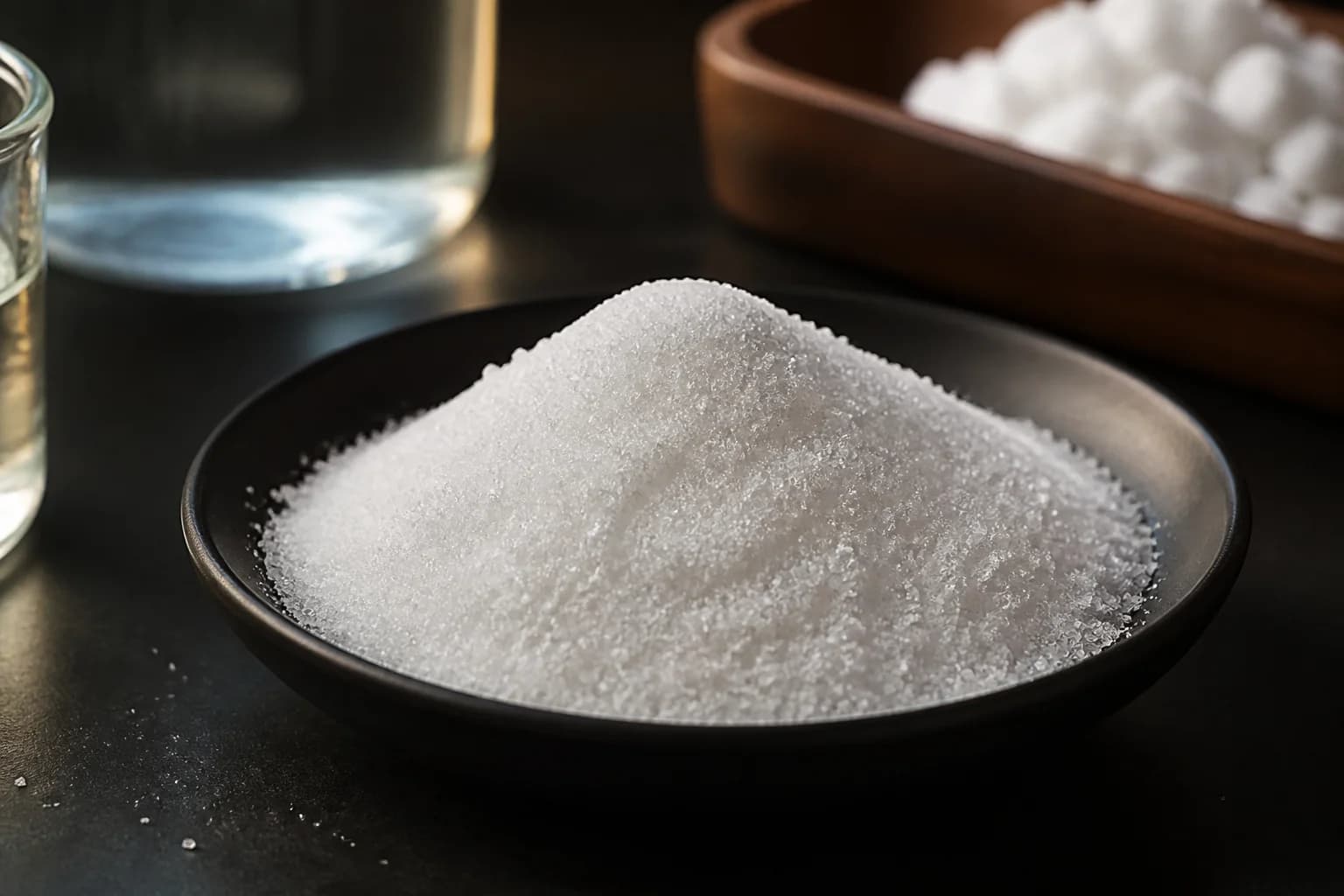
Pentaerythritol
ELFATTM – pETO
Get Pricing For This Product
Need pricing? Request a quote for this product and we'll get back to you shortly.
Speed Up Your Sample Testing Process
Express Delivery in 24–48 Hours
Pentaerythritol is a white crystalline polyol compound widely used in the production of alkyd resins, varnishes, and PVC stabilizers. It serves as a building block in the synthesis of esters and is…
CAS Number
115-77-5
HS Code
2905.42.10
INCI Name
Pentaerythritol
Molecular Formula
C5H12O4
Pentaerythritol
ELFATTM – pETO
Pentaerythritol is a white crystalline polyol compound widely used in the production of alkyd resins, varnishes, and PVC stabilizers. It serves as a building block in the synthesis of esters and is valued for its ability to enhance the durability and flexibility of coatings.…
CAS Number
115-77-5
INCI Name
Pentaerythritol
HS Code
2905.42.10
Molecular Formula
C5H12O4
Get Pricing For This Product
Need pricing? Request a quote for this product and we'll get back to you shortly.
Speed Up Your Sample Testing Process
We deliver domestic samples within 24 - 48 hours, helping you evaluate product without delays.
Product Specification
Physical Properties
| Property | Specification |
|---|---|
| Appearance | White crystalline solid |
| Odor | Odorless |
| Molecular Weight | 136.15 g/mol |
| Density | 1.396 g/cm³ |
| Specific Gravity | 1.39 at 25°C |
| Viscosity | Not applicable (Solid) |
| Refractive Index | 1.548 at 25°C |
| Ph (Aqueous Solution) | 3.5 – 4.5 (100 g/L at 35°C) |
| Assay / Purity | 98% min |
Chemical Properties
| Property | Specification |
|---|---|
| Pka | 14.10 |
| Ionic Nature | Non-ionic (polyol) |
| Incompatibilities | Strong oxidizing agents, strong acids, acid anhydrides, acid chlorides. |
| Hazardous Reactions / Decomposition Products | Hazardous decomposition products formed under fire conditions are carbon oxides (CO, CO2). Reacts violently with strong oxidants and strong acids, which generates an explosion hazard. |
Thermal Properties
| Property | Specification |
|---|---|
| Melting Point | 260 °C |
| Boiling Point | 276 °C at 30 mmHg |
| Flash Point | 240 °C (464 °F) |
| Autoignition Temperature | >400 °C at 1,013 hPa |
| Thermal Stability | Stable under normal conditions. |
Processing Methods & Reference Formulations
A. Solvent-Free Alkyd Resin for Brush Paints
This formulation produces a clear, low-viscosity alkyd resin suitable for paints with low solvent content.
| Key Ingredients | Indicative Dosage (% w/w) |
|---|---|
| Tall Oil Fatty Acid | 61.0% |
| Pentaerythritol | 12.8% |
| Hypophosphorous Acid | 1.1% |
| Trimellitic Anhydride | 25.1% |
B. Synthetic Lubricant Base Stock (Aviation Grade)
This describes the reactants for a polyol ester (POE) base stock used in high-performance lubricants, such as aviation turbo oils. The exact percentages of the fatty acids are adjusted to achieve desired properties like viscosity and low-temperature performance.
| Key Ingredients | Indicative Dosage (% w/w) |
|---|---|
| Technical Pentaerythritol | Polyol (85-92% monopentaerythritol, 8-15% dipentaerythritol) |
| C5-C10 Carboxylic Acids | Acid Reactants (blend of linear and branched acids) |
Dosing Guidelines
A. Dosing by Application
| Application | Recommended / Max Dosage |
|---|---|
| Alkyd Resins for Paints | 7.00% – 16.25% |
| Synthetic Lubricants (Polyol Esters) | Stoichiometrically reacted with fatty acids; technical grade contains 85-92% monopentaerythritol. |
About Pentaerythritol
Pentaerythritol manufacturers and suppliers play a crucial role in providing this versatile polyol compound to various industries. Known for its stability and multifunctional properties, Pentaerythritol is a key ingredient in the production of alkyd resins, which are widely used in paints and coatings. Its ability to enhance the durability and flexibility of coatings makes it a preferred choice for manufacturers. Additionally, Pentaerythritol is used in the production of PVC stabilizers, synthetic lubricants, and flame retardants, highlighting its versatility. The compound's role in the synthesis of explosives further underscores its importance in industrial applications. Manufacturers focus on producing high-purity Pentaerythritol to meet the stringent demands of these industries, ensuring consistent quality and performance. As the demand for sustainable and efficient raw materials grows, Pentaerythritol suppliers are increasingly adopting eco-friendly practices to minimize environmental impact. This aligns with the global trend towards sustainability in the chemical industry, making Pentaerythritol a valuable component in modern manufacturing processes.
- Versatile Polyol: Essential in resin and stabilizer production, enhancing product performance.
- Function: Primarily acts as a polyol building block and cross-linking agent. In cosmetics, it functions as a humectant and skin conditioning agent.
- High Purity Standards: Ensures consistent quality for industrial applications.
- Features: High thermal and chemical stability, four reactive hydroxyl groups, high melting point, non-hygroscopic (does not absorb moisture), and low toxicity.
- Eco-Friendly Production: Focus on sustainable manufacturing practices.
- Benefits: Enhances hardness, gloss, durability, and weather resistance in coatings. Improves thermal stability in lubricants and plastics. Acts as a char-forming agent in intumescent flame retardants.
- Durability Enhancer: Improves the longevity and flexibility of coatings.
- Key Explosive Precursor: Used in the synthesis of PETN for military applications.
About Pentaerythritol
Pentaerythritol manufacturers and suppliers play a crucial role in providing this versatile polyol compound to various industries. Known for its stability and multifunctional properties, Pentaerythritol is a key ingredient in the production of alkyd resins, which are widely used in paints and coatings. Its ability to enhance the durability and flexibility of coatings makes it a preferred choice for manufacturers. Additionally, Pentaerythritol is used in the production of PVC stabilizers, synthetic lubricants, and flame retardants, highlighting its versatility. The compound's role in the synthesis of explosives further underscores its importance in industrial applications. Manufacturers focus on producing high-purity Pentaerythritol to meet the stringent demands of these industries, ensuring consistent quality and performance. As the demand for sustainable and efficient raw materials grows, Pentaerythritol suppliers are increasingly adopting eco-friendly practices to minimize environmental impact. This aligns with the global trend towards sustainability in the chemical industry, making Pentaerythritol a valuable component in modern manufacturing processes.
- Versatile Polyol: Essential in resin and stabilizer production, enhancing product performance.
- Function: Primarily acts as a polyol building block and cross-linking agent. In cosmetics, it functions as a humectant and skin conditioning agent.
- High Purity Standards: Ensures consistent quality for industrial applications.
- Features: High thermal and chemical stability, four reactive hydroxyl groups, high melting point, non-hygroscopic (does not absorb moisture), and low toxicity.
- Eco-Friendly Production: Focus on sustainable manufacturing practices.
- Benefits: Enhances hardness, gloss, durability, and weather resistance in coatings. Improves thermal stability in lubricants and plastics. Acts as a char-forming agent in intumescent flame retardants.
- Durability Enhancer: Improves the longevity and flexibility of coatings.
- Key Explosive Precursor: Used in the synthesis of PETN for military applications.
Regulatory Compliance
| Region | Max Allowed Level | Notes | Certification Body |
|---|---|---|---|
| United States | - | Approved by the FDA for use as a stabilizer in PVC food packaging. Listed on the TSCA (Toxic Substances Control Act) inventory. | TSCA |
| European Union | - | Registered under REACH. Not classified as hazardous according to CLP Regulation (EC) No 1272/2008. | REACH |
| Canada | - | Not specifically restricted. Listed on the Domestic Substances List (DSL). | - |
| India | - | Not specifically restricted. Subject to standard import/export regulations. | - |
| Japan | - | Not specifically restricted. Listed on the ENCS (Existing and New Chemical Substances) inventory. | - |
| Australia | - | Not specifically restricted. Listed on the AICS (Australian Inventory of Industrial Chemicals). | - |
| China | - | Not specifically restricted. Listed on the IECIC (Inventory of Existing Chemical Ingredients in China). | - |
| Republic of Korea | - | Not specifically restricted. Listed on the KECI (Korean Existing Chemicals Inventory). | - |
| ASEAN | - | Not specifically restricted under the ASEAN Cosmetic Directive for its listed functions (Humectant, Skin Conditioning). | - |
FAQs - Pentaerythritol
Related Products
Related Products
Streamline
Your Chemical
Procurement
Get fast responses from real experts