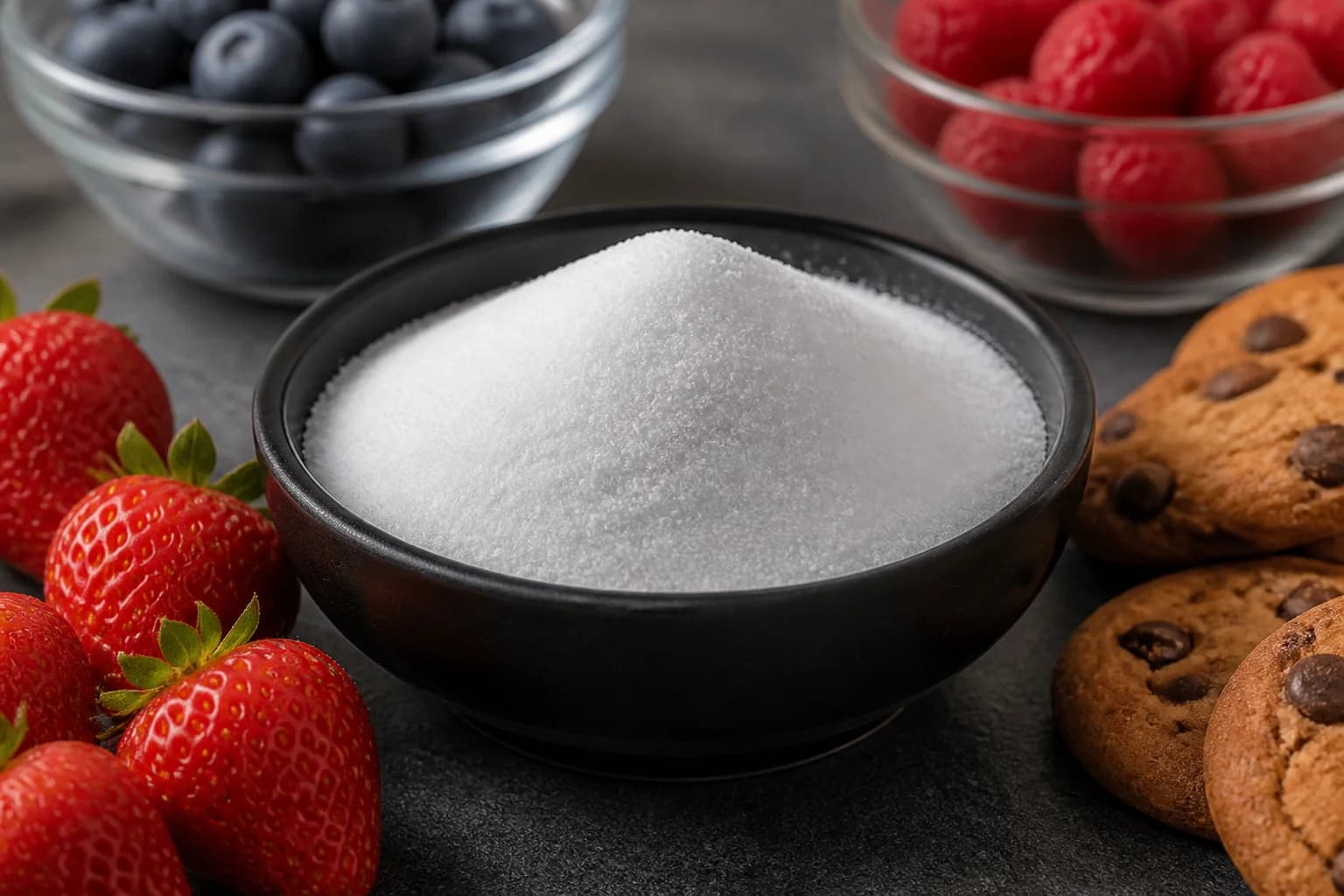
Erythritol
ETOTM
Get Pricing For This Product
Skip the quote. Sign up now and see pricing instantly
Speed Up Your Sample Testing Process
Express Delivery in 24–48 Hours
Erythritol is a naturally occurring sugar alcohol used as a low-calorie sweetener in various food and beverage products. It offers a sweet taste similar to sugar but with fewer calories, making it…
CAS Number
149-32-6
HS Code
29054900
INCI Name
Erythritol
Molecular Formula
C4H10O4
Erythritol
ETOTM
Erythritol is a naturally occurring sugar alcohol used as a low-calorie sweetener in various food and beverage products. It offers a sweet taste similar to sugar but with fewer calories, making it popular in sugar-free and low-calorie products. Erythritol is known for its…
CAS Number
149-32-6
INCI Name
Erythritol
HS Code
29054900
Molecular Formula
C4H10O4
Get Pricing For This Product
Skip the quote. Sign up now and see pricing instantly
Speed Up Your Sample Testing Process
We deliver domestic samples within 24 - 48 hours, helping you evaluate product without delays.
Product Specification
Physical Properties
| Property | Specification |
|---|---|
| Appearance | White crystalline powder |
| Odor | Odorless |
| Molecular Weight | 122.12 g/mol |
| Density / Specific Gravity | 1.451 g/cm³ at 20 °C |
| Viscosity | 184 +122/-73 Pa·s (pure erythritol) |
| Refractive Index | 1.4502 (estimate) |
| Ph (Aqueous Solution) | 5.0 - 7.0 (10% aqueous solution) |
| Assay / Purity | ≥99.0% (on dry basis) |
Chemical Properties
| Property | Specification |
|---|---|
| Pka | 13.903 at 18 °C |
| Incompatibilities | Strong oxidizing agents, Strong bases |
| Hazardous Reactions / Decomposition Products | Under fire conditions, may decompose to form carbon monoxide and carbon dioxide. |
Thermal Properties
| Property | Specification |
|---|---|
| Melting Point | 118 - 123 °C |
| Boiling Point | 329 - 331 °C |
| Flash Point | 329-331°C |
| Decomposition Temperature | Stable up to 160°C. Will not decompose or change at temperatures below 200°C. |
| Thermal Stability | Erythritol has very good thermal stability. It is stable under heat, acid, and alkali conditions. |
Dosing Guidelines
A. Dosing by Application
| Application | Recommended / Max Dosage |
|---|---|
| Coffee and tea | Quantum satis |
| Liquid dietary supplements | Quantum satis |
| Juice blends | Quantum satis |
| Soft drinks | Quantum satis |
| Flavored water | Quantum satis |
| Confections | Quantum satis |
| Biscuits and cookies | Quantum satis |
| Tabletop sweeteners | Quantum satis |
| Sugar-free chewing gum | Quantum satis |
| Toothpaste and mouthwash | As a non-cariogenic sweetener |
About Erythritol
Erythritol manufacturers and suppliers offer a versatile, low-calorie sweetener that is gaining popularity in the global market, particularly in North America. Known for its sugar-like taste and excellent digestive tolerance, erythritol is a preferred choice for health-conscious consumers and food manufacturers. Erythritol is produced through a fermentation process using natural sources, ensuring high purity and quality. It is widely used in sugar-free and low-calorie products, including beverages, baked goods, and confectionery. Erythritol's non-cariogenic properties make it an ideal sweetener for dental care products, as it does not contribute to tooth decay. Manufacturers focus on sustainable production practices, aligning with the growing demand for eco-friendly ingredients in the food industry. Erythritol's versatility extends beyond food applications, as it is also used in personal care products as a humectant, enhancing moisture retention and texture. The increasing trend towards healthier lifestyles and sugar reduction is driving the demand for erythritol, making it a key ingredient in the development of innovative, health-focused products.
- Low-Calorie Sweetener: Provides sweetness with minimal calories, ideal for sugar-free and low-calorie products.
- Function: Sweetener, Bulking Agent, Stabilizer, Humectant, Moisturizing Agent, Skin-Conditioning Agent.
- Excellent Digestive Tolerance: Well-tolerated compared to other sugar alcohols, with minimal gastrointestinal side effects.
- Features: Approximately 60-70% as sweet as sucrose with a clean taste and no aftertaste. Very low caloric value (0-0.2 kcal/g). Zero glycemic index; does not raise blood sugar or insulin levels. Non-cariogenic (does not cause tooth decay) and may inhibit oral bacteria. High digestive tolerance compared to other polyols. Creates a strong cooling sensation when dissolved in water. Non-hygroscopic (does not readily absorb moisture from the air).
- Non-Cariogenic: Does not contribute to tooth decay, making it suitable for dental care products.
- Benefits: Suitable for use in products for diabetics and those on ketogenic diets. Can be used to reduce calories and added sugars in food and beverage formulations. Improves mouthfeel and masks off-tastes of high-intensity sweeteners. In cosmetics, it helps maintain moisture in the product and on the skin. As a pharmaceutical excipient, it offers good flowability and stability, especially for moisture-sensitive active ingredients.
- Heat Stable: Suitable for baking and cooking applications, maintaining sweetness and texture.
- Natural Origin: Produced through fermentation, ensuring high purity and quality.
About Erythritol
Erythritol manufacturers and suppliers offer a versatile, low-calorie sweetener that is gaining popularity in the global market, particularly in North America. Known for its sugar-like taste and excellent digestive tolerance, erythritol is a preferred choice for health-conscious consumers and food manufacturers. Erythritol is produced through a fermentation process using natural sources, ensuring high purity and quality. It is widely used in sugar-free and low-calorie products, including beverages, baked goods, and confectionery. Erythritol's non-cariogenic properties make it an ideal sweetener for dental care products, as it does not contribute to tooth decay. Manufacturers focus on sustainable production practices, aligning with the growing demand for eco-friendly ingredients in the food industry. Erythritol's versatility extends beyond food applications, as it is also used in personal care products as a humectant, enhancing moisture retention and texture. The increasing trend towards healthier lifestyles and sugar reduction is driving the demand for erythritol, making it a key ingredient in the development of innovative, health-focused products.
- Low-Calorie Sweetener: Provides sweetness with minimal calories, ideal for sugar-free and low-calorie products.
- Function: Sweetener, Bulking Agent, Stabilizer, Humectant, Moisturizing Agent, Skin-Conditioning Agent.
- Excellent Digestive Tolerance: Well-tolerated compared to other sugar alcohols, with minimal gastrointestinal side effects.
- Features: Approximately 60-70% as sweet as sucrose with a clean taste and no aftertaste. Very low caloric value (0-0.2 kcal/g). Zero glycemic index; does not raise blood sugar or insulin levels. Non-cariogenic (does not cause tooth decay) and may inhibit oral bacteria. High digestive tolerance compared to other polyols. Creates a strong cooling sensation when dissolved in water. Non-hygroscopic (does not readily absorb moisture from the air).
- Non-Cariogenic: Does not contribute to tooth decay, making it suitable for dental care products.
- Benefits: Suitable for use in products for diabetics and those on ketogenic diets. Can be used to reduce calories and added sugars in food and beverage formulations. Improves mouthfeel and masks off-tastes of high-intensity sweeteners. In cosmetics, it helps maintain moisture in the product and on the skin. As a pharmaceutical excipient, it offers good flowability and stability, especially for moisture-sensitive active ingredients.
- Heat Stable: Suitable for baking and cooking applications, maintaining sweetness and texture.
- Natural Origin: Produced through fermentation, ensuring high purity and quality.
Regulatory Compliance
| Region | Max Allowed Level | Notes | Certification Body |
|---|---|---|---|
| United States | 60% | Generally Recognized as Safe (GRAS). The FDA has reviewed multiple GRAS notices for erythritol and has had "no questions" regarding its safety for use as a sweetener and for other functions in a wide variety of foods and beverages. | Food-grade products should be manufactured in a facility compliant with GMP. The substance must be listed on the TSCA Inventory for commercial importation or manufacturing. |
| European Union | 1.6% | Approved as a food additive (E 968). In a 2023 re-evaluation, EFSA established an Acceptable Daily Intake (ADI) of 0.5 g/kg of body weight per day, primarily to protect against laxative effects. Foods containing more than 10% added polyols must carry the warning: "excessive consumption may produce laxative effects." | Must comply with Regulation (EC) No 1333/2008. For chemical substances, REACH registration is required for manufacturing or importing in quantities over 1 tonne per year. |
| Canada | 11.6% | Approved as a food additive and listed on the List of Permitted Sweeteners. Health Canada has completed premarket safety assessments and found its use to be safe in specified food categories at specified levels. The total amount of sugar alcohols per serving must be declared on the label. | Must comply with Canadian Food and Drug Regulations. |
| India | - | Approved as a non-caloric sweetener and can be used as a flavour enhancer and humectant. It is listed in the Food Safety and Standards (Food Products Standards and Food Additives) Regulations. | Must comply with FSSAI regulations. |
| Japan | - | Approved for use in foods and was one of the first countries to commercialize erythritol in 1990. It is recognized as a zero-calorie sweetener under the Ministry of Health and Welfare's energy evaluation methods. | Must comply with Japan's Food Sanitation Act. |
| Australia | - | Approved as a food additive (INS number 968) and permitted in processed foods in accordance with GMP. | Must comply with the Australia New Zealand Food Standards Code. |
| China | - | Approved for use as a sweetener in foods. Its use should be in accordance with the GB 2760 standard for food additive use. | Must comply with national food safety standards (e.g., GB 2760). |
| Republic of Korea | - | Erythritol is an approved food additive. The Ministry of Food and Drug Safety (MFDS) regulates food additives to align with international standards. | Must comply with the Food Additive Codex regulated by the MFDS. |
| ASEAN | - | Regulation can vary by member state. Generally, countries align with international standards like Codex Alimentarius, which has an ADI of "not specified" for erythritol. | Varies by country. |
FAQs - Erythritol
Related Products
Related Products
Streamline
Your Chemical
Procurement
Get fast responses from real experts