

At a Glance
- Ingredient role: Shea-derived ingredients are used as skin-conditioning agents in cosmetics, but their presence alone does not prove a body wash will leave skin more hydrated.
- Formulation fit: Shea butter does not simply dissolve into a water-based cleanser; the formulator must validate how the selected base incorporates and holds it.
- Trade-offs: The butter may change appearance, viscosity, lather, rinse feel, and stability. The direction and acceptability of those changes depend on the full formula.
- Evidence: Ingredient-level safety assessments do not establish a specific cleanser’s performance or support every claim about its finished product.
- Next step: Review the ingredient specification, set acceptance criteria, and screen it in the target surfactant system before scale-up.
What you’ll learn
You’ll learn what shea butter may contribute to rinse-off body wash, which formulation variables to monitor, and how to evaluate the ingredient without assuming leave-on results carry over.
Introduction
Shea butter can be evaluated as a skin-conditioning ingredient in body wash, but its presence alone does not show that a rinse-off cleanser will leave skin more hydrated. The outcome depends on the ingredient specification, the surfactant base, how the butter is incorporated, and what remains after rinsing. Cosmetic ingredient assessments describe functions and safety scope, not the performance of every finished cleanser.
This guide is for North American product developers and technical buyers. It focuses on formulation decisions, not a consumer product review or a universal recipe. Elchemy’s shea butter product page is the relevant starting point for reviewing the listed ingredient and its document route. No shea-specific body-wash use level or validated formula has been approved for this article.
What role can shea butter play in body wash?
Shea butter may serve as a skin-conditioning component, but that function is not a guarantee of a particular skin result after rinsing. The Cosmetic Ingredient Review (CIR) describes shea-derived ingredients as commonly functioning as skin and hair conditioning agents in cosmetics. Its 2024 assessment concludes that the ingredients it reviewed are safe under present practices and concentrations when formulated to be non-sensitizing, not that every body wash containing shea has been proven effective or suitable for every user (CIR assessment).
Body wash is rinsed away, so a lotion claim cannot automatically be transferred to a cleanser.
Shea butter is also only one part of the formula. The surfactant system does the cleansing; the complete formula determines how the product looks, pours, lathers, rinses, and feels.
How does shea butter fit into a rinse-off cleanser?
Elchemy’s current product listing describes its shea butter as water-insoluble, so a formulator should not expect it to dissolve into the water phase on its own. Confirm that property and the processing guidance for the selected grade in its current shea butter technical data sheet before planning a batch.
The base must incorporate the butter through a validated approach, such as dispersion or emulsification. The grade and full formula determine which approach is suitable.
Body washes also do not all use the same cleanser type. Many liquid body washes use surfactant systems; true soap is a distinct category whose legal treatment can depend on its composition and claims. The FDA’s cosmetic, drug, and soap guidance explains the U.S. distinction.
| Formulation question | Why it matters | What to check |
| How will the butter be incorporated? | The material must remain acceptably distributed in the selected base. | Addition sequence, mixing conditions, appearance, and uniformity. |
| What happens to cleansing and lather? | Added lipid may change the product’s use profile. | Lather, cleansing performance, rinse, and residue against the control. |
| Does texture remain acceptable? | Viscosity and appearance affect filling and consumer use. | Viscosity, opacity, graininess, and changes over time. |
| Does the product remain stable? | Separation or sensory drift can make the batch unacceptable. | Appearance, odor, pH, viscosity, and package compatibility. |
Record the control and trial results using the team’s established methods.
Which formulation variables should be checked?
Start with the cleanser base and the product target, then assess the butter as one variable in that system. A change in one ingredient can affect several product attributes, so the team should define acceptable results before comparing prototypes.
Review the surfactant blend, viscosity system, fragrance, and any oil-dispersing or emulsifying components together. Elchemy lists cocamidopropyl betaine product details and sodium laureth sulphate product details as ingredient references, not a recommended combination or ratio.
Record the grade, lot, addition order, processing conditions, and formula changes for each trial, then compare prototypes with the control. Elchemy lists glycerine product grade details, a humectant with a different role from an oil-based butter.
| Attribute | Record for each prototype | Decision question |
| Ingredient identity | Grade, lot, and current specification | Does the material match the intended requirement? |
| Processing | Addition point and batch conditions | Can the manufacturing process reproduce the result? |
| Appearance and odor | Initial and later observations | Are color, opacity, and odor within the product target? |
| Physical properties | pH and viscosity using the team’s method | Do results remain within internal acceptance criteria? |
| Use experience | Lather, rinse, and after-feel against control | Does the prototype meet the intended user experience? |
| Stability and packaging | Results under the team’s protocol | Does the product remain acceptable in its intended pack? |
Published cleanser research reinforces the need to evaluate the finished system. For example, a clinical study of a glycinate-based body wash evaluated that particular formulation and its test conditions. It does not establish the effect of shea butter in another cleanser (body-wash study).
How should a formulator screen shea butter?
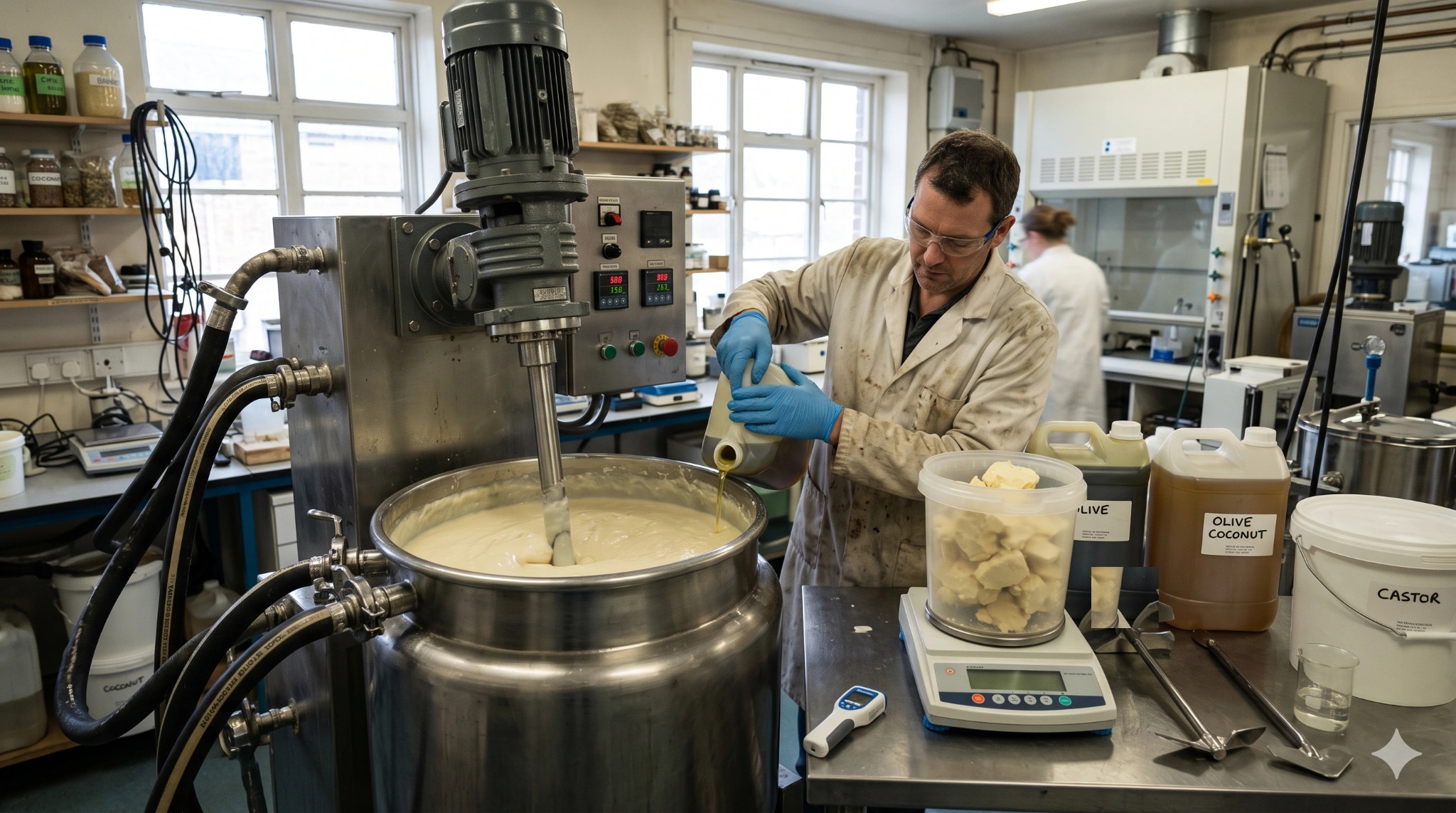
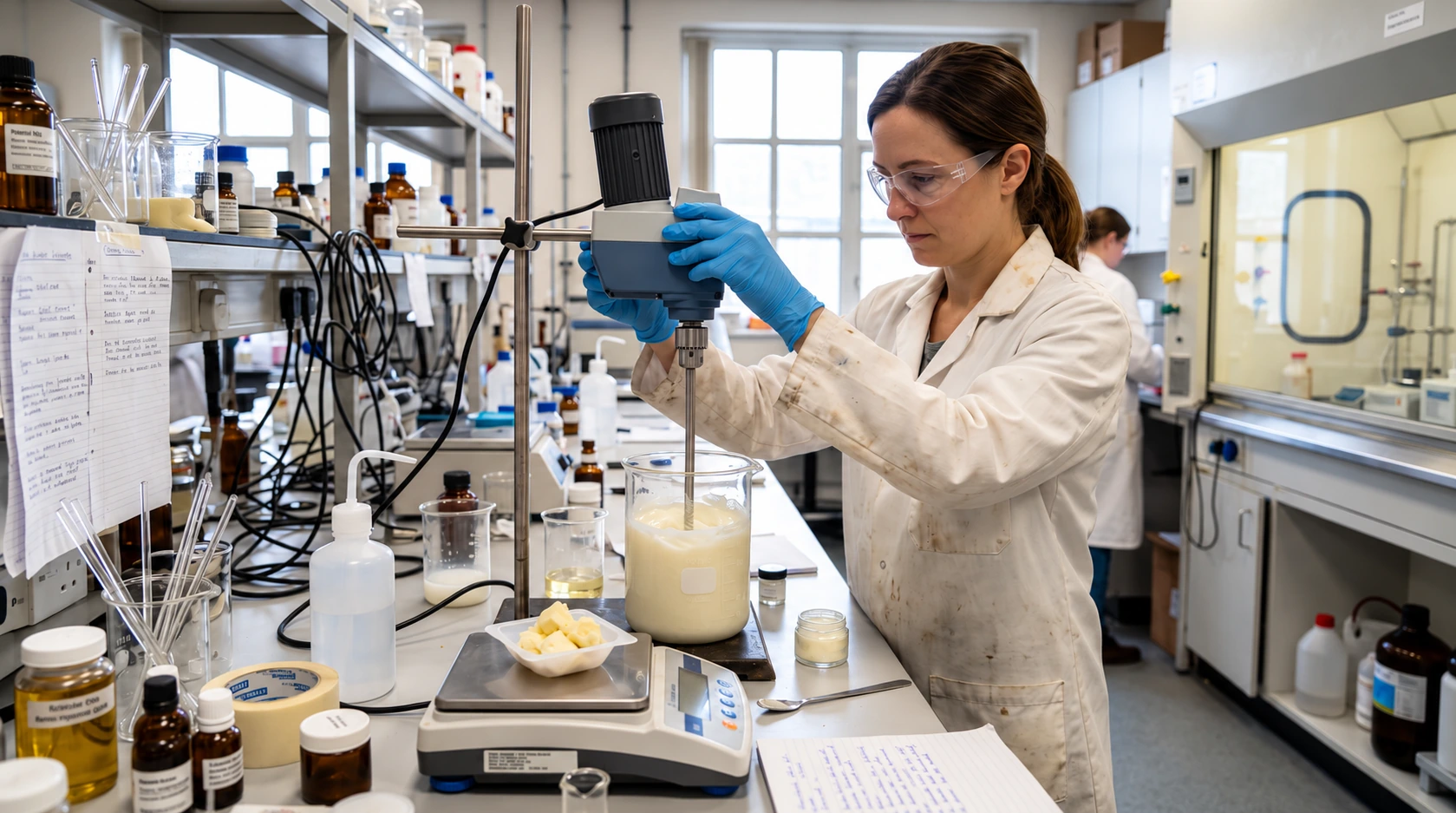
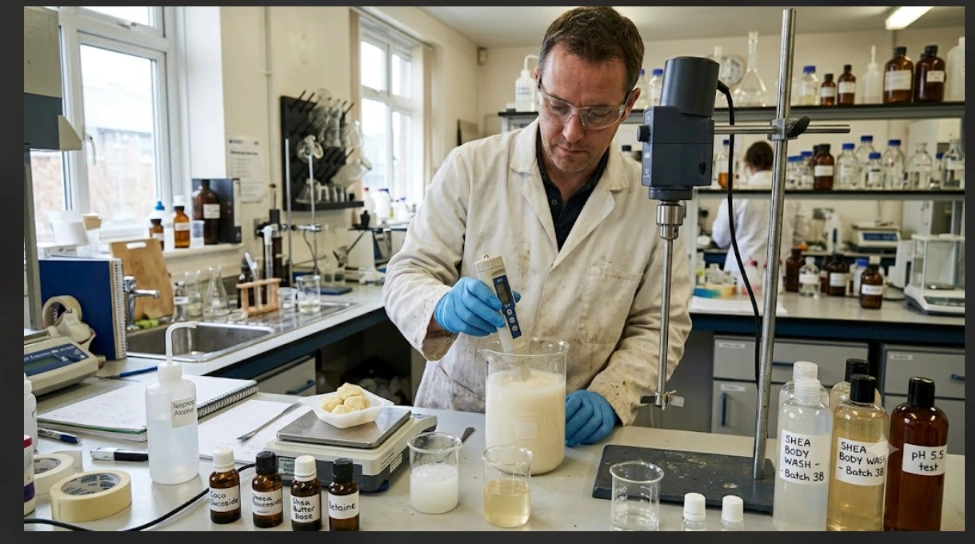
Use a controlled bench-trial plan in the intended base, with a control and pre-defined acceptance criteria. Keep the process repeatable so any differences can be related to the ingredient or processing change under review.
- Define the product target. Record the cleanser type, sensory goals, appearance, viscosity range, package, and required claims.
- Qualify the material. Confirm identity, grade, lot, specification, storage guidance, and current TDS, SDS, and CoA where available. Elchemy’s shea butter handling and safety data is a document route to check for the exact product.
- Set the trial design. Have a qualified formulator select trial levels for the chosen grade and base. Do not copy a leave-on use level or an online DIY recipe into a commercial body wash.
- Control processing. Record the addition sequence and batch conditions. Change one main variable at a time where practical.
- Compare against the control. Assess appearance, odor, viscosity, pH, lather, rinse, and after-feel at defined points.
- Apply development checks. Use the team’s stability, package compatibility, preservation, and safety protocols before approving scale-up or claims.
| Prototype | Grade and lot | Process notes | Appearance and odor | pH and viscosity | Lather, rinse, and feel | Stability result |
| Control | Record the control formula’s shea grade and lot, or write “none” if absent. | Record the baseline addition sequence and batch conditions. | Record the baseline appearance and odor. | Record the baseline pH and viscosity. | Record baseline lather, rinse, and after-feel. | Record baseline observations at each planned checkpoint. |
| Trial A | Record the shea grade and lot used in Trial A. | Record the addition sequence and batch conditions for Trial A. | Record Trial A appearance and odor. | Record Trial A pH and viscosity. | Record Trial A lather, rinse, and after-feel. | Record Trial A observations at each planned checkpoint. |
| Trial B | Record the shea grade and lot used in Trial B. | Record the addition sequence and batch conditions for Trial B. | Record Trial B appearance and odor. | Record Trial B pH and viscosity. | Record Trial B lather, rinse, and after-feel. | Record Trial B observations at each planned checkpoint. |
Use the table as a record sheet and publish only documented, reviewed trial results.
What should buyers confirm about the shea butter?
Buyers should qualify the raw material against the formula and the company’s documentation requirements. Do not infer the grade or commercial terms from the ingredient name alone.
Request the exact INCI identity, grade, specification, lot documents, handling guidance, and confirmation that the sample represents the proposed commercial source. Verify packaging, minimum order, destination terms, certifications, and traceability with the supplier.
When requesting a sample or quote, state the intended rinse-off application, required specification, expected quantity, destination, and documents needed. Elchemy’s North American chemical supply page is a regional route to review; confirm product-specific service scope and terms before making a supply decision.
Treat the product page as a starting point, then verify identity, grade, application, and commercial details against current technical documents.
Common formulation mistakes to avoid
Avoid assuming water solubility, copying leave-on levels, or attributing finished-product performance to one ingredient.
- Adding without checking incorporation: Confirm that the process gives the intended distribution and repeatability.
- Changing too many variables at once: Keep trials interpretable by recording the control and the variables changed.
- Treating appearance as proof of stability: A uniform first batch does not establish stability over the product’s intended life.
- Assuming more butter means better performance: Evaluate cleansing, lather, rinse, feel, and stability together.
- Using unsupported product claims: CIR’s ingredient-level assessment does not substantiate claims that a finished body wash treats eczema, repairs the skin barrier, or provides lasting hydration. U.S. cosmetic claims must be truthful and not misleading; therapeutic or structure/function claims can affect product classification. Review the FDA guidance cited above and obtain regulatory input for borderline language.
If the intended product is true soap rather than a surfactant-based body wash, use a soap-specific formulation and review the relevant U.S. classification. The planned <u>compare shea butter in soap</u> [Shea Butter Soap: Ingredient Selection and Formulation Considerations] article can serve that adjacent need once published.
Frequently asked questions
1. Is shea butter suitable for body wash?
It may be suitable when the selected base can incorporate it and the finished cleanser meets its performance and stability targets. Cosmetic assessments describe shea-derived ingredients as skin-conditioning agents, but they do not prove a particular rinse-off product will moisturize or soothe skin. Evaluate the complete formula before making a product claim.
2. Does shea butter dissolve in water?
Elchemy’s current product listing describes its shea butter as water-insoluble. Formulators should confirm the property for the selected grade in current technical documents, then validate an incorporation method in the full cleanser base. Do not assume simple mixing into the water phase will produce a stable, uniform product.
3. Can shea butter affect body-wash lather or viscosity?
It can be a variable worth testing, but the direction and size of any effect depend on the surfactant blend, other ingredients, processing, and target texture. Compare a control with controlled prototypes. Measure the team’s chosen properties rather than assuming more butter will always reduce foam or thicken the product.
4. How much shea butter should a body wash contain?
There is no approved universal percentage for this article. The appropriate level depends on the grade, the cleanser system, processing method, desired sensory profile, and stability results. Set trial levels with a qualified formulator using current supplier data, then document performance in the intended finished product.
5. Can a body wash with shea butter claim to moisturize skin?
A moisturizing claim must be truthful and supported for the finished product. Ingredient presence alone does not show how much remains after rinsing or what users experience. Claims about treating a skin condition or changing skin structure or function can raise drug-regulatory questions in the United States, so review wording with regulatory specialists.
6. What is the difference between body wash and true soap?
Many body washes are surfactant-based cleansers, while true soap is made from fatty-acid salts. U.S. regulatory treatment depends on composition and intended claims, so teams should not rely on the product name alone. FDA guidance explains the cosmetic, drug, and soap distinction for products marketed in the United States.
7. What should a formulator request from a shea butter supplier?
Request the exact ingredient identity, grade, current specification, TDS, SDS, and lot-specific CoA where applicable. Also confirm the sample’s relationship to the commercial source, packaging, minimum order, destination terms, and any required traceability or certification. Treat each commercial detail as product- and lot-specific until the supplier confirms it.
Conclusion
Shea butter can be screened as a skin-conditioning ingredient in body wash, but its presence does not guarantee a specific benefit after rinsing. Formulators should confirm the current ingredient specification, test an incorporation approach in the target surfactant base, and compare performance against defined criteria. Avoid transferring leave-on use levels or claims to a rinse-off product.
To evaluate the ingredient for your formulation, request a shea butter sample. Include your application, required specification, quantity, destination, and documentation needs so the request can be assessed against your use case.