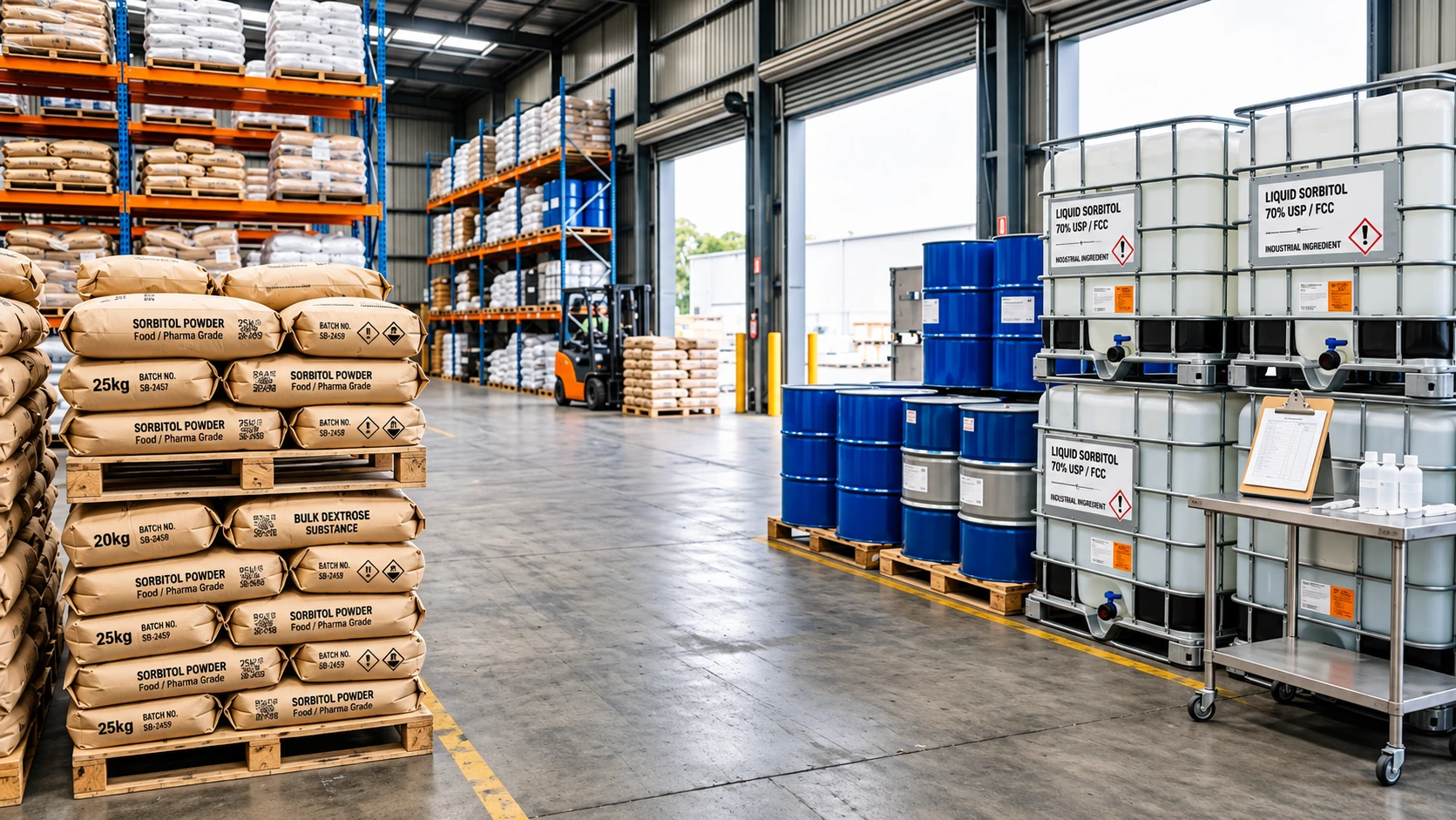


At a Glance
- Where to buy: Industrial volumes come from producers, distributors or sourcing partners. Retail and pharmacy listings are sized for kitchens and pharmacies.
- Form: Choose a 70% solution for liquid formulations and powder for dry or low-moisture ones.
- Spec: Name the standard on the purchase order, such as FCC or USP. Limits differ between standards, so the COA decides.
- Documents: Ask for a batch COA, a TDS and an SDS before the first order.
- Order terms: Solutions typically ship in drums or totes. Minimums vary by supplier, and Elchemy’s typical minimum is 1 MT.
- Price and import: Fix form, standard, pack and delivery terms before comparing quotes. Food-use imports may need FDA prior notice.
What You’ll Learn
Learn where to buy, which form to order, how to read a COA, what drives price and what import needs.
Introduction
Where can you buy sorbitol at industrial scale? Search results will mislead you, because most listings are retail packs or pharmacy bottles. A plant needs a sorbitol supplier that ships drums, totes or bags, with documents that match its specification.
Buying the wrong form or an unclear grade costs more than a delayed order. It can mean a failed batch, a rejected audit or a reformulation. Sorbitol is traded across borders, so channel choice shapes lead time and paperwork. Our guide to sorbitol in global trade explains why.
This guide covers where to buy, which form fits, which standards to name and how to compare suppliers. It is written for procurement and formulation teams buying for food, pharmaceutical, personal care and industrial use.
Where Can You Buy Sorbitol in Bulk?
Buy bulk sorbitol from a producer, a distributor or a sourcing partner. Retail and pharmacy listings suit small quantities, but they rarely give an industrial buyer the specification, documents or packaging needed. Each of the three channels fits a different buying pattern.
| Channel | Best for | Watch for |
| Producer (direct) | Steady, high volumes with a fixed spec | Contract minimums and less flexibility on small lots |
| Distributor | Smaller lots, local stock, several grades on one account | Which producer made the lot and who issues the COA |
| Sourcing partner | Several grades or markets, or an unfamiliar spec | Audit status of the network and the documents held |
| Retail or pharmacy listing | Lab trials and pilot batches | Unclear grade, small packs and no batch documents |
A sorbitol distributor is where many teams buy sorbitol in smaller lots. It holds stock from several producers, so always ask which one made your lot.
Some online listings use “wholesale” language but sell by the kilogram without naming a grade. Our guide on distributor versus manufacturer explains who carries quality responsibility in each case.
How Industrial Sorbitol Is Made
Commercial sorbitol is made by catalytic hydrogenation of glucose. 21 CFR 184.1835 describes it as made by hydrogenation or electrolytic reduction of sugar solutions containing glucose or fructose. Elchemy’s product page says the glucose comes from corn or wheat starch.
After hydrogenation, the solution is purified. Elchemy’s page says it is then concentrated into a 70% syrup or crystallised and dried into powder. That route explains why grades differ. Feedstock, process and finishing all shape the limits on a COA.
Sorbitol Powder vs 70% Solution: Which Form to Buy
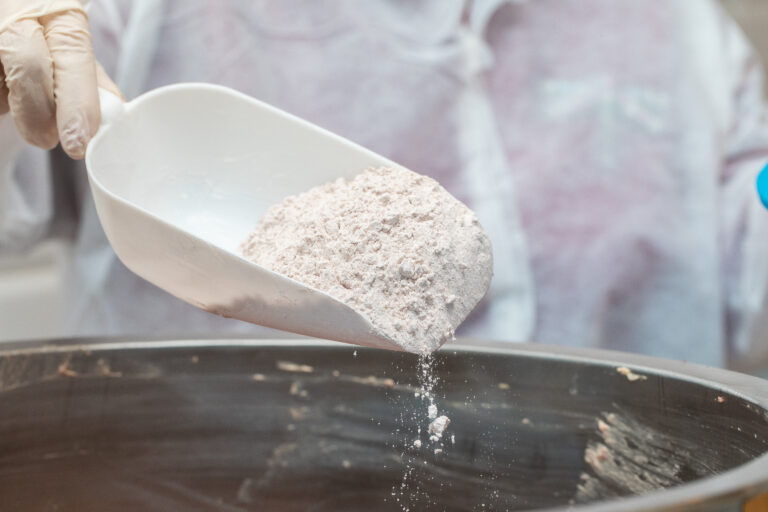
Most industrial buyers choose between powder and a sorbitol 70% solution. Elchemy’s product page calls them the same molecule in different forms. The solution, often called sorbitol liquid, is a clear, colourless aqueous liquid, while the powder is the drier solid.
| Feature | 70% solution | Powder |
| Appearance | Clear, colourless aqueous solution | White powder |
| Content limit (JECFA syrup) | At least 50.0% D-sorbitol, anhydrous basis | Stated as assay on the COA |
| Water (JECFA syrup) | No more than 31% | Low, as a solid form |
| Suited to | Toothpaste, syrups and other liquid formulations | Tablets, dry mixes and sugar-free confectionery |
| Storage note | One US seller advises storing above 70°F to limit crystallisation | Readily absorbs moisture, so keep packs sealed |
A sorbitol powder supplier should state the assay, water content and pack size on the COA. These vary between suppliers, so do not assume two powders match. Powder and solution also differ in water content, so swapping one for the other changes the formula.
Crystallising vs non-crystallising solution
Both types are sold as 70% solution, and the difference lies in what sits alongside the sorbitol. JECFA ties non-crystallising syrup to a glucose-syrup raw material, so the non-sorbitol portion is mainly hydrogenated oligosaccharides. The spec sheet should name which type you are buying.
One US seller advises storing its 70% solution above 70°F to help prevent crystallisation. It says gentle heat and agitation can restore the liquid. Ask your supplier for its own storage guidance.
If glycerin is also on your shortlist, see sorbitol versus glycerin.
Which Industries Buy Sorbitol and in Which Form
Sorbitol serves food, oral care, personal care and pharmaceutical buyers. In food, the regulation lists functional uses such as humectant, texturizer, stabilizer and nutritive sweetener. Elchemy’s product page links each use to the form that suits it.
| Use | What sorbitol does | Form the product page suggests |
| Toothpaste and oral care | Humectant and sweetener that keeps the paste from drying out | 70% solution |
| Syrups and liquid formulations | Sweetener and humectant | 70% solution |
| Sugar-free confectionery | Sweetener and texture modifier | Powder |
| Tablets and dry mixes | Sweetener and bulking agent | Powder |
| Cosmetics and personal care | Moisturiser and glycerin substitute | Confirm with your formulator |
Regulatory status differs by use. Food use falls under the FDA rule above, while cosmetic and pharmaceutical use follow other rules. Have a qualified reviewer confirm each one. For skin and hair products, see our guide to sorbitol for cosmetics.
Grades and Standards to Put on the Purchase Order
“Food grade” alone is not a specification. In the US, the regulation above affirms sorbitol as generally recognized as safe in food. It must also meet the Food Chemicals Codex, and the regulation sets maximum levels for some foods.
The same “70% solution” can carry different limits under different standards. The JECFA syrup monograph sets one set of limits. One producer’s specification for a USP/FCC solution sets another.
How to read a sorbitol COA
A COA reports measured results against the standard on your purchase order. Use the table below as an example of what to check, not as your specification.
| Parameter | JECFA sorbitol syrup | One producer’s USP/FCC solution |
| D-sorbitol | At least 50.0%, anhydrous | At least 64.0%, as is |
| Water | No more than 31% | 28.5 to 31.5% |
| Reducing sugars | No more than 0.3% | No more than 0.3%, dry basis, as glucose |
| Lead | No more than 1 mg/kg | No more than 1 ppm |
| Nickel | No more than 2 mg/kg | No more than 1 ppm |
| Sulfated ash or residue on ignition | No more than 0.1% | No more than 0.1%, dry basis |
| Chlorides | No more than 50 mg/kg | Not listed |
| Microbial limits | Not listed | Aerobic count 1,000 cfu/g maximum, yeast and mold 100 cfu/g maximum |
The bases differ, so the numbers are not directly comparable. Name the monograph and edition on the purchase order, then check each COA line against it. A missing parameter is a question for the supplier. Pharmacopoeial monographs add their own limits.
Food labels need the statement “Excess consumption may have a laxative effect” if daily intake could reach 50 g. For use levels, see our note on US usage limits. Have a qualified regulatory reviewer confirm label wording and use levels for your product.
Need to test a grade before you commit? Request a Sample and check it against your current specification.
Packaging, Minimum Orders and Documents
Packaging follows the form. US seller listings for 70% solution show 55-gallon drums of roughly 580 to 600 lb. Totes run roughly 2,800 to 3,000 lb, and small pails serve trials. Powder listings we reviewed use 20 to 25 kg packs.
Elchemy’s product page shows HDPE drums and bags, so confirm net weight and container type in writing. Minimums range from small online orders to tonne-scale contracts. Elchemy’s typical commercial minimum is 1 MT, and full container loads are available.
A sorbitol order should arrive with paperwork, not only product. Ask for these before the first shipment:
- Certificate of Analysis (COA): batch results against the standard you named.
- Technical data sheet (TDS): the specification and typical properties.
- Safety data sheet (SDS): hazard and handling information.
- Shipping documents: packing list, bill of lading and certificate of origin.
- Declarations: Halal, Kosher or non-GMO statements when your market requires them.
Shelf life depends on the producer. One USP/FCC solution specification states 12 months with a retest at 12 months. Follow the supplier’s specification and the SDS.
What Affects Sorbitol Pricing
Sorbitol quotes move with form, standard, volume, packaging and destination. Elchemy’s product page adds that price follows feedstock and hydrogenation energy costs. Public sorbitol prices mostly reflect retail packs, so they say little about a bulk offer.
Fix the variables below before you compare offers. Otherwise two quotes that look different may describe different products.
| Variable | Fix this before comparing |
| Form | Solution or powder, crystallising or not |
| Standard | FCC, USP or another, with the edition |
| Pack | Drum, tote or bag, with net weight |
| Volume | Tonnes per order and per year |
| Delivery terms | Incoterm and destination |
| Validity | How long the quote holds |
Ready to compare on one basis? Request a Quote with these six items filled in.
Importing Sorbitol: Customs and Compliance Basics
Imported sorbitol needs the right tariff number and the right paperwork. Elchemy lists HS code 2905.44.00 on its product page. Your customs broker should confirm the full national tariff number and any duty, because this guide gives no duty rates.
For food use, FDA requires advance notice of imported food. Ask your broker whether prior notice applies to your shipment. Agree an Incoterm and a destination in writing before you order.
Elchemy’s product page says it handles freight, customs paperwork and delivery. Confirm in your quote which of those the price includes. Buying from US stock can remove import steps from your side, so ask where the lot is held.
Common Sourcing Mistakes
Most sorbitol problems start at the purchase order, not at the plant. These six mistakes are the ones to design out.
- Ordering “food grade” with no named standard. Name the monograph and edition.
- Comparing quotes on different bases. As-is and anhydrous figures are not interchangeable.
- Treating powder and solution as a swap. Their water content differs, so the formula changes.
- Ignoring storage. Solutions can crystallise if stored cold, so ask for supplier guidance.
- Buying volume from a retail listing. Small packs rarely come with batch documents.
- Skipping the sample. Test a grade before you commit to a bulk order.
How to Evaluate a Sorbitol Supplier
A reliable supplier answers six questions in writing. Use the same checklist for every quote so the offers compare cleanly. For a full audit process, use our supplier approval checklist.
- Confirm the form and standard. Match solution or powder, crystallising or not, and the named monograph to your spec.
- Request a batch COA and TDS. Compare the results to your limits before you order.
- Check the documents. Ask for the SDS, origin papers and the declarations your customers expect.
- Verify who makes it. Ask which producer made the lot and whether the site is audited.
- Compare packaging and minimums. Use the same container and quantity basis for every quote.
- Test logistics. Get the warehouse location, shipping terms and lead time in writing.
Which channel fits your plant?
No channel wins on every point. Match the channel to your volume, spec stability and number of markets.
- Choose a producer if your volume is steady and your specification is fixed.
- Choose a distributor if you need smaller lots, local stock or several grades on one account.
- Choose a sourcing partner if you need several grades or markets, or your specification is still moving.
Sourcing Sorbitol Through Elchemy
Elchemy is a sourcing partner for industrial buyers, not a retail shop. It offers ELHUME™ SBO70 sorbitol 70% solution in crystallising and non-crystallising forms, plus crystalline powder and pharmaceutical grade. The product page states that every sorbitol manufacturer in its network is pre-audited.
Each batch ships with a COA, and a TDS and SDS are available. Packing list, bill of lading, certificate of origin and Halal, Kosher or non-GMO declarations are available on request. For food applications, read our guide to food-grade sorbitol sourcing.
FAQs
1. What is the minimum order for bulk sorbitol?
Minimums vary by supplier. Retail listings may sell by the kilogram, while contract suppliers quote by the tonne. Elchemy’s typical commercial minimum is 1 MT, and full container loads are available. Confirm the minimum, pack size and quote validity in writing before you compare offers.
2. How fast can I get a sample or a quote?
Elchemy states that domestic samples ship within 24 to 48 hours and that quotes return in 24 to 48 hours. Timing depends on destination and the detail in your request. Send your form, standard and quantity with the request so the first reply is complete.
3. Which documents should come with a sorbitol order?
Ask for a batch COA, a TDS and an SDS at minimum. International shipments also need a packing list, bill of lading and certificate of origin. Elchemy can supply Halal, Kosher and non-GMO declarations on request. Match every document to the standard named on your purchase order.
4. Does Elchemy hold US stock?
Elchemy’s product page lists US warehouses in New Jersey, Texas and California. It says Elchemy serves the USA, UK, UAE and 40+ countries. Availability and lead time vary by grade and quantity, so confirm both on your quote before you plan production.
5. Is E420 the same as sorbitol?
E420 is the additive number used for sorbitol in food labelling. JECFA splits it into INS 420(i) for crystalline sorbitol and INS 420(ii) for sorbitol syrup. Sorbitol is also called D-glucitol, so check which form your specification names before you order.
6. How long can I store sorbitol?
Shelf life depends on the producer and the form. One producer’s USP/FCC solution specification states 12 months, with a retest every 12 months. Follow your supplier’s specification and the SDS. Ask for retest dates on the COA instead of assuming one figure.
7. Can I order powder in bulk as well as solution?
Yes, industrial suppliers sell both. Elchemy lists crystalline or powder sorbitol alongside the 70% solution, and its product page shows drums and bags. Pack size, assay and water content differ between suppliers. Request the specification for the exact powder you plan to buy.
8. How do I avoid ordering the wrong product?
Confirm CAS 50-70-4 and the name D-glucitol on the specification. Sorbitan esters, such as sorbitan monostearate, are different materials that Elchemy lists on separate product pages. Check the CAS number on every quote and every COA, so a similar name never reaches your purchase order.
Conclusion
Where can you buy sorbitol with confidence? From a source that names the form, the standard and the documents before you pay. Retail listings rarely do, while producers, distributors and sourcing partners can.
Write the specification first, then compare quotes on the same basis. Check the COA, TDS and SDS against it, and confirm packaging and minimums in writing. Ask every supplier the same six questions, and keep the answers with your purchase records.
Request a Quote with your form, standard and quantity, and compare it against your current supplier.