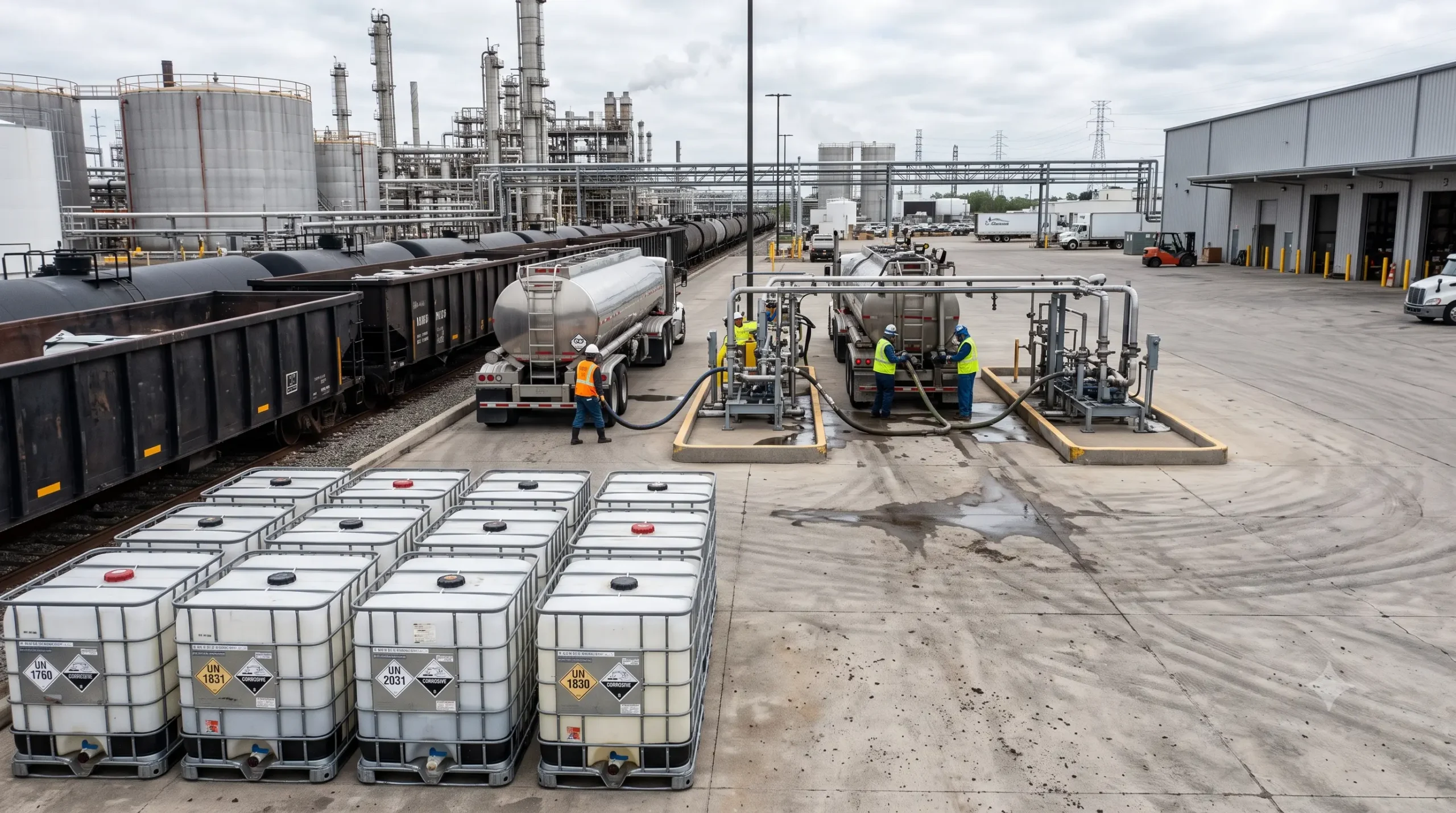


At a Glance
- Define the material first: Acid sourcing starts with acid type, concentration, grade, intended use, and required quality criteria.
- Compare suppliers on the same evidence: Product documentation, traceability, logistics, and commercial assumptions should be reviewed before unit price.
- Choose the supply route to fit the requirement: A direct manufacturer, distributor, or sourcing partner may each fit different demand patterns and support needs.
- Treat delivery as a qualification issue: A quote is incomplete until the supplier and buyer confirm destination, packaging, receiving, and transport assumptions.
- Escalate uncertainty early: If the process requirement or facility readiness is unclear, technical and EHS review should happen before an RFQ is issued.
What you’ll learn
This guide helps industrial buyers choose an acid supplier by defining requirements, qualifying evidence, and preparing a comparable supplier request.
Introduction
Choosing an acid supplier on unit price alone can create avoidable risk when the quoted materials, documents, and delivery assumptions are not equivalent. For industrial and commercial procurement, “where to buy acid” is not a consumer or laboratory-only question. It is a supplier-qualification decision that connects the required acid to process specifications, quality controls, site readiness, and continuity of supply.
This guide explains how to evaluate an industrial chemical supplier across acid categories without treating those acids as interchangeable. You will learn how to define a requirement, assess manufacturer, distributor, and sourcing-partner options, evaluate evidence, and prepare an RFQ suppliers can answer consistently.
Start by Defining the Acid Requirement
“Acid” is not a sufficient purchasing specification. An industrial supplier needs enough information to determine whether its product, documentation, logistics model, and delivery route fit your actual requirement.
Define the material before comparing sources. This protects the buying team from receiving quotes that appear comparable but differ in grade, concentration, documentation, or delivery assumptions.
| Requirement area | Buyer input required | Stakeholder who should confirm |
| Chemical identity | State the acid name and CAS number | Technical or process owner |
| Intended use | Describe the process, formulation, or application | Technical and EHS teams |
| Grade and concentration | State the required grade, assay basis, and concentration | Quality and technical teams |
| Quality criteria | Define impurity limits, customer requirements, and acceptance criteria | Quality team |
| Documentation | List SDS, COA, product specification, and other required records | Quality and EHS teams |
| Quantity and forecast | State order quantity, annual demand, and ordering pattern | Procurement and operations |
| Delivery and receiving | Provide destination, packaging constraints, and receiving requirements | Operations, warehousing, and EHS teams |
If the application, required grade, or site receiving conditions are unresolved, pause before issuing an RFQ. Commercial sourcing works best when the technical requirement is clear enough for suppliers to assess.
Decide Which Supplier Route Fits Your Buying Situation
Industrial buyers can source acids through several supplier models. The suitable route depends on how defined the requirement is, how frequently material is needed, what level of coordination is required, and whether the buyer can manage supplier qualification internally.
No route is universally best. A recurring, established requirement may suit a different supply model than a multi-site or documentation-intensive requirement.
Buying Directly From a Manufacturer
A manufacturer-direct route can be appropriate when demand is recurring, the product specification is stable, and the buyer has an established qualification process. It may also suit organisations that can manage technical review, delivery coordination, and supplier performance directly.
This route still requires evidence. Buyers should confirm product fit, documentation availability, supply assumptions, and destination feasibility before treating a manufacturer quote as the preferred option.
Buying Through a Chemical Distributor
A distributor can help coordinate product sourcing, documentation, delivery, and portfolio access for defined requirements. This can be useful when buyers need commercial flexibility or want to consolidate related chemical purchases.
The value of a distributor depends on the specific material, destination, and buyer requirements. For related supplier-evaluation resources, explore Elchemy’s chemical sourcing articles.
Working With a Sourcing Partner
A sourcing-partner discussion may fit buyers with multi-site requirements, fragmented purchasing, difficult-to-source materials, or substantial documentation and logistics coordination needs. It can also be relevant where the buying team needs to compare potential supply routes before committing to a supplier model.
Whether a sourcing partner is suitable for a particular acid, grade, or destination must be confirmed against the actual requirement. Buyers should provide a complete technical and commercial brief rather than relying on a generic request for acid pricing.
For acid-specific examples, buyers can review Elchemy’s Hydrochloric Acid product details and Sulphuric Acid product details. The key lesson is that product qualification must be specific to the acid and intended use.
When No Route Should Be Chosen Yet
Do not choose a commercial route simply because a supplier can provide a quick quote. If the process requirement, acceptance criteria, hazard controls, or receiving capability are unclear, the right next step is internal review.
Technical, quality, EHS, and operations stakeholders should resolve those gaps before procurement compares suppliers. This prevents a supplier-selection decision from being made before the requirement itself is ready.
Use One Supplier-Qualification Scorecard
A supplier scorecard gives every candidate the same evaluation standard. It shifts the decision away from generic claims and toward evidence that technical, quality, commercial, and operational stakeholders can review together.
Unit price belongs in the scorecard, but it should not control the decision before all other requirements are normalised. Two offers are not comparable if they differ in material specification, COA availability, delivery basis, or documentation.
| Evaluation criterion | Buyer question | Supplier evidence | Decision status |
| Product fit | Does the material meet the written requirement? | Product specification and written response to the RFQ | Confirm match against the approved specification |
| Documentation | Are required records available at the required stage? | SDS, COA process, technical documents, and document timing | Approve document package before purchase order |
| Quality and traceability | Can incoming material be traced to the required lot or batch information? | Traceability process and batch-document process | Confirm alignment with internal quality controls |
| Delivery feasibility | Can the material be delivered to the specified site under workable conditions? | Delivery assumptions, packaging format, and site requirements | Confirm with operations, warehousing, and EHS |
| Supply continuity | Can the supplier discuss forecast, communication, and escalation needs? | Supply-plan assumptions and escalation process | Review before awarding recurring business |
| Commercial clarity | Is the quotation basis complete and understandable? | Quantity, validity, inclusions, exclusions, and delivery basis | Compare only against matching quote scopes |
| Escalation path | Are technical, quality, and commercial contacts identified? | Named contacts and issue-escalation process | Confirm before supplier approval |
A practical decision rule is to reject or escalate any quote that cannot be evaluated against the scorecard. Missing evidence is not a neutral result. It is an unresolved buying risk.
Verify Documents Before Comparing Price
Supplier documentation helps a buyer verify what is being offered and how it should be assessed. It does not replace process qualification, facility procedures, or technical approval.
For hazardous chemicals, buyers should request and review the current SDS, product specification or technical data sheet, and any agreed COA requirements. OSHA’s Hazard Communication Standard explains the workplace role of labels, safety data sheets, and employee hazard communication.
The document review should answer practical questions:
- Does the product identifier match the material specified in the RFQ?
- Does the SDS correspond to the proposed product?
- Are quality requirements documented clearly enough for receiving inspection?
- Is a COA required, and when should it be provided?
- Can the lot or batch documentation support the buyer’s traceability needs?
- Are delivery and transport documents understood by the site receiving the material?
OSHA’s Safety Data Sheet information requirements outline the standard SDS sections. Buyers should use that information as part of a broader review, not as a stand-alone approval of process suitability.
Test Logistics and Supply Continuity
A supplier can meet the written product specification and still be unsuitable if the delivery route does not fit the facility. Receiving, unloading, storage, scheduling, documentation, and communication practices all affect whether an acid supply arrangement is workable.
Procurement should involve the teams who will receive and use the material. This gives suppliers complete operational requirements before commercial terms are finalised.
Delivery and Receiving Fit
The delivery plan should identify the destination, required packaging format, site access conditions, delivery appointments, unloading constraints, and receiving-document requirements. The buyer’s facility must confirm that it can receive the proposed arrangement under its own procedures.
Do not assume that a standard delivery format suits every facility. Each site may have different receiving, storage, segregation, or scheduling constraints that must be addressed before an order is placed.
Continuity and Second-Source Planning
Supply continuity is more than availability at the time of the first quote. Buyers should discuss forecast-sharing, change notifications, escalation contacts, and contingency expectations with suppliers before the relationship becomes critical.
A second-source strategy may be useful for important requirements, but it must be qualified against the same product, documentation, and logistics criteria. Adding a second supplier without normalising the requirement can create more complexity instead of more resilience.
Commercial Assumptions
A useful quote states its basis clearly. The buyer should be able to identify the quoted quantity, currency, delivery term, validity period, documents included, exclusions, and destination assumptions.
Ask suppliers to flag any assumption that could change the delivered cost or feasibility of supply. For a product-level example of commercial cost drivers, see Elchemy’s Hydrochloric Acid Price Guide.
Prepare an RFQ Suppliers Can Answer Accurately
An RFQ is the bridge between an internal requirement and a supplier response. A vague request creates vague quotations, which leaves the buyer to discover critical differences after the commercial comparison has started.
Use a structured RFQ so commercial, technical, quality, and logistics questions are addressed together. The goal is not to disclose unnecessary proprietary information. It is to provide enough detail for a supplier to assess fit accurately.
- State the acid identity, grade, concentration, and intended industrial use.
- Attach relevant specifications, acceptance criteria, and required documents.
- Provide quantity, forecast, destination, and delivery schedule.
- List packaging, receiving, and site-access constraints.
- Request a clear statement of supply, delivery, and documentation assumptions.
- Identify technical, quality, and commercial contacts for supplier questions.
| RFQ field | Information to provide |
| Acid / CAS number | State the chemical name, CAS number, and internal material code where applicable |
| Grade and concentration | Specify the required grade, concentration, assay basis, and acceptance criteria |
| Intended industrial use | Describe the process or application without disclosing unnecessary proprietary information |
| Quantity and forecast | State order quantity, unit of measure, buying frequency, and annual forecast where available |
| Delivery location | Provide facility address, receiving hours, site-access restrictions, and unloading requirements |
| Documentation required | List SDS, TDS, COA, traceability records, and any customer or quality documents |
| Packaging and receiving constraints | State approved packaging, storage, handling, unloading, and receiving conditions |
| Approval process and contacts | Identify procurement, technical, quality, EHS, and operations contacts for supplier questions |
Use the same RFQ format for every prospective supplier. This produces more meaningful comparisons and helps buying teams identify where a quote is incomplete.
Choose a Supplier Based on Fit, Not a Universal Winner
The best supplier route is the one that meets your specific product, documentation, logistics, and continuity requirements. It is not necessarily the manufacturer, the largest distributor, or the lowest-priced option.
Use this conditional framework:
- Choose a manufacturer-direct route when the requirement is stable, demand is established, and your organisation can manage qualification and logistics directly.
- Choose a distributor when the requirement is defined but needs delivery coordination, portfolio access, or supplier consolidation.
- Choose a sourcing-partner discussion when the requirement is multi-site, fragmented, documentation-intensive, or commercially complex.
- Pause commercial sourcing when process, EHS, quality, or receiving requirements remain unresolved.
Price comparisons become meaningful only after the purchase requirements are consistent. Until then, a cheaper quote may simply reflect a different product, document set, or delivery assumption.
Common Supplier-Selection Mistakes
A frequent mistake is selecting against a generic product name rather than a written requirement. The supplier may quote a material that appears similar but does not match the process, quality, or documentation need.
Another mistake is comparing quotes with different commercial assumptions. If quantities, delivery terms, packaging, or documents differ, the buyer is not comparing the same offer.
Teams should also avoid treating a COA or grade label as automatic proof of application fit. The process owner and quality team should decide whether the evidence supports the intended use.
Finally, do not leave EHS, receiving, and operations teams out of the decision. Their input is necessary to confirm that the acid can be approved, received, and used within the organisation’s current controls.
Related Acid Buying Guides
Acid-specific requirements should be evaluated separately from the general supplier-selection framework. Use these future links once the relevant guides are published:
- how to source nitric acid for industrial use [Where to Buy Nitric Acid: Industrial Sourcing Guide]
- buy hydrochloric acid for industrial applications [Where to Buy HCl: Industrial Hydrochloric Acid Buying Guide]
- source sulphuric acid for industrial operations [Where to Buy Sulphuric Acid: Industrial Buying Guide]
- procure caustic soda for industrial use [Where to Buy Caustic Soda: Industrial Sourcing Guide]
Frequently Asked Questions
1. What should I ask an industrial acid supplier before requesting a quote?
Ask for product identity, grade, concentration, specification information, documentation process, delivery assumptions, and the supplier’s questions about your destination and intended use. Provide your quantity, forecast, receiving constraints, and required documents so the supplier can assess fit.
2. Is a manufacturer always better than a distributor?
No. A manufacturer-direct route may suit stable and established demand, while a distributor may suit requirements needing delivery coordination, broader portfolio access, or commercial flexibility. The right route depends on the buying situation.
3. Which documents should I request from an acid supplier?
Request the current SDS, product specification or technical data sheet, and an agreed COA process where it is relevant to your quality system. The exact requirements should be determined by the intended use, facility procedures, and internal quality controls.
4. How do I compare two acid quotes fairly?
Use one RFQ and scorecard for both suppliers. Confirm that product specifications, documents, packaging, delivery terms, and destination assumptions are aligned before comparing price.
5. When should I involve EHS or technical teams in sourcing?
Involve them before issuing an RFQ when the process requirement, acceptance criteria, facility readiness, or safety controls are unclear. Their review helps ensure procurement is comparing suppliers against a requirement the organisation can actually approve and receive.
6. Should I select an acid supplier based on the lowest price?
No. Price should be evaluated after the buyer has confirmed that suppliers are quoting the same material, grade, concentration, documents, delivery basis, and commercial scope. A lower price can reflect a different or incomplete supply commitment.
Conclusion
Selecting an industrial acid supplier requires more than comparing unit prices. The strongest decision starts with a written material requirement, then tests each supplier against the same specification, documentation, delivery, and continuity criteria. This gives procurement, technical, quality, EHS, and operations teams a common basis for approving a supplier and identifying unresolved risk before an order is issued.
Once the acid type, grade, concentration, quantity, destination, and document requirements are confirmed, contact Elchemy to discuss your industrial acid sourcing requirement.