

At a Glance
- Three producers run US plants: among the titanium dioxide producers below, Chemours, Tronox and Kronos make it in the US.
- The chloride process dominates US sites: the US plants we found all use the chloride process.
- Older lists are out of date: Venator no longer has a US plant, and Chemours closed its Edge Moor plant.
- Three routes to buy: direct from a producer, through a distributor, or through a sourcing partner.
- Verify the plant: the same brand can come from plants in different countries, so confirm the plant on every quote.
What you’ll learn:
You’ll learn who makes titanium dioxide in the US and where each plant sits.
You’ll also get the grade, plant and RFQ checks that make quotes comparable.
Introduction
A titanium dioxide quote can hide three differences: the grade, the process and the plant. Miss one and you can buy the wrong pigment or the wrong paperwork.
Global supply is large. Chemours’ annual report estimates 2025 world demand for TiO2 pigment at about 7.3 million tonnes and nameplate capacity at about 10 million tonnes.
This guide helps US buyers compare titanium dioxide producers by plant. It shows who makes the pigment, where each US plant sits and how buyers reach the producers. Start with your grade, then choose a route.
Request a Quote with your grade, volume and destination to start a documented review.
Who makes titanium dioxide in the USA?
Three titanium dioxide producers run plants in the US: Chemours, Tronox and Kronos. Chemours operates in DeLisle, Mississippi and New Johnsonville, Tennessee. Tronox operates in Hamilton, Mississippi. Kronos operates in Lake Charles, Louisiana. All three also make pigment outside the US.
How this guide was built
We used company sites and SEC filings, and we named a source for every plant. Each company in the buying-routes list passed five gates: a first-party source, a stated commercial role, a US route, a stated grade or product, and a quote or documentation path.
Role evidence last checked: 5 October 2026. Plants and ownership change, so confirm them when you issue an RFQ.
Why Elchemy appears first in the buying routes. Elchemy publishes this guide, so weigh that. Elchemy is not a producer. It is listed first because it is the publisher and a sourcing partner for buyers who want a second source. The other four companies follow in alphabetical order. The order is not a ranking by capacity, quality, price, availability or delivery speed.
Where US titanium dioxide is made
TiO2 producers publish their plant lists. Read Ti-Pure’s manufacturing sites for Chemours.
Tronox lists its global locations, and its filings give plant capacity.
| Producer | US plant | Process | What the source says |
| Chemours | DeLisle, Mississippi | Chloride | Makes Ti-Pure. PCC Group announced a chlor-alkali unit on the site, planned for 2028. |
| Chemours | New Johnsonville, Tennessee | Chloride | Opened in 1958. A third-party chlor-alkali unit sits on the site. |
| Tronox | Hamilton, Mississippi | Chloride | 225,000 tonnes a year. Tronox’s largest TiO2 plant. |
| Kronos | Lake Charles, Louisiana | Chloride | About 156,000 tonnes a year. Wholly owned by Kronos since July 2024. |
Kronos also lists a plant in Varennes, Quebec. That plant is in Canada, not the US.
Chloride or sulfate: why the process matters
The chloride process reacts titanium ore with chlorine. The sulfate process uses sulfuric acid. Tronox’s plant in Bahia, Brazil, for example, uses the sulfate process.
The US plants we found all use the chloride process. Sulfate-process grades sold in the US therefore generally come from plants outside the US. Kronos lists both chloride and sulfate grades, so ask which plant made your grade.
Process and crystal form together decide performance. Read rutile versus anatase before you specify.
Why older producer lists are out of date
Check the date of any list of titanium dioxide plants you use. Two changes show why.
- Venator left the US. It sold its 50% share of the Louisiana Pigment Company in Lake Charles to Kronos in July 2024.
- Chemours closed Edge Moor. Its US plants are now DeLisle and New Johnsonville.
Who we left out, and why
Lists of titanium dioxide manufacturers in the USA often include names that do not belong on a US plant list.
- Venator. It has no US plant since July 2024.
- Producers outside the US. Chinese and European producers supply US buyers by import, but they do not run US plants.
- Titanium metal makers. Companies that make titanium metal and alloys sell a different product.
- Retail sellers. Craft and consumer sellers do not serve industrial buyers.
Grades by use
Start with the end use, then request the grade and documents that match it. Producers name chloride-process rutile grades for general coatings use. Ti-Pure R-902+ is a multi-purpose rutile grade, TiONA 595 is a multipurpose rutile grade, and KRONOS 2300 is a rutile grade surface treated with aluminum compounds.
| Use | What to ask | Do not assume |
| Paints and coatings | Rutile or anatase, the process and the surface treatment | Any rutile grade suits every coating |
| Plastics and masterbatch | Surface treatment and dispersion data | A coatings grade disperses well in plastics |
| Paper and laminates | The grade the producer names for the use | One grade suits both paper and paint |
| Cosmetic and pharmaceutical | Grade-specific documents and destination-market regulatory status | An industrial grade meets cosmetic rules |
For coatings detail, read TiO2 in paint.
How buyers reach a US producer
Buyers have three routes. Each trades control for convenience.
| Route | How it works | Ask |
| Direct from the producer | Chemours runs customer portals for Ti-Pure buyers. | Which plant supplies my grade? |
| Through a distributor | Palmer Holland lists KRONOS rutile with SDS, TDS, pricing and sample requests. | Which plant made the lot? |
| Through a sourcing partner | Compares sources and handles imports. | Which producer, plant and origin apply? |
For the wider trade-offs, see manufacturers versus distributors.
Titanium Dioxide Producers and Buying Routes to Consider
This is a role-verified shortlist, not a ranking by capacity, quality, price, availability or delivery speed. Elchemy publishes this article and appears first. The other four companies are in alphabetical order.
| Company | Verified commercial role | What buyers research it for | Ask before RFQ |
| Elchemy | Supplier / sourcing partner | Second source and imported grades | Which producer and plant apply? |
| Chemours | Producer | Ti-Pure rutile made in Mississippi and Tennessee | Which plant supplies my grade? |
| Kronos | Producer | KRONOS grades; Lake Charles plant | Which plant and process made my grade? |
| Palmer Holland | Distributor | KRONOS rutile through a distributor | Which plant made the lot? |
| Tronox | Producer | Chloride rutile from Hamilton | Which plant supplies my grade? |
Elchemy: titanium dioxide supplier and sourcing partner
Role: supplier / sourcing partner. Elchemy does not run a titanium dioxide plant. It works with manufacturers across more than one origin and quotes US buyers on the grade, process, surface treatment, pack and destination they specify. It can confirm the producer, plant and country of origin in writing for each quote. Technical and safety documents are available on request, and availability is confirmed case by case.
Best for: a second source, imported grades, or a sample to test before a volume order.
Not the best fit for: truckload or railcar volumes direct from a US producer.
Request a Sample to test a grade against your current supplier before you commit to volume.
Chemours: producer of Ti-Pure
Role: producer. Chemours makes Ti-Pure at four plants: DeLisle, Mississippi and New Johnsonville, Tennessee in the US, plus Altamira, Mexico and one site in Asia. Ti-Pure R-902+ is a multi-purpose rutile grade made by the chloride process. Ask which plant supplies your grade, because Chemours also makes Ti-Pure outside the US.
Kronos: producer with a US plant in Louisiana
Role: producer. Kronos is based in Dallas, Texas, and lists plants in Lake Charles, Louisiana and Varennes, Quebec, plus Germany, Norway and Belgium. It took full ownership of the Lake Charles plant in July 2024. Kronos lists chloride and sulfate grades and sells through agents and distributors. Ask which plant and process made your grade.
Palmer Holland: distributor of KRONOS pigment
Role: distributor. Palmer Holland, based in Westlake, Ohio, lists KRONOS 2233 rutile titanium dioxide with SDS and TDS downloads, a pricing request and a sample request. It suits buyers who want Kronos pigment through a distributor. Ask which plant made the lot and which grades it stocks.
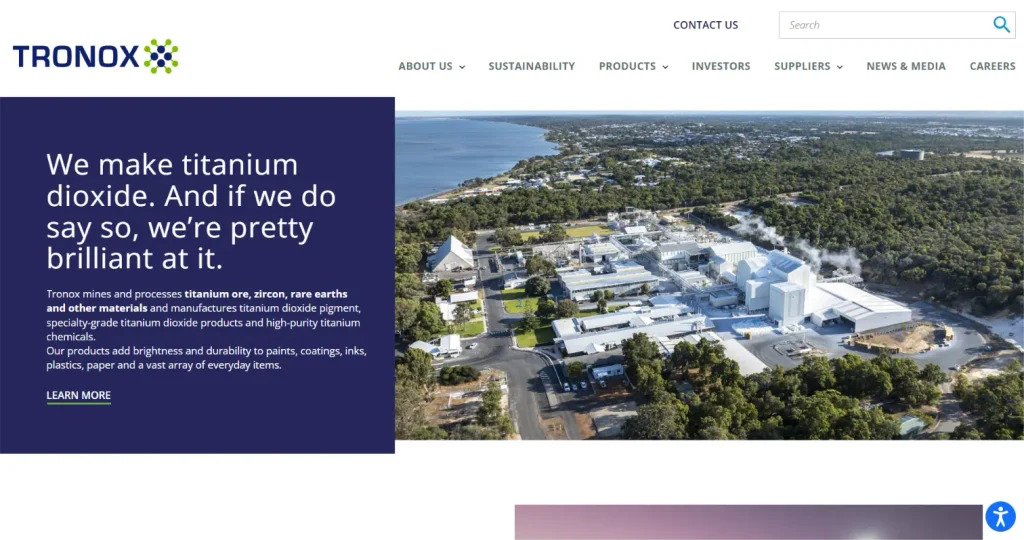
Tronox: vertically integrated producer in Mississippi
Role: producer. Tronox’s Hamilton, Mississippi plant is its largest TiO2 plant and makes chloride-process pigment at 225,000 tonnes a year, according to its filings. Tronox describes itself as the world’s largest vertically integrated TiO2 producer, from mining to pigment. TiONA 595 is a multipurpose rutile grade. Ask which plant supplies your grade, because Tronox also makes pigment outside the US.
What a titanium dioxide supplier needs in an RFQ
- Name the grade. State rutile or anatase, and the product name if you buy a branded grade.
- State the process. Chloride or sulfate, because it affects purity and color.
- Specify the surface treatment. Ask which inorganic or organic treatment the grade carries.
- Ask for the plant. Request the plant of manufacture and the producer of record in writing.
- List the documents. Request the SDS, TDS and lot COA. Use the supplier-approval checklist for the full review.
- Check import status. For imported pigment, ask about TSCA status and the country of origin.
- Define demand and delivery. Give first order, annual volume, pack, ship-to location and receiving limits.
Pair the RFQ with these supplier selection checkpoints so every quote is scored on the same evidence.
What changes a titanium dioxide quote
Ore, chlorine and energy feed into pigment cost. Chemours says it sources titanium-bearing ores mainly from Australia, Africa and Eastern Europe. Grade, surface treatment, pack, volume and freight also change the number.
A lower quote can reflect a different grade, process or plant. Ask each supplier to quote the same specification and delivery terms. For market context, see the price explainer.
Five sourcing mistakes to avoid
- Relying on an old producer list. Plants close and change hands, so check the date.
- Comparing quotes on different grades. A general-purpose grade and a durable grade are not comparable.
- Ignoring the process. Chloride and sulfate pigments are not interchangeable.
- Skipping the COA. Read SDS in procurement for what to check, then request the lot COA.
- Relying on one source. Plant outages and freight delays can tighten supply, so qualify a backup early.
Choosing your route: a decision framework
- Choose a producer route (Chemours, Kronos or Tronox) if you run recurring volume of a defined grade and can meet account and delivery terms.
- Choose a distributor (Palmer Holland) if you want a producer’s pigment through a distributor, with regional delivery.
- Choose a sourcing partner like Elchemy if you want a second source, imported grades, and the plant and producer of record confirmed.
Neither route is universally better. For the wider supplier view, read the supplier guide. Approve the documented grade, plant and delivery route, not the label.
FAQs
Who makes titanium dioxide in the USA?
Three producers run US TiO2 plants: Chemours in DeLisle, Mississippi and New Johnsonville, Tennessee; Tronox in Hamilton, Mississippi; and Kronos in Lake Charles, Louisiana. All three also operate plants elsewhere, so confirm the plant and producer of record on every quote you receive.
Is Venator still a US producer?
No. Venator sold its 50% share of the Louisiana Pigment Company plant in Lake Charles to Kronos in July 2024, and Kronos now owns the plant outright. Older supplier lists may still show Venator as a US maker, so check the date and source of any list you use.
What is the difference between the chloride and sulfate processes?
The chloride process reacts titanium ore with chlorine and is used at the US plants we found. The sulfate process uses sulfuric acid and is used at some plants outside the US, such as Tronox’s plant in Bahia, Brazil. The process affects purity and color, so ask which one made your grade.
Do US producers sell direct?
Yes, in part. Chemours runs customer portals for Ti-Pure buyers, and Kronos says it sells through agents and distributors. Direct supply fits recurring large volumes, while a distributor or sourcing partner can suit mixed grades. Confirm the route, the plant and the documents before you order.
How does global supply compare with demand?
Chemours estimates 2025 world demand for TiO2 pigment at about 7.3 million tonnes and nameplate capacity at about 10 million tonnes. Capacity is not the same as available supply, and grades are not fully interchangeable, so match the grade, plant and documents to your process.
What documents should I request?
Request the lot COA, plus the TDS and SDS for the exact grade. Add the process, surface treatment, plant and producer of record. For imported pigment, ask about TSCA status and country of origin. These let you compare quotes on the same grade and trace the pigment to its plant.
Can Elchemy supply titanium dioxide to US buyers?
Yes, for a defined requirement. Elchemy works with manufacturers and quotes on the grade, process, pack and destination you specify, with documents and samples available on request. Share your volume, destination and document needs, and the team confirms availability and commercial fit case by case. Elchemy is a sourcing partner, not a producer.
Conclusion
The safest way to compare titanium dioxide producers is to fix the grade, process and plant first, then weigh pack, delivery and a backup source. This plant-by-plant list is a role-verified starting point, not a ranking.
Request a Quote with your specification, volume and destination to begin a documented sourcing review.