

At a Glance
- Paints and coatings account for 45.7% of all titanium dioxide consumption globally as of 2025, making it the single largest end-use segment by a wide margin
- Rutile-grade TiO₂ offers 20 to 30% better hiding power than anatase per unit of weight, which is why it dominates architectural and industrial paint formulations
- The U.S. TiO₂ market was valued at $2.06 billion in 2024, driven by construction, automotive refinish, and industrial maintenance coatings
- IARC classifies TiO₂ as possibly carcinogenic to humans, though extensive studies on industry workers do not suggest an association between occupational exposure and increased cancer risk in humans
- OSHA does not regulate TiO₂ as a carcinogen; the permissible exposure limit is 15 mg/m³ as total dust on an 8-hour time-weighted average
Open any can of white paint and you are looking at a product that is, by weight, significantly titanium dioxide. No other ingredient does what it does. No substitute comes close at scale. Titanium dioxide, or TiO₂, is the reason a single coat of exterior latex can cover a dark surface. It is why architectural white stays white for years under direct sun.
Paint manufacturers in the U.S. have relied on it for nearly a century. The science behind that reliance is worth understanding, because it explains not just why TiO₂ dominates paint formulation, but why replacing it is so difficult, and what the regulatory and sourcing picture looks like for U.S. buyers today.
The Science of Why TiO₂ Works in Paint
No pigment performs this job better, and the reason is physics. Titanium dioxide is the principal white pigment used commercially, due to its high refractive index, its ease of dispersion into a variety of matrices, and its inertness towards those matrices during processing and throughout product life.
Paint opacity comes down to one thing: how efficiently a pigment scatters visible light. The bigger the difference between the pigment’s refractive index and the surrounding resin, the more light gets scattered back, and the more opaque the coating. Choosing a high refractive index pigment such as rutile TiO₂, with an R.I. of 2.73, maximizes the refractive index difference between the pigment and its medium, allowing for the greatest opacity development in the film.
TiO₂ is unique among pigments in paint formulation because it provides both wet and dry hiding of the substrate. Optimal light scattering occurs for well-dispersed TiO₂ pigments at a particle size between 0.2 and 0.3 microns. That particle size window is not accidental. It is engineered precisely in manufacturing to hit the scattering sweet spot for visible light wavelengths.
Rutile vs. Anatase: Which One Goes Into Paint
TiO₂ is not a single product. It comes in two commercially relevant crystal forms, and the choice between them matters a great deal to a paint formulator.
| Property | Rutile TiO₂ | Anatase TiO₂ |
| Refractive Index | 2.75 | 2.55 |
| Hiding Power | 20–30% higher per unit weight | Lower |
| UV Resistance | High; resists chalking | Low; accelerates chalking outdoors |
| Primary Use | Exterior and high-performance coatings | Interior paints, paper, specialty applications |
| Preferred Process | Chloride process | Sulfate process |
Rutile is the industry standard for almost all high-performance coatings. Anatase has a bluer undertone compared to the slightly yellower natural tone of rutile. This cleaner, bluer white is sometimes preferred in paper manufacturing or interior enamels where absolute whiteness is prioritized over hiding power.
For exterior applications, a rutile pigment is the best choice since anatase is most photoactive. To produce a pigment with the best possible durability, the base titanium dioxide should contain at least 1% alumina. That alumina coating is part of what makes modern rutile grades so stable outdoors.
How TiO₂ Is Made: Two Processes, Different Outputs
Understanding the production route matters for procurement, because in the sulfate process, depending on the chemistry and route chosen, either rutile or anatase titanium dioxide is made. In the chloride process, the crude titanium-rich starting material is purified by converting titanium to titanium tetrachloride using chlorine gas, which is then oxidized at high temperature, giving pure rutile titanium dioxide.
Titanium dioxide pigments made via the sulfate process tend to be a little more yellow than pigments made via the chloride process. For paint grades where color tone is specified tightly, this distinction drives supplier selection. U.S. producers like Chemours and Tronox operate primarily on the chloride route.
Where Titanium Dioxide in Paint Actually Shows Up?
The applications span far beyond the wall paint most people picture. Across the U.S. paint and coatings industry, TiO₂ shows up in four distinct segments, each with its own performance demands.
Architectural coatings are the largest segment. Interior and exterior wall paints, primers, and ceiling whites all rely on TiO₂ for opacity and whitewash coverage. According to the American Coatings Association, more than half of all coatings manufactured annually in the U.S. are generated in the architectural coatings sector, which is both the largest and most concentrated area of the paint business.
Automotive refinish and OEM coatings use rutile TiO₂ for its UV stability and tint strength. Color consistency across large body panels demands precise particle size control. Primer coats in automotive systems also use TiO₂ for opacity before topcoat application.
Industrial and protective coatings apply TiO₂ in coatings for steel structures, pipelines, bridges, and marine environments. Here, the compound’s UV resistance and chemical inertness are as important as its optical properties.
Specialty coatings include road marking paints, where high reflectivity is a safety requirement, and intumescent coatings, where TiO₂ contributes to fire-resistant systems. Platforms like Elchemy, connecting global buyers with verified chemical suppliers, handle sourcing for TiO₂ grades across several of these segments for U.S. buyers navigating supply from Asian producers.
The U.S. Safety and Regulatory Picture
This is where titanium dioxide in paint gets more nuanced. The compound is not a straightforward green light from every regulatory body, and paint manufacturers need to understand exactly where the lines are drawn in the U.S.
What OSHA Says
From a regulatory standpoint, OSHA does not regulate TiO₂ as a carcinogen. The permissible exposure limit for TiO₂ is 15 mg/m³ as total dust, expressed as an 8-hour time-weighted average. Under the Hazard Communication Standard, 29 CFR 1910.1200, the safety data sheet must convey the fact that TiO₂ is a potential carcinogen to rats for hazard communication purposes.
That distinction matters. OSHA requires disclosure, not restriction. The PEL of 15 mg/m³ treats it as a nuisance dust at standard pigmentary particle sizes.
IARC and the Inhalation Question
IARC has classified titanium dioxide as possibly carcinogenic to humans, based on studies that showed increased lung tumors in rats associated with TiO₂ inhalation. Extensive studies on titanium dioxide industry workers do not suggest an association between occupational exposure to titanium dioxide and an increased cancer risk in humans.
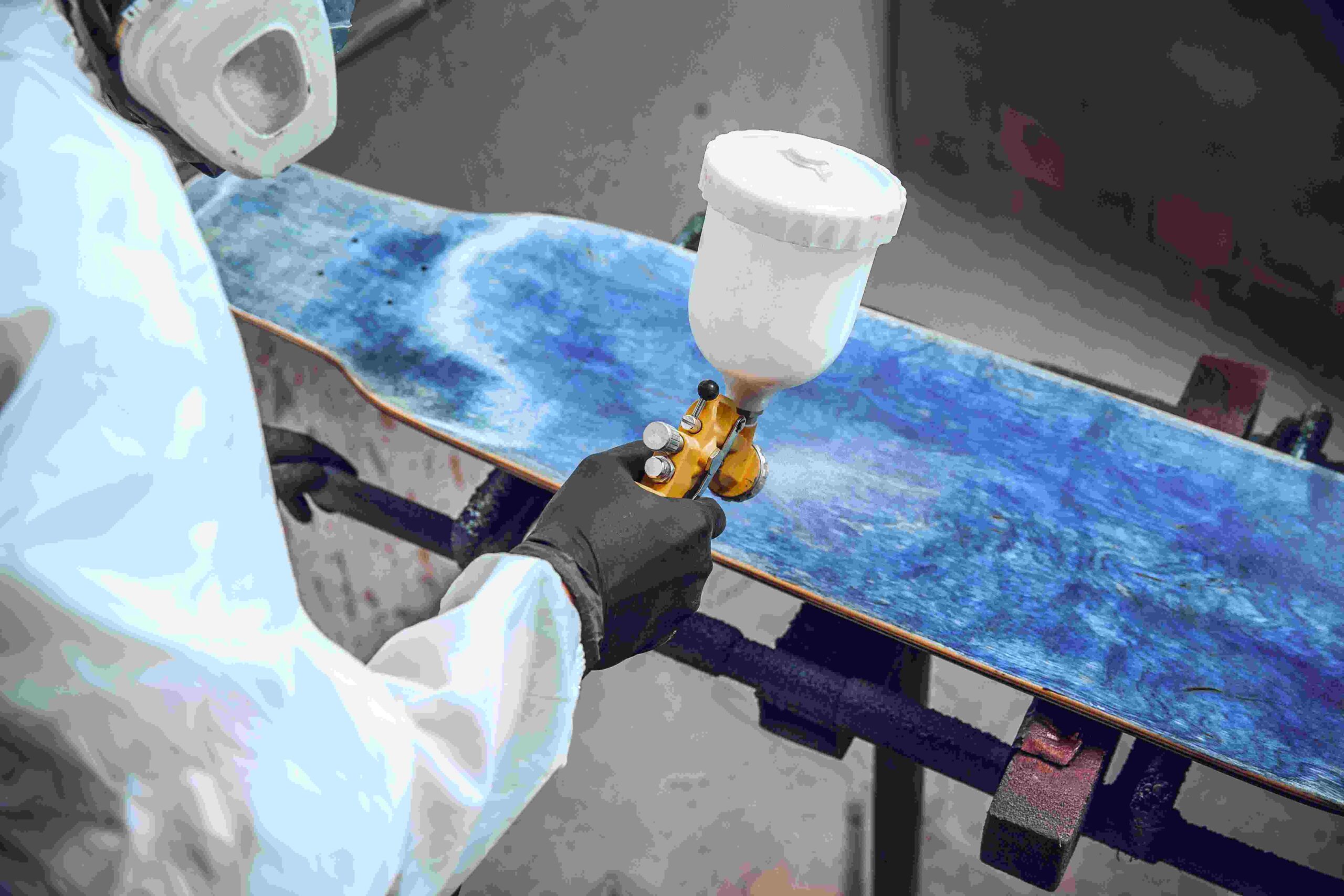
The risk is specific to inhalation of fine dust, not to the finished paint product. No significant exposure to titanium dioxide is thought to occur during the use of products in which TiO₂ is bound to other materials, such as in paints during brush application or drying. Risk of overexposure depends on duration and level of exposure to dust from repeated sanding of surfaces or spray mist.
Sanding dried paint, spray application without respiratory controls, and handling bulk TiO₂ powder are the exposure scenarios that demand attention.
NIOSH Recommendations vs. OSHA PEL
OSHA has established a Permissible Exposure Limit for titanium dioxide total dust and requires employers to control workplace exposure below that PEL. NIOSH has separately recommended a much lower REL of 2.4 mg/m³ for fine TiO₂ and 0.3 mg/m³ for ultrafine particles, based on its own cancer risk assessment. NIOSH recommendations are not enforceable law, but they signal where the science is pointing.
California Proposition 65
California lists airborne, unbound particles of respirable TiO₂ as a carcinogen under Proposition 65. Paint manufacturers selling into California must manage warning requirements for products where TiO₂ dust exposure during use, such as sanding applications, could exceed safe harbor thresholds.
FDA Stance
The FDA has assessed the safety of titanium dioxide pigment as a color additive in food, drug, and cosmetic applications, and as an ingredient in sunscreen products. FDA has stated that titanium dioxide may be safely used in cosmetics, including cosmetics intended for use around the eye. In paint applications, FDA jurisdiction does not directly apply, but it signals the broader regulatory posture: TiO₂ in bound form is not considered a systemic hazard.
| Regulatory Body | Position on TiO₂ |
| OSHA | PEL of 15 mg/m³; not classified as carcinogen; SDS disclosure required |
| IARC | Group 2B: possibly carcinogenic to humans via inhalation |
| NIOSH | Recommends 2.4 mg/m³ for fine particles; 0.3 mg/m³ for ultrafine |
| FDA | Approved for food, drug, cosmetic use within limits |
| California Prop 65 | Listed carcinogen for airborne respirable particles |
The U.S. Market: Who Produces, Who Buys
The Chemours Company leads the U.S. market via the chloride process, with approximately 1.3 million metric tons of production capacity across the U.S. and Mexico. Tronox, Kronos Worldwide, and Venator round out the major domestic producers.
The North America TiO₂ market size is expected to reach 2.24 million tons in 2025 and grow at a CAGR of 3.61% to reach 2.67 million tons by 2030. Construction and automotive production are the primary demand drivers domestically.
On the supply side, paint manufacturers in the U.S. also source TiO₂ from Asian producers, particularly for cost-sensitive architectural grades. In November 2024, the European Union implemented definitive anti-dumping duties on TiO₂ imports from China, with tariffs ranging from $0.28 to $0.83 per kilogram. While these duties are EU-specific, they signal the geopolitical pressures building around Chinese TiO₂ supply that U.S. procurement teams should monitor.
What Paint Formulators Should Keep in Mind?
Getting TiO₂ right in a paint formulation is not simply about loading the maximum amount. More TiO₂ does not automatically mean better opacity beyond a certain threshold.
Pigment Volume Concentration (PVC) is the key variable. At PVC levels above the critical PVC, TiO₂ particles crowd each other. Light scattering efficiency drops because particles are too close together. Formulators optimize TiO₂ loading relative to total pigment volume to stay in the efficiency zone.
Dispersion quality affects everything. Properly dispersed TiO₂ particles ensure even coverage, color consistency, and smooth texture. Advanced dispersion techniques like bead milling and high-speed mixing minimize the pigment’s tendency to clump, allowing for optimal use at lower pigment concentrations.
Surface treatment selection must match the resin system. Raw, untreated TiO₂ is rarely used in coatings because it is photo-active and extremely difficult to disperse. Manufacturers coat the TiO₂ particles with precise layers of inorganic oxides and organic molecules to tailor their performance.
Final Thoughts
Titanium dioxide in paint is not a commodity input that formulators pick on price alone. It is a performance-critical material where grade selection, particle size, surface treatment, and dispersion all directly affect the quality of the finished product. The U.S. regulatory picture, while not prohibitive, requires active management, particularly around inhalation controls for workers and Prop 65 obligations in California.
The demand picture remains strong. Construction activity, infrastructure investment, and premium architectural coatings continue to drive consumption. What is changing is the sourcing complexity, as domestic producers expand capacity and geopolitical pressure on Chinese imports grows. Paint manufacturers that treat TiO₂ procurement as a strategic decision, not just a purchasing function, will be better positioned as both price and supply dynamics continue to shift.