

At a Glance
- LAB consists of a benzene ring attached to an unbranched alkyl chain, typically C10-C16 carbon atoms
- Global production reached 2.8 million tonnes in 2002 with continued growth at 3.6% annually
- Over 80% of LAB production converts to LABSA for detergent manufacturing applications. Understanding LABSA price dynamics helps detergent manufacturers anticipate raw material costs driven by linear alkylbenzene feedstock pricing and sulfonation capacity.
- Understanding LABSA price dynamics helps detergent manufacturers anticipate raw material costs driven by linear alkylbenzene feedstock pricing and sulfonation capacity
- Available in two main grades: High Molecular Weight (HMW) and Low Molecular Weight (LMW)
- DETAL solid catalyst process now dominates over traditional HF process for safety and environmental reasons
- Flash point above 130°C classifies LAB as combustible but not highly flammable
- Aspiration hazard rated Category 1 requires immediate medical attention if swallowed
- Readily biodegradable with degradation exceeding 90% under aerobic conditions
The global detergent industry depends on a single petrochemical intermediate that most consumers never hear about yet encounter daily through cleaning products. Linear alkyl benzene (LAB), with annual production exceeding 2.8 million tonnes worldwide, serves as the foundation for manufacturing linear alkylbenzene sulfonate (LAS), the biodegradable surfactant powering household and industrial detergents across every continent. This colorless liquid transformed the cleaning products industry beginning in the 1960s when environmental concerns about non-biodegradable branched alkylbenzenes forced a complete industry transition to linear alternatives.
Understanding what is linear alkyl benzene enables manufacturers, procurement professionals, and formulation chemists to make informed decisions about raw material sourcing, quality specifications, and production planning. From its chemical structure through production methods, physical properties, and safety considerations, LAB represents a mature technology with well-established manufacturing processes and proven environmental credentials that continue driving its dominance in the global surfactants market.
What is Linear Alkyl Benzene?
Linear alkyl benzene represents a family of organic compounds following the chemical formula C₆H₅CₙH₂ₙ₊₁, where the benzene ring (C₆H₅) connects to a straight-chain alkyl group (CₙH₂ₙ₊₁). The “linear” designation indicates the alkyl chain contains no branching, distinguishing it from older branched dodecylbenzene that created environmental problems during the 1950s and early 1960s. This linear structure proves critical for biodegradability, allowing microorganisms to systematically break down the molecule through beta-oxidation pathways that cannot process branched chains effectively.
Commercial LAB production targets specific carbon chain length distributions optimized for surfactant performance. Typical specifications include C10-C13, C12-C15, and C12-C13 cuts, though the broader C10-C16 range encompasses all commercially relevant grades. The carbon chain length directly influences the properties of downstream surfactants, with longer chains providing better cleaning performance but reduced water solubility, while shorter chains offer excellent solubility with somewhat diminished grease-cutting ability.
The compound exists as a clear, colorless to pale amber liquid at room temperature with virtually no odor. Its role as an intermediate rather than final product means manufacturers seldom encounter pure LAB outside production facilities. Instead, LAB immediately undergoes sulfonation to create LABSA, which then neutralizes to form the sodium salt (LAS) incorporated into detergent formulations.
Linear Alkyl Benzene Properties
Understanding linear alkyl benzene properties enables manufacturers to establish appropriate quality specifications, storage conditions, and processing parameters. The compound’s physical and chemical characteristics determine how it performs during sulfonation and influence the quality of downstream surfactant products.
| Property | Specification | Significance |
| Molecular weight | 218-260 g/mol | Varies with alkyl chain length (C10-C13) |
| Physical state | Liquid at 20°C | Easy handling and processing |
| Appearance | Colorless to pale amber | Quality indicator |
| Odor | Odorless | Worker comfort and product acceptance |
| Density (20°C) | 0.8652 g/cm³ | Lighter than water, floats on surface |
| Melting point | <-39°C | Remains liquid in cold climates |
| Boiling point | 239.9-314.1°C | High boiling range indicates stability |
| Flash point | >130°C (143.9°C) | Combustible but not highly flammable |
| Water solubility | <1 mg/L at 20°C | Essentially insoluble in water |
Molecular Structure and Composition
The phenyl group (benzene ring) attaches at various positions along the alkyl chain depending on the alkylation process and catalyst employed. In commercial LAB, the phenyl group typically occupies positions 2 through 6 on the carbon chain, creating a mixture of positional isomers. The 2-phenyl isomer (where the benzene attaches at the second carbon) represents one extreme, while internal attachment positions create the middle range of isomer distribution. Terminal attachment at position 1 (alpha position) occurs rarely in commercial LAB production.
This isomer distribution significantly affects biodegradability and surfactant properties. The 2-phenyl isomers biodegrade faster than internal isomers, though all linear isomers achieve acceptable biodegradation rates exceeding 90%. Aluminum chloride-catalyzed processes favor 2-phenyl formation, while hydrogen fluoride catalysis produces more internal isomers. Modern DETAL solid catalyst technology provides excellent control over isomer distribution, creating products with optimized biodegradability and performance characteristics.
The alkyl chain composition reflects the normal paraffin feedstock used in production. Kerosene-derived n-paraffins contain primarily C10-C14 chains with small amounts of C9 and C15 components. Manufacturers fractionate this mixture into specific cuts matching customer requirements. High molecular weight (HMW) grades emphasize C13-C14 chains for enhanced cleaning power, while low molecular weight (LMW) products contain predominantly C10-C12 chains offering better cold water performance.
Commercial Grades and Specifications
Quality specifications for linear alkyl benzene properties extend beyond basic physical parameters to include indicators of process control and purity. Key specifications manufacturers monitor include:
Critical quality parameters:
- Bromine index: Measures residual olefin content; lower values indicate complete alkylation
- Sulfonatability: Determines conversion efficiency during sulfonation; typically >97%
- 2-phenyl content: Influences biodegradability; varies by production process
- Tetralin content: Unwanted aromatic byproduct; should be minimized
- Non-alkylbenzene components: Impurities from incomplete reaction or side reactions
- Linearity: Percentage of linear versus branched structures; affects biodegradation
DETAL process LAB typically demonstrates superior specifications compared to older technologies, particularly regarding low tetralin content and improved linearity. These quality advantages translate directly to enhanced biodegradability of the final LAS surfactant, supporting environmental compliance and marketing claims for detergent manufacturers.
Production Methods
Modern LAB production employs two principal commercial routes differentiated primarily by the benzene alkylation catalyst system. Both methods begin with n-paraffin separation from kerosene feedstock, followed by dehydrogenation to create linear olefins, but diverge at the critical alkylation step where these olefins react with benzene.
The HF (hydrogen fluoride) process dominated LAB manufacturing from the 1960s through the mid-1990s, accounting for the majority of installed global capacity. This process uses liquid HF acid as both catalyst and reaction medium, offering excellent selectivity and catalyst efficiency. However, safety concerns regarding HF handling, storage, and potential community exposure during transportation or emergency situations drove industry movement toward alternative technologies.
The DETAL (detergent alkylation) process, commercialized by UOP (now Honeywell UOP) in 1995, replaced liquid HF with solid acid catalysts, typically zeolites or fluorided alumina. This innovation eliminated HF handling hazards while delivering comparable or superior product quality. The solid catalyst operates in fixed-bed reactors where benzene and olefins flow through the catalyst bed under controlled temperature and pressure conditions. Catalyst life extends 3-5 years under proper operating conditions before requiring replacement.
Production process stages:
- Kerosene prefractionation: Separates desired boiling range for n-paraffin recovery
- Molecular sieve separation (Molex): Extracts linear paraffins from branched and aromatic compounds
- Dehydrogenation (PACOL): Converts n-paraffins to internal mono-olefins at 400-500°C
- Olefin refinement (DeFINE): Converts any residual diolefins to mono-olefins
- Benzene alkylation: Reacts olefins with benzene over HF or solid acid catalyst
- Product separation: Removes unreacted benzene, heavy alkylbenzenes, and byproducts
Raw Materials and Feedstock
Kerosene quality directly influences LAB production economics and product specifications. Hydrotreated kerosene provides optimal feedstock, offering high n-paraffin content with minimal sulfur and aromatic impurities. Sulfur compounds poison alkylation catalysts, reducing activity and selectivity, while aromatics consume benzene without producing LAB. Premium feedstocks containing 20-25% n-paraffins by weight enable efficient molecular sieve operation and high overall LAB yields.
Benzene sourcing represents another critical raw material consideration. LAB plants typically integrate with petroleum refineries or petrochemical complexes providing benzene as a co-product from catalytic reforming or aromatic extraction units. Benzene purity specifications require >99.5% purity with tightly controlled limits on non-aromatic hydrocarbons, sulfur, and water content. Even trace impurities affect alkylation selectivity and catalyst life.
Alternative ethylene-based routes produce linear alpha olefins (LAO) through oligomerization, which then alkylate benzene to form LAB. This pathway avoids the kerosene-paraffin-olefin sequence but requires different catalyst systems and produces somewhat different isomer distributions. LAO-based LAB finds specialty applications but accounts for a small fraction of global production compared to kerosene-derived material.
Industrial Applications
Linear alkyl benzene serves almost exclusively as feedstock for LABSA production, with more than 80% of global LAB converting directly to linear alkylbenzene sulfonic acid within hours of manufacture. This tight integration between LAB and LABSA production means few facilities store significant LAB inventory; instead, the material flows continuously through sulfonation units.
| Application | LAB Consumption | End Products | Market Segment |
| LABSA production | >80% | Laundry detergents, dishwashing liquids | Household cleaning |
| LABSA for industrial cleaners | 15–18% | Degreasers, floor cleaners | Industrial cleaning |
| Specialty applications | 1–2% | Heat transfer fluids, inks | Miscellaneous |
| Direct solvent use | <1% | Laboratory and industrial solvents | Niche applications |
Conversion to LABSA and LAS
The sulfonation reaction converting LAB to LABSA represents one of the most efficient and well-understood industrial organic reactions. Manufacturers employ either liquid-phase sulfonation using 98% sulfuric acid or gas-phase sulfonation with sulfur trioxide (SO₃) diluted in air. The SO₃ process dominates modern installations due to superior heat control, minimal byproduct formation, and higher product quality.
Falling-film sulfonators handle gas-phase reactions, where LAB flows down the interior walls of tubes while SO₃-air mixture flows in the outer shell. The reaction generates approximately 170-180 kJ per mole, requiring efficient heat removal to prevent product degradation. Residence time in the reactor measures only seconds, yet conversion typically exceeds 98% with proper temperature control.
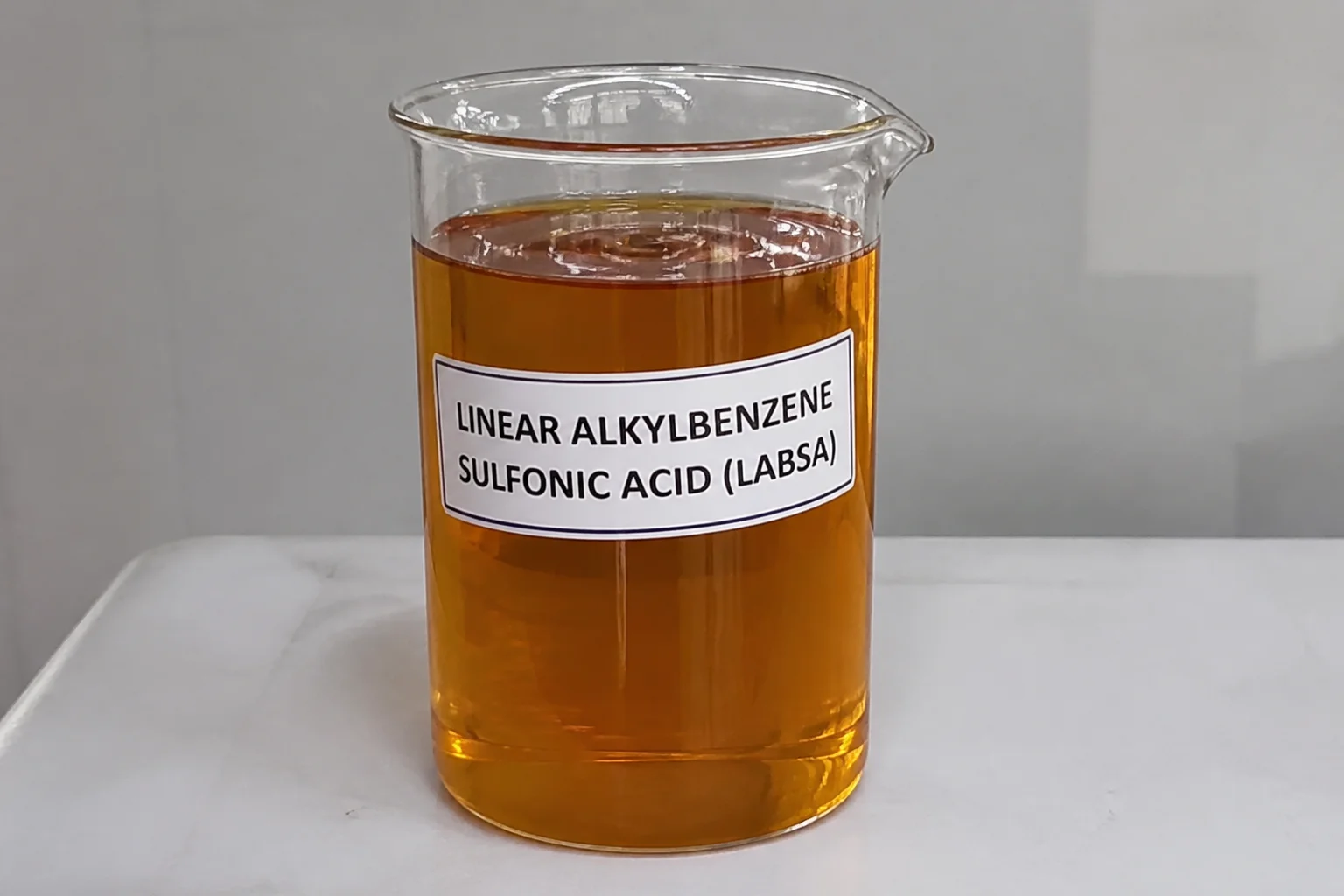
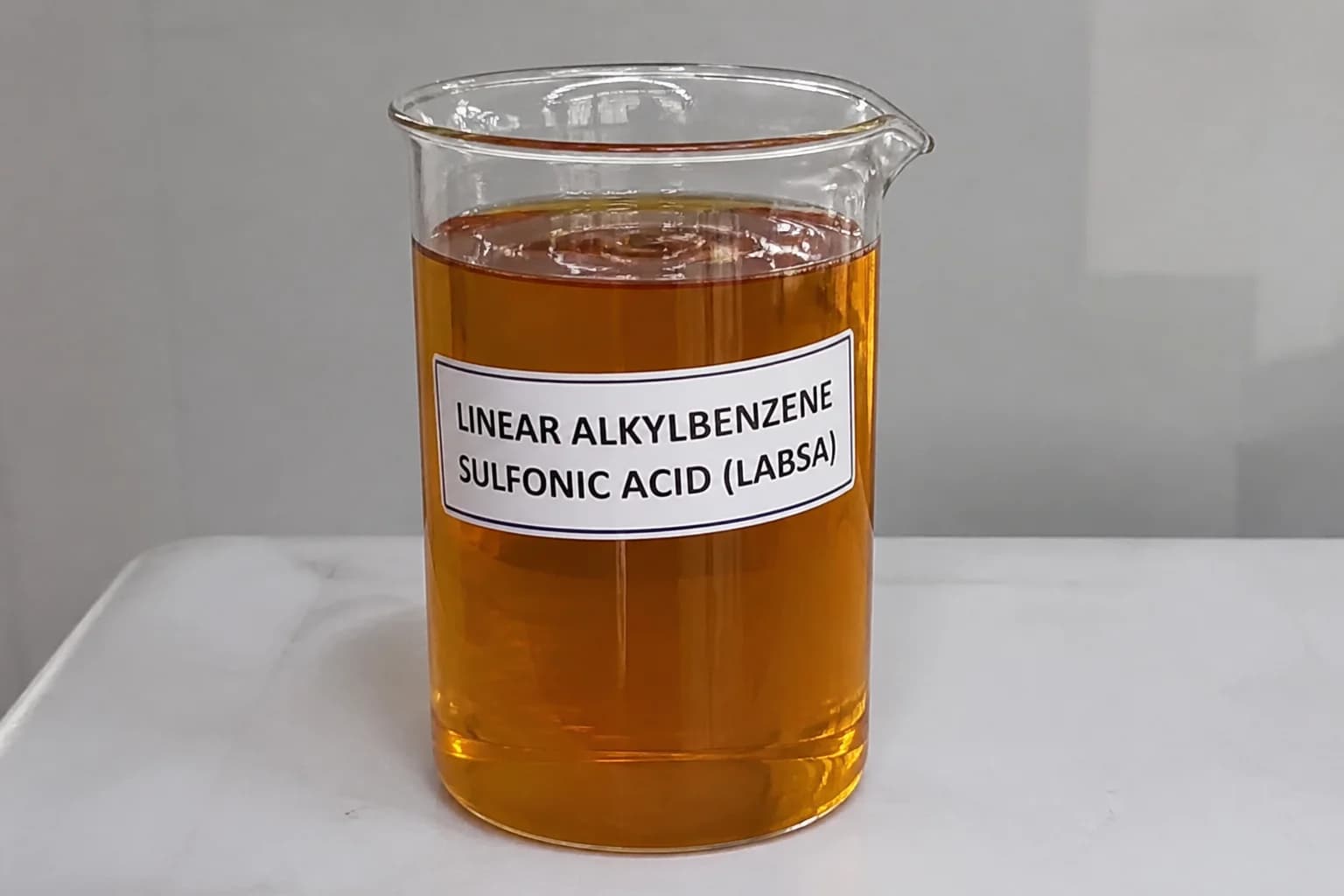
The resulting LABSA, a brown viscous liquid at 96% active concentration, then proceeds to neutralization with sodium hydroxide or sodium carbonate. This creates the sodium salt of linear alkylbenzene sulfonate (LAS), the actual surfactant incorporated into detergent formulations. LAS concentration in finished detergents ranges from 5% in liquid products to 28% in premium powder formulations.
Conclusion
Linear alkyl benzene occupies a unique position in the chemical industry as an intermediate compound few consumers recognize yet nearly everyone uses indirectly through detergent products. Its production technology, evolved over 60 years from environmentally problematic branched alternatives to today’s biodegradable linear structures, demonstrates how industry responds to environmental concerns while maintaining essential product functionality. The dominance of DETAL solid catalyst technology reflects continuing improvements in process safety, product quality, and environmental performance.
For manufacturers requiring linear alkyl benzene, LABSA, or downstream detergent raw materials, Elchemy’s technology-driven platform connects buyers with verified chemical suppliers across global markets. Founded by IIT Bombay engineer Hardik Seth and IIT Delhi engineer Shobhit Jain, Elchemy provides transparent access to quality documentation including certificates of analysis, MSDS information, and competitive pricing, supporting reliable procurement for manufacturers from detergent production through specialty chemical applications.