

At a Glance
• Hydrogen chloride (HCl) is a colorless gas at room temperature; hydrochloric acid is HCl gas dissolved in water
• Pure HCl gas boils at -85°C and freezes at -114°C — exists as gas unless extremely cold or under pressure
• Aqueous hydrochloric acid comes in concentrations from 10% to 38% HCl by weight in water
• HCl gas reacts violently with moisture forming acidic mist — creates white fumes in humid air
• Industrial uses differ: HCl gas for anhydrous reactions, hydrochloric acid for aqueous processing and cleaning
• Safety hazards vary: gas causes immediate respiratory damage, liquid causes chemical burns on contact
• Both have molecular formula HCl but completely different handling, storage, and application requirements
• Global production exceeds 20 million tonnes with most HCl gas converted to aqueous acid for commercial use
A chemical plant operator in Gujarat made a mistake during a valve switch. He thought he was draining dilute hydrochloric acid from a storage tank. Actually, he’d opened a line containing anhydrous hydrogen chloride gas. Within seconds, white fumes filled the area. His eyes burned. He couldn’t breathe properly. Emergency responders evacuated the section and neutralized the gas with ammonia spray. The operator recovered after treatment, but he’d learned an expensive lesson about the difference between HCl gas and hydrochloric acid solution.
Same molecule. Different physical state. Completely different dangers.
People often use hydrochloric acid vs hydrogen chloride interchangeably, but they’re talking about the same chemical in different forms. Understanding this difference matters for anyone working with these materials. Whether you’re in a lab, managing industrial processes, or just trying to understand chemistry better, knowing when you’re dealing with a corrosive gas versus a corrosive liquid changes everything about handling and safety.
What Actually Is Hydrogen Chloride?
The Gas Form
Hydrogen chloride in its pure form is a gas. One hydrogen atom bonds to one chlorine atom making HCl molecule. At normal room temperature and pressure, these molecules float around as colorless gas with a sharp, irritating smell.
The gas is heavier than air — about 1.27 times heavier. This means HCl gas doesn’t rise and disperse quickly like some gases do. It sinks and accumulates in low areas, making it extra dangerous in poorly ventilated spaces. Basements, pits, and ground-level areas become gas traps.
HCl gas has extremely low boiling point of -85°C. This tells you it really wants to be a gas at normal temperatures. You’d need to chill it below -85°C or compress it under high pressure to turn it into liquid. Neither is practical for most uses, so people work with it as gas or dissolve it in water.
Key properties of HCl gas: Colorless but creates white fumes in moist air Sharp, choking odor detectable at very low concentrations Highly soluble in water (dissolves readily) Non-flammable but highly corrosive Density 1.49 g/L (heavier than air at 1.29 g/L)
When HCl gas contacts water vapor in air, it immediately reacts forming tiny droplets of hydrochloric acid. These droplets scatter light creating the characteristic white fog or smoke you see. This “fuming” behavior is why concentrated hydrochloric acid solutions (above 35-37%) are called “fuming hydrochloric acid” — they release HCl gas that reacts with air moisture.
How It Forms in Industry
Most hydrogen chloride gas is byproduct from other chemical processes. When manufacturers make chlorinated organic compounds — things like vinyl chloride for PVC plastic or chlorinated solvents — HCl gas forms as unwanted product. Rather than waste it, they capture and use it.
Direct synthesis also happens. Burning hydrogen gas in chlorine gas produces HCl directly: H₂ + Cl₂ → 2HCl. This method makes very pure HCl gas used in semiconductor manufacturing and other applications needing high purity.
Salt (sodium chloride) plus sulfuric acid was the old method before petroleum chemistry took over. Heat salt with concentrated sulfuric acid and HCl gas evolves. This “salt-cake” process still runs in some places but it’s not the main source anymore.
What Makes Hydrochloric Acid Different
Dissolving Gas in Water
Take hydrogen chloride gas and bubble it through water. The gas dissolves extremely well — much better than most gases. You can dissolve hundreds of liters of HCl gas in just one liter of water. This creates hydrochloric acid solution.
The dissolving isn’t just physical mixing. Chemical reaction happens too. HCl molecules interact with water molecules, and many split apart releasing H⁺ ions (protons) and Cl⁻ ions. This makes the solution acidic — it’s the free H⁺ ions that create acidity.
Commercial hydrochloric acid typically comes as 30-37% solution. This percentage means 30-37 grams of HCl per 100 grams of total solution. You can make weaker solutions by diluting with more water. Above 38% concentration, the solution becomes unstable — it releases HCl gas continuously and you can’t store it properly.
Common concentrations and names: 10-12%: Dilute hydrochloric acid for lab use 20%: Industrial grade for general applications 28-32%: Muriatic acid (hardware store grade) 31-38%: Concentrated hydrochloric acid 37-38%: Fuming hydrochloric acid (releases HCl gas)
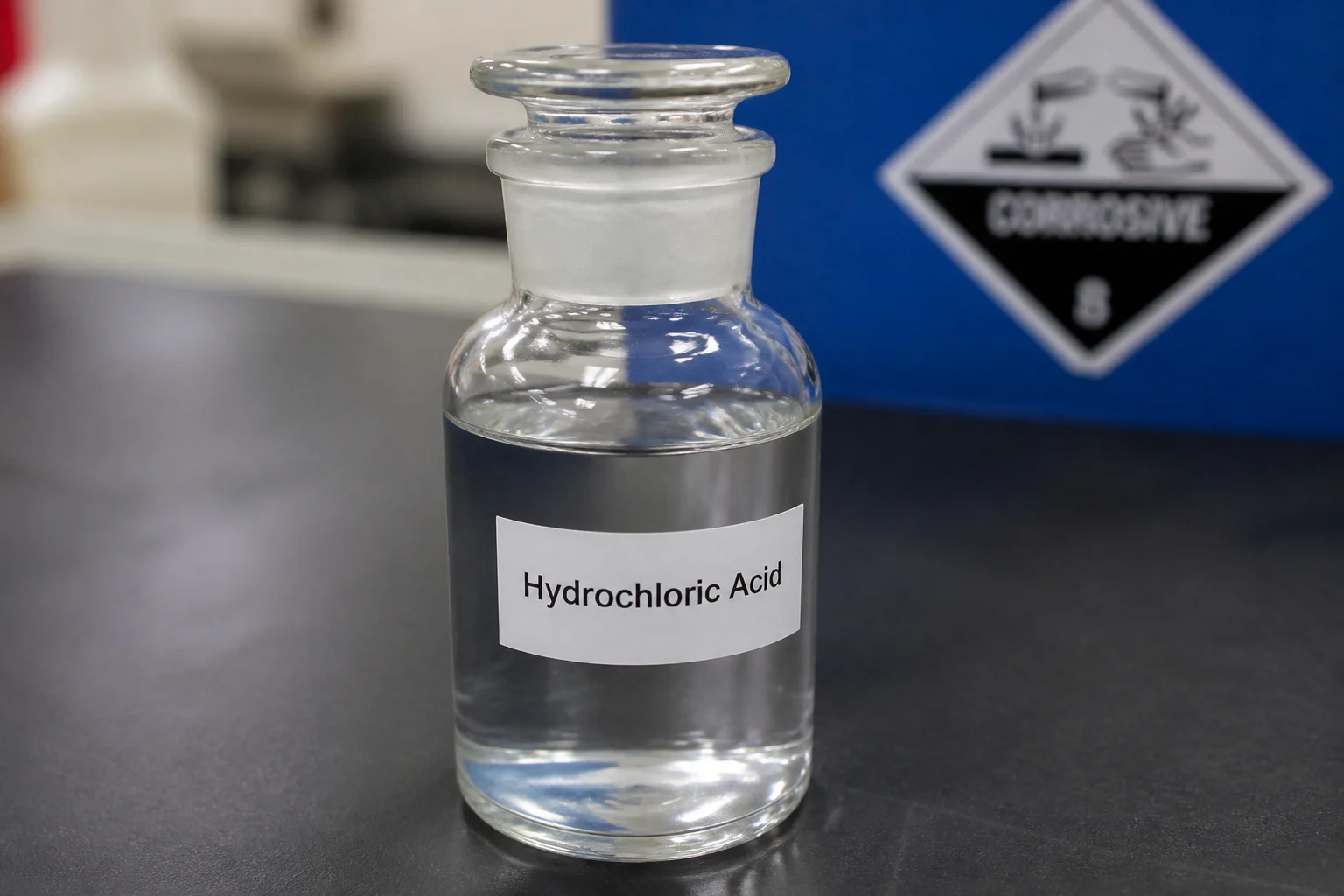
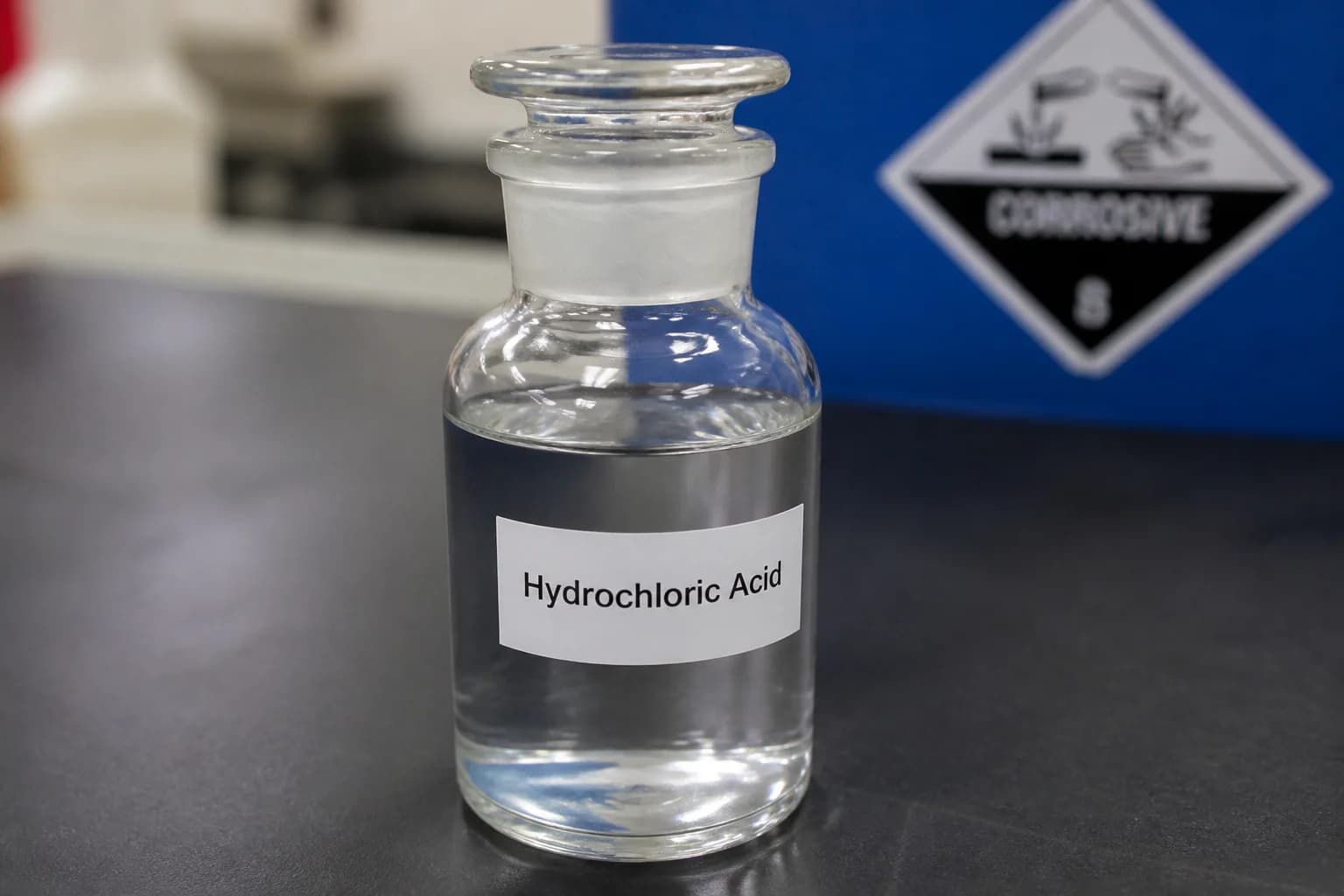
The acid solution is clear to pale yellow liquid. Yellow color comes from iron impurities in commercial grades. Reagent-grade hydrochloric acid is water-clear with no color. Unlike the gas, you can pour it, pump it, store it in bottles, and handle it much like other liquid chemicals (with proper safety gear, of course).
Why Water Changes Everything
Water transforms HCl from gas to liquid, but more importantly, it moderates the reactivity. HCl gas attacks materials instantly on contact. Hydrochloric acid solution reacts more controllably because water dilutes it and acts as buffer.
Think of it like this: dry chili powder versus chili in curry. Pure powder burns your mouth instantly. Mixed in curry, the heat spreads out and you can handle it better. Same idea with HCl gas versus acid solution.
The acid solution can be stored in plastic or glass bottles. HCl gas needs specialized cylinders or generation systems. The solution ships as liquid in drums, tankers, or bottles. The gas needs pressure cylinders or tube trailers. The physical state difference creates totally different logistics and handling requirements.
Table 1: Gas vs Aqueous Comparison
| Property | Hydrogen Chloride Gas | Hydrochloric Acid Solution |
| Physical state | Gas at room temp | Liquid (aqueous solution) |
| Appearance | Colorless, forms white fumes | Clear to pale yellow liquid |
| Boiling point | -85°C | Varies by concentration, ~110°C for azeotrope |
| Odor | Sharp, choking | Sharp, irritating but less intense |
| Solubility in water | Extremely high | Already dissolved in water |
| Reactivity | Instant, violent with moisture | Controlled, depends on concentration |
| Storage containers | Gas cylinders, steel tanks | HDPE bottles, rubber-lined tanks |
| Shipping classification | Toxic gas, UN1050 | Corrosive liquid, UN1789 |
Hydrochloric Acid vs Hydrogen Chloride: Where Each Gets Used
Applications for HCl Gas
Anhydrous (water-free) reactions need hydrogen chloride gas, not the aqueous acid. When you’re making certain chemicals and water would mess things up, you use the gas.
Pharmaceutical synthesis often requires HCl gas. Making hydrochloride salts of drug molecules works better with gaseous HCl bubbled through organic solvents. Adding aqueous hydrochloric acid would introduce water that could cause side reactions or require extra drying steps.
Semiconductor manufacturing uses ultra-pure HCl gas for etching silicon wafers. Any water contamination would leave residues or cause improper etching. The purity requirements are extreme — often 99.999% or better.
Polyvinyl chloride (PVC) production involves HCl gas in vinyl chloride synthesis. Some polymerization catalysts get made using HCl gas. The gas phase allows better control over reaction conditions without water interference.
HCl gas applications: Pharmaceutical intermediate synthesis in non-aqueous conditions Semiconductor wafer etching and cleaning PVC catalyst preparation Lab-scale reactions needing anhydrous conditions Chemical synthesis where water is unwanted
Applications for Hydrochloric Acid Solution
Most industrial and commercial applications use hydrochloric acid solution because it’s safer and easier to handle than gas. Steel pickling is huge — removing rust and scale from steel before galvanizing or coating. The acid dissolves iron oxides, cleaning the metal surface.
pH control in water treatment uses dilute hydrochloric acid. When water is too alkaline, adding HCl brings pH down to acceptable range. Swimming pools use muriatic acid (commercial hydrochloric acid) to lower pH and alkalinity.
Food processing uses food-grade hydrochloric acid for pH adjustment in making corn syrup, gelatin, and other products. The acid converts starches, adjusts processing conditions, and gets neutralized afterward leaving harmless salt.
Oil well acidizing injects hydrochloric acid into limestone formations. The acid dissolves rock, creating channels for oil and gas to flow. This stimulation technique improves well productivity significantly.
Hydrochloric acid solution applications: Metal cleaning and pickling (steel, copper, brass) pH adjustment in water treatment and pools Food processing (corn syrup, gelatin production) Oil and gas well stimulation Laboratory analysis and titrations Cleaning concrete and masonry
Safety: Why Physical State Changes Danger
Hazards from HCl Gas
Hydrogen chloride gas is immediately dangerous to life and health (IDLH) at just 50 ppm in air. You can smell it at 1-5 ppm, feel irritation at 5-10 ppm, and experience severe respiratory distress above 35 ppm. At 50-100 ppm, exposure for even a few minutes can be fatal.
The gas attacks mucous membranes in eyes, nose, throat, and lungs instantly. It dissolves in the moisture on these surfaces forming hydrochloric acid right there. This acid burns tissue causing inflammation, fluid buildup, and potentially fatal pulmonary edema (fluid in lungs).
Because it’s heavier than air, HCl gas accumulates at ground level. Workers bent over equipment or working in pits face higher exposure. Leaks in basement areas or confined spaces create deadly pockets of high concentration gas.
HCl gas emergency responses: Immediately evacuate contaminated area Move to fresh air, assist breathing if necessary Don’t attempt rescue without proper respiratory protection Neutralize large releases with ammonia water spray Medical evaluation required even after brief exposure
Hazards from Hydrochloric Acid Solution
Hydrochloric acid solution burns skin and eyes on contact. The severity depends on concentration — 10% causes irritation, 30% causes severe burns, and concentrated acid (37%) causes immediate deep tissue damage.
Fumes from concentrated acid irritate respiratory tract but less severely than pure HCl gas. The vapor pressure is lower, so less HCl gets in air. Still, working with concentrated hydrochloric acid in poorly ventilated areas causes coughing, chest pain, and respiratory irritation.
Ingestion is medical emergency. The acid burns mouth, throat, esophagus, and stomach. Don’t induce vomiting — it brings acid back up causing more damage. Immediate medical care is critical.
Hydrochloric acid solution first aid: Skin contact: flush immediately with large amounts of water for 15+ minutes Eye contact: flush with water for 15+ minutes, get medical help Inhalation: move to fresh air, give oxygen if breathing is difficult Ingestion: rinse mouth, give water or milk if person is conscious, get immediate medical care
Table 2: Safety Equipment Requirements
| Protection Type | For HCl Gas | For Hydrochloric Acid Solution |
| Respiratory | Full-face respirator or SCBA for leaks | Ventilation usually sufficient; respirator for concentrated acid |
| Eye protection | Gas-tight goggles or full-face respirator | Safety goggles or face shield |
| Hand protection | Butyl or neoprene gloves | Neoprene or PVC gloves |
| Body protection | Acid-resistant suit for gas handling | Rubber apron or acid-resistant clothing |
| Ventilation | Local exhaust essential, gas detection | General ventilation, fume hood for lab |
| Emergency equipment | Gas neutralization system, SCBA | Safety shower, eyewash station |
Storage and Handling Differences
Containing the Gas
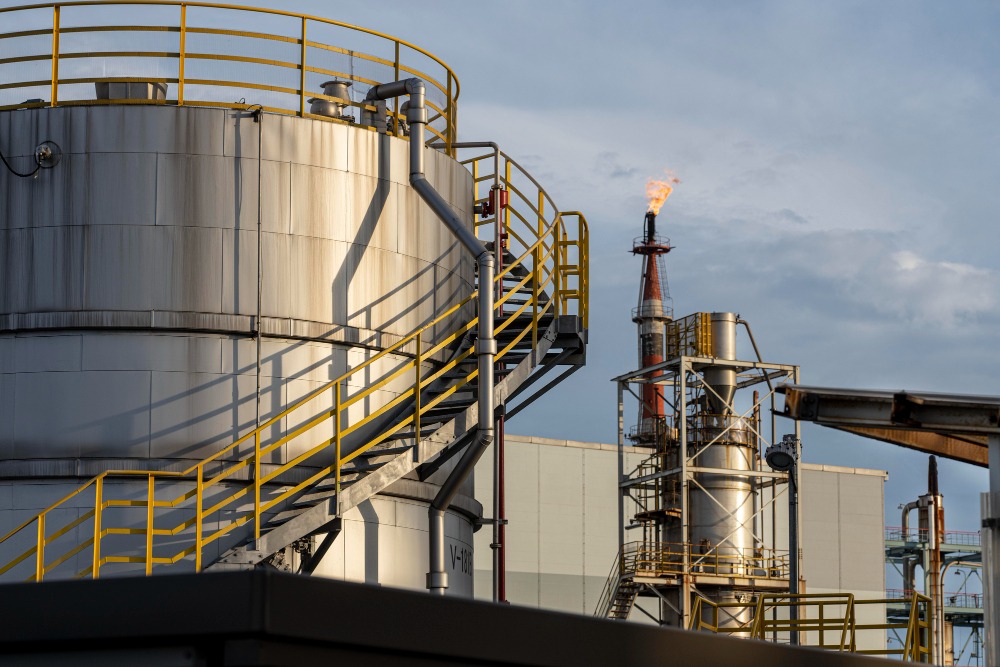
Hydrogen chloride gas needs pressure cylinders or specialized storage tanks. Steel works for dry HCl gas because without moisture, corrosion is minimal. But any moisture turns it into acid that attacks steel rapidly. Systems must be completely dry.
Gas cylinders typically hold HCl under pressure — usually around 600-700 psi at room temperature. The cylinders have special valves and connections specific to HCl. Never use with wrong fittings or equipment.
Large-scale users might have tube trailers or bulk storage tanks. These need pressure relief systems, leak detection, and scrubbing systems that neutralize any escaped gas. Installation requires permits and safety reviews.
Piping systems for HCl gas use materials like PTFE-lined steel, Hastelloy, or special plastics. Regular steel works only for bone-dry gas. Any condensation or moisture ingress causes immediate corrosion and leaks.
Containing the Solution
Hydrochloric acid solution stores in much simpler containers. High-density polyethylene (HDPE) bottles and drums work perfectly. Glass works for lab quantities. For large volumes, rubber-lined steel tanks or fiber-reinforced plastic tanks handle the job.
The acid slowly releases HCl gas, especially concentrated grades. Storage areas need ventilation. Containers shouldn’t be completely sealed — use vented caps or pressure relief to prevent pressure buildup as temperature changes.
Never store in metal containers unless specifically designed for it. Stainless steel corrodes rapidly. Carbon steel reacts forming hydrogen gas and iron chlorides. Aluminum dissolves. Only PTFE-lined vessels or certain exotic alloys like Hastelloy resist hydrochloric acid in metal form.
Keep away from bases (sodium hydroxide, calcium hydroxide, ammonia) and oxidizers (bleach, hydrogen peroxide). Mixing with bases generates tremendous heat. Mixing with oxidizers can generate toxic chlorine gas.
Converting Between Gas and Solution
Making Acid from Gas
Absorbing HCl gas into water is the standard commercial process for making hydrochloric acid. Absorption towers bring gas and water into contact. The gas dissolves readily creating acid solution.
The process generates significant heat. HCl dissolving in water releases about 74 kJ per mole of HCl. This heats the solution, requiring cooling systems in commercial absorbers. Without cooling, the solution can boil from dissolution heat alone.
Home chemistry doesn’t safely make hydrochloric acid from gas. The process needs proper equipment to handle corrosive, toxic gas and control the exothermic reaction. Buy prepared acid instead — it’s safer and more economical.
Generating Gas from Acid
Heating concentrated hydrochloric acid drives off HCl gas. The acid forms an azeotrope (constant-boiling mixture) at about 20% HCl by weight. Heating concentrated acid (37%) releases HCl gas until concentration drops to azeotrope point.
Adding sulfuric acid to hydrochloric acid forces HCl gas out. The sulfuric acid, being less volatile and stronger, drives the HCl out of solution. This method makes HCl gas in labs when small amounts are needed.
These methods generate corrosive, toxic gas. Proper ventilation, gas scrubbing, and safety equipment are mandatory. Most facilities just buy HCl gas in cylinders rather than generating it from acid.
The Relationship Between Forms
The key point about hydrochloric acid and hydrogen chloride is they’re the same chemical in different physical forms. It’s like water and steam — same molecule (H₂O), different state, different handling.
You can easily convert between them. Bubble gas through water, you get acid. Heat acid, you get gas back. The chemistry is reversible and straightforward. But the practical implications are massive in terms of safety, storage, and applications.
Most commercial hydrochloric acid starts as HCl gas byproduct from chemical reactions. The gas gets absorbed in water creating acid solution that ships to customers. Relatively few applications use pure HCl gas directly. The solution form is just more practical for most purposes.
Conclusion
The distinction hydrochloric acid vs hydrogen chloride comes down to physical state and what that means for handling. Hydrogen chloride is corrosive gas existing at room temperature with boiling point of -85°C, requiring pressure cylinders for storage and used primarily in anhydrous chemical synthesis and semiconductor manufacturing where water would interfere with reactions. Hydrochloric acid is aqueous solution of HCl gas dissolved in water at concentrations from 10-38%, stored in plastic containers and used widely for metal pickling, pH control, food processing, and cleaning applications.
Both forms share the same molecular formula HCl but differ completely in hazard profiles — gas causes immediate respiratory damage through inhalation and requires specialized ventilation with respiratory protection, while liquid causes chemical burns on skin contact and needs standard safety equipment like goggles and acid-resistant gloves. Industrial applications favor aqueous acid for its easier handling, though anhydrous gas remains essential for specific chemical reactions in pharmaceutical and semiconductor industries. Understanding whether you’re working with corrosive gas or corrosive liquid fundamentally changes your safety protocols, storage requirements, and handling procedures.
For industries requiring either form of this versatile chemical, Elchemy connects you with suppliers offering both anhydrous hydrogen chloride gas in pressure cylinders and hydrochloric acid solutions at various concentrations (technical-grade, reagent-grade, food-grade) with complete safety documentation, material compatibility data, and technical support for your specific metal treatment, synthesis, pH control, or processing applications.