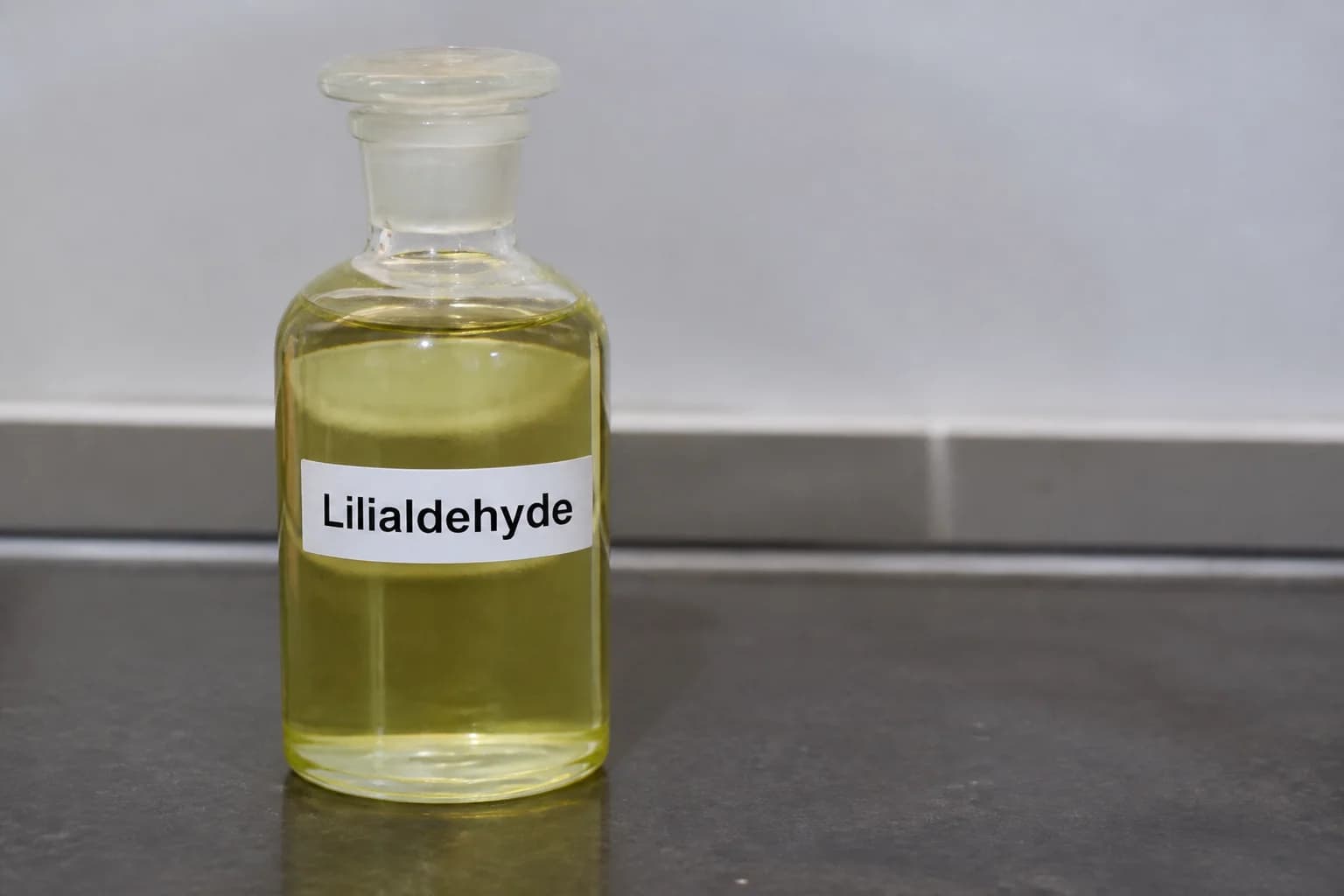
Lilialdehyde
ELAROMA™TM – LIAL
Get Pricing For This Product
Need pricing? Request a quote for this product and we'll get back to you shortly.
Speed Up Your Sample Testing Process
Express Delivery in 24–48 Hours
Lilialdehyde, also known as p-tert-Butyl-alpha-methylhydrocinnamic aldehyde, is a synthetic fragrance compound widely used in the personal care and fragrance industries. It imparts a floral, lily-like…
CAS Number
80-54-6
HS Code
2912.19.00
INCI Name
Lilialdehyde
Molecular Formula
C14H20O
Lilialdehyde
ELAROMA™TM – LIAL
Lilialdehyde, also known as p-tert-Butyl-alpha-methylhydrocinnamic aldehyde, is a synthetic fragrance compound widely used in the personal care and fragrance industries. It imparts a floral, lily-like scent and is commonly found in perfumes, soaps, and cosmetics. Its stability…
CAS Number
80-54-6
INCI Name
Lilialdehyde
HS Code
2912.19.00
Molecular Formula
C14H20O
Get Pricing For This Product
Need pricing? Request a quote for this product and we'll get back to you shortly.
Speed Up Your Sample Testing Process
We deliver domestic samples within 24 - 48 hours, helping you evaluate product without delays.
Product Specification
Physical Properties
| Property | Specification |
|---|---|
| Appearance | Colorless to pale yellow liquid |
| Odor | Fresh, green, floral, lily, with powdery and muguet notes |
| Molecular Formula | C14H20O |
| Molecular Weight | 204.31 g/mol |
| Density | 0.95 g/cm³ |
| Specific Gravity | 0.9420 to 0.9470 @ 25.00 °C |
| Viscosity | 14.872 mPa·s @ 20 °C |
| Refractive Index | 1.5030 to 1.5060 @ 20.00 °C |
| Assay / Purity | ≥96.0% - 97.28% |
Chemical Properties
| Property | Specification |
|---|---|
| Ionic Nature | Non-ionic |
| Incompatibilities | Strong oxidizing agents, strong acids, alkalis |
| Hazardous Reactions | Presents no significant reactivity hazard by itself or in contact with water. Not expected under normal conditions of use. |
| Hazardous Decomposition Products | Under fire conditions: Carbon oxides, unidentified organic compounds. |
Thermal Properties
| Property | Specification |
|---|---|
| Melting Point | 28-30 °C |
| Boiling Point | 263 °C |
| Flash Point | 98.89 °C (Closed Cup) |
| Thermal Stability | Good stability under normal storage conditions. Slowly oxidizes on storage. Avoid extreme heat. |
Dosing Guidelines
A. Dosing by Application
| Application | Recommended / Max Dosage |
|---|---|
| Fine Fragrance | 0.5% - 3% |
| Finished Products (General) | Permitted up to 1.4% (IFRA 51, Cat. 4) |
| Products applied to the axillae (e.g., Deodorants) | 0.09% (IFRA Restriction) |
| Products applied to the lips | Prohibited (IFRA Restriction) |
About Lilialdehyde
Lilialdehyde, also known as p-tert-Butyl-alpha-methylhydrocinnamic aldehyde, is a synthetic fragrance compound widely used in the personal care and fragrance industries. It imparts a floral, lily-like scent and is commonly found in perfumes, soaps, and cosmetics. Its stability and pleasant aroma make it a preferred choice for enhancing product appeal. As a fragrance ingredient, Lilialdehyde manufacturers and suppliers focus on producing high-quality, consistent products to meet the demands of global markets, particularly in North America. The compound's versatility and effectiveness in providing a long-lasting scent make it a valuable addition to various formulations. Sustainability and safety are key considerations in its production, with manufacturers adhering to stringent quality standards and regulatory guidelines to ensure consumer safety and environmental responsibility.
- Floral Fragrance: Provides a lily-like scent, enhancing the sensory appeal of products.
- Function: Fragrance Ingredient, Masking Agent.
- Stable Compound: Offers stability in formulations, ensuring consistent fragrance delivery.
- Features: Possesses a powerful, radiant, and stable floral scent reminiscent of lily-of-the-valley. It is valued for its good stability in various product bases, including soaps and detergents.
- Versatile Use: Suitable for a wide range of applications, including perfumes, soaps, and cosmetics.
- Benefits: Provides a universally appealing clean, dewy, and green-floral note that enhances and freshens fragrance compositions. It acts as a "universal freshness amplifier" in both fine fragrances and functional products.
- High Purity Standards: Manufactured to meet stringent quality and safety standards.
- Preferred in Fragrance Industry: Widely used due to its pleasant aroma and effectiveness in scent delivery.
About Lilialdehyde
Lilialdehyde, also known as p-tert-Butyl-alpha-methylhydrocinnamic aldehyde, is a synthetic fragrance compound widely used in the personal care and fragrance industries. It imparts a floral, lily-like scent and is commonly found in perfumes, soaps, and cosmetics. Its stability and pleasant aroma make it a preferred choice for enhancing product appeal. As a fragrance ingredient, Lilialdehyde manufacturers and suppliers focus on producing high-quality, consistent products to meet the demands of global markets, particularly in North America. The compound's versatility and effectiveness in providing a long-lasting scent make it a valuable addition to various formulations. Sustainability and safety are key considerations in its production, with manufacturers adhering to stringent quality standards and regulatory guidelines to ensure consumer safety and environmental responsibility.
- Floral Fragrance: Provides a lily-like scent, enhancing the sensory appeal of products.
- Function: Fragrance Ingredient, Masking Agent.
- Stable Compound: Offers stability in formulations, ensuring consistent fragrance delivery.
- Features: Possesses a powerful, radiant, and stable floral scent reminiscent of lily-of-the-valley. It is valued for its good stability in various product bases, including soaps and detergents.
- Versatile Use: Suitable for a wide range of applications, including perfumes, soaps, and cosmetics.
- Benefits: Provides a universally appealing clean, dewy, and green-floral note that enhances and freshens fragrance compositions. It acts as a "universal freshness amplifier" in both fine fragrances and functional products.
- High Purity Standards: Manufactured to meet stringent quality and safety standards.
- Preferred in Fragrance Industry: Widely used due to its pleasant aroma and effectiveness in scent delivery.
Regulatory Compliance
| Region | Max Allowed Level | Notes | Certification Body |
|---|---|---|---|
| United States | - | Not specifically restricted by the FDA for use in cosmetics. However, industry groups like the International Fragrance Association (IFRA) have prohibited its use in lip and oral care products. It is listed on the TSCA Inventory. | TSCA |
| European Union | 0% | Prohibited for use in cosmetic products since March 1, 2022. Classified as a CMR 1B substance (presumed reproductive toxicant). It is listed in Annex II (List of Substances Prohibited in Cosmetic Products) of the EU Cosmetics Regulation. | REACH registration is required for manufacture or import into the EU, but this does not permit its use in cosmetics. |
| Canada | - | Not currently on Health Canada's Cosmetic Ingredient Hotlist of prohibited or restricted ingredients. | - |
| India | - | No specific restrictions found in the Cosmetics Rules, 2020. | - |
| Japan | - | No specific restrictions found under the Standards for Cosmetics. | - |
| Australia | - | Not specifically restricted under the Australian Industrial Chemicals Introduction Scheme (AICIS) for cosmetic use, but it is noted as a skin sensitizer. | AICIS Inventory listing. |
| China | - | Listed in the Inventory of Existing Cosmetic Ingredients in China (IECIC 2021). | NMPA registration for finished products. |
| Republic of Korea | - | No specific restrictions found. | - |
| ASEAN | - | No specific restrictions found in the ASEAN Cosmetic Directive Annexes. | - |
FAQs - Lilialdehyde
Related Products

Related Products
Streamline
Your Chemical
Procurement
Get fast responses from real experts