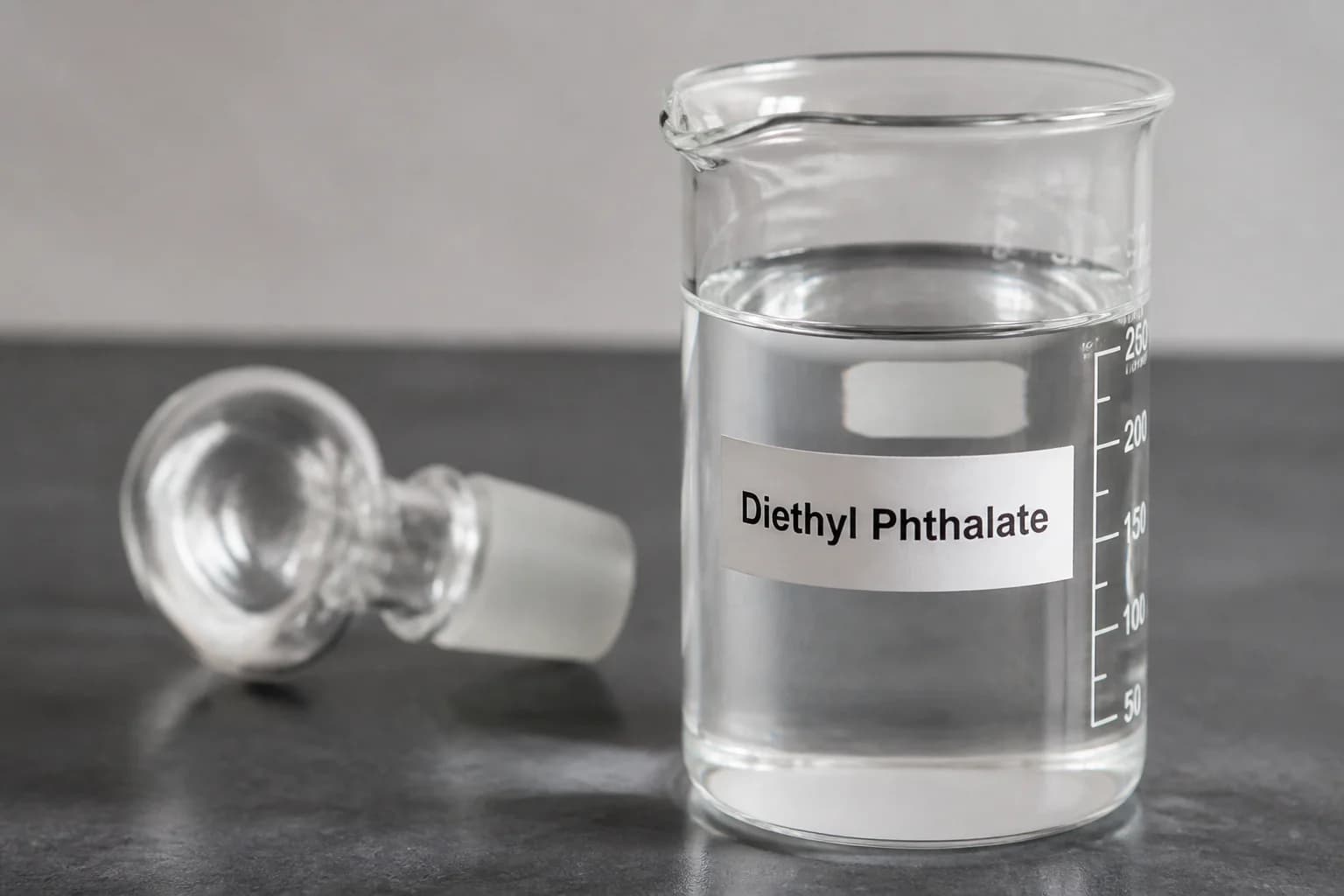
Diethyl phthalate
ELRASATM – DEP
Get Pricing For This Product
Skip the quote. Sign up now and see pricing instantly
Speed Up Your Sample Testing Process
Express Delivery in 24–48 Hours
Diethyl Phthalate (DEP) is a phthalate-ester plasticiser and solvent, supplied as a clear, colourless, oily liquid with very little odour. It functions as a plasticiser, fragrance fixative & solvent,…
CAS Number
84-66-2
HS Code
2917.34.00
INCI Name
Diethyl Phthalate (DEP)
Molecular Formula
C₁₂H₁₄O₄
Diethyl phthalate
ELRASATM – DEP
Diethyl Phthalate (DEP) is a phthalate-ester plasticiser and solvent, supplied as a clear, colourless, oily liquid with very little odour. It functions as a plasticiser, fragrance fixative & solvent, denaturant, gelatinising agent across fragrance & cosmetics, plastics &…
CAS Number
84-66-2
INCI Name
Diethyl Phthalate (DEP)
HS Code
2917.34.00
Molecular Formula
C₁₂H₁₄O₄
Get Pricing For This Product
Skip the quote. Sign up now and see pricing instantly
Speed Up Your Sample Testing Process
We deliver domestic samples within 24 - 48 hours, helping you evaluate product without delays.
Product Specification
Physical Properties
| Property | Specification |
|---|---|
| Appearance | Colorless oily liquid |
| Odor | Odorless |
| Molecular Weight (G/Mol) | 222.24 |
| Density Or Specific Gravity | 1.12 at 68 °F |
| Viscosity | 31.3 centistokes at 0 °C |
| Refractive Index | 1.5002 at 25 °C/D |
| Density | 1.12 at 68 °F |
Chemical Properties
| Property | Specification |
|---|---|
| Hazardous Reactions | When heated to decomp it emits acrid smoke and irritating fumes. |
Thermal Properties
| Property | Specification |
|---|---|
| Melting Point | 27 °F |
| Boiling Point | 568 °F at 760 mmHg |
| Flash Point | 284 °F |
| Autoignition Temperature | 855 °F |
Processing Methods & Reference Formulations
A. Perfume
Use at 5–30% as a solvent and fixative to dilute perfume oils, improve stability, and slow down evaporation of volatile notes. Blend with the perfume concentrate before adding alcohol to ensure a uniform, stable solution.
| Key Ingredients | Indicative Dosage (% w/w) |
|---|---|
| Linalool | 10% |
| Benzyl Acetate | 10% |
| Phenylethyl Alcohol | 20% |
| Iso E Super | 15% |
| Hedione | 10% |
| Galaxolide | 10% |
| Musk Ketone | 5% |
| Para Anisic Aldehyde | 2% |
| Cinnamic Alcohol | 1% |
| Diethyl Phthalate (DEP) | 17% |
B. Shampoo
Use at 0.1–2%, mainly as a fragrance solvent or fixative to help retain and stabilize scent in the final product. Add during the fragrance phase, ideally at the cool-down stage, to prevent volatility and ensure stability. Pre-mix with fragrance oils to improve solubility and avoid cloudiness or separation in the aqueous shampoo base.
| Key Ingredients | Indicative Dosage (% w/w) |
|---|---|
| Water | 63% |
| Sodium Laureth Sulfate | 15% |
| Cocamidopropyl Betaine | 6% |
| Glycerin | 3% |
| Citric Acid | 0.3% |
| Polyquaternium-10 | 0.2% |
| Disodium EDTA | 0.1% |
| Preservative (e.g. Phenoxyethanol) | 0.8% |
| Fragrance blend | ~11% |
| Diethyl Phthalate | 0.1% |
C. Soap
Use at 0.2–2% as a solvent or fixative to enhance fragrance longevity and help dissolve essential oils or aromatic compounds. Add during the fragrance phase, when the soap mixture has cooled, to avoid evaporation or degradation.
| Key Ingredients | Indicative Dosage (% w/w) |
|---|---|
| Sodium Palmate | 40% |
| Sodium Palm Kernelate | 25% |
| Water | 15% |
| Glycerin | 5% |
| Sorbitol | 5% |
| Titanium Dioxide | 1% |
| Tetrasodium EDTA | 0.1% |
| BHT | 0.2% |
| Fragrance Blend | ~8% |
| Diethyl Phthalate | 0.2% |
D. Cosmetic Lotion
Use at 0.5–2%, primarily as a solvent and fixative to help dissolve and stabilize fragrance components in the lotion. Add during the oil phase or with fragrance during the cool-down stage for better integration and stability.
| Key Ingredients | Indicative Dosage (% w/w) |
|---|---|
| Water | ~70% |
| Glycerin | 5% |
| Cetearyl Alcohol | 4% |
| Caprylic/Capric Triglyceride | 5% |
| Glyceryl Stearate | 3% |
| Dimethicone | 2% |
| Phenoxyethanol | 0.8% |
| Ethylhexylglycerin | 0.2% |
| Carbomer | 0.3% |
| Triethanolamine | 0.2% |
| Tocopherol (Vitamin E) | 0.2% |
| Fragrance Blend | ~9% |
| Diethyl Phthalate | 0.8% |
Dosing Guidelines
A. Dosing by Application
| Products | Authorized dosage |
|---|---|
| Perfume/Fragrance | 0.1-30% |
| Cosmetics/Personal Care | <0.1% – 1% |
About Diethyl phthalate
Diethyl phthalate (DEP) is a low-molecular-weight phthalate ester, valued as a versatile plasticiser and solvent with very low odour. Its most prominent use is as a fragrance fixative and solvent in perfumery and cosmetics, where its neutral odour and good solvency make it a preferred carrier. It is also a plasticiser for cellulose derivatives, a denaturant for alcohol, and a component in coatings and films. DEP's near-odourless character and excellent solvency for fragrance and cellulosic materials distinguish it from higher-molecular-weight phthalates, and it is one of the most widely used fragrance carriers in the industry. Note that phthalates as a class face regulatory scrutiny, so destination-market compliance (particularly for cosmetics and toys/childcare) is a sourcing consideration. Industrial buyers sourcing Diethyl Phthalate (DEP) in bulk also track diethyl phthalate pricing closely, since it feeds directly into their downstream costs which is why working with an established diethyl phthalate supplier and distributor like Elchemy matters.
- Dense Liquid: Density of 1.12 g/cm³ at 20°C, sinks in water.
- Low Volatility: Vapor pressure of 0.002 mmHg at 25°C.
- Chemical Stability: Reliable stability under normal conditions.
- Effective Plasticizer: Enhances flexibility in various polymers.
- Low Viscosity: Ensures ease of use in chemical processes.
About Diethyl phthalate
Diethyl phthalate (DEP) is a low-molecular-weight phthalate ester, valued as a versatile plasticiser and solvent with very low odour. Its most prominent use is as a fragrance fixative and solvent in perfumery and cosmetics, where its neutral odour and good solvency make it a preferred carrier. It is also a plasticiser for cellulose derivatives, a denaturant for alcohol, and a component in coatings and films. DEP's near-odourless character and excellent solvency for fragrance and cellulosic materials distinguish it from higher-molecular-weight phthalates, and it is one of the most widely used fragrance carriers in the industry. Note that phthalates as a class face regulatory scrutiny, so destination-market compliance (particularly for cosmetics and toys/childcare) is a sourcing consideration. Industrial buyers sourcing Diethyl Phthalate (DEP) in bulk also track diethyl phthalate pricing closely, since it feeds directly into their downstream costs which is why working with an established diethyl phthalate supplier and distributor like Elchemy matters.
- Dense Liquid: Density of 1.12 g/cm³ at 20°C, sinks in water.
- Low Volatility: Vapor pressure of 0.002 mmHg at 25°C.
- Chemical Stability: Reliable stability under normal conditions.
- Effective Plasticizer: Enhances flexibility in various polymers.
- Low Viscosity: Ensures ease of use in chemical processes.
Regulatory Compliance
| Region | Max Allowed Level | Notes | Certification Body |
|---|---|---|---|
| Australia | - | No explicit national restriction; follows IFRA and international safety assessments | - |
| China | - | No explicit national restriction; regulated under NMPA, aligns with IFRA for fragrance use | NMPA - National Medical Products Administration |
| India | - | No explicit national restriction; follows IFRA and international safety assessments | - |
| Japan | - | No explicit national restriction; follows IFRA and international safety assessments | MHLW – Ministry of Health, Labour and Welfare |
| Republic of Korea | - | No explicit national restriction; regulated under Cosmetic Products Act, aligns with IFRA. | MFDS - Ministry of Food and Drug Safety |
| United States | - | FDA does not restrict DEP; CIR and FDA consider DEP safe as used in cosmetics. Industry follows IFRA (no limit). | FDA |
| ASEAN | - | ASEAN Cosmetic Directive references IFRA; no explicit limit for DEP. | - |
| European Union | - | DEP is not listed as a restricted substance. Safe as used per SCCS and IFRA. | SCCS (Scientific Committee on Consumer Safety) |
FAQs - Diethyl phthalate
Related Products

Related Products
Streamline
Your Chemical
Procurement
Get fast responses from real experts