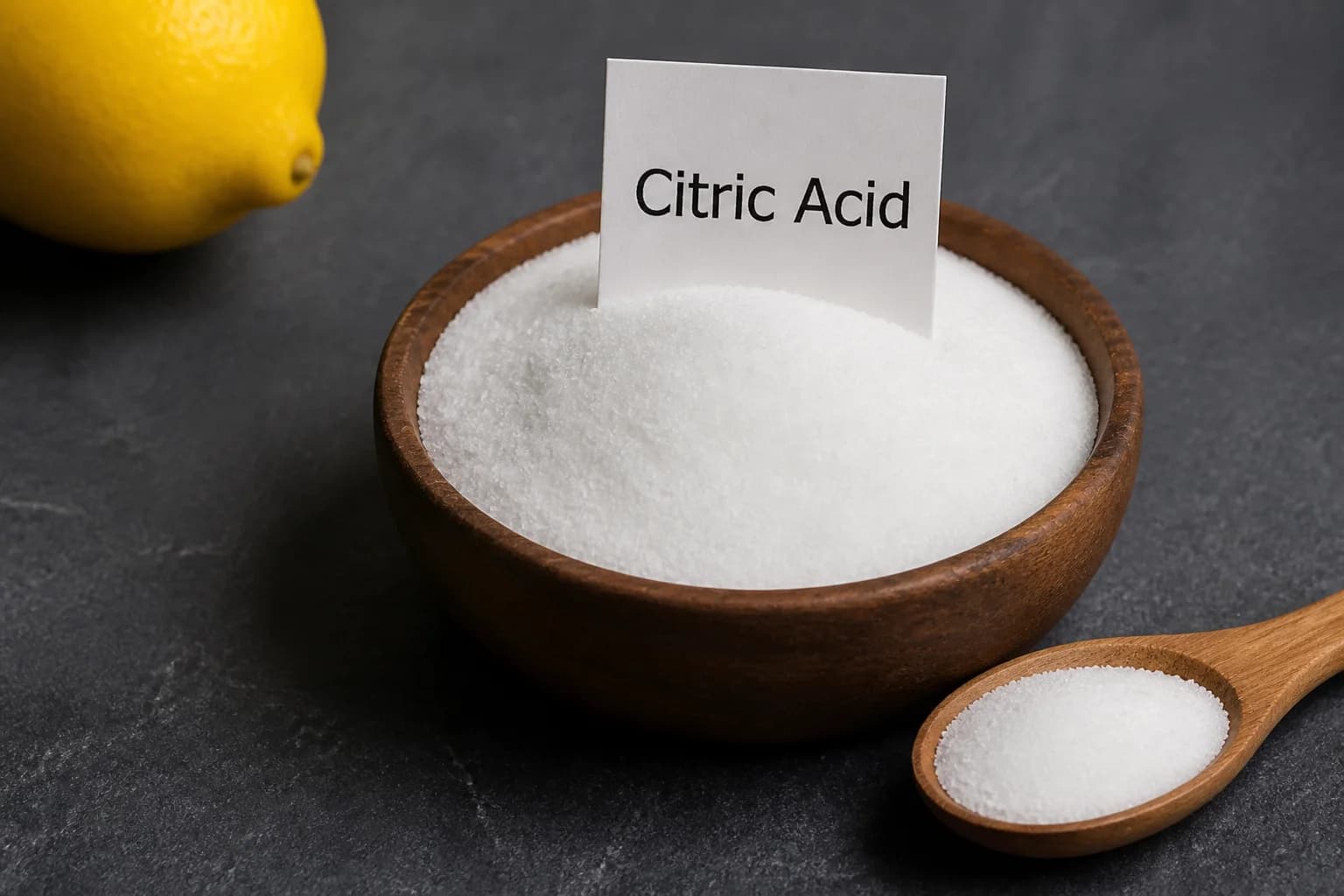
Citric Acid
ELAROMA™TM – CAmHy
Get Pricing For This Product
Need pricing? Request a quote for this product and we'll get back to you shortly.
Speed Up Your Sample Testing Process
Express Delivery in 24–48 Hours
Citric Acid Anhydrous is a naturally occurring weak organic acid extensively used across food, pharmaceutical, cosmetic, and industrial applications. As one of the leading citric acid anhydrous…
CAS Number
5949-29-1
HS Code
29181400
INCI Name
Citric Acid
Molecular Formula
C6H8O7·H2O
Citric Acid
ELAROMA™TM – CAmHy
Citric Acid Anhydrous is a naturally occurring weak organic acid extensively used across food, pharmaceutical, cosmetic, and industrial applications. As one of the leading citric acid anhydrous manufacturers in India, we provide high-quality, pure-grade citric acid that meets…
CAS Number
5949-29-1
INCI Name
Citric Acid
HS Code
29181400
Molecular Formula
C6H8O7·H2O
Get Pricing For This Product
Need pricing? Request a quote for this product and we'll get back to you shortly.
Speed Up Your Sample Testing Process
We deliver domestic samples within 24 - 48 hours, helping you evaluate product without delays.
Product Specification
Physical Properties
| Property | Specification |
|---|---|
| Appearance | White crystalline powder |
| Odor | Odorless |
| Molecular Weight | 210.14 g/mol |
| Density / Specific Gravity | 1.54 g/cm³ |
| Viscosity | Not applicable (solid at room temperature) |
| Refractive Index | n20/D 1.359 |
| Ph (Aqueous Solution) | 1.85 (50g/L at 25°C) ~2.2 (1% solution) 2.2 (0.1 N solution at 25°C) |
| Assay / Purity | ≥99.0% (ACS reagent) 99.5-100.5% (USP Food Grade) ≥98% |
Chemical Properties
| Property | Specification |
|---|---|
| Pka | pKa1: 3.13 pKa2: 4.76 pKa3: 6.4 |
| Ionic Nature | Weak organic acid |
| Incompatibilities | Oxidizing agents, bases, reducing agents, nitrates, metals. |
| Hazardous Decomposition Products | Carbon monoxide, Carbon dioxide. |
Thermal Properties
| Property | Specification |
|---|---|
| Melting Point | 135-152 °C |
| Boiling Point | Decomposes before boiling |
| Flash Point | 173.9 °C / 345 °F |
| Autoignition Temperature | 345 °C / 653 °F 1010 °C |
| Decomposition Temperature | >170 °C |
| Thermal Stability | Stable under normal conditions. Loses water of crystallization when heated to about 40-50 °C. |
Processing Methods & Reference Formulations
A. Basic Liquid Skin Cleanser
A high-foaming, economical skin cleanser formulation.
| Key Ingredients | Indicative Dosage (% w/w) |
|---|---|
| Water | qs to 100.00 |
| Sodium C14-16 Olefin Sulfonate | 25.00 |
| Cocamidopropyl Betaine | 10.00 |
| Cocamide DIPA | 4.00 |
| Sodium Chloride | 0.40 |
| Citric Acid | qs to pH 5.5 |
| Fragrance | qs |
| Preservative | qs |
B. Antibacterial and Anti-Dandruff Shampoo
A shampoo formulation designed for antibacterial and anti-dandruff applications.
| Key Ingredients | Indicative Dosage (% w/w) |
|---|---|
| Hydroxypropyl Guar Hydroxypropyltrimonium Chloride | 0.2 |
| Disodium EDTA | 0.1 |
| Sodium Laureth Sulfate | 17.0 |
| Cocamide Methyl MEA | 1.5 |
| Cocamidopropyl Hydroxysultaine | 3.0 |
| Polyquaternium Salt | 71.5 |
| Avocado Oil PEG-11 Esters | 0.5 |
| Sodium Benzoate | 0.4 |
| Allantoin | 0.1 |
| Hydrolyzed Corn Starch | 3.0 |
| Hexamidine Diisethionate | 0.05 |
| Preservative | 0.6 |
| Conditioner | 2.0 |
| Fragrance | 0.6 |
| Citric Acid | 0.03 |
| Water | Balance |
C. Apple Jam
A standard recipe for apple jam production.
| Key Ingredients | Indicative Dosage (% w/w) |
|---|---|
| Fruit Pulp | 1 kg |
| Sugar | 1 kg |
| Citric Acid | 3 g |
| Pectin (Grade 150 Rapid set) | 12 g |
| Color (Orange red) | 0.2 g |
| Flavor (Apple) | 1 mL |
| Sodium Benzoate | 1 g |
Dosing Guidelines
A. Dosing by Application
| Application | Recommended / Max Dosage |
|---|---|
| Carbonated Soft Drinks | 0.05% – 0.15% |
| Fruit Juices | 0.1% – 0.2% |
| Jams & Jellies | 0.5% - 0.6% |
| Shampoos, Lotions, Deodorants (pH adjustment) | 0.1% – 1.0% |
| Hair Conditioners & Soaps | Up to 2% - 4% |
| Exfoliating Products (as an AHA) | 5% - 10% |
| Bath Bombs | Up to 30% |
| General Purpose Cleaning | 0.1% - 10% |
| Light Descaling / Hard Water Stain Removal | 5% - 7% solution |
| Oral Solution (for Metabolic Acidosis) | 10 to 30 mL of solution (containing citric acid and sodium citrate) after meals and at bedtime, as directed by a physician. |
About Citric Acid
Citric acid (C6H8O7) is the highest-volume organic acid produced worldwide and the most widely used acidulant in the food, beverage and cleaning industries. It functions as a pH regulator, souring agent, antioxidant synergist, chelating/sequestering agent and mild preservative, and is supplied in two interchangeable forms: anhydrous (CAA) and monohydrate (CAM).
Citric acid is sourced globally at a very large scale - the great majority produced by fermentation - and for buyers dependable supply is as much about consistency, mesh size and documentation as chemistry. Citric acid (CAS 77-92-9) is affirmed GRAS by the US FDA under 21 CFR 184.1033 and carries FCC, USP-NF, BP and Ph.Eur. monographs.
Industrial buyers placing bulk orders also keep a close eye on citric acid pricing, since contract rates feed directly into the cost of everything they produce downstream.
Manufacturing Process of Citric Acid
Commercial citric acid is produced almost entirely by submerged fermentation. A carbohydrate feedstock - typically corn glucose syrup, molasses or starch hydrolysate - is fermented by the mould Aspergillus niger under carefully controlled aeration and nutrient limitation, which drives the organism to over-produce citric acid. The fermentation broth is filtered to remove biomass, then the citric acid is recovered, historically by calcium citrate precipitation and sulphuric acid liberation, or by modern solvent extraction / ion exchange. The purified liquor is decolourised over activated carbon, concentrated and crystallised. Crystallising above ~36.6 °C yields the anhydrous form; below it yields the monohydrate.
Citric Acid Price: Bulk Pricing for Industrial Buyers
If you're looking for current citric acid pricing for bulk procurement, Elchemy provides quotes based on your specific requirements. Fill out the quote request form with your volume, grade, destination and packaging preference, and our team will revert with a detailed offer within 24 to 48 hours.
Pricing works on a quote basis rather than a published rate because the cost is driven by the corn/glucose feedstock cost and fermentation energy, plus the balance of Chinese export supply that dominates the global market, rather than tracking a fixed list.
Beyond that, several factors layer in to shape the final number: grade, committed volume, origin country, packaging format, freight, Incoterm choice (FOB, CIF or DDP) and applicable import duty (HTS 2918.14 for US-bound shipments (note: US anti-dumping duties apply to citric acid from certain origins - a key sourcing consideration)).
For an approximate read on where the market sits, procurement teams often reference corn and citric-acid export price indices, which give a sense of how rates are trending.
Trade publications also report the citric acid price per kg as a unit-level benchmark, useful for spotting short-term regional shifts even on large industrial orders.
At bulk procurement scale, however, the citric acid price per ton is the most relevant commercial unit, since contracts are typically negotiated and committed at that level.
For an exact rate, none of these references replaces a direct quote. The actual price depends on your contract structure, destination, committed volume and timing of dispatch, which is why a quote from our team will always be the most accurate number for your specific procurement.
Packaging & Logistics
Citric Acid ships in 25 kg (55 lb) bags, 50 lb bags for the US market, or 1 MT (2,205 lb) FIBC jumbo bags (liquids ship in drums, IBCs or ISO tanks as applicable), supplied as per buyer requirements. A typical 20' container holds approximately 18 to 24 MT depending on packaging.
For US-bound orders, domestic stock supports faster fulfilment. Where sourcing is required from origin countries, transit times typically run 24 to 28 days to the US East Coast and 18 to 22 days to the West Coast. Elchemy offers EXW, FOB, CIF and DDP terms, depending on how your procurement team prefers to handle landed cost and customs.
Material should be stored in a cool, dry, well-ventilated area per the storage conditions on the TDS. Standard dispatch follows agreed contract terms, with expedited timelines available where needed. Samples are dispatched within 24 to 48 hours.
Why Choose Elchemy as a Trusted Citric Acid Supplier?
Elchemy makes citric acid procurement straightforward for industrial buyers. That means consistent material across the grades listed above, with a Certificate of Analysis for every batch and full documentation (TDS, SDS) as standard.
Because we source across multiple origins, we quote on the best landed cost for your destination rather than a single manufacturer's list price. Our partner plants operate to recognised quality standards (ISO 9001, plus food/pharma certifications where relevant), with Halal and Kosher certification available on request.
Beyond the US, Elchemy ships into 40+ countries with samples available for qualification before any bulk order, and pricing tailored to volume, destination and contract terms.
Safety & Handling
Classified under GHS as Eye Irritant Category 2 (H319) and may cause mild respiratory irritation. Not DOT hazmat-regulated for transport.
Citric acid is a food-grade organic acid, GRAS, and non-toxic at use levels. In concentrated form the powder and solutions are mildly irritating to the eyes, skin and respiratory tract, and can etch tooth enamel with repeated direct exposure. Dust may cause mechanical and acidic irritation. It is not a sensitiser at normal exposure. Occupational handling calls for basic dust control and eye protection.
The full 16-section GHS-aligned SDS is available alongside material orders.
- Natural Preservative: Extends shelf life by inhibiting microbial growth.
- Function: Acidulant, pH adjuster, chelating agent, preservative, antioxidant, flavoring agent, exfoliant.
- Flavor Enhancer: Provides a tangy taste to food and beverages.
- Features: Water-soluble, weak organic acid, biodegradable, non-toxic.
- pH Adjuster: Maintains desired acidity levels in various formulations.
- Benefits: Enhances flavor and stability in foods and beverages, improves the efficacy of preservatives, promotes skin cell turnover in cosmetics, and acts as an environmentally friendly cleaning and descaling agent.
- Antioxidant Properties: Protects products from oxidative damage.
- Eco-Friendly Production: Produced with sustainable practices, minimizing environmental impact.
About Citric Acid
Citric acid (C6H8O7) is the highest-volume organic acid produced worldwide and the most widely used acidulant in the food, beverage and cleaning industries. It functions as a pH regulator, souring agent, antioxidant synergist, chelating/sequestering agent and mild preservative, and is supplied in two interchangeable forms: anhydrous (CAA) and monohydrate (CAM).
Citric acid is sourced globally at a very large scale - the great majority produced by fermentation - and for buyers dependable supply is as much about consistency, mesh size and documentation as chemistry. Citric acid (CAS 77-92-9) is affirmed GRAS by the US FDA under 21 CFR 184.1033 and carries FCC, USP-NF, BP and Ph.Eur. monographs.
Industrial buyers placing bulk orders also keep a close eye on citric acid pricing, since contract rates feed directly into the cost of everything they produce downstream.
Manufacturing Process of Citric Acid
Commercial citric acid is produced almost entirely by submerged fermentation. A carbohydrate feedstock - typically corn glucose syrup, molasses or starch hydrolysate - is fermented by the mould Aspergillus niger under carefully controlled aeration and nutrient limitation, which drives the organism to over-produce citric acid. The fermentation broth is filtered to remove biomass, then the citric acid is recovered, historically by calcium citrate precipitation and sulphuric acid liberation, or by modern solvent extraction / ion exchange. The purified liquor is decolourised over activated carbon, concentrated and crystallised. Crystallising above ~36.6 °C yields the anhydrous form; below it yields the monohydrate.
Citric Acid Price: Bulk Pricing for Industrial Buyers
If you're looking for current citric acid pricing for bulk procurement, Elchemy provides quotes based on your specific requirements. Fill out the quote request form with your volume, grade, destination and packaging preference, and our team will revert with a detailed offer within 24 to 48 hours.
Pricing works on a quote basis rather than a published rate because the cost is driven by the corn/glucose feedstock cost and fermentation energy, plus the balance of Chinese export supply that dominates the global market, rather than tracking a fixed list.
Beyond that, several factors layer in to shape the final number: grade, committed volume, origin country, packaging format, freight, Incoterm choice (FOB, CIF or DDP) and applicable import duty (HTS 2918.14 for US-bound shipments (note: US anti-dumping duties apply to citric acid from certain origins - a key sourcing consideration)).
For an approximate read on where the market sits, procurement teams often reference corn and citric-acid export price indices, which give a sense of how rates are trending.
Trade publications also report the citric acid price per kg as a unit-level benchmark, useful for spotting short-term regional shifts even on large industrial orders.
At bulk procurement scale, however, the citric acid price per ton is the most relevant commercial unit, since contracts are typically negotiated and committed at that level.
For an exact rate, none of these references replaces a direct quote. The actual price depends on your contract structure, destination, committed volume and timing of dispatch, which is why a quote from our team will always be the most accurate number for your specific procurement.
Packaging & Logistics
Citric Acid ships in 25 kg (55 lb) bags, 50 lb bags for the US market, or 1 MT (2,205 lb) FIBC jumbo bags (liquids ship in drums, IBCs or ISO tanks as applicable), supplied as per buyer requirements. A typical 20' container holds approximately 18 to 24 MT depending on packaging.
For US-bound orders, domestic stock supports faster fulfilment. Where sourcing is required from origin countries, transit times typically run 24 to 28 days to the US East Coast and 18 to 22 days to the West Coast. Elchemy offers EXW, FOB, CIF and DDP terms, depending on how your procurement team prefers to handle landed cost and customs.
Material should be stored in a cool, dry, well-ventilated area per the storage conditions on the TDS. Standard dispatch follows agreed contract terms, with expedited timelines available where needed. Samples are dispatched within 24 to 48 hours.
Why Choose Elchemy as a Trusted Citric Acid Supplier?
Elchemy makes citric acid procurement straightforward for industrial buyers. That means consistent material across the grades listed above, with a Certificate of Analysis for every batch and full documentation (TDS, SDS) as standard.
Because we source across multiple origins, we quote on the best landed cost for your destination rather than a single manufacturer's list price. Our partner plants operate to recognised quality standards (ISO 9001, plus food/pharma certifications where relevant), with Halal and Kosher certification available on request.
Beyond the US, Elchemy ships into 40+ countries with samples available for qualification before any bulk order, and pricing tailored to volume, destination and contract terms.
Safety & Handling
Classified under GHS as Eye Irritant Category 2 (H319) and may cause mild respiratory irritation. Not DOT hazmat-regulated for transport.
Citric acid is a food-grade organic acid, GRAS, and non-toxic at use levels. In concentrated form the powder and solutions are mildly irritating to the eyes, skin and respiratory tract, and can etch tooth enamel with repeated direct exposure. Dust may cause mechanical and acidic irritation. It is not a sensitiser at normal exposure. Occupational handling calls for basic dust control and eye protection.
The full 16-section GHS-aligned SDS is available alongside material orders.
- Natural Preservative: Extends shelf life by inhibiting microbial growth.
- Function: Acidulant, pH adjuster, chelating agent, preservative, antioxidant, flavoring agent, exfoliant.
- Flavor Enhancer: Provides a tangy taste to food and beverages.
- Features: Water-soluble, weak organic acid, biodegradable, non-toxic.
- pH Adjuster: Maintains desired acidity levels in various formulations.
- Benefits: Enhances flavor and stability in foods and beverages, improves the efficacy of preservatives, promotes skin cell turnover in cosmetics, and acts as an environmentally friendly cleaning and descaling agent.
- Antioxidant Properties: Protects products from oxidative damage.
- Eco-Friendly Production: Produced with sustainable practices, minimizing environmental impact.
Regulatory Compliance
| Region | Max Allowed Level | Notes | Certification Body |
|---|---|---|---|
| United States | - | Affirmed as Generally Recognized as Safe (GRAS) for use in food with no limitations other than GMP. The Cosmetic Ingredient Review (CIR) Expert Panel concluded it is safe in the present practices of use and concentration in cosmetics. | FDA GRAS (for food), TSCA Inventory. |
| European Union | - | Approved for use in cosmetics without restriction according to the general provisions of the Cosmetics Regulation. It is a registered substance under REACH. | REACH registration. |
| Canada | 3% | Listed on the Cosmetic Ingredient Hotlist with restrictions related to its function as an alpha-hydroxy acid in skin products. | Health Canada compliance. |
| India | - | Regulated as a food additive by the Food Safety and Standards Authority of India (FSSAI). Must comply with FSSAI standards for purity. | FSSAI License. |
| Japan | - | Approved for use as a food additive. It is used as a pH adjuster and Vitamin C stabilizer in foods and beverages. | Compliance with Japanese Standards of Food Additives. |
| Australia | - | Permitted as a food additive in a wide range of foods at levels consistent with Good Manufacturing Practice (GMP). | Compliance with Food Standards Australia New Zealand (FSANZ) Code. |
| China | - | Approved as a food additive and is included in the Inventory of Existing Cosmetic Ingredients in China (IECIC). Its use in food must comply with national food safety standard GB 1886.235. | NMPA (for cosmetics), Compliance with GB 1886.235 (for food). |
FAQs - Citric Acid
Related Products


Related Products
Streamline
Your Chemical
Procurement
Get fast responses from real experts