Benzyl Benzoate
ELAROMATM – BZBT
Get Pricing For This Product
Skip the quote. Sign up now and see pricing instantly
Speed Up Your Sample Testing Process
Express Delivery in 24–48 Hours
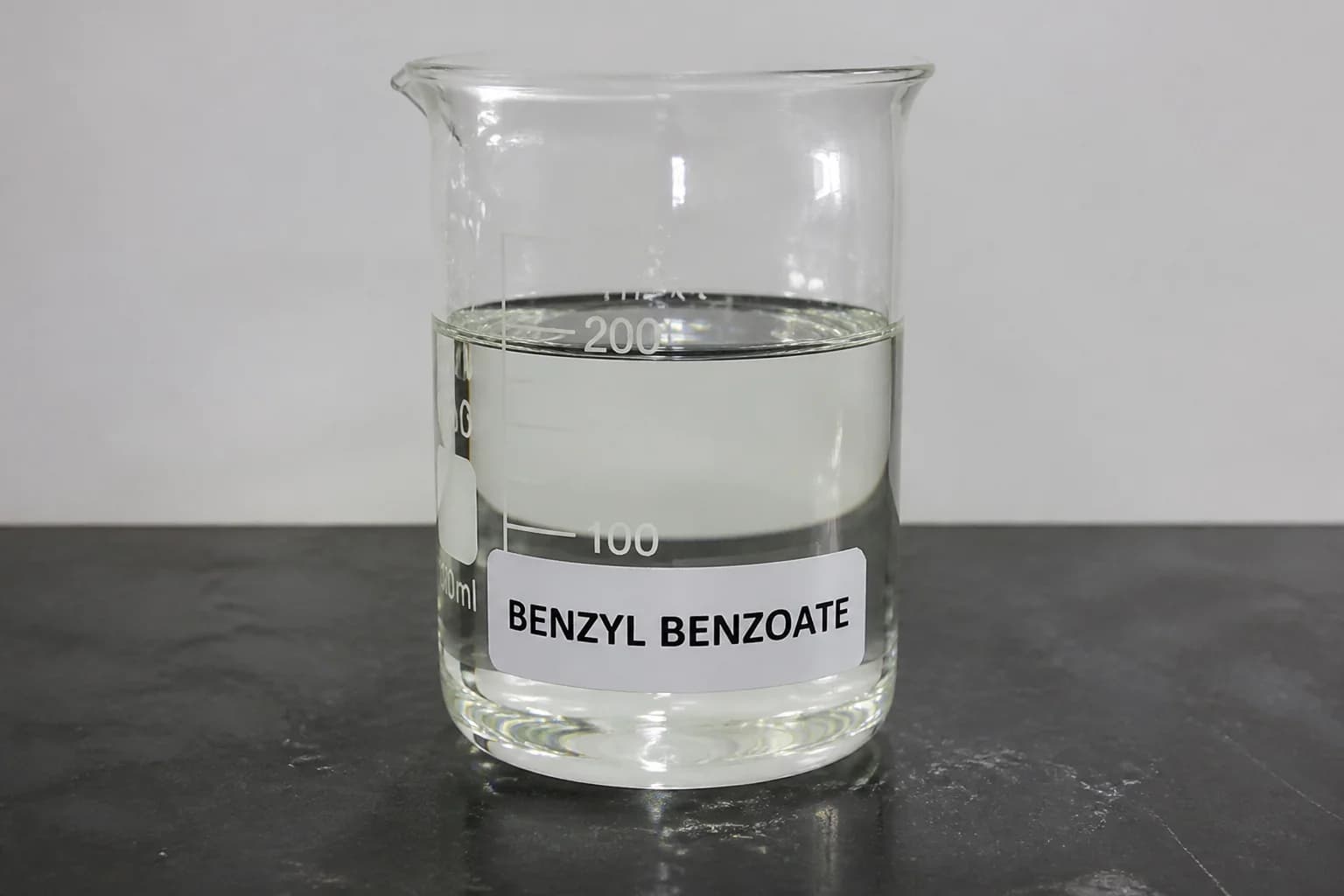
Benzyl Benzoate is an aromatic ester supplied as a clear, colourless to pale-yellow oily liquid with a faint sweet-balsamic odour. It functions as a fragrance fixative & solvent, plasticiser,…
CAS Number
120-51-4
HS Code
29.16.31.20
INCI Name
Benzyl Benzoate
Molecular Formula
C₁₄H₁₂O₂
Benzyl Benzoate
ELAROMATM – BZBT
Benzyl Benzoate is an aromatic ester supplied as a clear, colourless to pale-yellow oily liquid with a faint sweet-balsamic odour. It functions as a fragrance fixative & solvent, plasticiser, acaricide/scabicide active, synthesis intermediate across fragrance & cosmetics,…
CAS Number
120-51-4
INCI Name
Benzyl Benzoate
HS Code
29.16.31.20
Molecular Formula
C₁₄H₁₂O₂
Get Pricing For This Product
Skip the quote. Sign up now and see pricing instantly
Speed Up Your Sample Testing Process
We deliver domestic samples within 24 - 48 hours, helping you evaluate product without delays.
Product Specification
Physical Properties
| Property | Specification |
|---|---|
| Appearance | Colorless liquid |
| Odor | Faint, pleasant, aromatic odor |
| Molecular Weight (G/Mol) | 212.24 |
| Density Or Specific Gravity | 1.1121 g/cu cm at 25 °C |
| Viscosity | 8.292 cP at 25 °C |
| Refractive Index | 1.5680 at 20 °C/D |
Thermal Properties
| Property | Specification |
|---|---|
| Melting Point | 21 °C |
| Boiling Point | 323.5 °C |
| Flash Point | 148 °C |
| Autoignition Temperature | 896 °F (480 °C) |
Processing Methods & Reference Formulations
A. Hair Conditioner
Add during the cool-down phase, to preserve its function as a fragrance fixative and solvent without degrading sensitive ingredients. Pre-mix with fragrance or oil phase, especially in creamy conditioners, to ensure uniform distribution and avoid separation.
| Key Ingredients | Indicative Dosage (% w/w) |
|---|---|
| Water (Aqua) | ~85–90% |
| Behentrimonium Methosulfate + Cetearyl Alcohol | 1–3% |
| Stearyl Alcohol | 1–3% |
| Distearoylethyl Dimonium Chloride + Cetearyl Alcohol | 1–3% |
| Cetyl Alcohol | 0.3–1% |
| Hydrogenated Polydecene | 0.3–1% |
| Cetearyl Alcohol (additional) | 0.3–1% |
| Propanediol | 1–3% |
| PPG-3 Benzyl Ether Ethylhexanoate | 0.3–1% |
| Dicaprylyl Carbonate | 0.10–0.3% |
| Fragrance - contains benzyl benzoate | 0.3–1% |
B. Soap
Add during the fragrance phase, when the soap mixture has cooled to preserve its fixative and fragrance-enhancing properties. Check for heat sensitivity in hot process soaps, as prolonged high heat may slightly reduce its effectiveness or alter fragrance performance.
| Key Ingredients | Indicative Dosage (% w/w) |
|---|---|
| Sodium stearate (soap base) | 40 – 70% |
| Sodium carbonate | 1 – 2% |
| Triethanolamine | 0.1 – 0.2% |
| Benzyl benzoate | 2 – 30% |
| Methyl salicylate | 0.1 – 0.5% |
C. Medicinal lotion
Add during the oil phase if using Benzyl Benzoate as a solvent or fixative, since it is oil-soluble and heat-stable. Blend thoroughly to ensure even distribution, especially if used with essential oils or perfumes in the lotion.
| Key Ingredients | Indicative Dosage (% w/w) |
|---|---|
| Benzyl benzoate | 26–30% |
| Triethanolamine | 0.5% |
| Oleic acid | 2% |
| Purified water | ~70% |
Dosing Guidelines
A. Dosing by Application
| Products | Typical dosage % |
|---|---|
| Fragrance Ingredient | 0.01%–0.5% |
| Cosmetic Products | 0.001%–1% |
About Benzyl Benzoate
Benzyl benzoate (C14H12O2) is a versatile aromatic ester used across fragrance, pharmaceutical and industrial applications. In perfumery it is a fixative and solvent that holds and blends fragrance notes; in pharmaceuticals and veterinary medicine it is the active ingredient in topical treatments for scabies and lice; and industrially it serves as a plasticiser and a synthesis intermediate. Its low volatility, good solvency for fragrance materials and musks, and mild balsamic odour make it a staple perfumery fixative, while its acaricidal action underpins its medical use. It is supplied as technical, cosmetic and pharmaceutical (USP/BP) grades distinguished by purity and odour. Industrial buyers sourcing Benzyl Benzoate in bulk also track benzyl benzoate pricing closely, since it feeds directly into their downstream costs which is why working with an established benzyl benzoate supplier and distributor like Elchemy matters.
- Reliable Preservative: Prevents microbial growth, extending product shelf life.
- High Purity Standards: Ensures effectiveness across food, cosmetic, and pharmaceutical products.
- Eco-Friendly Production: Minimizes environmental impact, aligning with consumer demand.
About Benzyl Benzoate
Benzyl benzoate (C14H12O2) is a versatile aromatic ester used across fragrance, pharmaceutical and industrial applications. In perfumery it is a fixative and solvent that holds and blends fragrance notes; in pharmaceuticals and veterinary medicine it is the active ingredient in topical treatments for scabies and lice; and industrially it serves as a plasticiser and a synthesis intermediate. Its low volatility, good solvency for fragrance materials and musks, and mild balsamic odour make it a staple perfumery fixative, while its acaricidal action underpins its medical use. It is supplied as technical, cosmetic and pharmaceutical (USP/BP) grades distinguished by purity and odour. Industrial buyers sourcing Benzyl Benzoate in bulk also track benzyl benzoate pricing closely, since it feeds directly into their downstream costs which is why working with an established benzyl benzoate supplier and distributor like Elchemy matters.
- Reliable Preservative: Prevents microbial growth, extending product shelf life.
- High Purity Standards: Ensures effectiveness across food, cosmetic, and pharmaceutical products.
- Eco-Friendly Production: Minimizes environmental impact, aligning with consumer demand.
Regulatory Compliance
| Region | Max Allowed Level | Notes | Certification Body |
|---|---|---|---|
| Australia | - | No explicit national restriction; aligns with IFRA and international safety assessments | - |
| China | - | No explicit national restriction, regulated under NMPA, aligns with IFRA for fragrance use | NMPA - National Medical Products Administration |
| Japan | - | No explicit national restriction; generally aligns with IFRA and international safety standards | MHLW – Ministry of Health, Labour and Welfare |
| Republic of Korea | - | No explicit national restriction. | MFDS - Ministry of Food and Drug Safety |
| United States | - | Not on FDA restricted list; industry follows IFRA guidelines and CIR safety assessment. | FDA |
| ASEAN | - | ASEAN Cosmetic Directive references IFRA for fragrance allergens; no explicit limit for benzyl benzoate. | - |
| European Union | - | Must be labeled if >0.001% in leave-on or >0.01% in rinse-off products | - |
FAQs - Benzyl Benzoate
Related Products
Related Products
Streamline
Your Chemical
Procurement
Get fast responses from real experts