

At a Glance
- Choose pea protein isolate for a plant-led route: It can fit plant-based and dairy-free positioning when the approved ingredient, facility controls, and finished label support that route.
- Choose whey for a milk-derived route: It can fit conventional dairy protein products, provided the formula and manufacturing plan account for milk-allergen requirements.
- Do not buy on protein percentage alone: Compare current COAs, amino-acid data, sensory results, microbiological limits, contaminant controls, and total cost per usable gram of protein.
- Treat formulation performance as product-specific: Flavor, foam, viscosity, sediment, and texture depend on the supplier grade and the complete formula.
- Use a five-gate approval process: Positioning, nutrition, formulation, quality, and commercial fit should all pass before a protein ingredient is approved.
What you’ll learn
This guide helps supplement procurement and formulation teams compare pea protein isolate and whey protein using the criteria that affect a real buying decision: label position, nutrition design, sensory performance, quality documentation, and approved landed cost.
Introduction
Pea protein isolate and whey protein can both support a credible supplement product. The buying decision becomes difficult when a brand must translate a broad protein choice into a finished powder, ready-to-mix beverage, meal replacement, or bar that meets its label promise, sensory target, quality plan, and margin requirements.
The right option depends on the product brief. A brand pursuing a plant-based route may begin by evaluating Elchemy’s pea protein isolate, while a dairy-based product may shortlist whey grades that fit its protein target and allergen controls. Neither route is automatically better. The useful question is which approved ingredient can deliver the required finished-product performance with defensible documentation and a workable commercial model.
Pea protein isolate vs whey protein: the buyer comparison
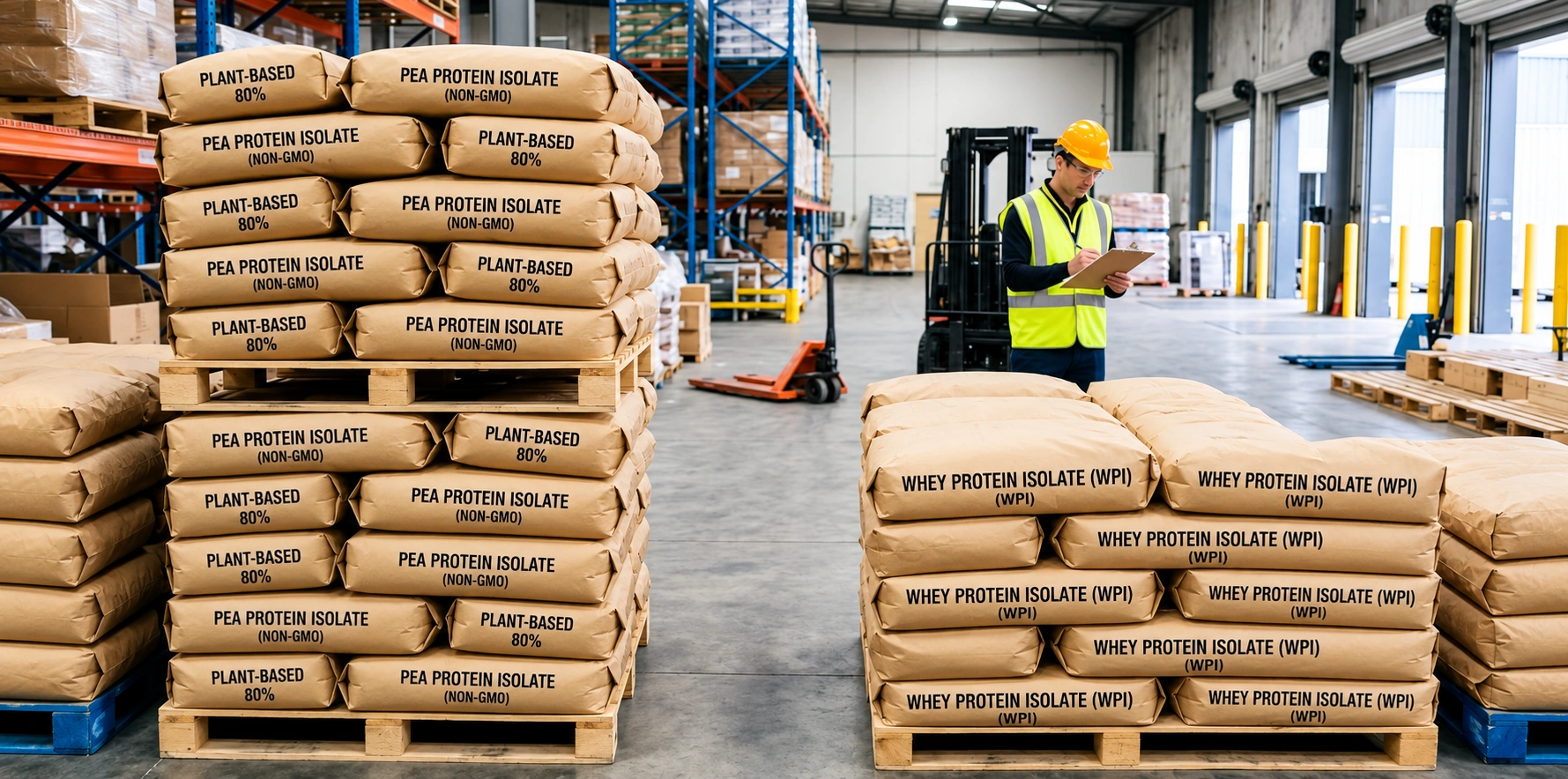
Pea protein isolate and whey protein serve different product-positioning routes, but both should face the same technical and commercial approval criteria. A supplier brochure or a generic nutrition comparison cannot establish whether either ingredient will work in a specific formula.
The most useful comparison starts with source, documentation, allergen controls, formulation behavior, and cost. It then moves to supplier-specific data and finished-product trials.
| Buying criterion | Pea protein isolate | Whey protein | Buyer action |
| Source route | Plant-derived protein, commonly produced from yellow peas | Milk-derived protein ingredient | Confirm source, process description, and country of origin in current documents. |
| Product positioning | Can fit plant-based or dairy-free positioning | Fits dairy-derived protein positioning | Define the intended consumer and label route before sampling. |
| Protein declaration | Varies by supplier grade and lot | Varies by whey form and supplier grade | Compare protein on the same documented basis. |
| Amino-acid profile | Requires supplier-specific amino-acid data | Requires supplier-specific amino-acid data | Review the planned serving with R&D and regulatory teams. |
| Allergen position | Milk is absent by source, but cross-contact must be checked | Milk-allergen controls are required | Obtain an allergen statement and facility-control information. |
| Sensory direction | May bring vegetal, earthy, bitter, or dry notes | May bring dairy notes and foam considerations | Run blinded trials in the intended flavor system. |
| Dispersion and texture | Depends on particle properties and formula design | Depends on whey type and formula design | Test wetting, mix time, foam, viscosity, and sediment. |
| Quality package | Requires identity, micro, contaminant, and traceability evidence | Requires identity, micro, contaminant, and traceability evidence | Set acceptance limits before commercial approval. |
| Commercial comparison | Assess total delivered protein cost and formulation adjustments | Assess total delivered protein cost and formulation adjustments | Compare total approved cost per usable gram of protein. |
Start with the product position, not the protein trend
The product brief should decide which protein route enters development. Choosing pea because plant protein is popular, or choosing whey because it is familiar to sports-nutrition buyers, creates avoidable reformulation work if the ingredient does not fit the finished product.
A plant-based positioning route may favor pea protein isolate, but the team still needs to confirm label language, allergen controls, sensory acceptance, and finished-product nutrition. A dairy protein route may favor whey, but milk-allergen declarations, supply documentation, and product positioning must be clear from the start.
Use the following questions before requesting commercial samples.
| Product-brief question | Approval criterion |
| Who is the target consumer? | The audience and dietary exclusions are documented. |
| What is the product format? | Powder, beverage, bar, or meal replacement is defined. |
| What protein level is required? | The target serving is approved by nutrition and R&D teams. |
| Which claims are being considered? | Intended claims have regulatory review. |
| Which allergens are acceptable? | The brand’s allergen policy is documented. |
| What cost range is workable? | Target cost and margin are approved internally. |
A protein source does not establish a “clean,” “better digestion,” or “high-performance” claim by itself. Those outcomes depend on the approved grade, the complete formulation, the intended serving, and the evidence behind the finished-product language.
Compare the nutrition package using supplier documents
The purchase decision should use supplier-specific protein and amino-acid information, not a generic chart copied from a consumer article. Protein levels can vary by ingredient form, production route, moisture basis, and lot specification.
Start with the current product specification and lot COA. Then request an amino-acid profile that allows the nutrition and regulatory teams to calculate what the proposed serving contributes. If the product concept relies on protein quality, essential amino acids, or a performance-oriented message, that review should happen before label copy is approved.
Peer-reviewed research can provide useful context. A randomized study of resistance-trained participants compared pea protein, whey protein, and placebo during an eight-week protocol. It found that pea protein supplementation supported muscle-thickness gains compared with placebo, with results that were not statistically different from whey in that study population. The study does not prove that every pea or whey ingredient, serving size, or finished supplement will perform the same way. Use it as context, not as a finished-product claim. Read the published trial.
For buyers, the practical test is simpler: can the approved ingredient, at the intended inclusion rate, support the product’s nutrition target and label strategy?
Formulation differences that affect the finished supplement
Formulation performance should decide the final ingredient choice when both protein routes fit the product brief. Two grades described with similar protein numbers can behave very differently in a vanilla powder, chocolate shake, high-protein beverage, or bar.
The team should test approved samples in the intended product system, using the same serving size, mixing conditions, flavor system, and storage observations. Testing a plain protein slurry can screen candidates, but it cannot replace a trial in the actual formula.
Flavor and aroma
Pea protein isolate often requires a different flavor strategy from whey because its base notes can be more vegetal, earthy, bitter, or drying depending on the grade and formula. Whey can introduce dairy notes and may change the perception of sweeteners, cocoa, vanilla, and cream flavors.
Run a blinded evaluation that records initial flavor, lingering notes, mouthfeel, sweetness interaction, and consumer-panel acceptance where available. A grade that works in a strongly flavored chocolate powder may not work in a lightly flavored vanilla or unflavored product.
When the formula includes a high-intensity sweetener, the team should evaluate the full system instead of approving the sweetener and protein separately. Elchemy’s sports nutrition sweetener formulation guide can help teams assess one common sweetness route in this type of formula.
Dispersion, foam, viscosity, and sediment
Neither protein can be approved based on a claim of “good solubility” alone. Dispersion depends on particle characteristics, fat level, pH, liquid temperature, sweeteners, gums, emulsifiers, mixing equipment, and the amount of protein per serving.
Use a fixed protocol for each sample:
- Use the same protein dose and liquid volume.
- Use the same shaker, blender, or processing equipment.
- Record mixing time and visible clumping.
- Measure foam immediately after mixing and after a fixed rest period.
- Observe sediment, viscosity, grittiness, and re-dispersion.
- Repeat after short-term storage or stability exposure appropriate to the product format.
For powders and meal replacements, carbohydrate carriers can also change scoop flow, dispersion, sweetness, and texture. Review maltodextrin in sports nutrition only when it is relevant to the proposed formula.
Format-specific decision points
A protein that passes in one format may fail in another. The following table should guide sample trials.
| Format | Pea protein isolate evaluation | Whey protein evaluation | Required result |
| Flavored powder | Check masking needs, dry mouthfeel, sediment, and scoop flow. | Check dairy notes, foam, mix time, and scoop flow. | Product meets sensory and reconstitution targets. |
| Ready-to-mix beverage | Check suspension, viscosity, settling, and process response. | Check foam, heat response, viscosity, and settling. | Product remains acceptable through planned shelf-life testing. |
| Protein bar | Check firmness, water activity interaction, and texture drift. | Check firmness, dairy compatibility, and texture drift. | Product meets texture and shelf-life targets. |
| Meal replacement | Check compatibility with fats, fibers, vitamins, and gums. | Check compatibility with fats, fibers, vitamins, and gums. | Formula meets nutrition, sensory, and processing targets. |
Allergen, quality, and compliance controls
Quality qualification should be as rigorous for pea protein as it is for whey protein. The two routes present different questions, but neither should move into production without a defined supplier package and finished-product controls.
Milk is a major food allergen under FDA labeling requirements. That makes whey a clear allergen-management consideration for U.S. supplement brands. Pea protein does not contain milk by source, but it should not be described as allergen-free unless the supplier’s allergen statement, cross-contact controls, and finished-product review support that exact wording. FDA guidance also highlights the importance of preventing allergen cross-contact and undeclared allergens in manufacturing and packaging. Review FDA allergen information.
Ask suppliers for the following records before commercial approval.
| Document or test | Why it matters | Acceptance owner |
| Current product specification | Defines the approved ingredient. | Procurement and QA |
| Lot COA | Confirms the supplied lot meets agreed limits. | QA |
| Amino-acid profile | Supports serving and nutrition review. | R&D and regulatory |
| Allergen statement | Supports formula, label, and cross-contact review. | QA and regulatory |
| Microbiological data | Supports ingredient-risk assessment. | QA |
| Contaminant-control plan | Shows how relevant hazards are managed. | QA and supplier quality |
| Country-of-origin statement | Supports traceability and commercial planning. | Procurement |
| Change-control policy | Prevents unreviewed material changes. | QA and procurement |
| Commercial sample lot | Enables formula and sensory validation. | R&D |
| Quote and supply terms | Supports cost and continuity evaluation. | Procurement |
Finished dietary supplements have their own manufacturing and control responsibilities. Ingredient documentation supports raw-material qualification, but it does not replace the finished-product controls required under applicable dietary supplement CGMP expectations. FDA’s dietary supplement CGMP resource is a useful starting point for the internal review.
A buyer building a complete supplier-approval process can also use Elchemy’s guidance on reliable supplement supplier selection. The specific acceptance criteria should still be set by the brand’s quality and regulatory teams.
Calculate total approved cost per usable gram of protein
The lowest quoted price per kilogram is not always the lower-cost protein route. A less expensive ingredient can become more expensive if it requires extra flavor masking, changes the serving size, creates unacceptable sediment, or increases testing and rework.
Use a total-cost calculation that reflects the approved formula:
Total approved cost per usable gram of protein =
(landed ingredient cost + formula-correction cost + required testing cost + expected waste cost) ÷ verified grams of protein delivered in approved finished-product yield
The calculation should use protein values from approved supplier documentation. It should also include freight, duties where applicable, minimum order quantity, formula adjustments, qualification testing, expected loss, and commercial terms that affect the actual buying decision.
Do not publish assumed market prices for pea or whey without a dated, like-for-like commercial basis. Pricing depends on the grade, specification, purchase volume, delivery location, and supply terms.
Use a five-gate decision framework
A supplement brand should approve the protein that passes every relevant gate for the product. This approach prevents one attractive attribute, such as plant positioning or a low quote, from outweighing an unacceptable formulation or quality risk.
| Gate | Approval question | Evidence required |
| Positioning | Does the source fit the target product and consumer route? | Signed product brief and label review |
| Nutrition | Does the approved grade support the intended serving and claims strategy? | COA, amino-acid profile, formula calculation |
| Formulation | Does the sample meet sensory and physical targets? | Trial protocol and recorded results |
| Quality | Can the supplier meet defined safety and traceability requirements? | Supplier quality package and QA approval |
| Commercial | Does the route meet cost and continuity needs? | Quote, landed-cost model, MOQ, and supply review |
Choose pea protein isolate when the product requires a plant-derived or dairy-free route and the approved grade passes the nutrition, sensory, quality, and commercial gates. Choose whey when a milk-derived protein fits the positioning and the formula can meet the required allergen, sensory, and supply controls.
For brands using a contract manufacturer, the ingredient decision should also align with the manufacturer’s capabilities, quality system, and batch-size requirements. Elchemy’s private-label supplement manufacturing guide provides useful context for that production route.
Frequently asked questions
1. Is pea protein isolate better than whey protein for a supplement brand?
No. The better option is the one that fits the finished product’s positioning, required serving, sensory target, allergen policy, quality requirements, and cost model. Pea may suit a plant-based route, while whey may suit a dairy protein route. Both require supplier qualification and formulation testing.
2. Is pea protein isolate suitable for a dairy-free protein powder?
Yes, pea protein isolate can be a candidate for a dairy-free powder because it is pea-derived. The brand should still verify the supplier’s allergen statement, facility cross-contact controls, flavor-system compatibility, and the final label. A dairy-free claim applies to the finished product, not only its primary protein source.
3. Does whey protein require milk-allergen controls?
Yes. Whey is milk-derived, and milk is a major food allergen under U.S. food labeling requirements. The brand and manufacturer should assess ingredient declarations, potential cross-contact, cleaning validation, finished-product labeling, and the controls required by the manufacturing site before commercial release.
4. Should buyers compare pea and whey by protein percentage alone?
No. Protein percentage is only one input. Buyers should compare the same measurement basis, supplier amino-acid data, expected grams of protein per serving, formulation yield, sensory corrections, micro and contaminant controls, MOQ, freight, and landed cost. This creates a more useful approval decision than a price-per-kilogram comparison.
5. Which protein is easier to formulate?
Neither protein is universally easier to formulate because performance depends on the grade and finished system. Pea may require more work on vegetal notes, dryness, or sediment in some formulas. Whey may require management of dairy notes, foam, and milk-allergen controls. Side-by-side formula trials provide the answer.
6. Can a supplier COA replace finished-product testing?
No. A COA supports raw-material qualification for a specific lot. The finished supplement still needs the controls appropriate to its formula, process, packaging, shelf life, allergens, microbiological risks, and label claims. Ingredient compliance evidence and finished-product verification have different roles in the quality system.
Choose the protein that passes your product brief
Pea protein isolate and whey protein are not interchangeable purchase decisions. Each can be the right choice when it matches the product position and passes the same nutrition, formulation, quality, and commercial evaluation.
For a plant-protein supplement route, start with a supplier sample and current documentation rather than broad category claims. Request a quote for Pea Protein Isolate to begin a formulation and qualification review.