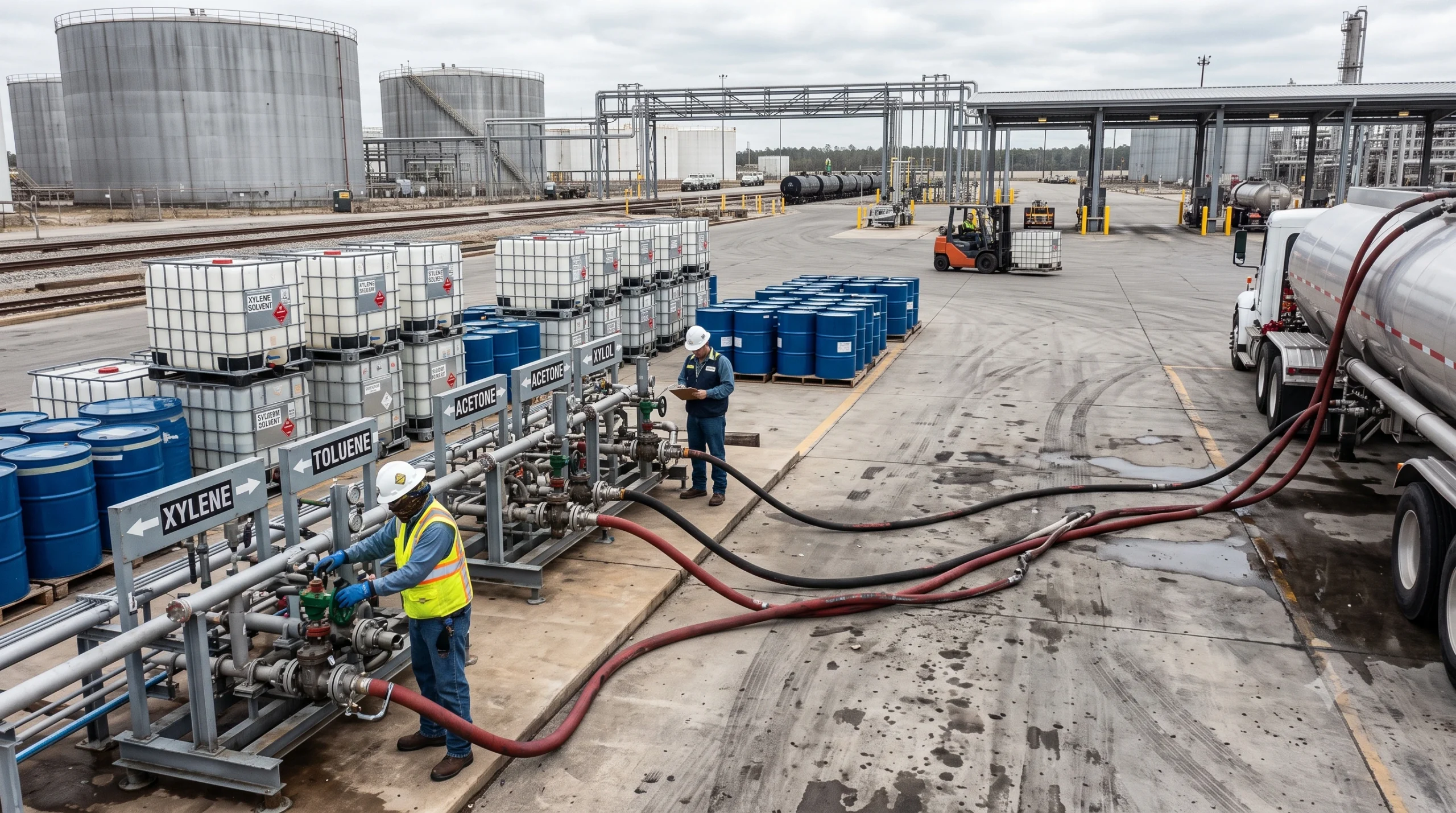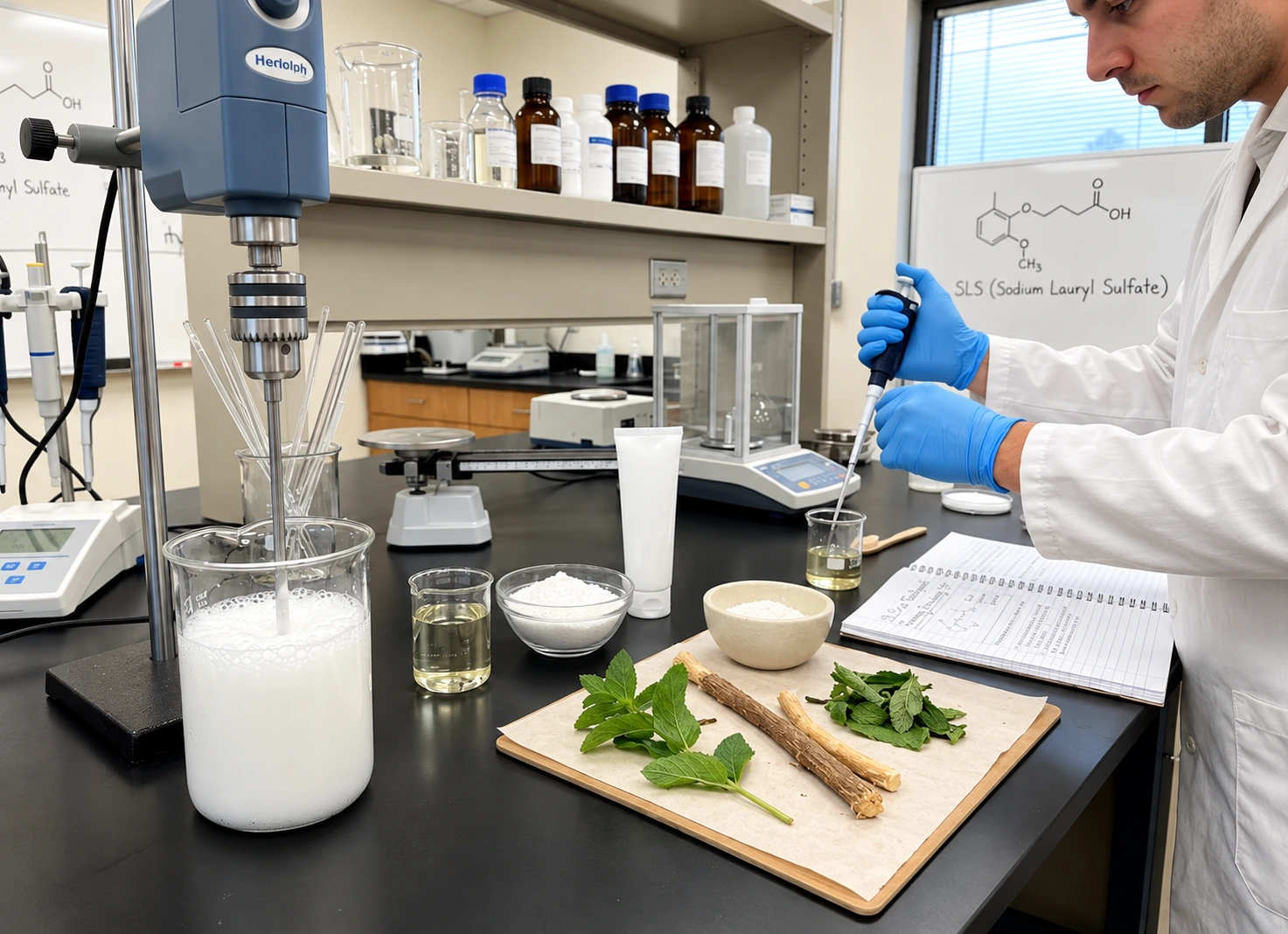


At a Glance
- SLS is a surfactant: Sodium lauryl sulfate helps toothpaste disperse during brushing and contributes to foaming behaviour.
- Its role is system-dependent: Foam, flavour release, texture, active compatibility, and oral feel must be assessed in the finished formula.
- More foam is not automatically better: Foam can influence product experience, but it is not a standalone measure of toothpaste performance.
- SLS-free is not a universal upgrade: Removing SLS changes the surfactant system and requires fresh evaluation of stability, sensory performance, and claims.
- Oral tolerance needs careful language: Some evidence suggests that people with recurrent aphthous ulcers may benefit from SLS-free dentifrice, but this does not support a universal health claim.
- Validation comes before positioning: Select the surfactant system against a defined product brief, then test the finished toothpaste appropriately.
What you’ll learn
This guide explains how SLS functions in toothpaste, when oral-care teams may assess alternatives, and which questions should be resolved before making ingredient or finished-product claims.
Introduction
Sodium lauryl sulfate, commonly called SLS, is an anionic surfactant used in many toothpastes to support dispersion and foaming during brushing. For an oral-care developer, the more useful question is not whether SLS is simply good or bad. It is whether the surfactant system delivers the intended performance, sensory profile, and oral-tolerance outcome for the finished toothpaste.
That distinction matters because SLS affects one part of a complex formula that may also include abrasives, humectants, binders, flavour systems, active ingredients, sweeteners, preservatives, and water. Teams evaluating a raw material can begin with Elchemy’s sodium lauryl sulphate product details, then assess the ingredient against their own formula, target market, and claims strategy.
This article is written for formulators, R&D teams, and technical buyers. It is not dental, medical, toxicological, or regulatory advice.
What does SLS do in toothpaste?
SLS is an anionic surfactant that helps lower surface tension and contributes to wetting, dispersion, and foam generation in toothpaste. It is also called sodium dodecyl sulfate, so formulation records and supplier documents may use either name.
In a toothpaste system, SLS can help distribute the product through the oral cavity during brushing and contribute to the familiar foaming experience many users expect. However, the effect of SLS cannot be separated completely from the rest of the formula. Abrasive selection, humectant balance, flavour load, binder system, active ingredients, water content, and processing conditions all influence the finished product.
A raw-material review should therefore begin with current supplier information, including SLS technical documentation, but it should not end there. Finished-product testing is needed to establish how the selected surfactant system behaves in the actual toothpaste.
Why formulators use SLS in dentifrice systems
Formulators may use SLS when the product brief calls for an anionic surfactant that contributes to a recognisable foaming and cleansing profile. The decision should be based on the whole dentifrice system, rather than on a generic claim about one ingredient.
Foam and product experience
Foam can influence how consumers perceive spread, freshness, and cleaning during brushing. That makes foam a meaningful sensory variable, even though high foam alone does not prove superior cleaning or oral-health performance.
The formulation team should define the target foam profile early. A high-foam profile, a controlled-foam profile, and a low-foam profile can all be valid product directions when they align with the intended user, product position, and substantiation plan. Elchemy’s SLS application overview provides broader context on the ingredient beyond toothpaste.
Dispersion and processing behaviour
The surfactant system can affect ingredient dispersion and processing behaviour, so it should be assessed in both bench work and scale-up trials. A formula that appears acceptable in a small batch may show different rheology, aeration, flavour behaviour, or filling characteristics at larger scale.
For this reason, formulators should document process observations alongside finished-product properties. The useful question is not only whether the product foams, but whether the formula remains stable, manufacturable, and consistent within the chosen operating window.
What are the formulation trade-offs of SLS?
SLS may support a desired foam and cleansing profile, while another surfactant direction may better fit a low-foam, tolerance-focused, or differently positioned toothpaste. Neither outcome is automatically better without a product brief and finished-product evidence.
The American Dental Association notes that sodium lauryl sulfate is among toothpaste ingredients reported as allergens or contact irritants. That is a reason to assess user tolerance and product claims carefully, not a reason to make a blanket safety judgment about every SLS-containing toothpaste. ADA toothpaste guidance
| Formulation question | SLS-containing system | Alternative-system question |
| Foam profile | Does the foam match the intended sensory brief? | Can the desired foam profile be achieved without SLS? |
| Cleaning and dispersion | Does the complete formula meet its performance targets? | Does the revised system retain required performance? |
| Oral tolerance | Has the finished toothpaste been evaluated for intended users? | Does the new system address the stated tolerance objective? |
| Stability and processing | Are viscosity and process behaviour acceptable? | Does the change introduce a stability or scale-up risk? |
| Claims support | Are product claims supported by finished-product evidence? | Does an SLS-free claim require additional review? |
Formulators should use this table as a review framework, not as a substitute for testing. The same formula can perform differently when the surfactant system, abrasive loading, flavour system, or processing method changes.
When should a toothpaste developer consider alternatives?
A developer should assess alternatives when the product brief, target-user feedback, oral-tolerance objective, or brand positioning calls for a different balance of foam, mildness, and processing behaviour. The decision should begin with a clear reason for changing the system, rather than an assumption that every SLS-free formula is inherently preferable.
SLES and cocamidopropyl betaine, commonly called CAPB, are distinct surfactants with different chemistry and formulation behaviour. They should not be treated as interchangeable labels or as automatic drop-in replacements for SLS.
For a surfactant-system review, formulators can examine cocamidopropyl betaine product information and sodium laureth sulphate product information as adjacent raw-material references. Each candidate still needs to be assessed within the complete toothpaste formula, using the same performance and safety review process.
Compare surfactant directions on the same criteria
The most useful choice is the surfactant system that meets the finished-product brief and validation requirements. A comparison based only on an ingredient’s reputation, consumer trend, or raw-material price can overlook compatibility, process, sensory, and claims risks.
| System direction | Why a formulator may assess it | Validation priority |
| SLS-containing system | Targeting a conventional foaming and dispersing profile | Sensory, stability, compatibility, and oral-tolerance review |
| SLES-containing system | Assessing a different anionic-surfactant profile | Foam, formula compatibility, and claims review |
| CAPB-containing system | Assessing a different surfactant contribution or co-surfactant route | System compatibility, oral tolerance, and finished-product performance |
| No added surfactant | Targeting a low-foam or surfactant-minimised concept | Product dispersion, user experience, and cleaning validation |
Use a conditional formulation framework. Choose an SLS-containing system when it meets the desired product profile and validation requirements. Assess another direction when the brief prioritises a different foam profile, user experience, tolerance objective, or ingredient-positioning strategy.
The wider formulation context also matters. Teams developing toothpaste alongside other personal-care products can use Elchemy’s personal care ingredient sourcing page to explore the broader category, while maintaining a separate oral-care validation plan.
How to validate a toothpaste surfactant decision
A surfactant decision should be validated in the finished toothpaste through technical, sensory, quality, safety, regulatory, and claims review. Raw-material data provides important input, but it cannot establish finished-product suitability by itself.
A practical development sequence is:
- Define the product brief. Record the intended user, market, product position, target foam profile, and required claims.
- Set non-negotiable criteria. Identify stability, sensory, manufacturing, oral-tolerance, and regulatory requirements.
- Review ingredient documentation. Obtain current specifications, technical information, safety information, and quality documents from suppliers.
- Build controlled prototypes. Compare surfactant directions under equivalent formulation and processing conditions.
- Assess finished-product properties. Review appearance, rheology, dispensing, foam, flavour, stability, and manufacturing behaviour.
- Complete appropriate safety and claims review. Use qualified internal or external reviewers for the intended market and claim set.
- Document the selected system. Record the formulation rationale, approved raw materials, testing record, and change-control requirements.
Supplier documentation is part of this process. Elchemy’s SLS safety documentation can support raw-material review, but it does not replace a safety assessment of the finished toothpaste.
What does the evidence say about oral tolerance?
Evidence supports a careful, population-specific discussion rather than a universal consumer-health claim. In particular, the question is relevant for people with recurrent aphthous stomatitis, often called recurrent mouth ulcers or canker sores.
A 2019 systematic review included four crossover trials involving 124 participants and found a consistent direction favouring SLS-free dentifrice for measured ulcer outcomes. The authors also stated that better-designed research was needed. Systematic review of SLS-free dentifrice
A 2022 scoping review similarly described limited evidence that people with recurrent aphthous ulcers may benefit from SLS-free toothpaste, while calling for further research. Scoping review of toothpaste SLS effects
For formulators, the practical implication is clear: do not overstate the evidence. A tolerance-focused toothpaste concept should be evaluated with appropriate clinical, claims, regulatory, and dental review for the intended market and user group.
Questions formulators should answer before removing SLS
Removing SLS should be treated as a formulation project, not a label-editing exercise. It may change foam, flavour expression, dispersibility, texture, process robustness, consumer perception, and the evidence needed to support finished-product positioning.
Before approving a reformulation, the team should answer these questions:
- What specific product objective is driving the change?
- Which performance attributes must remain unchanged?
- Which attributes are allowed to change?
- What oral-tolerance, claims, or regulatory review is required?
- Which alternative surfactant system is technically plausible?
- How will bench, pilot, and commercial-scale performance be compared?
- What supplier documents are required for each candidate raw material?
- What change-control process applies if the selected surfactant system changes later?
If material testing is part of the approved development route, teams can use Elchemy’s request oral care samples page to begin a product-evaluation discussion.
FAQs
What does SLS do in toothpaste?
SLS acts as an anionic surfactant that contributes to wetting, dispersion, and foam generation during brushing. In a finished toothpaste, its effect depends on the entire formula, including abrasives, humectants, binders, flavour, active ingredients, water content, and processing conditions. It should not be evaluated in isolation.
Is sodium lauryl sulfate the same as sodium dodecyl sulfate?
Yes. Sodium lauryl sulfate and sodium dodecyl sulfate are names used for the same ingredient, commonly abbreviated as SLS. Formulators should still check the supplier’s current specification, product form, and documentation rather than assuming that materials from different sources have identical characteristics or handling requirements.
Does foam prove that toothpaste cleans better?
No. Foam can influence the sensory experience of brushing and help distribute toothpaste, but it is not a standalone proof of cleaning or oral-health performance. Cleaning performance depends on the finished formula, brushing behaviour, abrasive system, active ingredients, and the evidence used to substantiate any product claims.
Is SLS-free toothpaste always better?
No. An SLS-free toothpaste may be appropriate for a particular tolerance goal, sensory profile, or brand position, but it is not universally better. Removing SLS changes the surfactant system and may affect foam, texture, flavour, stability, manufacturing, and claims. The revised formula needs its own validation.
Can CAPB replace SLS in toothpaste?
CAPB may be assessed as part of an alternative surfactant system, but it should not be described as a universal drop-in replacement for SLS. Its suitability depends on the product brief and complete formula. Compare prototypes against the same technical, sensory, stability, safety, and claims criteria before selecting a system.
What documents should an oral-care formulator request for SLS?
Request current raw-material documentation appropriate to your quality system, such as a technical data sheet, safety data sheet, specification, certificate of analysis format, and traceability information. Additional documents may be needed depending on the target market, customer requirements, product claims, and internal regulatory or quality procedures.
What should be tested when removing SLS from a toothpaste formula?
Test the finished product, not only the replacement ingredient. Relevant work may include stability, rheology, dispensing, foam, flavour, sensory perception, process behaviour, compatibility, safety review, and claims substantiation. The exact test plan should be defined by the intended market, formula, product profile, and quality system.
Can a toothpaste make an SLS-free claim without further review?
An SLS-free claim should be reviewed against the formula, manufacturing controls, applicable labelling rules, and the target market’s claims requirements. The claim may be simple in appearance, but it can affect ingredient controls, communication, and consumer expectations. Obtain suitable regulatory and claims approval before publication.
Build the surfactant system around the product brief
SLS can be a useful component of a toothpaste surfactant system when its performance profile fits the product brief. It is not a universal answer, and neither is removing it. The stronger development decision comes from defining the desired product experience, comparing technically plausible systems, and validating the finished formula.
Start with current raw-material documentation, then use controlled prototype work and appropriate technical review to make the decision. When you are ready to evaluate raw-material options, review sodium lauryl sulphate details against your toothpaste specification and development plan.