

At a Glance
- The best phthalic anhydride supplier is the one that can meet an approved specification, documentation need, delivery route, and application requirement on the same quoted basis.
- PA flakes and molten PA require different storage, transport, unloading, and receiving arrangements, so they should not be compared as identical offers.
- A manufacturer, authorised distributor, and sourcing partner provide different traceability and commercial pathways. Confirm the counterparty’s role before approval.
- There is no universal bulk PA price. Product form, origin, quantity, packaging, freight, delivery term, and quote validity all affect the delivered-cost comparison.
- India-manufacturer sourcing needs verification of the producer identity, origin, and documents for every offer.
What you’ll learn
This guide helps procurement and technical teams evaluate bulk PA offers and compare PA flakes quotes fairly for India or US delivery.
Introduction
Searching for phthalic anhydride suppliers produces manufacturer pages, distributor listings, laboratory offers, and price-led marketplaces. Those results do not establish that a product is the right form, specification, origin, or delivery route for an industrial order.
Phthalic anhydride, commonly called PA, is an industrial chemical intermediate with uses in resin, plasticizer, pigment, and related chemical manufacturing. For a buyer, the central question is not simply who sells PA. It is which technically comparable offer can support the required material, evidence, logistics, and commercial terms.
What is phthalic anhydride?
Phthalic anhydride is an organic chemical intermediate with CAS number 85-44-9. It is commonly supplied in solid flake form or, for compatible industrial systems, as molten material. The US EPA’s phthalic anhydride risk-evaluation page provides current US regulatory context and identifies industrial-use settings.
For purchasing purposes, the chemical name is only the starting point. The buyer must also define the physical form, quality limits, intended application, documents, packaging, delivery destination, and acceptance process. That turns a generic material request into a quote that can be compared and qualified.
What is phthalic anhydride used for?
Phthalic anhydride is used as an intermediate in plasticizer routes, alkyd resins and coatings, unsaturated polyester resins, dyes, pigments, and other chemical applications. The relevant quality discussion depends on the specific process.
This is why PA applications drive pricing. A buyer’s approved specification, required documents, physical form, and delivery constraints can change the sourcing route and the total delivered cost. A price comparison is meaningful only after those application-linked requirements have been aligned.
What you are buying: PA flakes, molten PA, and technical-grade terminology
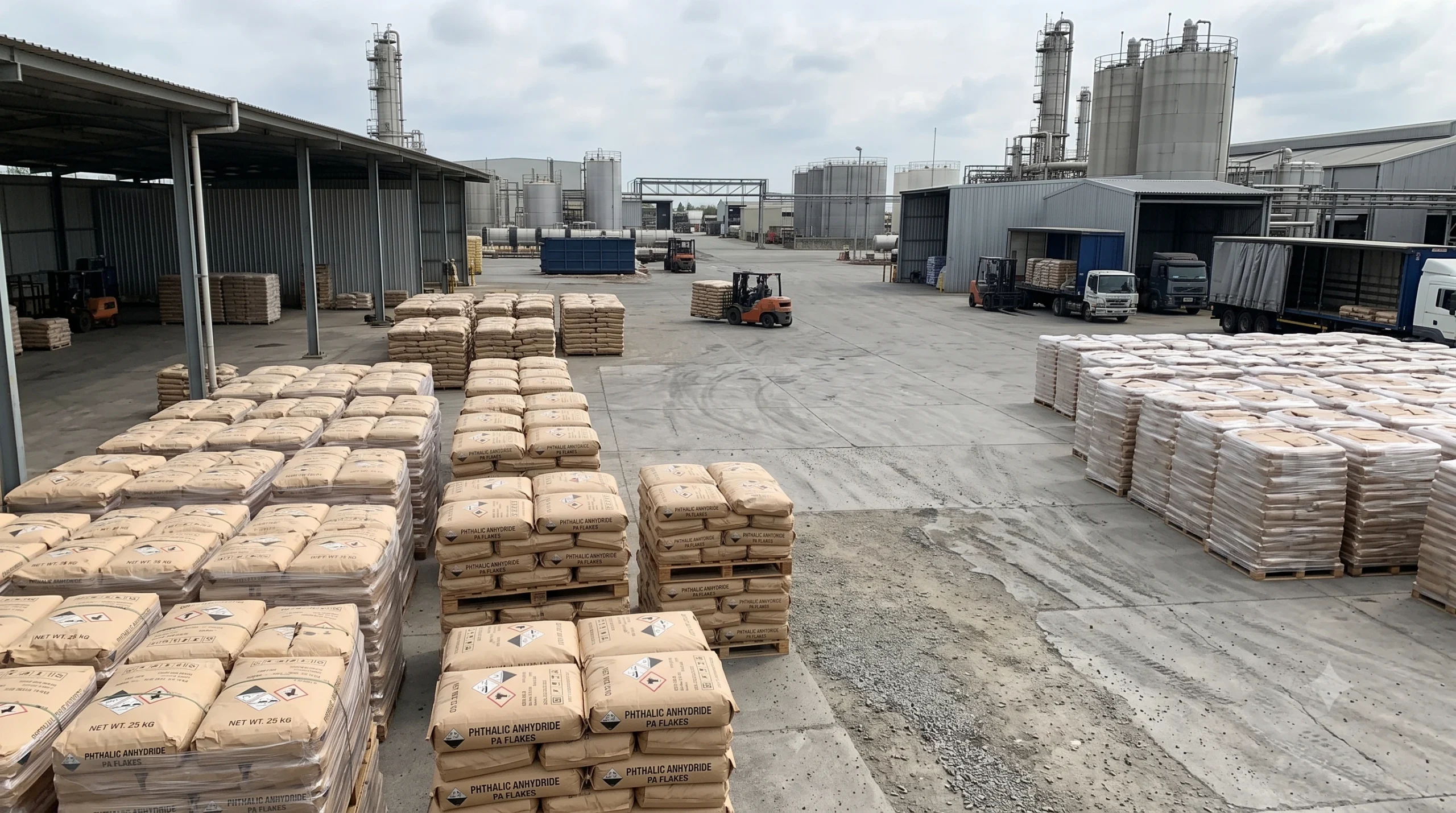
PA flakes are a solid form of phthalic anhydride. Molten PA is supplied as a liquid at elevated temperature. They may have the same chemical identity, but they are not interchangeable from an operations or procurement perspective.
Flakes may suit a site designed to receive, store, and process solids. Molten material may suit a buyer with compatible transport, unloading, storage, and process infrastructure. Agree the form before an RFQ is issued, because a lower price for the wrong form does not reduce procurement risk.
“Technical grade” also needs a defined specification. Supplier labels can vary, so the buyer should request the current product specification and representative certificate of analysis, then compare the reported parameters against internal limits. Do not approve high quality phthalic anhydride based on a marketing label alone.
| Confirm before quoting | Why it matters |
| Physical form | It determines site handling and transport requirements. |
| Application and intended process | It identifies the relevant quality and qualification discussion. |
| Approved quality limits | It prevents different grades from being compared as equivalent. |
| Documentation required | It establishes the SDS, CoA, technical data, traceability, and declarations needed. |
| Delivery basis | It reveals which costs and responsibilities are included in the offer. |
How is phthalic anhydride manufactured?
Commercial phthalic anhydride is generally produced by catalytic oxidation of an aromatic feedstock. Industrial production routes may use o-xylene or naphthalene as the feedstock, followed by recovery and finishing steps that produce the supplied material form. The exact process configuration and quality controls are manufacturer-specific.
The manufacturing route can be relevant for producer identity, origin, process-linked documentation, or a supply-source change. It should not replace a current specification, batch CoA, and application qualification. A deeper technical explainer on the naphthalene process for PA would be a useful reference when that destination is published.
How to compare phthalic anhydride suppliers
The right supplier is not necessarily the producer or the lowest-priced distributor. The best route depends on the visibility, technical support, inventory flexibility, and logistics coordination required. Use the same evidence standard for every candidate.
| Supply route | May suit buyers who need | Questions to resolve before approval |
| Manufacturer or producer-linked route | Direct producer engagement, origin clarity, or an established plant approval pathway | Who produces the material, what is the approved grade, and how will batch documents be supplied? |
| Authorised distributor | Local commercial coordination, regional inventory, or structured delivery support | What is the origin, how is traceability maintained, and which documents travel with the shipment? |
| Sourcing partner | Help coordinating a defined multi-market requirement | What is the named supply route, who is responsible for documents, and how are technical changes controlled? |
| Marketplace or broker listing | Initial market discovery | Can the supplier role, origin, specification, and document chain be independently confirmed? |
The decision framework is straightforward. Choose a producer-linked route when direct plant engagement and verified origin are essential. Choose a qualified distributor or sourcing partner when the buyer needs a documented commercial route that matches the delivery requirement. Do not choose any route when the offered specification, origin, or document chain remains unclear.
Phthalic anhydride manufacturers in India and USA supply routes
The phrase “phthalic anhydride manufacturers in India” is often used to find producers, but an industrial purchase may ultimately be supplied through a producer, an authorised distributor, or a sourcing partner. India-manufacturer positioning is useful only when the producing entity, origin, form, and evidence chain can be confirmed.
For an India-sourced requirement, ask who manufactures the PA, who will invoice it, where it will ship from, and who provides the documents. For an India-bound purchase, use a qualified compliance resource to check current destination-specific requirements.
US buyers may source through domestic production, distributor inventory, or imported material. These routes differ in origin, freight planning, inventory position, and document review. In either market, confirm product, form, specification, documents, origin, delivery basis, and site requirements before treating offers as comparable.
What determines phthalic anhydride price and price trends?
There is no single reliable phthalic anhydride price for a bulk buyer. A public figure may relate to a laboratory pack, different grade, unspecified form, historical date, or a delivery basis excluding freight and destination charges. It is not a procurement-ready quotation.
Phthalic anhydride prices can vary with feedstock and energy conditions, regional supply and demand, plant operations, product form, packaging, order size, origin, freight, destination, Incoterm, payment terms, documentation needs, and quote validity. Assess a price trend against the buyer’s actual grade, route, and purchase timing rather than an unrelated spot listing.
Build a comparable quote sheet
Ask every supplier to state its quote basis in writing. This reduces the chance that procurement accepts a lower unit price which later proves to exclude the packaging, freight, documentation, or delivery requirement needed for the order.
| Comparison factor | Offer A | Offer B | Offer C |
| Product form and specification | |||
| Packaging and net weight | |||
| Named producer or supply route | |||
| Origin and traceability basis | |||
| Delivery term and destination | |||
| SDS, CoA, and technical data | |||
| Quote validity and payment basis | |||
| Total delivered-cost basis |
Where commercial data is ready, request a buy phthalic anhydride in bulk (India-sourced) discussion using this same comparison basis. It will make the price conversation more useful than an unsupported request for a “best rate.”
Supplier qualification checklist for bulk PA
Bulk PA supply should be qualified as both a technical and commercial decision. A strong process catches unclear form, documentation, and logistics assumptions before a production trial or purchase order creates a problem.
- Define the requirement. State CAS 85-44-9, flakes or molten form, intended application, approved material limits, quantity, and delivery destination.
- Request current documents. Obtain the current SDS, technical data or specification sheet, representative batch CoA, traceability information, and any customer-required declarations.
- Confirm the supplier’s role. Establish whether the counterparty is a producer, authorised distributor, or sourcing partner, and identify the product origin.
- Review packaging and route. Confirm pack type, net weight, storage and receiving constraints, delivery term, freight scope, and import or destination responsibilities.
- Compare on one basis. Align specification, packaging, quantity, origin, delivery term, and total delivered cost before comparing unit prices.
- Qualify where needed. Use the buyer’s normal sample, trial, or change-control process before approving a new grade or source.
The practical trust signal is a current record set: TDS or specification, SDS, CoA, traceability information, and a qualification pathway tied to the application.
Is phthalic anhydride dangerous?
Phthalic anhydride requires appropriate safety review and handling controls. Assess it using the supplier’s current SDS and the receiving site’s EHS procedures, not a general online summary.
Before ordering, confirm that responsible site personnel have reviewed the SDS, product identity, storage requirements, exposure-control information, applicable transport classification, and emergency procedures. The handling plan must be compatible with the supplied form and packaging.
MOQ and packaging for bulk PA
MOQ and packaging are commercial details that vary by supplier, product form, supply route, destination, and timing. They should be requested as part of the RFQ rather than assumed from a product listing or a previous order from another source.
State the required quantity, purchase frequency, preferred packaging, receiving constraints, and delivery location. The supplier can then confirm available pack formats, any minimum-order requirements, and the freight or handling implications for that specific request. This keeps the final offer aligned with the buyer’s total delivered-cost model.
Conclusion: make the PA request specific
Phthalic anhydride suppliers should be evaluated on documented equivalence, not price alone. The buyer needs to confirm PA flakes or molten form, the approved specification, supplier role, origin, documents, packaging, destination, and delivered-cost basis. India-manufacturer positioning can be valuable, but only when the identity and evidence chain are verified for the proposed supply route.
When your requirement is defined, discuss it with a buy phthalic anhydride in bulk (India-sourced) route and include the application, physical form, specification, quantity, packaging, destination, and documentation needs. That is the most practical way to move from an online supplier search to a comparable commercial offer.
FAQs
What is phthalic anhydride?
Phthalic anhydride is an industrial chemical intermediate with CAS number 85-44-9. It is commonly sourced as PA flakes or, for compatible industrial systems, molten PA. The right purchase specification depends on the downstream process and handling requirements.
What is phthalic anhydride used for?
Phthalic anhydride is used in industrial routes including plasticizers, alkyd resins, coatings, unsaturated polyester resins, dyes, pigments, and other chemical intermediates. The specific application determines the relevant material and qualification requirements.
How is phthalic anhydride manufactured?
It is generally manufactured by catalytic oxidation of aromatic feedstocks, commonly o-xylene or naphthalene. The exact plant process is manufacturer-specific, so buyers should request current product documents rather than infer quality from the stated route.
Is phthalic anhydride dangerous?
It requires appropriate EHS review and site-specific handling controls. Review the current supplier SDS and confirm the receiving site’s storage, exposure-control, transport, and emergency requirements before ordering or handling the material.
Who are the best phthalic anhydride suppliers in the USA and India?
There is no universal best supplier. The right option is the one that can demonstrate fit with the buyer’s approved specification, material form, documents, origin requirements, delivery destination, and qualification process. Compare every candidate using the same checklist.
What is the price of phthalic anhydride?
The bulk price must be quoted for the actual product form, specification, quantity, packaging, origin, delivery term, and destination. A public lab-pack or historical price does not establish the delivered cost of an industrial order.
What is the price trend for phthalic anhydride?
Price trends can be influenced by feedstock and energy conditions, regional supply and demand, plant operations, freight, and the buyer’s selected supply route. Assess any trend against the specific grade, geography, and timing of the planned purchase.
Which manufacturers offer technical-grade PA?
Confirm this directly with the prospective supplier or producer. Ask for the current technical-grade definition, specification sheet, CoA format, material origin, and documentation package, then compare it with the application-specific internal requirement.
What are the MOQ and packaging options for bulk PA?
MOQ and packaging vary by supplier, form, supply route, and destination. Include quantity, purchase frequency, preferred pack format, delivery point, and site constraints in the RFQ so the supplier can confirm the applicable commercial options.