

At a Glance
- Phthalic anhydride is an industrial intermediate, not a finished plasticizer, coating, composite, dye, or pigment.
- Plasticizer, alkyd-resin, UPR, and dye or pigment teams require different PA acceptance criteria and qualification evidence.
- The same PA name does not make every grade, source, or physical form suitable for every downstream process.
- Select PA from the required downstream material and process, then work backward to specifications and documentation.
- Current TDS or specification, SDS, CoA, traceability information, and application testing are stronger approval evidence than a generic use claim.
What you’ll learn
This guide explains what phthalic anhydride is used for, how it fits into four industrial application routes, and what technical and procurement teams should define before selecting an input.
Introduction
Phthalic anhydride creates value after it reacts into a downstream material. A buyer is choosing an upstream input for a plasticizer, coating resin, thermoset resin, or colour-chemical route.
The practical question is therefore not only “what is phthalic anhydride used for?” It is which PA application route fits the required output, and which material controls must be verified before production or sourcing approval. This guide provides a decision framework for plasticizers, alkyd resins, UPR, and dye or pigment manufacturing.
What is phthalic anhydride?
Phthalic anhydride, often shortened to PA, is an organic chemical intermediate with CAS number 85-44-9. It is used as a reactant in several industrial manufacturing pathways. PubChem’s phthalic anhydride record provides the basic chemical identity.
For a purchasing or formulation decision, chemical identity is only the first control point. Define physical form, quality limits, intended application, documents, and a qualification plan before approval.
What is phthalic anhydride used for?
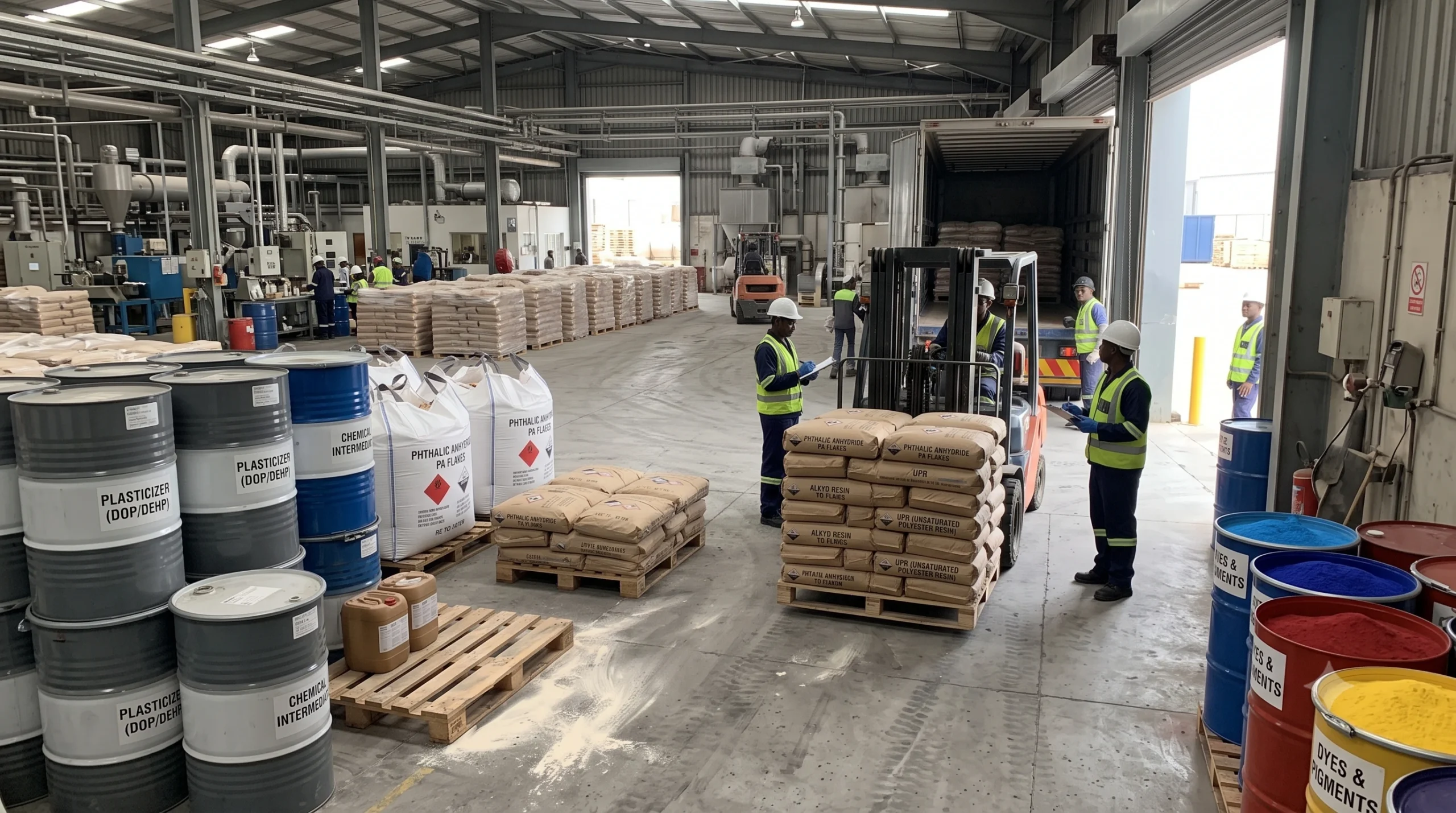
Phthalic anhydride is used as a building block in selected plasticizer, alkyd-resin, unsaturated polyester resin, dye, pigment, and other chemical manufacturing routes. The American Chemistry Council describes PA as a building-block chemical for plasticizers, resins, and coatings. Its overview of PA in manufacturing offers useful context.
PA is not a substitute for the finished material it helps make. The downstream application determines the PA specification and evidence required upstream.
Choose the application route before choosing the input
The most useful starting point is the performance job of the downstream material. Beginning with the desired output links PA selection to formulation, process, quality, and procurement requirements. Starting with an unqualified list of PA uses does not.
| Required downstream outcome | PA application route | Questions to define first |
| Polymer flexibility or processability | Plasticizer route | Which polymer, performance target, end use, and applicable restrictions? |
| Coating or binder resin | Alkyd-resin route | Which coating system, substrate, durability need, and processing window? |
| Thermoset composite matrix | UPR route | Which reinforcement, process method, curing system, and service environment? |
| Colour chemical or intermediate | Dye or pigment route | Which intermediate, purity profile, process controls, and customer criteria? |
Choose the plasticizer route when the output is a polymer-modifying ester. Choose the alkyd route when the output is a coating binder. Choose UPR when the output is a thermoset resin system. Choose a dye or pigment route only when the intended intermediate and process requirements are technically defined.
PA in plasticizer manufacture: DOP/DEHP routes
Plasticizer manufacture is one of the best-known phthalic anhydride applications. At a high level, PA can react with selected alcohols to produce phthalate esters. Those downstream esters may be used to modify polymer flexibility, workability, and processing behaviour.
DOP and DEHP are terms commonly associated with di(2-ethylhexyl) phthalate, though terminology and requirements should be checked against the relevant market. PA is the upstream reactant, so approval of a PA source does not establish downstream plasticizer fitness.
Define polymer compatibility, flexibility, process conditions, service environment, and applicable restrictions. Procurement can then align the PA request to the approved process specification. Do not assume a plasticizer route is suitable for regulated end uses without appropriate review.
PA in alkyd resins
Alkyd resins are oil-modified polyester systems used in paints, varnishes, and industrial coatings. PA can contribute as a dibasic-acid component alongside polyols and oils or fatty acids. It is one building block in the resin design, not the finished coating.
An alkyd team should begin with the target coating system and substrate. Resin architecture, oil or fatty-acid route, performance objectives, curing approach, colour requirements, and process controls determine whether a PA input is suitable.
Two manufacturers may use PA in alkyd chemistry while working to different resin specifications and coating outcomes. Any material change should follow the approved specification and change-control process.
PA in unsaturated polyester resins (UPR)
Unsaturated polyester resins are thermoset systems used in composite applications. PA can be considered alongside glycols and other acids or anhydrides in selected UPR manufacturing routes. It should not be presented as a universal answer for every composite-resin requirement.
UPR selection begins with finished-resin performance requirements. Reinforcement, process method, cure design, service environment, and documentation needs all affect the assessment.
Do not use a general guide to infer resin ratios, cure packages, or finished performance. Those decisions require qualified formulation input and validation in the actual process.
PA in dye and pigment manufacturing
PA can also be used as a precursor in selected colour-chemical routes. Here, it is an intermediate before the finished dye, pigment, ink, or colour system is made. The US EPA identifies synthetic dye, pigment, and printing-ink manufacturing among PA conditions of use considered in its evaluation. EPA’s phthalic anhydride page provides current US context.
Purchasing PA does not mean purchasing a finished pigment or dye. The applicable PA requirement may be shaped by process-specific purity needs, colour-quality controls, batch consistency, and customer specifications for the final product. The route, intermediate, and qualification tests should be confirmed with an appropriately qualified technical team.
For a future India-focused colour-chemical resource, retain the PA in dye/pigment (India) link opportunity. It should not be represented as a published destination or evidence of a specific manufacturing capability.
How is phthalic anhydride manufactured?
Commercial PA is generally produced through catalytic oxidation of aromatic feedstocks. Common industrial feedstocks include o-xylene and naphthalene, followed by recovery and finishing steps that provide the supplied material. The exact plant configuration, controls, and product definition are manufacturer-specific.
The manufacturing process matters when a producer, origin, specification, or traceability route changes. It does not replace current technical data, batch documentation, and validation in the intended process.
A practical PA qualification framework
The same qualification sequence can serve all four application families, while the acceptance criteria remain application-specific. It gives technical, quality, and procurement teams a shared way to define a PA request and review any proposed source or material change.
- Define the output. Name the plasticizer, alkyd resin, UPR system, or colour-chemical intermediate being produced.
- Define PA’s role. Identify the physical form, approved composition or grade, and incoming-material limits that can affect the process.
- Set the evidence standard. Request the current specification or TDS, SDS, batch CoA format, traceability information, and any customer-required declarations.
- Plan qualification. Agree the laboratory, process, or finished-product checks needed before release.
- Control change. Treat a different grade, producer, or source route as a formal change until the relevant evidence supports approval.
Where the material requirement is defined, discuss it with a phthalic anhydride supplier (technical grade). The supplier conversation should include the application, physical form, specification, quantity, destination, and document requirements, rather than relying on a generic request for PA.
Where to source phthalic anhydride
Sourcing should follow, not replace, the technical definition of the requirement. A good request specifies the application, physical form, approved limits, expected quantity, delivery destination, packaging constraints, and required documents. That enables procurement to compare technically similar offers.
For commercial evaluation of price, grade, producer role, and supply route, preserve the bulk PA supplier [Bulk Phthalic Anhydride (PA Flakes) Supplier Guide 2026: Prices, Grades, Manufacturers in India & USA] pathway. Until the guide is published, the product and document review should remain grounded in the supplied specification and current evidence.
Conclusion
Phthalic anhydride is used because it can support several industrial chemistry routes, not because it is a finished material in its own right. The appropriate use depends on the required downstream output: a plasticizer, alkyd resin, UPR system, or colour-chemical intermediate.
Start with the application and define PA’s approved role, material limits, documentation, and validation plan. Once those criteria are clear, a phthalic anhydride supplier (technical grade) can help frame a material discussion around the actual sourcing and qualification requirement.
FAQs
1. How is phthalic anhydride manufactured?
Phthalic anhydride is generally manufactured by catalytic oxidation of aromatic feedstocks, commonly o-xylene or naphthalene. The exact manufacturing configuration is producer-specific, so buyers should use current technical documents and batch records to assess a proposed material.
2. What is phthalic anhydride used for?
Phthalic anhydride is used as an industrial intermediate in selected plasticizer, alkyd-resin, UPR, dye, pigment, and related chemical manufacturing routes. Its relevance depends on the downstream material being produced and the technical requirements of that process.
3. What is phthalic anhydride?
Phthalic anhydride is an organic chemical intermediate with CAS number 85-44-9. It is commonly supplied as solid flakes or, for compatible industrial operations, molten material.
4. Is phthalic anhydride a finished plasticizer or resin?
No. PA is an upstream reactant that can be converted into selected phthalate esters or used as a component in resin chemistry. The plasticizer or resin must be designed, processed, and qualified as its own finished material.
5. What should a buyer check before approving PA for an application?
Check the approved material specification, physical form, current TDS or specification, SDS, CoA, traceability information, and the relevant application-validation plan. A generic use claim is not enough to approve PA for a specific process.