

At a Glance
- Two distinct use categories: food-grade thickening and binding versus industrial-grade paper, textile, and adhesive applications.
- Fastest-growing segment: bioplastic packaging (straws, plates, containers), pushed forward by regulatory bans on single-use plastic.
- Grade determines application, not the other way around: native, modified, and bioplastic-spec starch are not interchangeable.
- Biodegradable does not mean compostable everywhere: most starch-based bioplastics need industrial composting infrastructure, not a backyard bin.
- Bottom line: the right starch grade is decided by end-use first and cost second.
What you’ll learn: this guide covers corn starch for food, thickener alternatives, industrial uses, bioplastics, and how to pick the correct grade for your application.
Introduction
Choosing the wrong corn starch grade is an expensive mistake either way. Corn starch for food applications used where industrial specs are required will underperform on viscosity or bonding. Industrial-grade starch used in a food application, meanwhile, can fail certification checks entirely.
That risk is growing more relevant as demand shifts. Corn starch is the dominant feedstock in the starch polymers market, accounting for roughly 46% of revenue share due to its availability, cost-effectiveness, and established production infrastructure, and the global starch polymers market was valued at about USD 3.10 billion in 2024, with growth projected to USD 4.74 billion by 2030. So before sourcing in bulk, it helps to understand where corn starch for food differs from its industrial and bioplastic counterparts, and how to match grade to use.
What Is Corn Starch Powder?
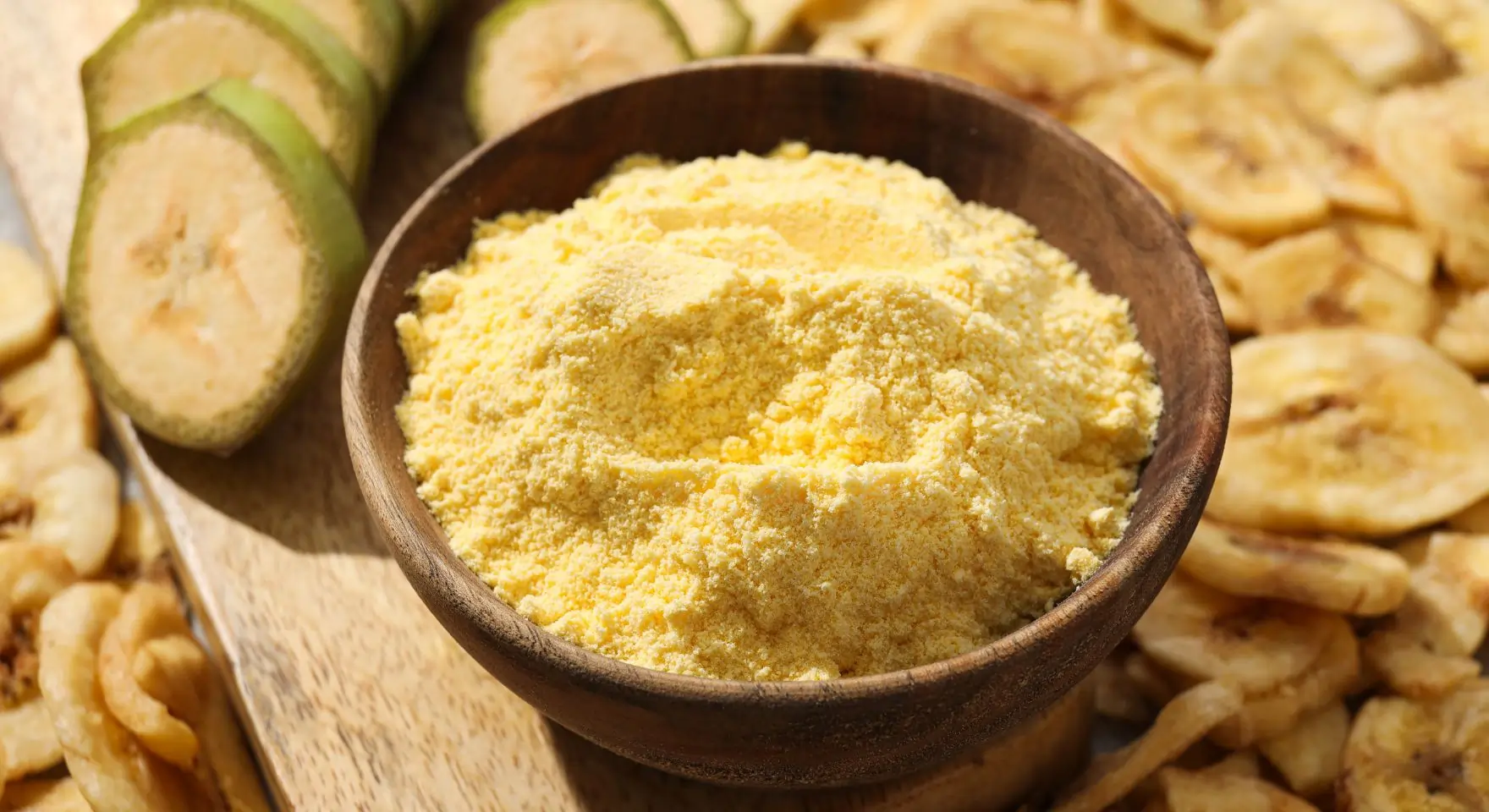
Corn starch powder is extracted from maize kernels and refined into a fine, neutral-tasting powder. It’s the workhorse starch across food and industrial manufacturing because of its wide availability and predictable behavior.
Its performance comes down to one thing: the ratio of amylose to amylopectin. Amylose contributes gel strength and film-forming ability, while amylopectin drives viscosity and paste clarity. That balance is why corn starch behaves differently than tapioca, potato, or wheat starch, even though all four are used for similar jobs. We’ll come back to that comparison shortly.
Corn Starch for Food: Core Uses
Corn starch for food applications generally falls into four functional roles:
- Thickening: sauces, gravies, soups, and pie fillings, where it builds body without altering flavor.
- Binding: processed meats, batters, and baked goods, holding moisture and structure together.
- Anti-caking: powdered mixes and spice blends, keeping particles free-flowing.
- Texture and mouthfeel modification: snack coatings and confectionery, adjusting crispness or smoothness.
Each of these functions depends on how the starch gelatinizes under heat, which is why formulators test dosage and cook temperature before scaling up a recipe.
Corn Starch vs Other Thickening Agents
| Thickener | Clarity | Freeze-Thaw Stability | Typical Dosage | Best Fit |
| Corn starch | Slightly opaque | Moderate, can weep on thawing | 1-2% | General sauces, gravies, baked fillings |
| Tapioca starch | Clear, glossy | Good | 1-1.5% | Fruit fillings, clear glazes |
| Potato starch | Clear | Poor | 1-1.5% | Fast-thickening soups, short shelf-life items |
| Xanthan gum | Clear | Excellent | 0.1-0.3% | Frozen foods, gluten-free formulations |
Xanthan gum vs cornstarch comes down to a clarity and texture tradeoff. Xanthan gum holds up through repeated freeze-thaw cycles and needs a fraction of the dosage, which makes it attractive for frozen or shelf-stable products. Corn starch, however, delivers a fuller, more traditional mouthfeel at a much lower cost per batch. Formulators comparing corn starch vs other thickeners should weigh gel texture and freeze-thaw performance against dosage cost before substituting one for another.
Request a Sample to test corn starch against your current thickening agent in your own formulation.
Corn Starch Uses in Industrial Applications
Outside food, corn starch is a backbone raw material across several manufacturing processes:
- Paper sizing and coating: improving surface strength and print quality
- Textile sizing: protecting yarn during weaving
- Adhesives and binders: corrugated board, packaging glues, and construction adhesives
- Corrugating: bonding fluted medium to linerboard in box manufacturing
These applications typically call for a different specification than food-grade starch, since purity thresholds and moisture tolerances shift once the end use is non-food.
Corn Starch in Bioplastics & Packaging
Corn Starch Straws
Corn starch straws use a thermoplastic starch blend extruded into rigid tubes. They’re positioned as a direct swap for plastic straws in foodservice, particularly where single-use plastic bans are already in effect.
Corn Starch Plates
Corn starch plates are molded from starch-based bioplastic resin, offering rigidity comparable to standard disposable plates. This is currently one of the easiest search terms to rank for in the category, since competition and content depth are both still thin.
Corn Starch Containers
Corn starch containers extend the same bioplastic base into deeper, structural shapes such as clamshells and takeout boxes, often blended with PLA for added heat resistance.
Biodegradable Plastics from Corn Starch
The mechanism is straightforward: corn starch is blended or chemically modified into a bioplastic base, frequently alongside polylactic acid (PLA), to create material that behaves like conventional plastic during molding but breaks down afterward. That said, there’s an honest caveat worth flagging.
According to the U.S. EPA, plastic labeled as compostable is generally meant for an industrial or commercial composting facility, since those facilities reach higher temperatures and different breakdown conditions than a typical home compost bin, so buyers marketing these products as “backyard compostable” without qualification risk overstating the claim. You can review the EPA’s full guidance on plastic composting for the underlying disposal requirements.
Grades & Applications at a Glance
Corn starch isn’t a single product; it’s a family of grades, and matching the right one to the right job avoids both performance failures and compliance headaches.
| Grade | Typical Application | Key Spec to Check |
| Food-grade (native) | Sauces, soups, direct food-contact thickening | Moisture content, food-safety certification |
| Food-grade (modified) | Processed foods needing heat/shear stability | Degree of modification, viscosity stability |
| Industrial/technical-grade | Paper, textile, adhesives | Purity threshold, particle size |
| Bioplastic-spec | Straws, plates, containers | Compatibility with PLA blend, compostability certification |
How to Choose the Right Corn Starch Grade
- Confirm whether the application is food-contact, industrial, or compostable-packaging. This decision drives every spec that follows.
- Check moisture and particle-size specs against your process requirements before committing to a supplier.
- Request a sample batch before committing to volume, so your process team can validate performance under real conditions.
- Verify certifications relevant to the end use, since food-grade and industrial-grade approvals are not interchangeable.
- Confirm COA/TDS/SDS documentation is current for the specific grade you’re ordering, not a generic version.
Where to Source Corn Starch
Buyers sourcing bulk corn starch for food & industrial use should confirm grade-specific documentation before placing a first order.
Sourcing & Pricing Considerations
⚠️ Pricing referenced is indicative and subject to change based on market conditions, order volume, and grade specification. Contact our sales team for a current formal quote.
For a full grade-by-grade breakdown, see our guide to bulk corn starch pricing
Request a Sample before locking in a purchase order, so pricing discussions happen against confirmed performance rather than a spec sheet alone.
Trust & Compliance Signal
- COA (Certificate of Analysis) available on request for each batch
- TDS/SDS provided before shipment, so your team can validate specs ahead of receiving
- Relevant certifications FDA, FSSAI, REACH, or NSF/ANSI, depending on grade and destination market
Decision Framework Close
- Choose native food-grade if you need a clean-label, direct food-contact thickener with no processing history.
- Choose modified food-grade if your product needs heat or shear stability during industrial processing.
- Choose industrial-grade if the application is non-food and a lower purity threshold is acceptable.
- Choose bioplastic-spec if you’re producing packaging or foodservice disposables intended for industrial composting.
FAQs
Is corn starch biodegradable?
Yes, corn starch itself breaks down naturally, and starch-based bioplastics are engineered to biodegrade under composting conditions. Most require industrial composting facilities rather than home compost bins.
What’s the difference between corn starch and cornmeal?
Corn starch is a refined, gluten-free powder extracted from the endosperm, used for thickening and binding. Cornmeal is coarser and includes more of the whole kernel, used mainly for baking and coating.
Can corn starch replace plastic packaging?
Partially. Corn starch-based bioplastics work well for straws, plates, and containers, but they generally cost more and have different heat and moisture tolerances than conventional plastic.
Is xanthan gum better than corn starch for thickening?
Neither is universally better. Xanthan gum offers superior freeze-thaw stability at a much lower dosage, while corn starch is more cost-effective for everyday sauces and gravies.
Is corn starch powder the same as cornflour?
In the US, “corn starch” and “cornflour” refer to the same refined product. In the UK, “cornflour” means the same thing, but “corn flour” (two words) refers to whole ground corn, similar to American cornmeal.
What grade of corn starch is used for straws and plates?
Bioplastic-spec corn starch, typically blended with PLA, is used for straws and plates. This grade is formulated for extrusion and molding rather than direct food-contact thickening.
Conclusion
Whether you’re thickening a sauce, sizing paper, or molding a compostable plate, the right corn starch grade is decided by end-use first and cost second. Request a Quote to get grade-specific documentation and pricing for your application.