
Triacetin
ELFATTM – TRA

Get Pricing for This Product
Need pricing? Request a quote for this product and we'll get back to you shortly.
 Free Samples Available
Speed Up Your Sample Testing Process
We deliver domestic samples within 24 - 48 hours, helping you evaluate product without delays.
Triacetin, also known as glycerol triacetate, is a versatile chemical compound used in various industries. It serves as a plasticizer, solvent, and humectant, enhancing the flexibility, stability, and…
CAS Number
102-76-1
HS Code
29.15.39.90
INCI Name
Triacetin
Molecular Formula
C₉H₁₄O₆
Triacetin
ELFATTM – TRA
Triacetin, also known as glycerol triacetate, is a versatile chemical compound used in various industries. It serves as a plasticizer, solvent, and humectant, enhancing the flexibility, stability, and moisture retention of products. Commonly used in food, pharmaceuticals, and…
CAS Number
102-76-1
INCI Name
Triacetin
HS Code
29.15.39.90
Molecular Formula
C₉H₁₄O₆
Get Pricing for This Product
Need pricing? Request a quote for this product and we'll get back to you shortly.
Free Samples AvailableSpeed Up Your Sample Testing Process
We deliver domestic samples within 24 - 48 hours, helping you evaluate product without delays.
 By
By
Specialty chemicals, delivered right
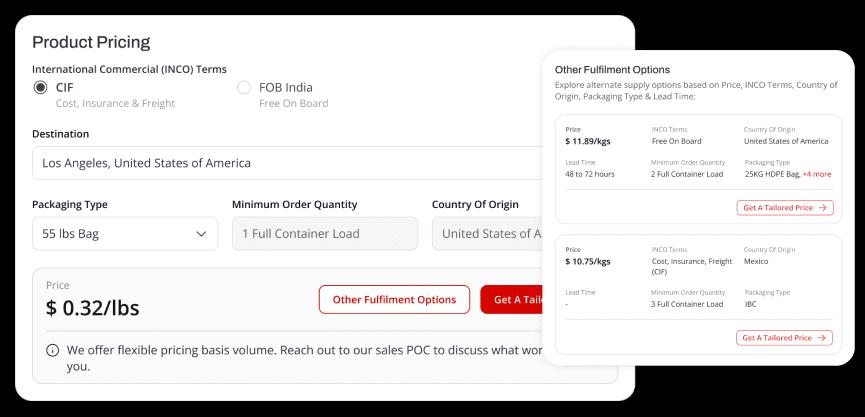
Access live, grade-specific pricing for every chemical, so your teams talks with data, not intuition on Elixir.
Compare fulfilment options across grades, INCO terms, origins, and lead times: all in one platform.

Live, transparent pricing
Real-time quotes across 12,000+ specialty chemicals.

Product Specification
Physical Properties
| Property | Specification |
|---|---|
| Appearance | Colorless, oily liquid |
| Odor | Smellless |
| Molecular Weight | 218.21 |
| Density | 1.16 g/cm³ |
| Specific Gravity (20°C) | 1.154–1.164 g/ml |
| Specific Gravity (25°C) | 1.154–1.158 g/ml |
| Viscosity (20°C) | 23 mPa·s |
| Viscosity (25°C) | approx. 17 mPa.s |
| Refractive Index (20°C) | 1.430–1.435 |
| Refractive Index (25°C) | 1.429–1.431 |
| Ph (50 G/L Aqueous Solution, 20°C) | 5.0–6.0 |
| Assay / Purity | ≥99.5% |
Chemical Properties
| Property | Specification |
|---|---|
| Ionic Nature | Non-ionic |
| Incompatibilities | Strong oxidizing agents. |
| Hazardous Decomposition Products | When heated to decomposition it emits acrid smoke and irritating fumes. |
Thermal Properties
| Property | Specification |
|---|---|
| Melting Point | 3 °C |
| Boiling Point | 258 °C |
| Flash Point | 138 °C (closed cup) |
| Autoignition Temperature | 433 °C |
| Thermal Stability | Stable under recommended storage conditions. |
Processing Methods & Reference Formulations
A. Aqueous Tablet Film Coating
This formulation describes a typical aqueous-based film coating for pharmaceutical tablets, where triacetin acts as a hydrophilic plasticizer to improve the flexibility and durability of the polymer film.
| Key Ingredients | Indicative Dosage (% w/w) |
|---|---|
| Hydroxypropyl Methylcellulose (HPMC) | Base Polymer |
| Triacetin | 10–35% |
| Water | q.s. to desired solids content |
B. Flavor Microemulsion
This formulation creates a stable microemulsion for flavor delivery, leveraging triacetin as the oil phase.
| Key Ingredients | Indicative Dosage (% w/w) |
|---|---|
| Triacetin (Oil Phase) | 25% |
| Polysorbate 20 (Surfactant) | 25% |
| Polyoxyl 35 Castor Oil (Cosurfactant) | 25% |
| Water | 50% |
Dosing Guidelines
A. Dosing by Application
| Application | Recommended / Max Dosage |
|---|---|
| Pharmaceutical Tablet & Capsule Coatings | 10–35% w/w of the polymer content |
| Flavoring Agent / Solvent | Governed by Good Manufacturing Practices (GMP) |
| Chewing Gum (as Plasticizer) | Governed by Good Manufacturing Practices (GMP) |
| Baked Goods (as Humectant) | Governed by Good Manufacturing Practices (GMP) |
| Beverages (Non-alcoholic) | Governed by Good Manufacturing Practices (GMP) |
| Confections and Frostings | Governed by Good Manufacturing Practices (GMP) |
| Hard Candy | Governed by Good Manufacturing Practices (GMP) |
| Frozen Dairy Desserts | Governed by Good Manufacturing Practices (GMP) |
About Triacetin
Triacetin, also known as glycerol triacetate, is a highly versatile compound used across multiple industries. As a plasticizer, it enhances the flexibility and durability of polymers, making it a crucial component in the production of plastics and resins. In the pharmaceutical sector, Triacetin acts as a solvent, improving the solubility and bioavailability of active ingredients, which is essential for effective drug formulations. Its role as a humectant in personal care products helps retain moisture, enhancing skin hydration and product stability. Triacetin is also used as a flavoring agent in the food industry, ensuring uniform distribution and stability of flavors. Its compatibility with other film-forming agents makes it ideal for coatings and films, providing a glossy finish and protective barrier. Manufacturers and suppliers of Triacetin focus on producing high-purity grades to meet the stringent demands of these industries. The production process is carefully controlled to ensure consistency and stability, which are crucial for the compound’s effectiveness in various applications. Sustainability is an increasing focus for Triacetin manufacturers, with many adopting greener practices to minimize their environmental impact. These efforts include optimizing energy use during production and reducing waste emissions. The trend toward eco-friendly manufacturing aligns with the growing demand for sustainable raw materials in the chemical industry.
Why Source Triacetin Through Elchemy?
- Verified Triacetin Manufacturer Network: Every triacetin producer in the Elchemy network is pre-audited for purity and export compliance before onboarding. You deal with one accountable partner for food, pharma, and industrial grades, and we manage supplier risk.
- Bulk Supply with Transparent Per-Kg Pricing: Source triacetin (CAS 102-76-1) from samples up to drums, IBCs, and bulk volumes, priced per kg and scaled to your volume, with a binding quote within 24 business hours.
- Food, Pharma & Industrial Grades, Fully Documented: Food-grade (E1518) as a flavour carrier and humectant, pharmaceutical-grade as a plasticiser and excipient, and technical grade for industrial use — every order ships with COA, TDS, and GHS-compliant SDS.
- Flavour, Pharma & E-Liquid Formulation Ready: Consistent, high-purity triacetin for flavour-ingredient formulation, pharmaceutical coatings, and e-liquid applications, with batch-level COAs.
- Samples Dispatched in 24 to 48 Hours: Verify grade and purity before bulk commitment. COA-backed samples of triacetin are dispatched within 24 to 48 hours of confirmation.
- 40+ Country Reach with Food & Pharma Compliance: Elchemy delivers worldwide with documentation aligned to FCC/FSSAI, USP, EU, and Halal/Kosher requirements.
- Versatile Plasticizer: Enhances flexibility and durability in polymers, crucial for plastics and resins.
- Functions: Plasticizer, Solvent, Humectant, Flavoring Agent, Film Former, Flavor Fixer, Emulsifier, Stabilizer, Antifungal Agent.
- Effective Solvent: Improves solubility and bioavailability of active ingredients in pharmaceuticals.
- Features: High purity (≥99.5%), low water content (≤0.05%), low acidity (≤0.005%), colorless and odorless. Complies with major pharmacopeias (USP, EP, BP) and food standards (FCC).
- Moisture Retention: Acts as a humectant in personal care products, enhancing skin hydration.
- Benefits: Acts as a versatile, non-phthalate plasticizer. Its high solvency and low volatility make it an excellent solvent and fixative for flavors and fragrances.
- Flavor Stability: Used as a flavoring agent in food, ensuring uniform distribution and stability.
- Glossy Film Former: Provides a glossy finish and protective barrier in coatings and films.
About Triacetin
Triacetin, also known as glycerol triacetate, is a highly versatile compound used across multiple industries. As a plasticizer, it enhances the flexibility and durability of polymers, making it a crucial component in the production of plastics and resins. In the pharmaceutical sector, Triacetin acts as a solvent, improving the solubility and bioavailability of active ingredients, which is essential for effective drug formulations. Its role as a humectant in personal care products helps retain moisture, enhancing skin hydration and product stability. Triacetin is also used as a flavoring agent in the food industry, ensuring uniform distribution and stability of flavors. Its compatibility with other film-forming agents makes it ideal for coatings and films, providing a glossy finish and protective barrier. Manufacturers and suppliers of Triacetin focus on producing high-purity grades to meet the stringent demands of these industries. The production process is carefully controlled to ensure consistency and stability, which are crucial for the compound’s effectiveness in various applications. Sustainability is an increasing focus for Triacetin manufacturers, with many adopting greener practices to minimize their environmental impact. These efforts include optimizing energy use during production and reducing waste emissions. The trend toward eco-friendly manufacturing aligns with the growing demand for sustainable raw materials in the chemical industry.
Why Source Triacetin Through Elchemy?
- Verified Triacetin Manufacturer Network: Every triacetin producer in the Elchemy network is pre-audited for purity and export compliance before onboarding. You deal with one accountable partner for food, pharma, and industrial grades, and we manage supplier risk.
- Bulk Supply with Transparent Per-Kg Pricing: Source triacetin (CAS 102-76-1) from samples up to drums, IBCs, and bulk volumes, priced per kg and scaled to your volume, with a binding quote within 24 business hours.
- Food, Pharma & Industrial Grades, Fully Documented: Food-grade (E1518) as a flavour carrier and humectant, pharmaceutical-grade as a plasticiser and excipient, and technical grade for industrial use — every order ships with COA, TDS, and GHS-compliant SDS.
- Flavour, Pharma & E-Liquid Formulation Ready: Consistent, high-purity triacetin for flavour-ingredient formulation, pharmaceutical coatings, and e-liquid applications, with batch-level COAs.
- Samples Dispatched in 24 to 48 Hours: Verify grade and purity before bulk commitment. COA-backed samples of triacetin are dispatched within 24 to 48 hours of confirmation.
- 40+ Country Reach with Food & Pharma Compliance: Elchemy delivers worldwide with documentation aligned to FCC/FSSAI, USP, EU, and Halal/Kosher requirements.
- Versatile Plasticizer: Enhances flexibility and durability in polymers, crucial for plastics and resins.
- Functions: Plasticizer, Solvent, Humectant, Flavoring Agent, Film Former, Flavor Fixer, Emulsifier, Stabilizer, Antifungal Agent.
- Effective Solvent: Improves solubility and bioavailability of active ingredients in pharmaceuticals.
- Features: High purity (≥99.5%), low water content (≤0.05%), low acidity (≤0.005%), colorless and odorless. Complies with major pharmacopeias (USP, EP, BP) and food standards (FCC).
- Moisture Retention: Acts as a humectant in personal care products, enhancing skin hydration.
- Benefits: Acts as a versatile, non-phthalate plasticizer. Its high solvency and low volatility make it an excellent solvent and fixative for flavors and fragrances.
- Flavor Stability: Used as a flavoring agent in food, ensuring uniform distribution and stability.
- Glossy Film Former: Provides a glossy finish and protective barrier in coatings and films.
Regulatory Compliance
| Region | Max Allowed Level | Notes | Certification Body |
|---|---|---|---|
| Australia | - | Approved as a food additive (A1518) for use as a humectant and solvent in flavorings. | FSANZ approval. |
| Canada | - | Listed in the List of Permitted Food Additives with Other Generally Accepted Uses to be used as a carrier or extraction solvent in food. Not listed on the Cosmetic Ingredient Hotlist. | Health Canada approval for food use. |
| China | - | Listed in the Inventory of Existing Cosmetic Ingredients in China (IECIC). | NMPA (for cosmetics). |
| India | - | Listed with HSN code 29153900. | - |
| United States | - | Affirmed as Generally Recognized as Safe (GRAS) for direct use in human food and animal feed. The Cosmetic Ingredient Review (CIR) Expert Panel concluded it is safe as used in cosmetic formulations. | FDA (for food/pharma use), TSCA Inventory listing. |
| European Union | - | Approved as a food additive (E1518) under Regulation (EC) No 1333/2008, for uses such as a carrier solvent in flavorings and in chewing gum. Not specifically restricted in cosmetics. | REACH registration. |
FAQs - Triacetin
Related Products

Related Products

Streamline
Your Chemical
Procurement
Get fast responses from real experts