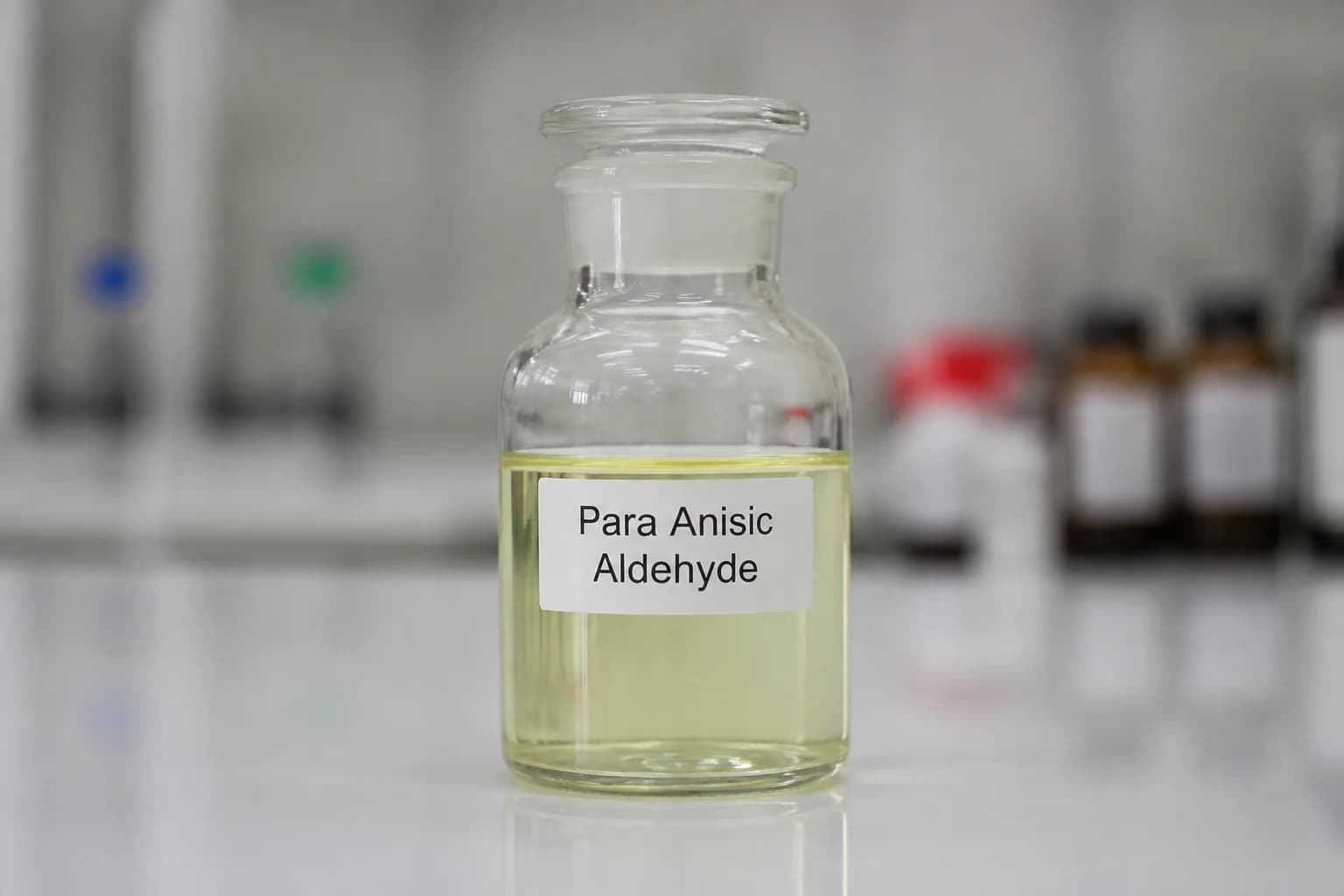
Para Anisic Aldehyde
ELAROMATM – pAAL
Get Pricing For This Product
Need pricing? Request a quote for this product and we'll get back to you shortly.
Speed Up Your Sample Testing Process
Express Delivery in 24–48 Hours
Para Anisic Aldehyde, also known as 4-Methoxybenzaldehyde, is a fragrance compound widely used in the flavors and fragrance industry. It imparts a sweet, floral, and anisic aroma, making it a popular…
CAS Number
123-11-5
HS Code
2912.49.10
INCI Name
Para Anisic Aldehyde
Molecular Formula
C₈H₈O₂
Para Anisic Aldehyde
ELAROMATM – pAAL
Para Anisic Aldehyde, also known as 4-Methoxybenzaldehyde, is a fragrance compound widely used in the flavors and fragrance industry. It imparts a sweet, floral, and anisic aroma, making it a popular choice in perfumes, soaps, and cosmetics. Additionally, it serves as an…
CAS Number
123-11-5
INCI Name
Para Anisic Aldehyde
HS Code
2912.49.10
Molecular Formula
C₈H₈O₂
Get Pricing For This Product
Need pricing? Request a quote for this product and we'll get back to you shortly.
Speed Up Your Sample Testing Process
We deliver domestic samples within 24 - 48 hours, helping you evaluate product without delays.
Product Specification
Physical Properties
| Property | Specification |
|---|---|
| Appearance | Colorless to pale yellow liquid |
| Odor | Sweetish odor |
| Molecular Weight (G/Mol) | 136.15 |
| Density Or Specific Gravity | 1.1191 g/cu cm at 15 °C |
| Viscosity | 4.22 mPa s at 25 °C |
| Refractive Index | 1.5730 at 20 °C |
| Ph (If Aqueous Solution) | 7 (2g/l, H2O, 20℃) |
| Assay (Gc) | 97.5% min (97-99%) |
| Assay | 97.5% min (97-99%) |
Chemical Properties
| Property | Specification |
|---|---|
| Hazardous Reactions | When heated to decomposition it emits acrid smoke and irritating fumes. |
Thermal Properties
| Property | Specification |
|---|---|
| Melting Point | 0 °C |
| Boiling Point | 255 °C |
| Flash Point | 116 °C (241 °F) - closed cup |
Processing Methods & Reference Formulations
A. Shampoo
Add during the cool-down phase, to preserve its aroma and prevent degradation due to heat. Pre-mix with a solubilizer to ensure uniform dispersion in the aqueous base.
| Key Ingredients | Indicative Dosage (% w/w) |
|---|---|
| Water | 63% |
| Sodium Laureth Sulfate | 15% |
| Cocamidopropyl Betaine | 6% |
| Glycerin | 3% |
| Citric Acid | 0.3% |
| Polyquaternium-10 | 0.2% |
| Disodium EDTA | 0.1% |
| Preservative (e.g. Phenoxyethanol) | 0.8% |
| Fragrance blend | 11.4% |
| Para Anisic Aldehyde | 0.2% (included in the 11.4%) |
B. Soap
Add during the fragrance phase, when the soap has cooled below 45°C, to minimize evaporation and maintain scent quality Pre-blend with other fragrance components for better dispersion and scent consistency throughout the soap
| Key Ingredients | Indicative Dosage (% w/w) |
|---|---|
| Sodium Palmate | 40% |
| Sodium Palm Kernelate | 25% |
| Water | 15% |
| Glycerin | 5% |
| Sorbitol | 5% |
| Titanium Dioxide | 1% |
| Tetrasodium EDTA | 0.1% |
| Preservative (e.g. BHT) | 0.2% |
| Fragrance Blend | 8.5% |
| Para Anisic Aldehyde | 0.2% (within the 8.5%) |
C. Cream
Add during the cool-down phase, to preserve fragrance integrity and avoid evaporation or degradation. Pre-dilute in a carrier oil or solubilizer for even distribution in the emulsion
| Key Ingredients | Indicative Dosage (% w/w) |
|---|---|
| Water | 70% |
| Glycerin | 5% |
| Cetearyl Alcohol | 4% |
| Caprylic/Capric Triglyceride | 5% |
| Glyceryl Stearate | 3% |
| Dimethicone | 2.% |
| Phenoxyethanol | 0.8% |
| Ethylhexylglycerin | 0.2% |
| Carbomer | 0.3% |
| Triethanolamine | 0.2% |
| Tocopherol | 0.2% |
| Fragrance blend | 9% |
| Para Anisic Aldehyde | 0.09% (included in fragrance) |
Dosing Guidelines
A. Dosing by Application
| Product | Authorized dosage |
|---|---|
| Perfume/Fragrance | 0.2% – 1.4% |
| Cosmetics/Personal Care | Up to 1.4% |
About Para Anisic Aldehyde
Para Anisic Aldehyde, also known as 4-Methoxybenzaldehyde, is a versatile fragrance compound widely used in the flavors and fragrance industry. It is known for its sweet, floral, and anisic aroma, making it a popular choice in perfumes, soaps, and cosmetics. As a key ingredient in fragrance formulations, Para Anisic Aldehyde manufacturers and suppliers focus on producing high-purity compounds to meet the stringent demands of the industry. The compound's stability and pleasant scent make it a preferred choice for high-end fragrance formulations. Additionally, it serves as an intermediate in organic synthesis, valued for its reactivity and versatility in chemical reactions. Sustainability is an increasing focus for Para Anisic Aldehyde manufacturers, with many adopting greener practices to minimize their environmental impact. These efforts include optimizing energy use during production and reducing waste emissions. The trend toward eco-friendly manufacturing aligns with the growing demand for sustainable raw materials in the chemical industry. Beyond its role in fragrances, Para Anisic Aldehyde is also used in the flavor industry to enhance the taste of food products, providing a sweet and aromatic profile that complements various culinary applications. Its widespread use across multiple sectors underscores the importance of Para Anisic Aldehyde as a fundamental compound in modern industry.
- Sweet, Floral Aroma: Imparts a pleasant, anisic scent to fragrances and flavors.
- High Purity Standards: Ensures performance in fragrance and flavor formulations.
- Eco-Friendly Production: Focus on minimizing energy use and waste.
- Versatile Intermediate: Useful in organic synthesis and chemical reactions.
- Stable Formulation: Provides long-lasting fragrance in personal care products.
About Para Anisic Aldehyde
Para Anisic Aldehyde, also known as 4-Methoxybenzaldehyde, is a versatile fragrance compound widely used in the flavors and fragrance industry. It is known for its sweet, floral, and anisic aroma, making it a popular choice in perfumes, soaps, and cosmetics. As a key ingredient in fragrance formulations, Para Anisic Aldehyde manufacturers and suppliers focus on producing high-purity compounds to meet the stringent demands of the industry. The compound's stability and pleasant scent make it a preferred choice for high-end fragrance formulations. Additionally, it serves as an intermediate in organic synthesis, valued for its reactivity and versatility in chemical reactions. Sustainability is an increasing focus for Para Anisic Aldehyde manufacturers, with many adopting greener practices to minimize their environmental impact. These efforts include optimizing energy use during production and reducing waste emissions. The trend toward eco-friendly manufacturing aligns with the growing demand for sustainable raw materials in the chemical industry. Beyond its role in fragrances, Para Anisic Aldehyde is also used in the flavor industry to enhance the taste of food products, providing a sweet and aromatic profile that complements various culinary applications. Its widespread use across multiple sectors underscores the importance of Para Anisic Aldehyde as a fundamental compound in modern industry.
- Sweet, Floral Aroma: Imparts a pleasant, anisic scent to fragrances and flavors.
- High Purity Standards: Ensures performance in fragrance and flavor formulations.
- Eco-Friendly Production: Focus on minimizing energy use and waste.
- Versatile Intermediate: Useful in organic synthesis and chemical reactions.
- Stable Formulation: Provides long-lasting fragrance in personal care products.
Regulatory Compliance
| Region | Max Allowed Level | Notes | Certification Body |
|---|---|---|---|
| Australia | 1.4% | No explicit national limit; aligns with IFRA and international safety assessments | - |
| China | 1.4% | No explicit national restriction; generally aligns with IFRA and international safety standards | NMPA - National Medical Products Administration |
| Japan | 1.4% | No explicit national restriction; follows IFRA guidelines for fragrance ingredients. | MHLW – Ministry of Health, Labour and Welfare |
| Republic of Korea | 1.4% | MFDS - Ministry of Food and Drug Safety | MFDS - Ministry of Food and Drug Safety |
| United States | 1.4% | Not specifically restricted by FDA; industry follows IFRA Standard | FDA |
| ASEAN | 1.4% | - | - |
| European Union | 1.4% | Not listed as restricted. Must comply with general safety requirements. | SCCS |
FAQs - Para Anisic Aldehyde
Related Products
Related Products
Streamline
Your Chemical
Procurement
Get fast responses from real experts