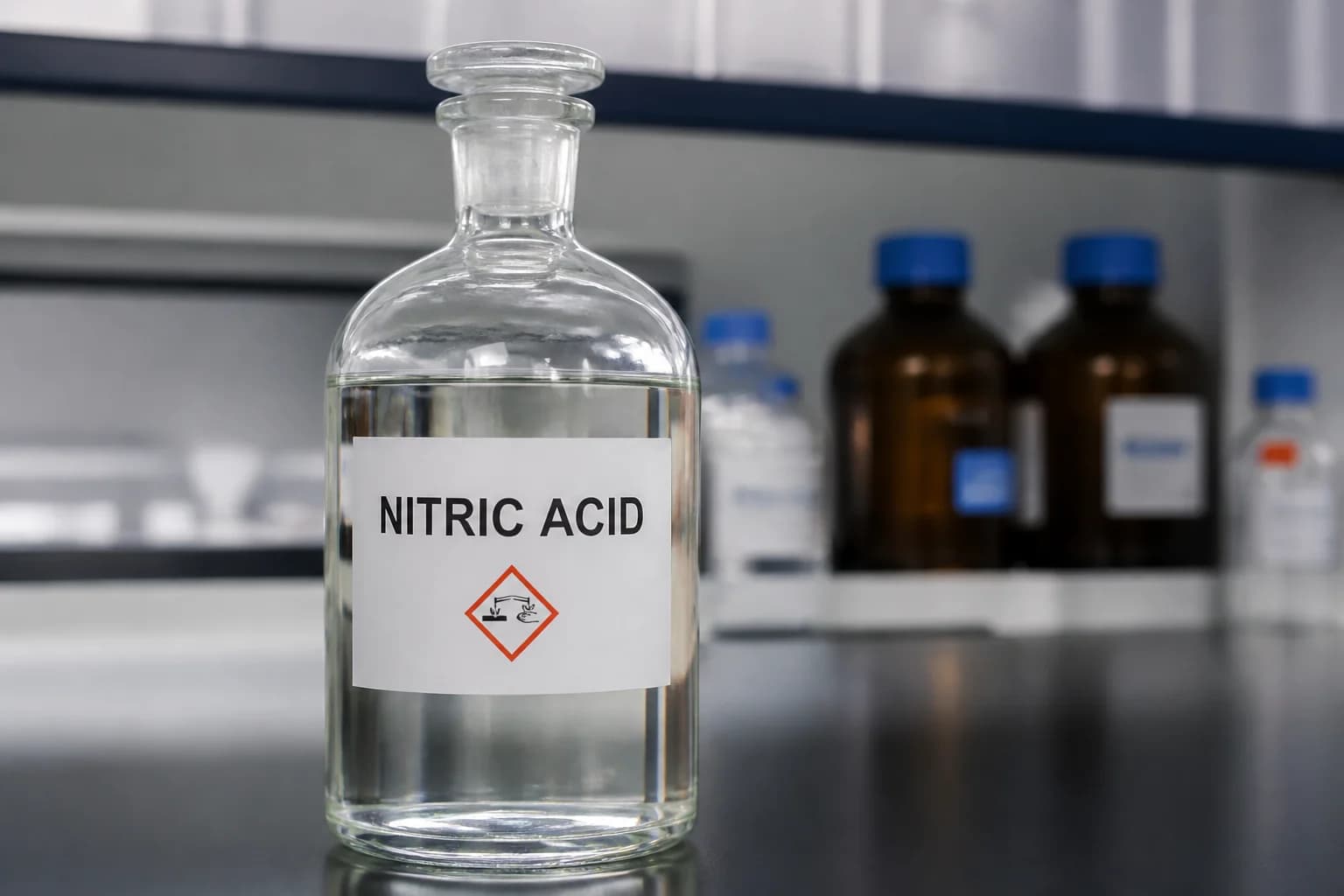
Nitric Acid
ELRASATM – NTA

Get Pricing for This Product
Need pricing? Request a quote for this product and we'll get back to you shortly.
 Free Samples Available
Speed Up Your Sample Testing Process
We deliver domestic samples within 24 - 48 hours, helping you evaluate product without delays.
Nitric Acid is a strong, corrosive, oxidising mineral acid supplied as a colourless to pale-yellow fuming liquid, typically at 60–68%. It functions as a strong oxidising acid, nitrating agent, raw…
CAS Number
7697-37-2
HS Code
28.08.00
INCI Name
Nitric Acid
Molecular Formula
HNO3
Nitric Acid
ELRASATM – NTA
Nitric Acid is a strong, corrosive, oxidising mineral acid supplied as a colourless to pale-yellow fuming liquid, typically at 60–68%. It functions as a strong oxidising acid, nitrating agent, raw material, pickling/etching agent across fertilisers, explosives, chemicals, metals…
CAS Number
7697-37-2
INCI Name
Nitric Acid
HS Code
28.08.00
Molecular Formula
HNO3
Get Pricing for This Product
Need pricing? Request a quote for this product and we'll get back to you shortly.
Free Samples AvailableSpeed Up Your Sample Testing Process
We deliver domestic samples within 24 - 48 hours, helping you evaluate product without delays.
 By
By
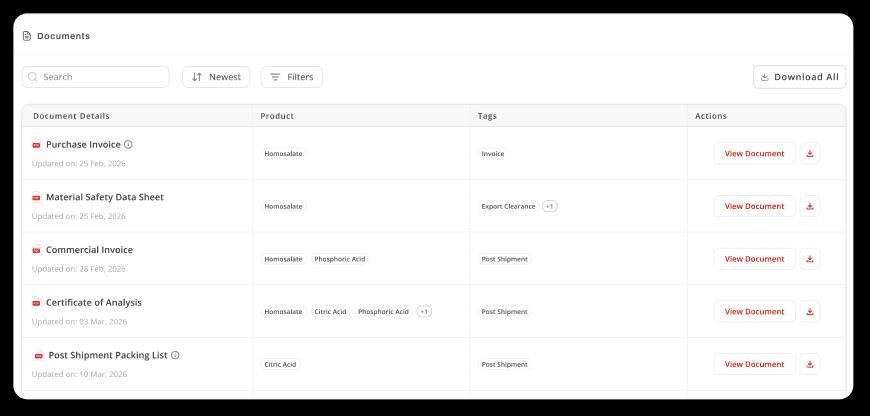
Specialty chemicals, delivered right
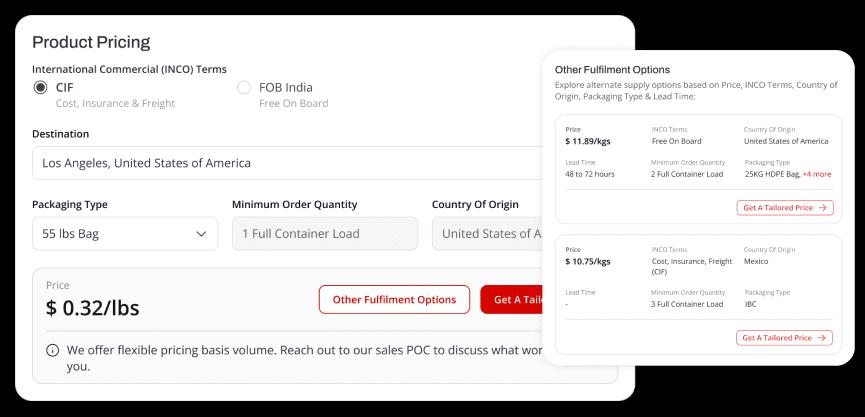
Access live, grade-specific pricing for every chemical, so your teams talks with data, not intuition on Elixir.
Compare fulfilment options across grades, INCO terms, origins, and lead times: all in one platform.

Live, transparent pricing
Real-time quotes across 12,000+ specialty chemicals.

Product Specification
Physical Properties
| Property | Specification |
|---|---|
| Appearance | Colorless to yellow liquid |
| Odor | Acrid, suffocating |
| Assay / Purity | Min 68% HNO₃ |
| Molecular Weight | 63.012 g/mol |
| Density | 1.51 g/cm³ |
| Specific Gravity | 1.405 min (@ 20°C) |
| Viscosity | 0.75 mPa·s |
| Refractive Index | 1.397 (@ 16.5 °C) |
| Ph (Aqueous Solution) | <1 |
Chemical Properties
| Property | Specification |
|---|---|
| Pka | -1.3 |
| Ionic Nature | Strong acid, fully dissociated in dilute solution. |
| Incompatibilities | Alcohols, strong bases, reducing agents, finely powdered metals, organic materials, cyanides, ammonia, acetic acid, acetone, and combustible materials. |
| Hazardous Reactions | A powerful oxidizing agent that can ignite on contact or react explosively with many organic and inorganic substances. Reacts violently with water, releasing heat. Contact with metals can form flammable and explosive hydrogen gas. |
| Hazardous Decomposition Products | Thermal decomposition releases toxic and corrosive nitrogen oxides (NOx). |
Thermal Properties
| Property | Specification |
|---|---|
| Melting Point | -42 °C |
| Boiling Point | 83 °C |
| Flash Point | Not flammable. |
| Decomposition Temperature | 83 °C |
| Thermal Stability | Decomposes upon exposure to heat or light, forming nitrogen dioxide, which can cause a yellow or brown color. |
Dosing Guidelines
A. Dosing by Application
| Application | Recommended / Max Dosage |
|---|---|
| Water Treatment (pH control) | Add slowly until target pH is reached. |
| Cleaning / Descaling | 5-15% solutions are typically used. |
About Nitric Acid
Nitric acid (HNO3) is a strong, highly corrosive and powerfully oxidising mineral acid. Its dominant use is in fertilizer manufacture - chiefly ammonium nitrate - and it is equally essential to the production of explosives, adipic acid (for nylon), nitro-compounds, and in metal pickling, etching, and precious-metal refining. It is supplied most commonly at 60–68% concentration. Nitric acid is both an acid and a strong oxidiser, which gives it its distinctive ability to dissolve most metals (including, with hydrochloric acid as aqua regia, gold and platinum) and to nitrate organic compounds. Concentrated and fuming grades release corrosive, toxic nitrogen-oxide (NOx) fumes and demand specialised handling. Industrial buyers sourcing Nitric Acid in bulk also track nitric acid pricing closely, since it feeds directly into their downstream costs - which is why working with an established nitric acid supplier and distributor like Elchemy matters.
Manufacturing Process of Nitric Acid
Nitric acid is manufactured by the Ostwald process. Ammonia is catalytically oxidised over platinum-rhodium gauze to nitric oxide (NO), which is further oxidised in air to nitrogen dioxide (NO2) and absorbed in water to form nitric acid, typically at 60–68% (weak acid). Concentrated (>68%) and fuming nitric acid are made by further distillation with a dehydrating agent such as sulphuric acid or magnesium nitrate. As a quality-focused nitric acid manufacturer and sourcing partner, Elchemy tests every shipment for assay (concentration), chloride, sulphate and heavy metals before dispatch, with a Certificate of Analysis travelling alongside each order.
Nitric acid price: Bulk Pricing for Industrial Buyers
If you are comparing nitric acid price for bulk procurement, Elchemy provides quotes based on your exact requirements. Share your volume, grade, destination and packaging on the quote form and our team reverts with a detailed offer within 24 to 48 hours. Pricing is quoted rather than published because the cost is driven by the price of ammonia (natural-gas derived) and energy, plus fertiliser demand, not a fixed list. This is why a live quote from a nitric acid supplier is always more accurate than any headline figure. Beyond that, several factors shape the final nitric acid price: grade, committed volume, origin country, packaging format, freight, Incoterm (FOB, CIF or DDP) and import duty (HTS 2808.00 for US-bound shipments). For an approximate read on where the market sits, procurement teams often reference ammonia, natural gas and nitric acid price indices. Trade publications also report the nitric acid price per kg as a unit-level benchmark, useful for spotting short-term regional shifts. At bulk procurement scale, the nitric acid price per ton (or per MT) is the most relevant commercial unit, since contracts are negotiated at that level. For an exact rate, none of these replaces a direct quote. Your final price depends on contract structure, destination, volume and timing - so a quote from our team is always the most accurate number for your procurement.
Packaging & Logistics for Bulk Nitric Acid
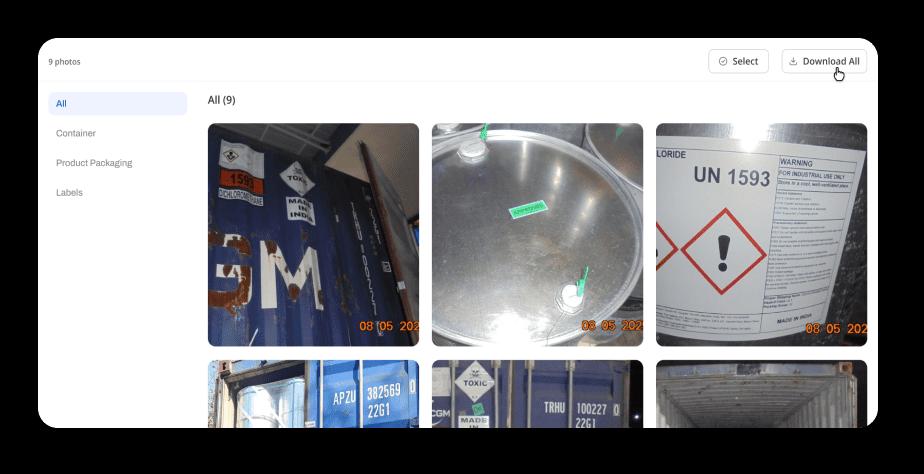
Nitric Acid ships in standard export packaging - bags, drums, IBCs or bulk as the material requires - with both metric and imperial weights, supplied to your specification. A typical 20' container holds a full commercial load depending on packaging. For US, UK and UAE buyers, Elchemy arranges compliant freight and customs documentation, offering EXW, FOB, CIF and DDP terms. Transit times and stock position are confirmed at quotation, and samples are dispatched within 24 to 48 hours. Store per the conditions on the TDS. As a global nitric acid distributor, Elchemy ships to 40+ countries with the documentation each destination market requires.
Why Choose Elchemy as a Trusted Nitric Acid Supplier
Elchemy makes sourcing Nitric Acid straightforward for industrial buyers. Every order ships with a Certificate of Analysis, TDS and GHS-aligned SDS as standard, across the grades listed above. Because we source across multiple origins, we quote the best landed cost for your destination rather than a single nitric acid manufacturer's list price. Partner plants operate to recognised quality standards (ISO 9001, plus food/pharma certifications where relevant), with Halal and Kosher documentation on request. From the USA and UK to the UAE and beyond, Elchemy serves as a single nitric acid supplier, manufacturer and distributor relationship - with samples before bulk and pricing tailored to your volume and contract terms.
Safety & Handling
Classified under GHS as Oxidiser Category 3 (H272), Skin Corrosive Category 1A (H314). DOT/UN: UN2031, Class 8 Corrosive (subsidiary 5.1 Oxidiser for higher strengths), Packing Group II. Nitric acid is severely corrosive AND a strong oxidiser, a doubly hazardous combination. It causes deep burns and characteristic yellow staining of skin and tissue, and its brown NOx vapour severely damages the lungs, sometimes with delayed onset. As an oxidiser it can ignite contact with organics, wood, solvents and reducing agents, and reacts violently with bases and many metals (releasing NOx). It is a security-controlled explosives precursor. Handle only with full acid/oxidiser-rated PPE, fume extraction and specialised storage, and confirm licensing for the destination market. The full 16-section GHS-aligned SDS is available alongside every Nitric Acid order.
- Strong Oxidizing Agent: Essential for nitration reactions in chemical manufacturing.
- Function: Primarily acts as a strong oxidizing agent and a nitrating agent.
- Key in Fertilizer Production: Used to produce ammonium nitrate, a vital agricultural input.
- Features: Highly corrosive, strong mineral acid, high reactivity with metals and organic compounds, and effective in dissolving metal oxides and impurities.
- Critical for Explosives: Provides nitrogen content for explosives like TNT and nitroglycerin.
- Benefits: Essential for producing nitrogen-based fertilizers, a key precursor for many explosives, effective for metal cleaning and passivation, and a versatile reagent in chemical synthesis.
- Metal Processing Aid: Used for pickling and passivation to clean and protect metals.
- Versatile Industrial Use: Employed in water treatment, pharmaceuticals, and more.
About Nitric Acid
Nitric acid (HNO3) is a strong, highly corrosive and powerfully oxidising mineral acid. Its dominant use is in fertilizer manufacture - chiefly ammonium nitrate - and it is equally essential to the production of explosives, adipic acid (for nylon), nitro-compounds, and in metal pickling, etching, and precious-metal refining. It is supplied most commonly at 60–68% concentration. Nitric acid is both an acid and a strong oxidiser, which gives it its distinctive ability to dissolve most metals (including, with hydrochloric acid as aqua regia, gold and platinum) and to nitrate organic compounds. Concentrated and fuming grades release corrosive, toxic nitrogen-oxide (NOx) fumes and demand specialised handling. Industrial buyers sourcing Nitric Acid in bulk also track nitric acid pricing closely, since it feeds directly into their downstream costs - which is why working with an established nitric acid supplier and distributor like Elchemy matters.
Manufacturing Process of Nitric Acid
Nitric acid is manufactured by the Ostwald process. Ammonia is catalytically oxidised over platinum-rhodium gauze to nitric oxide (NO), which is further oxidised in air to nitrogen dioxide (NO2) and absorbed in water to form nitric acid, typically at 60–68% (weak acid). Concentrated (>68%) and fuming nitric acid are made by further distillation with a dehydrating agent such as sulphuric acid or magnesium nitrate. As a quality-focused nitric acid manufacturer and sourcing partner, Elchemy tests every shipment for assay (concentration), chloride, sulphate and heavy metals before dispatch, with a Certificate of Analysis travelling alongside each order.
Nitric acid price: Bulk Pricing for Industrial Buyers
If you are comparing nitric acid price for bulk procurement, Elchemy provides quotes based on your exact requirements. Share your volume, grade, destination and packaging on the quote form and our team reverts with a detailed offer within 24 to 48 hours. Pricing is quoted rather than published because the cost is driven by the price of ammonia (natural-gas derived) and energy, plus fertiliser demand, not a fixed list. This is why a live quote from a nitric acid supplier is always more accurate than any headline figure. Beyond that, several factors shape the final nitric acid price: grade, committed volume, origin country, packaging format, freight, Incoterm (FOB, CIF or DDP) and import duty (HTS 2808.00 for US-bound shipments). For an approximate read on where the market sits, procurement teams often reference ammonia, natural gas and nitric acid price indices. Trade publications also report the nitric acid price per kg as a unit-level benchmark, useful for spotting short-term regional shifts. At bulk procurement scale, the nitric acid price per ton (or per MT) is the most relevant commercial unit, since contracts are negotiated at that level. For an exact rate, none of these replaces a direct quote. Your final price depends on contract structure, destination, volume and timing - so a quote from our team is always the most accurate number for your procurement.
Packaging & Logistics for Bulk Nitric Acid
Nitric Acid ships in standard export packaging - bags, drums, IBCs or bulk as the material requires - with both metric and imperial weights, supplied to your specification. A typical 20' container holds a full commercial load depending on packaging. For US, UK and UAE buyers, Elchemy arranges compliant freight and customs documentation, offering EXW, FOB, CIF and DDP terms. Transit times and stock position are confirmed at quotation, and samples are dispatched within 24 to 48 hours. Store per the conditions on the TDS. As a global nitric acid distributor, Elchemy ships to 40+ countries with the documentation each destination market requires.
Why Choose Elchemy as a Trusted Nitric Acid Supplier
Elchemy makes sourcing Nitric Acid straightforward for industrial buyers. Every order ships with a Certificate of Analysis, TDS and GHS-aligned SDS as standard, across the grades listed above. Because we source across multiple origins, we quote the best landed cost for your destination rather than a single nitric acid manufacturer's list price. Partner plants operate to recognised quality standards (ISO 9001, plus food/pharma certifications where relevant), with Halal and Kosher documentation on request. From the USA and UK to the UAE and beyond, Elchemy serves as a single nitric acid supplier, manufacturer and distributor relationship - with samples before bulk and pricing tailored to your volume and contract terms.
Safety & Handling
Classified under GHS as Oxidiser Category 3 (H272), Skin Corrosive Category 1A (H314). DOT/UN: UN2031, Class 8 Corrosive (subsidiary 5.1 Oxidiser for higher strengths), Packing Group II. Nitric acid is severely corrosive AND a strong oxidiser, a doubly hazardous combination. It causes deep burns and characteristic yellow staining of skin and tissue, and its brown NOx vapour severely damages the lungs, sometimes with delayed onset. As an oxidiser it can ignite contact with organics, wood, solvents and reducing agents, and reacts violently with bases and many metals (releasing NOx). It is a security-controlled explosives precursor. Handle only with full acid/oxidiser-rated PPE, fume extraction and specialised storage, and confirm licensing for the destination market. The full 16-section GHS-aligned SDS is available alongside every Nitric Acid order.
- Strong Oxidizing Agent: Essential for nitration reactions in chemical manufacturing.
- Function: Primarily acts as a strong oxidizing agent and a nitrating agent.
- Key in Fertilizer Production: Used to produce ammonium nitrate, a vital agricultural input.
- Features: Highly corrosive, strong mineral acid, high reactivity with metals and organic compounds, and effective in dissolving metal oxides and impurities.
- Critical for Explosives: Provides nitrogen content for explosives like TNT and nitroglycerin.
- Benefits: Essential for producing nitrogen-based fertilizers, a key precursor for many explosives, effective for metal cleaning and passivation, and a versatile reagent in chemical synthesis.
- Metal Processing Aid: Used for pickling and passivation to clean and protect metals.
- Versatile Industrial Use: Employed in water treatment, pharmaceuticals, and more.
Regulatory Compliance
| Region | Max Allowed Level | Notes | Certification Body |
|---|---|---|---|
| India | - | Regulated under HSN Code 28080010 for taxation and trade. | - |
| United States | - | Listed on the TSCA (Toxic Substances Control Act) inventory. Regulated as a hazardous substance. | TSCA |
| European Union | 3% | Registered under REACH. Self-classified for acute toxicity by inhalation (Category 3 for concentrations >26%). Subject to Seveso Directive storage rules based on concentration and quantity. | REACH |
FAQs - Nitric Acid
Related Products

Related Products

Streamline
Your Chemical
Procurement
Get fast responses from real experts