
Corn Starch
ELVISCTM – CST G4

Get Pricing for This Product
Need pricing? Request a quote for this product and we'll get back to you shortly.
 Free Samples Available
Speed Up Your Sample Testing Process
We deliver domestic samples within 24 - 48 hours, helping you evaluate product without delays.
Corn Starch is a versatile carbohydrate extracted from the endosperm of corn kernels. It is widely used in the food industry as a thickening agent for soups, sauces, and gravies. In addition to its…
CAS Number
65996-63-6
HS Code
1108.12.00.00
INCI Name
Corn Starch
Molecular Formula
(C6H10O5)n
Corn Starch
ELVISCTM – CST G4
Corn Starch is a versatile carbohydrate extracted from the endosperm of corn kernels. It is widely used in the food industry as a thickening agent for soups, sauces, and gravies. In addition to its culinary applications, Corn Starch is utilized in the pharmaceutical industry as a…
CAS Number
65996-63-6
INCI Name
Corn Starch
HS Code
1108.12.00.00
Molecular Formula
(C6H10O5)n
Get Pricing for This Product
Need pricing? Request a quote for this product and we'll get back to you shortly.
Free Samples AvailableSpeed Up Your Sample Testing Process
We deliver domestic samples within 24 - 48 hours, helping you evaluate product without delays.
 By
By
Specialty chemicals, delivered right
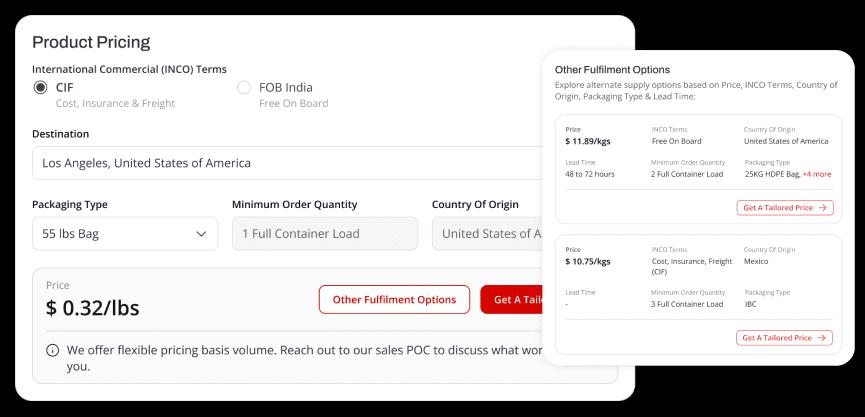
Access live, grade-specific pricing for every chemical, so your teams talks with data, not intuition on Elixir.
Compare fulfilment options across grades, INCO terms, origins, and lead times: all in one platform.

Live, transparent pricing
Real-time quotes across 12,000+ specialty chemicals.


Product Specification
Physical Properties
| Property | Specification |
|---|---|
| Appearance | A matt, white to slight yellowish, very fine powder, which creaks when pressed between the fingers. |
| Odor | Odorless |
| Molecular Weight | The molecular weight of the base unit is 162.14 g/mol. |
| Density / Specific Gravity | 1.5 g/cm³ |
| Refractive Index | 1.591 |
| Ph (Aqueous Solution) | 4.00 – 7.00 |
| Assay / Purity | The material is conformed as per the BP specification. |
Chemical Properties
| Property | Specification |
|---|---|
| Ionic Nature | Covalent. |
| Incompatibilities | Strong oxidizing agents. |
| Hazardous Reactions / Decomposition Products | If the product is consumed by flame, thermal decomposition byproducts may include carbon monoxide, carbon dioxide, and smoke. |
Thermal Properties
| Property | Specification |
|---|---|
| Melting Point | Decomposes before melting. |
| Boiling Point | Decomposes. |
| Autoignition Temperature | 400 °C / 752 °F |
| Thermal Stability | Stable under normal operational conditions. Refrigeration treatment enhances the thermal stability of corn starch. |
Processing Methods & Reference Formulations
A. Metronidazole Sustained-Release Tablets
Granules were prepared by wet granulation method using acacia gum as the binder and acetylated corn starch as a disintegrant. Lactose was used as the diluent. The tablets produced met the standard requirements for friability, hardness, and content uniformity, and provided sustained release of metronidazole over several hours.
| Key Ingredients | Indicative Dosage (% w/w) |
|---|---|
| Acetylated Corn Starch | 5, 7.5, 10, 15, 20, and 25% |
B. Low-Fat Whipped Cream
Micronized cornstarch was used to partially substitute the fat in whipped cream.
| Key Ingredients | Indicative Dosage (% w/w) |
|---|---|
| Fat | 85% |
| Micronized Cornstarch | 15% |
Dosing Guidelines
A. Dosing by Application
| Application | Recommended / Max Dosage |
|---|---|
| Disintegrating agent for tablets | 3-15% |
| Binder in wet granulation | 2.5–7.5% (w/v) |
| Lotions (to reduce tack and oiliness) | 0.5–3% |
| Cream to powder formulations | Up to 30% |
| Topical body powders | Up to 99% |
About Corn Starch
Corn Starch, also known as maize starch, is a white, odorless powder derived from the endosperm of corn kernels. It is a key ingredient in the food industry, where it serves as a thickening agent for soups, sauces, and gravies. Corn Starch manufacturers focus on producing high-quality, pure starch to meet the diverse needs of various industries. In the pharmaceutical sector, it is used as a binder and disintegrant in tablet formulations, ensuring the effective delivery of active ingredients. The paper industry utilizes Corn Starch as a binder to enhance the strength and quality of paper products. Its moisture-absorbing properties make it a popular choice in personal care products, where it helps reduce friction and absorb excess oil. Corn Starch suppliers are committed to sustainable production practices, ensuring minimal environmental impact while meeting the growing demand for this versatile compound.
- Versatile Thickening Agent: Essential in culinary applications for creating smooth, consistent textures.
- Function: Primarily used as a pharmaceutical excipient.
- High Purity Standards: Ensures performance in food, pharmaceuticals, and industrial applications.
- Binder: Forms a paste when granulated to hold tablet ingredients together, ensuring tablet robustness.
- Eco-Friendly Production: Focus on sustainable practices to minimize environmental impact.
- Disintegrant: Absorbs water and swells, causing tablets to break apart in the body for rapid release of the active ingredient.
- Effective Binder: Enhances the structural integrity of tablets and paper products.
- Filler/Diluent: Adds bulk to formulations with small amounts of active pharmaceutical ingredients (API) to create tablets of a practical size.
- Moisture Absorbent: Ideal for personal care products to reduce friction and absorb excess oil.
- Glidant: Its small particle size can help improve the flowability of powders during manufacturing.
- Features & Benefits: Biocompatible, cost-effective, non-toxic, non-irritant, and derived from a natural, renewable source.
About Corn Starch
Corn Starch, also known as maize starch, is a white, odorless powder derived from the endosperm of corn kernels. It is a key ingredient in the food industry, where it serves as a thickening agent for soups, sauces, and gravies. Corn Starch manufacturers focus on producing high-quality, pure starch to meet the diverse needs of various industries. In the pharmaceutical sector, it is used as a binder and disintegrant in tablet formulations, ensuring the effective delivery of active ingredients. The paper industry utilizes Corn Starch as a binder to enhance the strength and quality of paper products. Its moisture-absorbing properties make it a popular choice in personal care products, where it helps reduce friction and absorb excess oil. Corn Starch suppliers are committed to sustainable production practices, ensuring minimal environmental impact while meeting the growing demand for this versatile compound.
- Versatile Thickening Agent: Essential in culinary applications for creating smooth, consistent textures.
- Function: Primarily used as a pharmaceutical excipient.
- High Purity Standards: Ensures performance in food, pharmaceuticals, and industrial applications.
- Binder: Forms a paste when granulated to hold tablet ingredients together, ensuring tablet robustness.
- Eco-Friendly Production: Focus on sustainable practices to minimize environmental impact.
- Disintegrant: Absorbs water and swells, causing tablets to break apart in the body for rapid release of the active ingredient.
- Effective Binder: Enhances the structural integrity of tablets and paper products.
- Filler/Diluent: Adds bulk to formulations with small amounts of active pharmaceutical ingredients (API) to create tablets of a practical size.
- Moisture Absorbent: Ideal for personal care products to reduce friction and absorb excess oil.
- Glidant: Its small particle size can help improve the flowability of powders during manufacturing.
- Features & Benefits: Biocompatible, cost-effective, non-toxic, non-irritant, and derived from a natural, renewable source.
Regulatory Compliance
| Region | Max Allowed Level | Notes | Certification Body |
|---|---|---|---|
| United States | - | Generally Recognized as Safe (GRAS) for food use (21 CFR 182.90, 172.892). Listed in the FDA Inactive Ingredient Database for multiple pharmaceutical dosage forms. Considered safe for use in cosmetics by the CIR Expert Panel. | Conformance with USP/NF monograph for pharmaceutical use. Subject to TSCA regulations. |
| European Union | - | Approved as a food additive (E 1401 for Acid-treated starch). Listed in the European Pharmacopoeia. Compliant with cosmetic regulations. | Conformance with Ph. Eur. monograph. REACH registration may be required depending on tonnage. |
| Canada | - | Listed in the Natural Health Products Ingredients Database as an approved non-medicinal ingredient (binder, stabilizing agent, thickening agent). | Conformance with BP or USP monograph is generally accepted. |
| India | - | Conforms to Indian Pharmacopoeia (IP) and British Pharmacopoeia (BP) standards for pharmaceutical use. | Conformance with IP/BP monograph. |
| Japan | - | Listed in the Japanese Pharmacopoeia (JP). Permitted for use in cosmetics and quasi-drugs. | Conformance with JP monograph. |
| Australia | - | Listed on the Australian Inventory of Industrial Chemicals (AIIC). Accepted as an excipient in therapeutic goods. | Conformance with BP or USP monograph is generally accepted. |
| China | - | Listed in the Inventory of Existing Cosmetic Ingredients in China (IECIC). Conforms to Chinese Pharmacopoeia (ChP). | Conformance with ChP monograph. |
| Republic of Korea | - | Permitted for use in cosmetics and pharmaceuticals. | Conformance with Korean Pharmacopoeia (KP). |
| ASEAN | - | Permitted for use in cosmetic products under the ASEAN Cosmetic Directive. | Conformance with a recognized pharmacopoeia (e.g., BP, USP) is generally required for pharmaceutical use. |
FAQs - Corn Starch
Related Products



Related Products

Streamline
Your Chemical
Procurement
Get fast responses from real experts