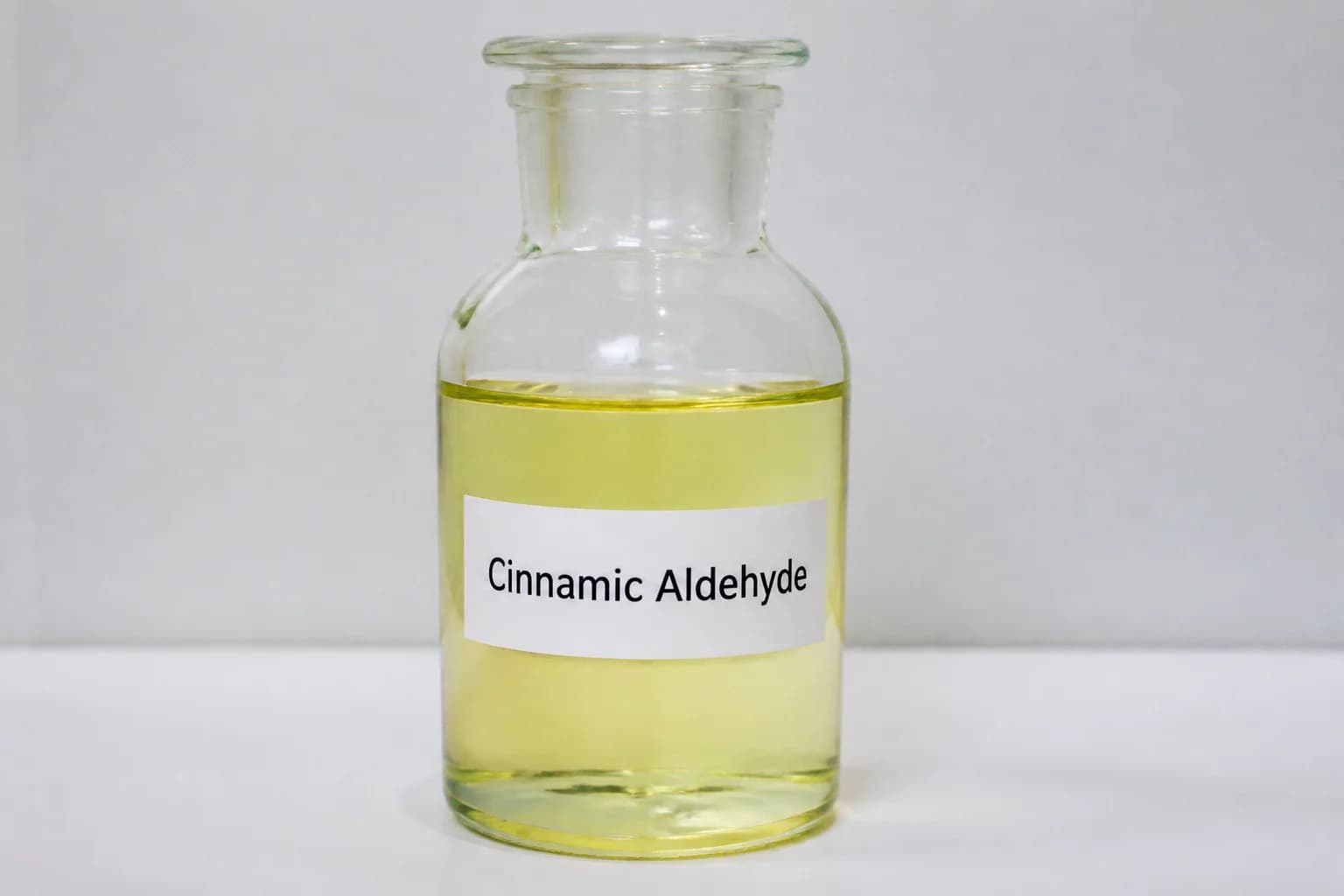
Cinnamic Aldehyde
ELAROMATM – CNAL
Get Pricing For This Product
Skip the quote. Sign up now and see pricing instantly
Speed Up Your Sample Testing Process
Express Delivery in 24–48 Hours
Cinnamic Aldehyde is a naturally occurring organic compound that gives cinnamon its flavor and odor. It is widely used in the flavor and fragrance industry, as well as in the formulation of perfumes,…
CAS Number
104-55-2
HS Code
29.12.29.10
INCI Name
Cinnamic Aldehyde
Molecular Formula
C₉H₈O
Cinnamic Aldehyde
ELAROMATM – CNAL
Cinnamic Aldehyde is a naturally occurring organic compound that gives cinnamon its flavor and odor. It is widely used in the flavor and fragrance industry, as well as in the formulation of perfumes, cosmetics, and food products. Known for its antimicrobial properties, it is also…
CAS Number
104-55-2
INCI Name
Cinnamic Aldehyde
HS Code
29.12.29.10
Molecular Formula
C₉H₈O
Get Pricing For This Product
Skip the quote. Sign up now and see pricing instantly
Speed Up Your Sample Testing Process
We deliver domestic samples within 24 - 48 hours, helping you evaluate product without delays.
Product Specification
Physical Properties
| Property | Specification |
|---|---|
| Appearance | Clear yellow liquid |
| Odor | Strong odor of cinnamon |
| Molecular Weight (G/Mol) | 132.16 |
| Density Or Specific Gravity | 1.048-1.052 at 25 °C |
| Refractive Index | 1.618-1.623 at 20 °C/D |
Chemical Properties
| Property | Specification |
|---|---|
| Pka | 0[at 20 ℃] |
| Water Solubility | Slightly soluble |
| Incompatibilities | Strong oxidizing agents, strong bases |
Thermal Properties
| Property | Specification |
|---|---|
| Melting Point | -7.5 °C |
| Boiling Point | 253 °C |
| Flash Point | 160 °F |
Processing Methods & Reference Formulations
A. Perfume
Pre-dilute in a solvent to improve blending and control intensity. Pair with oriental, woody, or gourmand notes like vanilla, clove, or amber to create warm, rich accords. Use at low levels as it has a very strong, spicy-cinnamon scent and can easily overpower a blend.
| Key Ingredients | Indicative Dosage (% w/w) |
|---|---|
| Cinnamic Aldehyde | 0.01% |
| Eugenol | 1% |
| Iso Eugenol | 0.5% |
| Coumarin | 1.5% |
| Benzyl Salicylate | 5% |
| Linalool | 5% |
| Linalyl Acetate | 4% |
| Benzyl Acetate | 3% |
| Geraniol | 2% |
| Hydroxycitronellal | 3% |
| Citronellol | 3% |
| Phenylethyl Alcohol | 8% |
| Hexyl Cinnamic Aldehyde | 10% |
| Vanillin | 1.5% |
| Methyl Dihydrojasmonate (Hedione) | 6% |
| Iso E Super | 10% |
| Galaxolide 50% | 12% |
| Ambroxan | 4% |
| Patchouli Oil | 5% |
| Sandalore | 5% |
| Cashmeran | 3% |
| Fixative blend (e.g., DPG, TEC) | ~10% |
B. Shampoo
Use at low levels as it is highly potent and can be irritating at higher concentrations. Add during the cool-down phase, to preserve its fragrance and avoid volatility loss. Pre-mix with a solubilizer for proper dispersion in the water-based shampoo.
| Key Ingredients | Indicative Dosage (% w/w) |
|---|---|
| Sodium laureth sulfate | 20% |
| Sodium lauroamphoacetate | 5% |
| Cocoamphodiacetate | 3% |
| Soybean oil | 2% |
| Citric acid | 1.5% |
| Fragrance blend (contains cinnamic aldehyde) | 0.5% |
| Water | 68% |
C. Detergents
Use at low levels, as it has a strong spicy scent and potential for skin irritation in higher doses. Add during the final mixing stage, after cooling, to preserve its fragrance and prevent volatilization. Ensure pH compatibility, as high-pH detergents may cause degradation.
| Key Ingredients | Indicative Dosage (% w/w) |
|---|---|
| Sodium C12–C14 linear alkylbenzene sulfonate | 18% |
| Alcohol ethoxylate (non-ionic surfactant) | 8% |
| Sodium carbonate | 5% |
| Zeolite or citrate builder | 5% |
| Enzyme blend (protease/amylase) | 0.5% |
| Polycarboxylate polymer | 1% |
| Perfume composition (includes cinnamic aldehyde) | 1% |
| Optical brightener | 0.2% |
| Preservative (e.g., benzisothiazolinone) | 0.2% |
| Sodium citrate | 1% |
| Water | 60% |
D. Cosmetic cream
Use at very low levels, as it is a strong fragrance and known skin sensitizer. Add during the cool-down phase, to protect its aroma and prevent degradation. Pre-dilute in a suitable carrier (e.g., caprylic/capric triglyceride or fragrance oil) to ensure even distribution in the cream base.
| Key Ingredients | Indicative Dosage (% w/w) |
|---|---|
| Water | ~70% |
| Glycerin | 5% |
| Caprylic/Capric Triglyceride | 4% |
| Cetearyl Alcohol | 3% |
| Glyceryl Stearate | 2.5% |
| Dimethicone | 1% |
| Phenoxyethanol | 0.8% |
| Ethylhexylglycerin | 0.2% |
| Carbomer | 0.3% |
| Triethanolamine | 0.2% |
| Tocopherol | 0.2% |
| Cinnamic Aldehyde | 0.01% |
| Fragrance blend | 0.5% |
| Panthenol | 0.5% |
| Disodium EDTA | 0.1% |
| Allantoin | 0.1% |
Dosing Guidelines
A. Dosing by Application
| Products | Authorized dosage |
|---|---|
| Perfume/Fragrance | Upto 0.01% |
| Cosmetics | Upto 0.01% |
About Cinnamic Aldehyde
Cinnamic Aldehyde, also known as Cinnamaldehyde, is a versatile organic compound widely used in the flavor and fragrance industry. As a key ingredient in cinnamon oil, it imparts a warm, spicy aroma and flavor, making it a popular choice for food and beverage applications. Cinnamic Aldehyde manufacturers focus on producing high-purity compounds to meet the stringent demands of the flavor and fragrance sectors. Its antimicrobial properties make it valuable in personal care products, where it helps inhibit microbial growth and enhance product safety. The compound's natural origin and potent aromatic profile make it a preferred choice for manufacturers seeking to create authentic, appealing products. Sustainability is a growing focus for Cinnamic Aldehyde suppliers, with efforts to source raw materials responsibly and minimize environmental impact during production. These initiatives align with the increasing demand for eco-friendly ingredients in the global market. Cinnamic Aldehyde's versatility extends to industrial applications, where it serves as a surfactant and colorant, further highlighting its importance in modern industry.
- Natural Flavor and Fragrance: Provides a warm, spicy cinnamon aroma and flavor, enhancing product appeal.
- High Purity Standards: Ensures consistent performance in flavor and fragrance applications.
- Antimicrobial Properties: Inhibits microbial growth in personal care products, enhancing safety and shelf life.
- Eco-Friendly Production: Focus on sustainable sourcing and minimal environmental impact.
- Versatile Industrial Applications: Used as a surfactant and colorant in various formulations.
About Cinnamic Aldehyde
Cinnamic Aldehyde, also known as Cinnamaldehyde, is a versatile organic compound widely used in the flavor and fragrance industry. As a key ingredient in cinnamon oil, it imparts a warm, spicy aroma and flavor, making it a popular choice for food and beverage applications. Cinnamic Aldehyde manufacturers focus on producing high-purity compounds to meet the stringent demands of the flavor and fragrance sectors. Its antimicrobial properties make it valuable in personal care products, where it helps inhibit microbial growth and enhance product safety. The compound's natural origin and potent aromatic profile make it a preferred choice for manufacturers seeking to create authentic, appealing products. Sustainability is a growing focus for Cinnamic Aldehyde suppliers, with efforts to source raw materials responsibly and minimize environmental impact during production. These initiatives align with the increasing demand for eco-friendly ingredients in the global market. Cinnamic Aldehyde's versatility extends to industrial applications, where it serves as a surfactant and colorant, further highlighting its importance in modern industry.
- Natural Flavor and Fragrance: Provides a warm, spicy cinnamon aroma and flavor, enhancing product appeal.
- High Purity Standards: Ensures consistent performance in flavor and fragrance applications.
- Antimicrobial Properties: Inhibits microbial growth in personal care products, enhancing safety and shelf life.
- Eco-Friendly Production: Focus on sustainable sourcing and minimal environmental impact.
- Versatile Industrial Applications: Used as a surfactant and colorant in various formulations.
Regulatory Compliance
| Region | Max Allowed Level | Notes | Certification Body |
|---|---|---|---|
| Australia | 0.05% | No explicit national limit; aligns with IFRA and international safety assessments | - |
| China | 0.05% | No explicit national restriction; aligns with IFRA standards for fragrance use | NMPA - National Medical Products Administration |
| Japan | 0.05% | No explicit national restriction; generally aligns with IFRA standards. | MHLW – Ministry of Health, Labour and Welfare |
| Republic of Korea | 0.05% | No explicit national restriction; aligns with IFRA standards for fragrance use | MFDS - Ministry of Food and Drug Safety |
| United States | 0.05% | In the United States, the regulatory status includes approval by the Food and Drug Administration (FDA) and Generally Recognized as Safe (GRAS) as flavor ingredients. Industry follows IFRA guidelines. | FDA |
| ASEAN | 0.05% | ASEAN Cosmetic Directive references IFRA for fragrance allergens; no explicit national limit. | - |
| European Union | 0.05% | Listed as a fragrance allergen; must be labeled if >0.001% (leave-on) or >0.01% (rinse-off). SCCS recommends a concentration limit of 0.01% for safe use of cinnamaldehyde as a fragrance in cosmetic products. | SCCS |
FAQs - Cinnamic Aldehyde
Streamline
Your Chemical
Procurement
Get fast responses from real experts