

At a Glance
- The name describes a physical change: Nearly pure acetic acid can form ice-like crystals near 16.6°C, which gave rise to the word “glacial.”
- It is not a different chemical: Glacial acetic acid is acetic acid, also called ethanoic acid, in a nearly water-free form.
- Water changes phase behaviour: Diluted acetic acid solutions do not behave like nearly pure material at the same temperature.
- The name is not a specification: “Glacial” does not replace a current assay, certificate of analysis, safety data sheet, or technical data sheet.
- Technical review still matters: If crystallisation, storage, or use conditions affect an operation, follow the current product documentation and site procedures.
What you’ll learn
This guide explains why nearly pure acetic acid is called glacial, how its phase behaviour relates to the name, and what technical readers should verify before working with the material.
Introduction
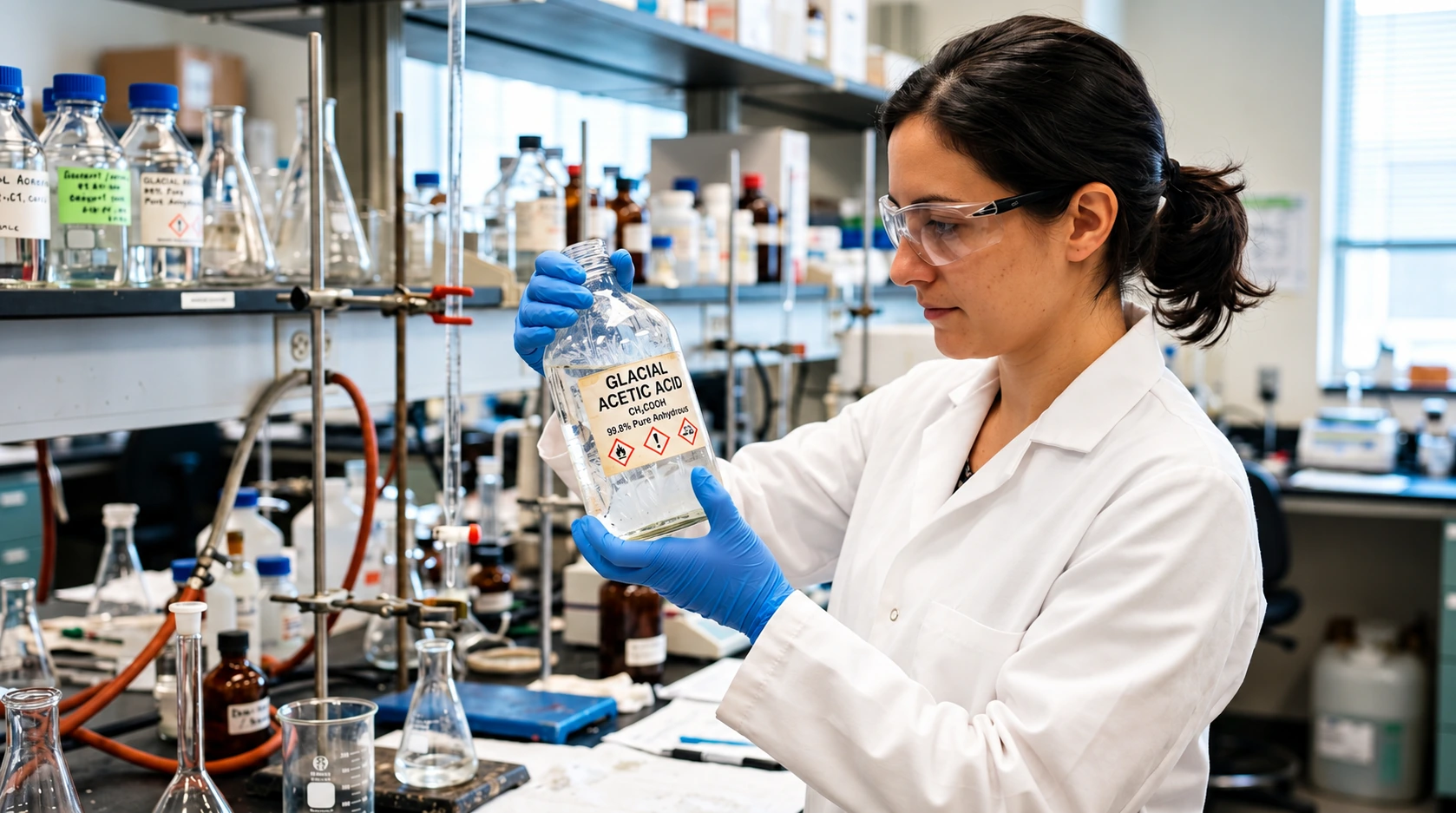
Pure acetic acid is called glacial acetic acid because it can solidify into clear, ice-like crystals in ordinary ambient conditions. The name describes that appearance. It does not mean that glacial acetic acid is a separate chemical.
Acetic acid and ethanoic acid are two names for the same compound, CH₃COOH. In practice, “glacial” signals a nearly water-free form whose phase behaviour differs from a diluted solution. Readers who need application-specific information should review Glacial Acetic Acid specifications alongside the current COA, SDS, and technical documentation. This distinction helps prevent terminology from being mistaken for an approved application, specification, or handling instruction. This article explains the terminology and the underlying physical behaviour, rather than providing a handling procedure.
The short answer: why “glacial”?
The word “glacial” comes from the ice-like crystals that nearly pure acetic acid can form as it solidifies. NIST lists a fusion temperature of 289.6 ± 0.5 K, approximately 16.5°C. NIST’s acetic acid data also identifies glacial acetic acid as another name for acetic acid.
The name is descriptive, not a separate grade. Its ice-like appearance gave the material its historic name.
| Temperature condition | Likely physical observation for nearly pure acetic acid | What the observation means |
| Above its phase-change temperature | Liquid | The material remains liquid. |
| Near its phase-change temperature | Transition may begin | Review product documentation. |
| Below its phase-change temperature | Ice-like crystals | This appearance explains “glacial.” |
Acetic acid, ethanoic acid, and glacial acetic acid
Acetic acid and ethanoic acid name the same compound, while “glacial” describes its concentrated, nearly water-free form. NIST lists the molecular formula as C₂H₄O₂ and CAS Registry Number as 64-19-7. Read the product name with its specification.
| Term | Meaning | What it does not confirm | What technical teams should check |
| Acetic acid | Common name for CH₃COOH. | Grade or use fit. | Specification and COA. |
| Ethanoic acid | Systematic name for CH₃COOH. | A different chemical. | CAS number and identity. |
| Glacial acetic acid | Nearly water-free acetic acid. | Certification or use approval. | Assay, SDS, and TDS. |
| Vinegar | Aqueous food product containing acetic acid. | Interchangeability with industrial acid. | Relevant product standard. |
Why water changes the freezing behaviour
Water changes an acetic-acid mixture, so diluted solutions do not behave like nearly pure glacial acetic acid at the same temperature. Vinegar therefore does not show the same crystal-forming behaviour.
Appearance alone does not establish composition or quality. Use the current product specification and COA to assess the supplied material.
This matters in formulation, quality review, and receiving. Teams can explore food and nutrition ingredients, then assess the exact material against approved requirements.
Glacial acetic acid versus vinegar
Glacial acetic acid and vinegar are not interchangeable because they differ fundamentally in concentration, intended context, and technical-review needs. Vinegar is an aqueous product containing acetic acid, whereas glacial acetic acid refers to concentrated, nearly water-free material used in technical and industrial settings.
Search results often blend household and industrial questions. Qualified reviewers must confirm the material and intended use for any regulated application.
| Comparison point | Glacial acetic acid | Vinegar |
| Chemical context | Concentrated acetic acid used in technical or industrial contexts. | Aqueous consumer or food product containing acetic acid. |
| Water content | Nearly water-free form, subject to the product specification. | Water is a principal component. |
| Phase behaviour | Can form ice-like crystals near its fusion temperature. | Does not behave like nearly pure acetic acid at the same temperature. |
| Review need | Requires current product and site documentation. | Requires evaluation against the applicable food or consumer-product context. |
| Interchangeability | Not a substitute for a consumer or food product. | Not a substitute for industrial glacial material. |
Why the term matters to industrial buyers and technical teams
For industrial users, “glacial” signals that product-specific specification and safety review are essential. It should prompt confirmation of the assay, documents, intended application, and operational requirements.
Personal care teams can explore personal care ingredient options, while buyers can review North American chemical sourcing support. Both routes still require product-level qualification.
The CDC/NIOSH Pocket Guide for acetic acid supports occupational-hazard context. It does not replace the SDS or site procedures.
A practical terminology and document check
Before approving or using glacial acetic acid, verify the product identity and current documents. This separates an educational term from a technically defensible material decision.
- Confirm the exact material name, CAS number, and intended application.
- Review the current product specification for assay and relevant quality limits.
- Review the current COA and SDS for the material being evaluated.
- Confirm internal requirements for quality, regulatory, receiving, and handling review.
- Escalate questions about crystallisation, compatibility, storage, transport, or process use to the supplier and qualified site personnel.
If the decision extends beyond terminology into procurement, use choose an industrial acid supplier [Where to Buy Acid: How to Choose an Industrial Chemical Supplier] once that planned resource is published. For a broader production need, custom chemical manufacturing capabilities may be relevant, but it does not replace product-level qualification.
Frequently asked questions
1. Why is pure acetic acid called glacial acetic acid?
Pure or nearly water-free acetic acid is called glacial because it can solidify into clear, ice-like crystals near 16.6°C. The name describes this physical appearance and phase behaviour. It does not mean that glacial acetic acid is a different molecule from acetic acid or ethanoic acid.
2. Is glacial acetic acid the same as ethanoic acid?
Glacial acetic acid and ethanoic acid refer to the same underlying chemical, CH₃COOH. “Ethanoic acid” is a systematic chemical name, while “glacial” describes the concentrated, nearly water-free form. The exact material supplied should still be confirmed through its current product specification and documentation.
3. Is glacial acetic acid the same as vinegar?
No. Vinegar is an aqueous product containing acetic acid, while glacial acetic acid refers to a concentrated, nearly water-free material. They differ in composition, phase behaviour, intended context, and technical-review requirements. They should not be treated as substitutes for one another in industrial, food, or consumer applications.
4. What is the freezing point of pure acetic acid?
NIST reports a fusion temperature for acetic acid of 289.6 ± 0.5 K, approximately 16.5°C. This is why nearly pure acetic acid can form crystals in relatively cool ambient conditions. Actual product decisions should rely on the current supplier specification and not on a general reference value alone.
5. Does glacial acetic acid contain water?
Glacial acetic acid is commonly used to describe a nearly water-free form of acetic acid. However, the exact assay and water-content limits are product-specific. Technical teams should verify the applicable product specification, current COA, and other required documents rather than assuming a universal threshold from the name alone.
6. Why can glacial acetic acid form crystals?
Glacial acetic acid can form crystals because nearly pure acetic acid undergoes a phase change near 16.5°C. Below that range, the liquid may become a clear, ice-like crystalline solid. Water changes the mixture’s behaviour, so diluted acetic acid solutions do not show the same simple phase-change pattern.
7. Is glacial acetic acid a different chemical from acetic acid?
No. Glacial acetic acid is not a different chemical species from acetic acid. It is a term used for concentrated, nearly water-free acetic acid and its characteristic phase behaviour. Confirming the CAS number, assay, specification, and documentation is still necessary when evaluating a particular product or shipment.
8. What documents should I review before buying glacial acetic acid?
Review the current product specification, certificate of analysis, safety data sheet, and any application-specific documentation required by your quality or regulatory process. Also confirm the intended use, delivery conditions, receiving requirements, and internal approval criteria. The product name alone does not supply enough information for a purchasing decision.
Conclusion
Glacial acetic acid gets its name from ice-like crystals that nearly pure acetic acid can form near its phase-change temperature. It is still acetic acid, also known as ethanoic acid.
The useful takeaway is simple: treat “glacial” as a clue to physical behaviour, not as a complete technical specification. Confirm the exact product, current assay, COA, SDS, and intended-use requirements before making an industrial, formulation, or procurement decision.
For product-level information, review glacial acetic acid.