

At a Glance
- Chemical identity: Propylene glycol monomethyl ether, also called PGME, PM solvent, or 1-methoxy-2-propanol, is identified by CAS 107-98-2.
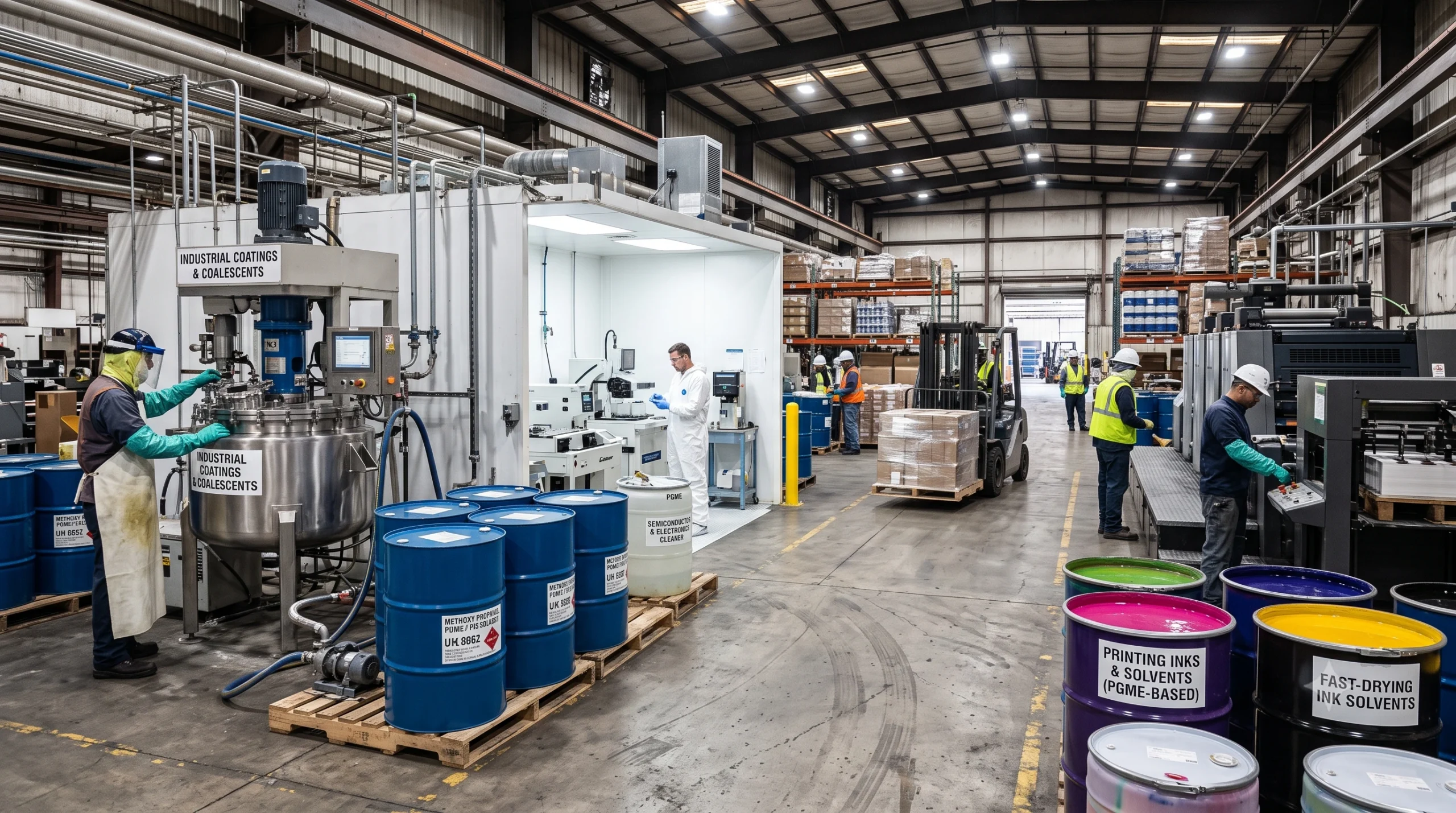
- Coatings role: PGME may be evaluated for solvency and film-formation-related needs, but coalescent selection must be validated in the full coating system.
- Ink role: PGME is used in selected printing-ink applications where solvency, resin compatibility, drying behaviour, and process requirements are assessed together.
- Semiconductor boundary: Semiconductor processes require application-specific qualification and may require electronic-grade material with controlled impurities.
- Not interchangeable: PGME, PGMEA/PMA, and DPM are related glycol ethers, but they should not be substituted based on name alone.
- Next step: Define the application, required grade, purity controls, and documentation before requesting a sample or quote.
What you’ll learn
This guide explains where propylene glycol monomethyl ether is used in coatings, inks, cleaning, and semiconductor-related processes. It helps technical buyers and formulators identify the questions that determine whether standard industrial PGME, a different glycol ether, or a distinct high-purity qualification path is required.
Introduction
Propylene glycol monomethyl ether is a versatile glycol ether, but “used in” does not mean “qualified for.” The same solvent can be considered for a coating, ink, cleaning, or electronics-related process, yet each route has different requirements for formulation fit, documentation, purity, and process validation.
This is especially important in semiconductor-related searches. Standard industrial PGME should not be assumed suitable for a high-purity electronic process. Likewise, a related glycol ether such as PGMEA or DPM should not be treated as a drop-in replacement just because it appears in the same supplier catalogue.
This guide is an application map rather than a formulation manual. It explains the major PGME application paths and the decision points that should be settled before material selection or sourcing begins.
What is propylene glycol monomethyl ether?
Propylene glycol monomethyl ether is a glycol ether solvent commonly known as PGME or PM solvent. It is also called 1-methoxy-2-propanol and is identified by CAS 107-98-2.
The US National Institute for Occupational Safety and Health lists propylene glycol monomethyl ether under the synonyms 1-methoxy-2-propanol and propylene glycol methyl ether. NIOSH’s PGME profile is a useful reference for chemical identity and occupational-safety context.
The full identity should appear in technical requests, RFQs, sample enquiries, and internal approval records:
Product: Propylene glycol monomethyl ether
Common names: PGME, PM solvent, 1-methoxy-2-propanol
CAS number: 107-98-2
The required grade depends on the process, customer specification, and end-use environment. A chemical name and CAS number establish the identity, but they do not establish that a particular material meets the application requirement.
How do you decide whether PGME fits an application?
Start with the job the solvent must perform. The question is not simply whether PGME appears on an application list. The question is whether its identity, grade, documentation, and technical profile fit the specific formulation or process.
A practical application review asks five questions. What must the solvent dissolve, carry, or help process? What drying or production window is required? Which resin, substrate, or formulation system is involved? Is standard industrial material appropriate, or are controlled impurities needed? What evidence must be reviewed before approval?
| Application path | PGME’s potential role | Critical validation question |
| Coatings | Solvent or formulation component assessed alongside coalescent choices | Does the complete coating system meet the required application and film-performance criteria? |
| Printing inks | Solvent or carrier option in selected ink systems | Does the solvent fit the resin, substrate, printing method, and drying requirements? |
| Industrial cleaning | Solvent considered within a complete cleaning formulation | Does the full formulation meet process, surface, safety, and customer requirements? |
| Semiconductor processing | Material considered for process-specific use | Is the proposed grade qualified for the exact process, impurity limits, packaging, and customer controls? |
This framework does not replace formulation development or process qualification. It helps teams identify the right technical conversation before requesting material.
PGME in coatings and coating-coalescent systems
PGME can be evaluated as a solvent in coating systems and may be considered alongside coalescent choices. However, it should not be described as a universally suitable coating coalescent because the correct selection depends on the entire formulation.
Solvency and film-formation context
A coating system brings together resin chemistry, pigments, additives, application method, drying conditions, substrate, and performance requirements. The solvent decision must work within that system. A result observed in one coating does not automatically transfer to another system.
For this reason, a coatings buyer should not select PGME solely from a broad claim such as “used in coatings.” The formulator must assess what role the solvent is intended to play and whether the complete system meets its required processing and finished-film criteria.
Coatings-formulation questions
The most useful starting point is a specification discussion with the formulation team. Identify the coating chemistry and resin system, then document the required application behaviour and finished-film expectations.
Questions to resolve include:
- Is the system waterborne, solventborne, or otherwise formulation-specific?
- What application method and substrate are involved?
- What appearance, adhesion, flow, drying, or durability requirements matter?
- Are there VOC, customer, or regulatory constraints to review?
- Which purity, consistency, and documentation requirements apply to the solvent?
Do not publish or rely on a universal claim about open time, coalescence, gloss, film formation, or defect reduction without approved technical evidence for the actual formulation.
PGME as a printing-ink solvent
PGME is used in selected printing-ink applications where the solvent is assessed as part of the complete ink system. Its potential role must be considered with the resin or binder, pigment system, substrate, printing method, and drying requirements.
Where it may fit
In ink manufacture, a solvent may help carry resin and other formulation components through production and printing. However, the application remains formulation-specific. A solvent that is evaluated for one graphic-arts or commercial-printing process may not be appropriate for another.
The decision should therefore begin with the ink type and production method. Do not treat “ink solvent” as a universal approval for every printing process, substrate, or customer application.
Ink-selection criteria
A technical review should identify the binder or resin system, substrate, printing method, and required production conditions. Drying requirements, odour, residue, colour expectations, migration requirements, and customer specifications may all affect the selection path.
For product-level context, review PGME solvent specifications. The product discussion should then be matched to the buyer’s actual technical requirement before a sample or commercial material is approved.
PGME in semiconductor cleaning and processing
Semiconductor-related applications require the clearest boundary in this guide. PGME may appear in semiconductor-processing discussions, but the phrase “semiconductor cleaner” does not describe one standard process, one universal grade, or one qualification route.
Why semiconductor cleaner needs qualification
Semiconductor cleaning, edge-bead removal, thinner functions, and other photoresist or process-aid contexts are distinct applications. They may involve different equipment, contamination controls, chemical interactions, process windows, and customer requirements.
Standard industrial-grade PGME should not be assumed suitable for semiconductor use. A standard product page or general solvent description does not establish that the material meets the purity, packaging, traceability, or process-control requirements of an electronic application.
Electronic-grade qualification questions
An electronic-process buyer should begin with the exact process and qualification standard, not with a general PGME application claim. The supplier discussion should establish the required impurity controls, traceability, packaging cleanliness, contamination-control expectations, change-control requirements, and documentation format.
The buyer should also confirm process compatibility and customer approval requirements before trialling a new material. Do not specify a purity level, metal-ion limit, particle limit, or electronic-grade claim unless it is supported by approved documentation for the offered product.
PGME compared with PGMEA/PMA and DPM
PGME, PGMEA or PMA, and DPM are related glycol ethers. They may be evaluated for different solvent-property requirements, but they should not be treated as interchangeable names or automatic substitutes.
The correct comparison starts with the performance target and the approved formulation requirement. If the solvent must meet a specific processing, resin, substrate, or customer need, evaluate the relevant product through its current technical documentation and application validation.
| Material | Common name | CAS number | Selection consideration |
| PGME | PM solvent, 1-methoxy-2-propanol | 107-98-2 | Confirm that PGME is the required chemical identity and grade for the application. |
| PGMEA | PMA, propylene glycol methyl ether acetate | Confirm through current supplier SDS | Assess whether the acetate glycol ether is required for the formulation. |
| DPM | Dipropylene glycol methyl ether | Confirm through current supplier SDS | Assess whether a different glycol-ether profile is required. |
Use PGMEA/PMA product information and DPM product information to begin a product comparison. A final substitution decision should come from formulation and technical review, not a name-based comparison.
From application to specification: what buyers should request
Once the application path is clear, convert it into a technical requirement. This gives the supplier enough context to identify the correct material and gives the buyer a consistent basis for internal review.
- Confirm the full product identity: propylene glycol monomethyl ether, PGME, CAS 107-98-2.
- State the application and the critical performance or process requirement.
- Define the grade, purity, impurity, and documentation expectations where they are known.
- Request the current SDS, specification sheet, and representative COA format.
- Confirm packaging, sampling, traceability, and delivery requirements.
- Complete internal formulation or process qualification before commercial approval.
A buyer who has already identified the application but needs to move into commercial evaluation can review bulk PGME grades, prices, and USA sourcing requirements [Bulk Methoxy Propanol (PGME / PM Solvent) Supplier Guide 2026: Prices, Grades & Sourcing (USA)]. For broader procurement context, see chemical-intermediate sourcing requirements.
Safety and handling boundary
PGME should be reviewed through the supplier’s current SDS, the site EHS process, and the controls relevant to the actual operation. This article does not provide handling procedures, exposure-control instructions, storage conditions, or emergency-response guidance.
The application changes the review. A coatings process, printing operation, industrial-cleaning system, and electronic process can create different compatibility, control, and documentation requirements. Teams should use current approved documents and qualified internal review rather than relying on general statements about a solvent’s applications.
Discuss your PGME application with Elchemy
Elchemy publicly lists PGME as a product and provides product, quote, and sample-request pathways. A useful enquiry should state the application, required grade or specification, quantity, destination, and documentation requirements.
For a US sourcing discussion, review bulk chemical sourcing support in North America. To move from application research to a technical evaluation, request a PGME sample for technical evaluation or discuss your PGME application with our team.
FAQs
1. What is propylene glycol monomethyl ether used for?
Propylene glycol monomethyl ether is used in industrial solvent applications, including selected coatings, printing inks, cleaning formulations, and process-related applications. The appropriate use depends on the complete formulation, required grade, customer specifications, and process validation. A listed use does not establish suitability for every system.
2. Is PGME a coating coalescent?
PGME may be evaluated alongside coalescent choices in coating systems, but it should not be treated as a universally suitable coalescent. Resin chemistry, formulation type, application method, drying conditions, performance targets, and regulatory constraints should all be assessed by the responsible formulator.
3. Can standard industrial PGME be used in semiconductor cleaning?
Standard industrial PGME should not be assumed suitable for semiconductor cleaning or other electronic processes. These applications may require process-specific qualification, controlled impurities, packaging cleanliness, traceability, and customer approval. Confirm the exact grade and documentation requirements before requesting or approving material.
4. Is PGME the same as PGMEA or PMA?
No. PGME and PGMEA, often called PMA, are distinct glycol ethers. They should not be substituted based on similar names. The correct material depends on the required solvent performance, formulation role, technical documentation, and application-specific validation.
5. What information is needed to select PGME for ink applications?
Provide the ink type, resin or binder system, substrate, printing method, required drying behaviour, and relevant customer specifications. Also state the expected grade, packaging, quantity, destination, and document requirements. This allows suppliers and technical teams to assess the material against the real application.
6. What documents should accompany a PGME sample?
A PGME sample review should normally begin with the current SDS, product specification sheet, and representative COA format. Additional documents may be required by the buyer’s application, customer, or quality process. Confirm the documentation package before starting an application trial.
Conclusion
Propylene glycol monomethyl ether can serve different industrial application paths, but those paths should not be grouped into one generic use claim. Coatings, inks, cleaning, and semiconductor-related processes each require a different conversation about formulation fit, grade, documentation, and qualification.
Begin with the exact application, then define the appropriate PGME requirement. Once the technical path is clear, request a PGME sample for technical evaluation to begin a specification-led sourcing discussion.